Bradford Pear Removal Tallahassee — Get Rid of a Failure-Prone Invasive Tree
Bradford pears were planted across Tallahassee from the 1970s through the 2000s as fast-growing landscape ornamentals. They’re now widely recognized as one of the worst residential tree choices in the Southeast: structurally weak with brittle wood that splits in storms, invasive (escaped trees forming dense thickets in pastures and woodland edges), short-lived (15–25 years before structural failure), and producing fruit that birds spread aggressively across the region. Most Tallahassee Bradford pears planted in the 1990s are now hitting their failure window. Our bradford pear removal Tallahassee crews handle removal, stump grinding, and replacement species recommendations. ISA-Certified arborists oversee all work.
Why Bradford Pears Should Come Out
Bradford pear (Pyrus calleryana 'Bradford') is one of the few species where the honest arboricultural recommendation is removal — not preservation. Eight specific reasons drive that recommendation.
Catastrophic Structural Failure
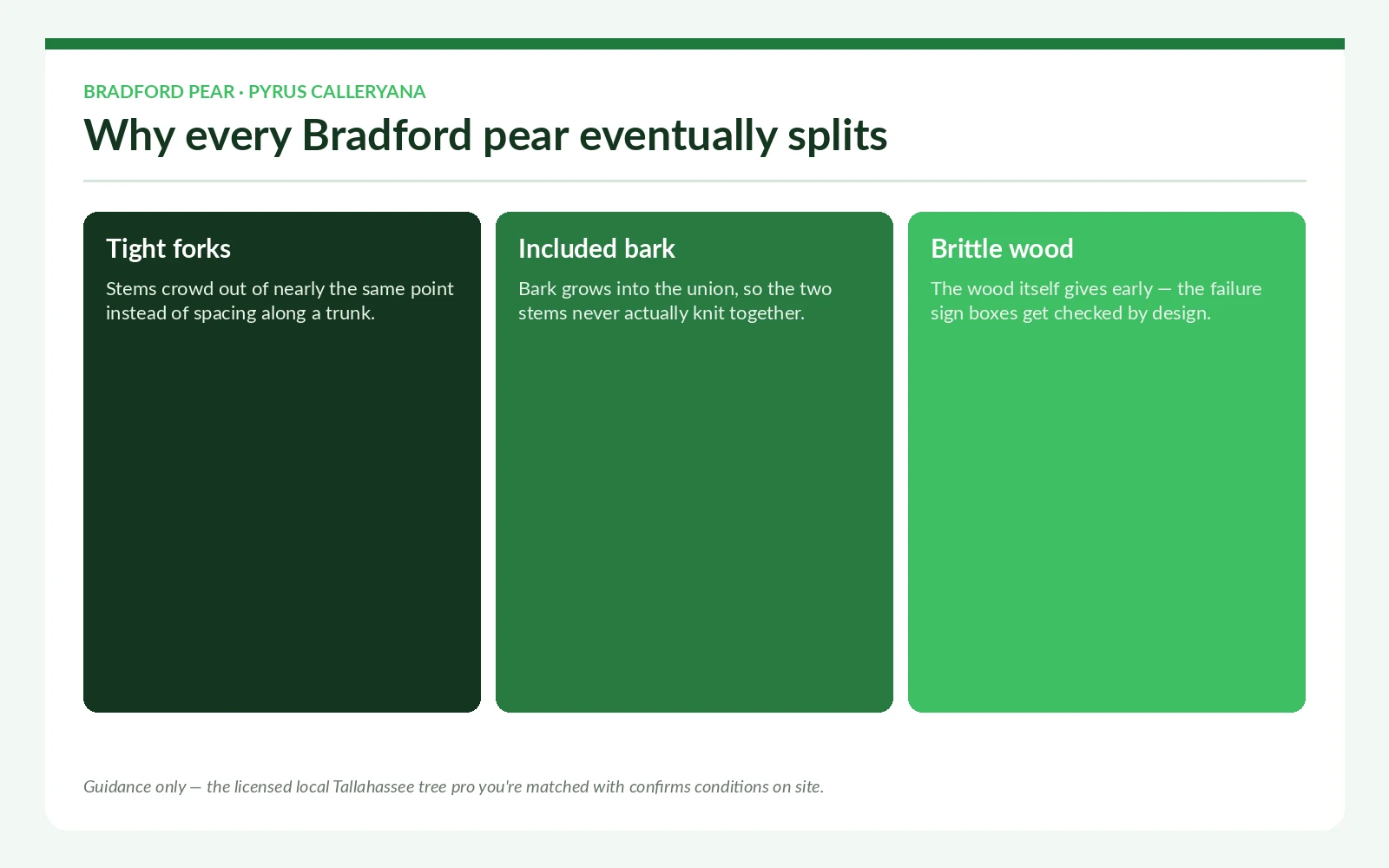
Multiple co-dominant leaders attached at narrow angles with included bark. Splits down the middle in thunderstorms, ice events, and hurricanes. Failure is when, not if, on mature specimens 15+ years old.
Brittle Wood
Pyrus calleryana wood is famously brittle. Even individual scaffold limbs fail under their own weight as trees age. Storm wind loading accelerates the timeline dramatically.
Invasive in North Florida
Bradford pears were originally bred sterile, but cross-pollination with other Pyrus calleryana cultivars produced fertile fruit. Birds spread seeds aggressively. Wild Callery pears now form dense thorny thickets across pastures and woodland edges throughout the Southeast.
Short Functional Lifespan
Most Bradford pears planted in the 1990s reach structural failure between ages 15 and 25. The tree was never designed for long-term landscape value — it was bred for fast establishment and bloom display.
No Wildlife Value
Native pollinators rarely use Bradford pear flowers despite the showy bloom display. The fruit feeds birds in winter but those birds spread the invasive seeds. Net ecological impact is strongly negative compared to native alternatives.
Property Damage Liability
Failed Bradford pears regularly damage roofs, vehicles, fences, and adjacent ornamentals. Insurance claims for Bradford pear damage are common across Tallahassee after major storm events. Removal before failure is dramatically cheaper than removal after.
Notorious Bloom Smell
Bradford pear bloom carries an unpleasant smell often compared to rotting fish or wet dog. While brief (10–14 days), the smell makes outdoor enjoyment difficult during peak bloom for properties with multiple trees.
Banned in Multiple States
South Carolina, Ohio, and Pennsylvania have moved to ban sale of Bradford pear and related Callery pear cultivars. Florida has not yet enacted bans but multiple universities and extension offices recommend removal. Bradford pear is widely classified as invasive in the Southeast.
Bradford Pear Failure Windows
Bradford pears fail predictably during specific weather events. Knowing the failure windows helps Tallahassee homeowners decide when removal becomes urgent rather than optional.
Severe Thunderstorms (Mar–Sep)
Tallahassee’s spring and summer thunderstorm season is peak Bradford pear failure window. Sudden microburst winds (50–70 mph) split co-dominant trunks at included-bark unions. Most failures happen in spring storms when leaves are fully expanded, creating maximum sail load.
Ice Events (Dec–Feb)
Rare but devastating. The January 2025 ice event broke hundreds of Bradford pears across Tallahassee neighborhoods. Ice accumulation on the dense crown adds weight that brittle wood and weak unions cannot bear. Trees that survive previous storms often fail in ice events.
Hurricanes & Tropical Systems (Jun–Nov)
Helene (2024), Idalia (2023), Michael (2018), and Hermine (2016) each took out significant numbers of Bradford pears across the Tallahassee region. Sustained winds plus saturated soils combine to produce both structural splits and full uprooting.
Self-Failure Under Own Weight
Mature Bradford pears (20+ years) sometimes fail in calm weather as accumulated structural stress finally exceeds wood strength at branch unions. These failures often happen on still hot summer days, surprising owners who didn’t experience a storm.
Tornado & Microburst Events
The May 2024 EF-2 tornado outbreak across Tallahassee took down Bradford pears in addition to native species. Bradford pears are among the first species to fail in localized severe wind events because of their structural design weakness.
Heavy Wet Snow (Rare)
Tallahassee gets measurable snow once or twice a decade, but heavy wet snow events have produced Bradford pear failures historically. The combination of snow load on dense canopy plus brittle wood at weak unions produces splits even in modest accumulations.
How Bradford Pear Removal Works
The process is straightforward for most Bradford pears given the typical 25–35 foot mature height and lawn-setting locations. Larger or pre-damaged specimens may need crane access.
On-Site Assessment
ISA-Certified arborist confirms species (occasionally other ornamental pears get mistaken for Bradford), evaluates current structural condition, identifies clearance to structures and utilities, and confirms permit requirements.
Permit Verification
Most Bradford pears are 6–12 inches DBH and require a tree removal permit under City of Tallahassee §5-83. We handle the permit application as part of the removal scope. Outside city limits, county requirements may apply.
Written Quote
Itemized scope: removal, stump grinding (optional), permit fees, debris hauling. Same-day for simpler scopes; 1–3 business days for multi-tree or technical access work.
Site Preparation
Crews protect adjacent landscaping, hardscape, and irrigation systems before work begins. Drop zones identified and cleared. Communication with neighbors when work area extends near property lines.
Climber-Cut or Crane Removal
Most Bradford pears come down via traditional climber-cut techniques — sectional dismantling from top to bottom. Pre-damaged trees with active splits or trees in tight access zones may require crane to safely remove without secondary damage.
Wood & Brush Disposal
Bradford pear wood is unsuitable for firewood (brittle, low BTU, splits poorly). Brush is chipped and removed; trunk wood hauled off-site to landscape recycling. Property left clean.
Stump Grinding (Optional)
Stump grinding 6–8 inches below grade clears the way for replanting. Bradford pear stumps re-sprout aggressively if not ground — suckers from the root system can persist for years if grinding isn’t done. See stump grinding.
Replacement Planning
Recommendations for what to plant in the same spot. Native or non-invasive ornamentals with comparable bloom display and better long-term structural integrity. See replacement species below.
Don’t Wait for the Storm.
Pre-failure Bradford pear removal runs $400–$1,200. Post-failure cleanup with structural damage runs $2,000–$8,000+. The math is clear.
Better Replacements for Bradford Pear
If you removed a Bradford pear because of the bloom display, several native and non-invasive species deliver comparable spring beauty without the structural and ecological problems.
Eastern Redbud
Cercis canadensisNative, blooms purple-pink in March before Bradford pear. 20–30′ mature, much stronger structure, lives 50–75 years, supports native pollinators heavily. The single best Bradford pear replacement for most Tallahassee sites.
Fringetree
Chionanthus virginicusNative, fragrant white blooms in April–May (later than Bradford). 15–20′ mature, structurally sound, lives 40–75 years. Good for filtered shade or partial sun. Increasingly popular Tallahassee replacement choice.
Saucer Magnolia
Magnolia x soulangeanaNon-native but non-invasive. Dramatic pink-purple blooms in February–March, before Bradford. 20–30′ mature, decent structure though wood is moderately brittle. Showy alternative for owners who specifically want big spring color.
Carolina Silverbell
Halesia carolinaNative Southeastern understory tree. Bell-shaped white flowers in April. 25–30′ mature, prefers filtered shade. Less heat-tolerant than redbud but a beautiful native choice for shaded sites.
Japanese Magnolia
Magnolia kobus / liliflora hybridsMultiple cultivars. Pink, white, or yellow blooms in late winter to early spring. 15–30′ depending on cultivar. Long-lived (60+ years) and structurally sound. Common in older Tallahassee landscapes.
Flowering Dogwood (Hybrid)
Cornus x rutgersensis (Stellar series)Hybrid disease-resistant dogwoods. Showy bracts in April, red fall color. 20–25′ mature, supports pollinators and birds. Better choice than native flowering dogwood on tough sun-exposed sites. See dogwood tree care.
Bradford Pear Removal Pricing in Tallahassee
Pricing depends on tree size, access conditions, whether the tree is intact or pre-damaged, and how much cleanup the site requires.
| Service | Typical Range | Notes |
|---|---|---|
| Small Bradford pear (under 20′) | $300 – $600 | Single-trunk young tree |
| Medium Bradford pear (20–30′) | $500 – $1,100 | Most common residential size |
| Large Bradford pear (30–40′) | $900 – $1,800 | Mature multi-trunk specimens |
| Storm-damaged / pre-failed pear | $1,200 – $3,500+ | Tangled, on roof, or threatening utilities |
| Stump grinding (Bradford pear) | $100 – $250 | Add-on to removal |
| Tree removal permit fee (City of Tallahassee) | $273 | Reported FY2026 rate; confirm with City Growth Management |
| Multi-tree property (2+ pears) | 10–20% per-tree discount | Same-day visit efficiency |
| Replacement tree planting | $300 – $1,200 | Tree cost + planting labor |
What Not to Do With a Bradford Pear
A few common temptations homeowners encounter. None of them solve the underlying structural problems.
- Don’t top it. Topping a Bradford pear creates worse problems. Sprout regrowth at topping cuts is even more brittle than the original wood, attached at decay-prone wound sites. A topped Bradford pear is a future hazard tree, not a saved tree. See tree topping alternative.
- Don’t cable it. Cabling can support some species with structural defects, but Bradford pears have so many failure points that cabling rarely buys meaningful additional life. The wood itself is the problem; cables hold weak attachment angles together but don’t make the wood stronger.
- Don’t prune heavily and hope. Aggressive thinning to reduce wind sail can buy a season or two but doesn’t address fundamental structural defects. Most arborists recommend removal over preservation pruning on Bradford pears 15+ years old.
- Don’t plant another Bradford pear in its place. Despite continued availability at some big-box retailers, replacing a Bradford pear with another Bradford pear repeats the failure cycle. New plantings should use native or non-invasive alternatives.
- Don’t leave the stump unground. Bradford pear root systems sucker aggressively. Unground stumps produce dozens of basal sprouts each spring that grow into a multi-stemmed thicket if not controlled. Stump grinding 6–8 inches below grade prevents this.
- Don’t assume insurance covers pre-failure removal. Most homeowners insurance covers tree-related damage to insured structures (house, garage, fence) but not preventive removal. Pre-failure removal is paid out-of-pocket; post-failure damage may be partially covered minus deductible.
- Don’t delay if the tree shows active splitting. Visible cracks at branch unions, especially after a storm, indicate failure is imminent. These trees should come down within days, not months. Same-week emergency removal is available; call (850) 555-0123.
Make the Call Before Nature Does.
Bradford pear removal Tallahassee work is straightforward, fairly priced, and pays for itself many times over compared to post-failure cleanup and property damage costs.
Bradford Pear Removal Tallahassee FAQs
How do I know if my tree is actually a Bradford pear?
Bradford pears bloom early March in Tallahassee with dense white flowers (the smelly ones). They have a distinctive teardrop or lollipop shape on younger trees, glossy oval leaves with crinkly margins, brilliant red-purple fall color, and small hard fruit (1/4″ pea-sized). Multiple trunks at narrow angles is a giveaway. An ISA-Certified arborist confirms species during the diagnostic visit if you’re unsure. Call (850) 555-0123 for ID help.
Why are Bradford pears considered invasive?
Bradford was originally bred sterile, but cross-pollination with other Pyrus calleryana cultivars (Aristocrat, Cleveland Select, Chanticleer, etc.) produces fertile fruit that birds spread. Wild Callery pears now form dense thorny thickets across pastures, woodland edges, and roadsides throughout the Southeast. Multiple states have moved to ban sale of Bradford pear specifically because of this invasive potential.
Do I need a permit to remove a Bradford pear in Tallahassee?
Yes for most trees over 4″ DBH on most properties under City of Tallahassee §5-83. Most mature Bradford pears are 6–12″ DBH and require permits. The 36″ DBH heritage tree exemption applies to certain native species but doesn’t apply to Bradford pears (a non-native cultivar). We handle the permit application as part of the removal scope. See our permit guide.
How urgent is removing a 20-year-old Bradford pear?
Urgent. Most Bradford pears planted in the 1990s and early 2000s are now in the failure window. If yours is 15+ years old and shows visible co-dominant trunks with included bark, structural failure is a question of when, not if. Pre-storm removal is dramatically cheaper than post-storm cleanup. Schedule within the next 3–6 months to beat the next major weather event.
Will the stump grow back after removal?
If you don’t grind the stump, yes — aggressively. Bradford pear and Callery pear root systems sucker prolifically. Without stump grinding, expect dozens of basal sprouts each spring that grow into a multi-stemmed thicket. Grinding 6–8 inches below grade addresses this. Some homeowners pair grinding with herbicide stump treatment for extra suppression on stubborn root systems.
What should I plant instead?
Eastern redbud is the single best Bradford pear replacement for most Tallahassee sites — same general size, earlier bloom, native, structurally sound, supports pollinators. Fringetree, saucer magnolia, Carolina silverbell, and hybrid disease-resistant dogwoods are also strong alternatives depending on site conditions. See our best trees to plant page.
Can I remove a Bradford pear myself?
Technically possible for very small specimens but not recommended. Bradford pear wood is unpredictable — cuts that should hinge cleanly often split unexpectedly because of the brittle wood and structural defects. Even small specimens can drop sections in directions you didn’t plan. Plus most Tallahassee Bradford pears require permits regardless of who does the work. Professional removal is the safer and often more economical choice.
Is the wood worth keeping for firewood?
No. Bradford pear wood is brittle, low BTU, and splits poorly. It burns acceptably but you’ll go through it twice as fast as oak for the same heat output. Most professional crews haul Bradford pear wood directly to landscape recycling or chip it on site. Don’t plan on using it for fireplace stock.
How long does the removal take?
Most residential Bradford pear removals take 2–5 hours including cleanup. Larger or pre-damaged specimens may take a full day. Multi-tree properties with multiple Bradford pears are usually scheduled as a single-day operation. Stump grinding adds another 1–2 hours per stump.
Do you serve areas outside Tallahassee city limits?
Yes — ISA-Certified bradford pear removal Tallahassee crews dispatch throughout Leon County and into Wakulla, Gadsden, and Jefferson Counties. Bradford pears are common in suburban and rural-residential properties throughout the region. Permit requirements outside the city follow county or municipality rules; we handle that as part of the scope. Call (850) 555-0123.
Bradford Pears Across Tallahassee Neighborhoods
Bradford pear plantings track neighborhood development cycles. Where they were planted heaviest tells you which neighborhoods now face the most active removal need.
Heavy Bradford pear plantings in Tallahassee happened in roughly three waves. The first wave, 1980s through mid-1990s, hit neighborhoods like Killearn Estates, Killearn Lakes, and parts of Northwest Tallahassee as Bradford was the favored fast-establishing landscape ornamental of the era. Most of these trees are now 30–45 years old and either already failed or in active decline. Bradford pear removal Tallahassee work in these neighborhoods often involves clearing failed or pre-failure specimens and replacing with structurally sound natives.
The second wave, late 1990s through 2010, hit then-newer subdivisions in Bradfordville, Southwood, and areas of Killearn Lakes as developers continued planting Bradford in builder-grade landscaping. These trees are now 15–25 years old — squarely in the failure window. Properties in these neighborhoods often have 2–4 Bradford pears each and are facing decisions on whether to remove all at once or stage removal over 2–3 years.
A small third wave continued into the 2010s in some commercial and big-box parking-lot landscape installations across Tallahassee. Many of these are now reaching mid-life and beginning to show structural defects. Commercial property managers across Tallahassee are increasingly proactive about removing Bradford pears from parking-lot islands before they fail and damage cars or block traffic. See commercial tree service and property management tree service.
Out in the rural Big Bend — Wakulla County, Crawfordville, Monticello, Quincy — Bradford pears were planted less heavily in residential settings but commercial and roadside plantings exist. The bigger rural concern is wild Callery pear thickets establishing in pastures and along property edges from bird-spread seeds. These thickets are notoriously thorny (Callery pear seedlings revert to the rootstock’s wild thorns, unlike the smooth-stemmed Bradford cultivar) and difficult to clear by hand — mechanical brush clearing or selective herbicide treatment is usually needed for established stands. Call (850) 555-0123 for both residential Bradford pear removal and rural Callery pear thicket clearing — we cover both with the same crews and equipment, available for one-time clearing visits or ongoing pasture maintenance contracts.
Related Tallahassee Tree Services
Bradford pear removal connects to multiple adjacent services. Most relevant pages below.
Get the Bradford Pear Out Before It Comes Down on Its Own.
Bradford pear removal Tallahassee work is one of the few species recommendations where the honest answer is “remove it.” Pre-failure removal is straightforward and fairly priced. Post-failure cleanup with structural damage is dramatically more expensive. ISA-Certified arborists, permit handling, stump grinding, and replacement species recommendations all included.