Tree Service Lake Jackson ISA-Certified Arborists
Lake Jackson has a tree service profile found nowhere else in Tallahassee. The lake is a prairie lake — it drains and refills through limestone sinkholes — and that fluctuating water table creates root zone conditions that determine how shoreline trees stand, fail, and need to be managed. The arborists dispatched know the difference between an upland live oak and a waterfront tree whose root plate sits in seasonally saturated soil.
Free estimates across Lake Jackson and northwest Tallahassee
Tree Service Across Lake Jackson & Northwest Tallahassee
Neighborhoods and corridors served in the Lake Jackson area:
Okeeheepkee — Why Lake Jackson's Disappearing Water Changes Everything About Lakeside Tree Service
Lake Jackson is a prairie lake. It drains and refills through limestone sinkholes — Indigenous peoples knew it as Okeeheepkee, "disappearing waters." Understanding this hydrology is the foundation of tree work on Lake Jackson properties.
🌊 The Disappearing Lake — A Hydrology Found Nowhere Else in Tallahassee
Lake Jackson covers approximately 4,000 acres when full, but it is not a permanent feature in the same sense as a stream-fed lake. It drains periodically through sinkholes in the underlying limestone karst — most notably Porter Sink and Lime Sink — reducing the full lake to a series of shallow pools and exposed grassland. Documented dry-down events have occurred in roughly 25-year cycles: 1907, 1932, 1957, 1982, 1999–2001, and most recently 2021. The lake refills naturally over months or years following each dry-down.
For tree service, this matters because trees along Lake Jackson's shoreline are adapted to a water table that moves — sometimes dramatically. Shoreline trees develop root systems shaped by seasonal saturation and the occasional full dry-down. When the lake is full, these trees have their root plates in waterlogged soil with reduced oxygen and reduced anchorage. When the lake drains, the same trees experience rapid root zone desiccation. Neither condition exists for upland trees in Killearn or Betton Hills, and neither is handled the same way by ISA arborists assessing risk.
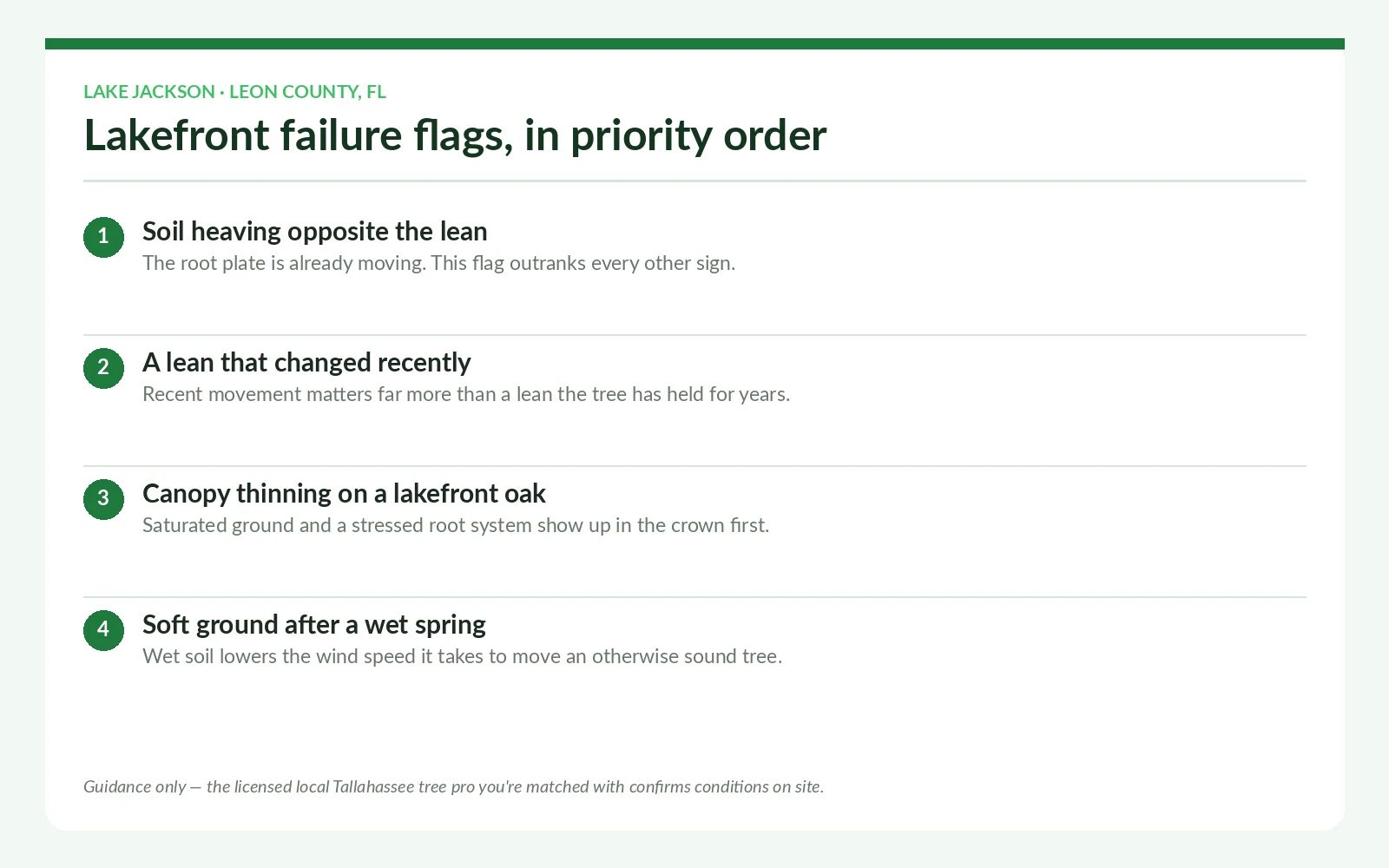
The practical implications for lakeside tree owners:
Need a Lakefront Tree Estimate?
The arborists dispatched check root plate condition, wetland buffer position, Old Bainbridge Road buffer, and access route before quoting Lakeshore Drive or any waterfront property. ISA-CA TRAQ assessment available on the same visit.
📞 (850) 619-0000Lakeshore Drive vs. Inland Lake Jackson — Two Different Tree Service Profiles
The Lake Jackson area spans both waterfront properties on Lakeshore Drive and established inland neighborhoods on its western and southern edges. The tree service profile differs significantly between them.
🌊 Lakeshore Drive Properties
Waterfront · 4-Mile Signature Street · Wind-ExposedLakeshore Drive winds approximately four miles along the southern and western shore of Lake Jackson, with homes ranging from 1960s ranch-style builds to larger custom waterfront properties. Mature canopy of magnolias, moss-draped live oaks, and tall slash pines defines the shoreline.
Primary tree concerns: Shoreline trees with saturated root zones, asymmetric wind-loaded crowns facing the lake, water oaks near dock structures, and any large pine within falling distance of the waterfront. Root zone assessment before any Lakeshore Drive removal is non-negotiable — saturated root plates behave unpredictably under chainsaw loading.
Access: Lakeshore Drive is a winding two-lane road — equipment staging and debris management require coordination with neighbors and sometimes temporary lane management. Plan for longer setup time on Lakeshore Drive jobs than on standard subdivision streets.
🏘 Inland Lake Jackson Neighborhoods
1950s–1980s Development · Mature Upland CanopyThe inland neighborhoods surrounding the lake — Lake Jackson Heights, Lakeshore Estates, Lakewood Village, Merry Oaks, Holly Hills, Hartsfield — were developed primarily from the 1950s through the 1980s. Trees planted during this era are now 40–70 years old, putting them in the same end-of-life range as Betton Hills and southern Killearn Estates.
Primary tree concerns: Laurel oak end-of-life assessment (the same 1950s–1980s planting wave hitting everywhere in NW Tallahassee), water oak co-dominant stem management, and sweetgum root encroachment on foundations and sewer lines. Old Bainbridge Road adjacency creates Canopy Road buffer considerations for properties near that corridor.
Access: Standard subdivision access — most inland Lake Jackson lots have manageable gate widths and driveway surfaces for standard equipment. Older 1950s–1960s development has narrower lots than newer construction, so side-yard clearance needs the usual pre-work check.
Old Bainbridge Road — The Canopy Road Through the Lake Jackson Area
Old Bainbridge Road is one of Tallahassee's nine designated Canopy Roads, running through the western Lake Jackson area. Properties along it carry the standard Canopy Road permit layer.
Old Bainbridge Road runs roughly parallel to North Monroe Street through northwest Tallahassee — and along its route, archaeologists have identified Native American village sites and a 1600s Spanish mission. The road's mature live oak canopy is a protected City of Tallahassee resource, with the standard 100-foot Canopy Road Protection Zone buffer extending from the road centerline on both sides.
For Lake Jackson area homeowners: Properties with frontage on or adjacency to Old Bainbridge Road that have trees within 100 feet of the road centerline require City of Tallahassee Canopy Road Conservation Committee (CRCC) review before any tree removal or major pruning, regardless of tree size. This is in addition to any standard City permit requirements for trees above the 36-inch DBH threshold.
The arborists dispatched check Old Bainbridge Road buffer position as part of every estimate walk-through for Lake Jackson area properties near that corridor. If your property is confirmed within the buffer, the standard permit and the CRCC review get navigated simultaneously — not as two separate processes you manage on your own.
📋 Lake Jackson Area Permit Summary
Lake Jackson Mounds — Why This Land Has Native Canopy Depth
The land around Lake Jackson has continuous human history reaching back at least 10,000 years. That history shapes the tree canopy you see today.
🏛 Lake Jackson Mounds Archaeological State Park — A 1,000-Year-Old Ceremonial Center on the South Shore
On the south shore of Lake Jackson stands Lake Jackson Mounds Archaeological State Park, listed on the National Register of Historic Places since 1971. The site was built and occupied between approximately 1000 and 1500 AD by people of the Fort Walton culture — ancestors of the Apalachee — and was the capital of a regional chiefdom and an important Mississippian ceremonial center. Six earthen platform mounds remain on the site.
The park's trails wind through hardwood forest above the lake — a remnant of the native tree canopy that surrounded Lake Jackson for centuries before European contact. This native mixed hardwood and pine community is the ecological baseline for the trees that still define the Lake Jackson neighborhood: live oaks, water oaks, magnolias, bald cypress at the water's edge, and the tall slash pines that dominate older lots.
For tree service purposes, this history matters because it explains the density and variety of the Lake Jackson area's tree canopy. This land was never clear-cut farmland like much of the SouthWood parcel. It transitioned from native forest to residential development with significant native tree retention along the way. The oldest trees in the Lake Jackson neighborhood may have been growing through all of it. For properties immediately adjacent to the State Park: trees within the park boundary are state-managed property, not homeowner-managed. Any boundary tree requires survey-confirmed jurisdiction before removal.
Tree Services Available in Lake Jackson & NW Tallahassee
All services with waterfront root zone expertise, Old Bainbridge Road permit knowledge, and lakeside access planning built in.
Tree Removal — Lakeshore & Inland Lake Jackson
Lakeshore Drive removals include saturated root zone assessment and fall direction planning before any cut — shoreline trees on saturated soil behave differently than upland specimens. Inland Lake Jackson removals include Old Bainbridge Road buffer check for properties near that corridor. No travel surcharge for Lake Jackson and northwest Tallahassee.
Removal services →ISA Arborist Assessment — Waterfront Risk Evaluation
Waterfront trees on Lake Jackson require arborist assessment that accounts for the lake's unique hydrology. Root plate condition in seasonally saturated soil, crown asymmetry from prevailing lake winds, and structural loading on trees leaning over water or dock structures are assessed differently than upland trees. ISA-CA TRAQ ratings provided for any high-stakes lakeside removal.
Storm assessment guide →Crown Reduction & Wind-Load Management
Lakeshore Drive trees facing the lake develop asymmetric crowns from prevailing winds across the open water fetch. ANSI A300 crown reduction to lower wind-load moment arms on these trees — particularly large pines and oaks leaning toward the lake or toward structures — is the highest-value preventive service for lakeside properties before storm season. April–May structural pruning window recommended.
Trimming services →Emergency Storm Response — 24/7
24/7 dispatch for storm damage across Lake Jackson and northwest Tallahassee. Lakeshore Drive storm emergencies present access challenges — the winding two-lane road can become blocked by fallen trees during the same storm that caused the damage. Emergency crew assessment accounts for access constraints on first contact so the right equipment is deployed from the start.
Emergency service →Stump Grinding — Lake Jackson
Post-removal stump grinding for both lakeside and inland Lake Jackson properties. Lakeshore Drive stump grinding on saturated or near-saturated soil requires assessment of machine position stability before grinding begins. Call 811 before any stump grinding near buried utilities, which run through older NW Tallahassee infrastructure at varying depths.
Stump grinding →Live Oak Heritage Care
Lake Jackson area mature live oaks — many over 60 years old, some over 100 — are heritage assets worth preserving. ANSI A300 structural pruning, codominant stem cabling per Part 3 standards, and root protection during construction. Removal is the last option, not the first, for a structurally sound mature live oak.
Live oak care →Storm-Damaged Tree, Active Hazard, or Lakefront Concern?
24/7 emergency dispatch across the Lake Jackson corridor. Florida Statute §163.045 imminent-danger provisions handled with same-visit ISA-CA TRAQ documentation when applicable.
📞 (850) 619-0000Tree Service Lake Jackson — FAQ
Do I need a permit to remove a tree near Lake Jackson?
Most Lake Jackson area residential properties — especially on the south and east sides of the lake — are inside City of Tallahassee limits, where City LDC §5-83 applies. Trees over 36" DBH require a $273 (FY2026) Growth Management permit. Properties along Old Bainbridge Road or within 100 feet of its centerline require Canopy Road Conservation Committee review regardless of tree size. Some properties on the northern and western edges of the lake may be unincorporated Leon County, where §10-4.362 applies (12" DBH live oak threshold). Verify your specific address with City Growth Management at (850) 891-6586 or Leon County Development Services at (850) 606-1300. Trees within NWFWMD wetland buffers may require additional review.
What about properties on Old Bainbridge Road in Lake Jackson?
Old Bainbridge Road is one of Tallahassee's nine designated Canopy Roads, and it runs along the western Lake Jackson area. The 100-foot Canopy Road Protection Zone is measured from the road centerline — not from the road edge or right-of-way line. For most properties with frontage on or backyards abutting Old Bainbridge Road, at least some trees fall within the buffer. Tree removal within the buffer requires Canopy Road Conservation Committee review regardless of size — even trees that would otherwise be exempt from the 36" DBH threshold. Plan for 3–6 additional weeks beyond standard permit timeline for CRCC review.
How does Lake Jackson's periodic drying up affect my trees?
Lake Jackson is a prairie lake that drains and refills through limestone sinkholes — Indigenous peoples knew it as Okeeheepkee, meaning "disappearing waters." Major dry-down events have been documented in 1907, 1932, 1957, 1982, 1999–2001, and 2021. For shoreline trees, this matters in two ways. First, the rapid drop in water table after years of saturation can trigger root system stress in trees that developed shallow, wide-spreading root structures adapted to high water. Second, when the lake refills, those same trees experience renewed saturation. Trees that were mature during the last dry-down may carry structural legacy from that event. ISA arborist assessment of significant lakeside trees, particularly those over 30 years old, is the appropriate posture.
I have a large tree hanging over the water on my Lakeshore Drive property. Is it safe to leave it, or does it need removal?
A tree hanging over water is not automatically unsafe — but it needs ISA arborist assessment to determine its actual risk level. The factors that matter: root plate condition in the saturated soil (50–70% of structural root failure happens in waterlogged conditions before any visible symptoms appear above ground), crown asymmetry from lake wind loading (which puts additional moment arm stress on the root plate), and whether there are structures — docks, boats, neighboring shoreline — in the fall zone. An ISA-CA TRAQ assessment takes 45–60 minutes and gives a documented risk rating that tells you whether intervention is urgent, precautionary, or not currently needed. That assessment also creates the documentation foundation if removal becomes necessary under Florida Statute §163.045.
What species of trees are most common on Lake Jackson waterfront properties?
The Lakeshore Drive canopy is primarily water oaks and live oaks on the drier upland portions of lots, with bald cypress (Taxodium distichum) at the water's edge on the wettest shoreline zones. Southern magnolias are common throughout and hold up well in mixed moisture conditions. Slash pines are the dominant large pine on inland Lake Jackson lots from the 1960s–1980s development era — those trees are now 40–60 years old and in the SPB monitoring window. Sweetgum is common on slightly lower, wetter inland lots and is the species most likely to cause root intrusion into sewer lines on older sections.
How much does tree service cost in Lake Jackson?
Tree service Lake Jackson pricing follows the broader Tallahassee market: tree removal $350–$7,000+, trimming $250–$1,800, stump grinding $100–$500 per stump, emergency response $500–$5,000+. Lakeshore Drive and lakefront property work often runs 25–40% above standard subdivision pricing for three reasons: saturated soil access challenges for equipment, narrow road staging on Lakeshore Drive's two-lane corridor, and the additional rigging required for trees leaning toward water or dock structures. Inland Lake Jackson neighborhoods follow standard Tallahassee pricing. The $273 City permit applies for trees over 36" DBH; CRCC review for Old Bainbridge Road buffer trees does not add a separate fee but extends the timeline.
What about properties near Lake Jackson Mounds State Park?
Lake Jackson Mounds Archaeological State Park sits on the south shore of the lake and is state-managed land, not homeowner-managed. Trees within the park are state property and not subject to private removal. For private properties adjacent to or near the park boundary, standard City of Tallahassee permit requirements apply, with the additional consideration that any boundary tree (one that may be on or near the property line shared with state park land) requires survey-confirmed jurisdiction before removal. The arborists dispatched will note boundary-adjacent trees and recommend survey confirmation if there is any ambiguity during the on-site estimate.
Related Tree Services & Guides
Tree Removal
Full removal across Tallahassee with permit coordination.
✂️Tree Trimming
ANSI A300 crown reduction for wind-load management.
🔗Tree Cabling
ANSI A300 Part 3 support for codominant stems and split trunks.
🪵Stump Grinding
Standalone stump grinding across all soil types.
🚨Emergency Service
24/7 dispatch for storm-damaged trees.
🌀Storm-Damaged Trees
Post-storm assessment — when to cable, brace, or remove.
🌳Live Oak Care Guide
Heritage live oak preservation, structural pruning, root protection.
💰Tree Service Cost Guide
2026 pricing across all services and tree sizes.
Also Serving These Nearby Areas
Get a Free Tree Service Estimate at Lake Jackson
On-site assessment with saturated root zone evaluation for waterfront properties, Old Bainbridge Road buffer verification where applicable, and access route walk-through before any work is scheduled. 24/7 emergency dispatch for storm damage.
(850) 619-0000 Mon–Sat 7am–7pm · 24/7 Emergency Dispatch