24 Hour Tree Service in Tallahassee, FL
A tree just hit your house at 11 PM. One fell across your driveway in a Helene-style squall. A limb is hung up over a power line as the next cell rolls in. You don’t need a sales pitch — you need someone who answers. Call now and we’ll connect you with a vetted, licensed and insured local emergency tree pro. Life-safety calls are triaged first.
📞 Call Now — (858) 319-0022Call now and we’ll connect you any hour — 24/7 dispatch line*What counts as a true 24-hour tree emergency
Not every tree call is a middle-of-the-night emergency, and the pro you’re matched with will tell you straight which category yours falls into. The honest framing matters: after-hours response typically carries surcharges in this market, it means waking a crew, and it exposes climbers to night-condition risks. Nobody should push the emergency designation on a call that can safely wait until morning — and we don’t.
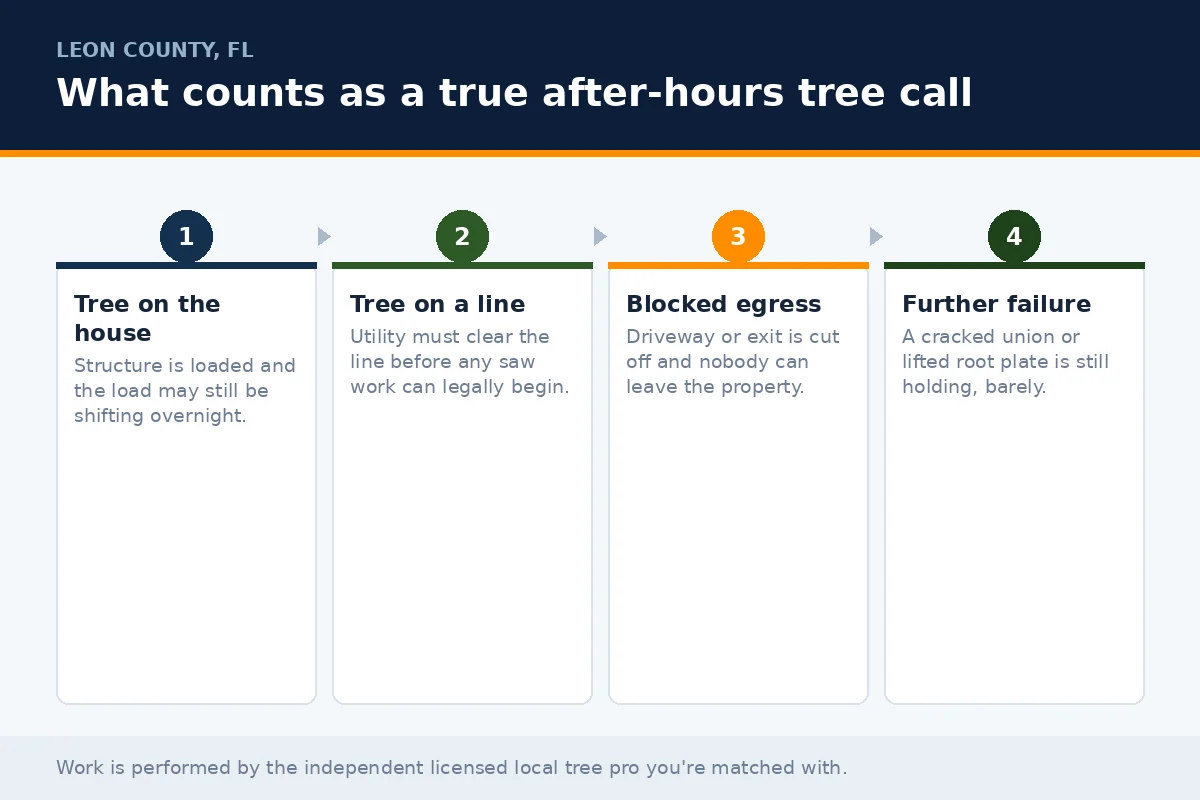
A true after-hours tree emergency meets at least one of these criteria: active structural damage (tree on a house, on a wall, on a vehicle inside a covered structure), imminent further failure (a tree partially failed and the rest is going to come down within hours), blocked emergency egress (driveway or only-access road blocked by a fallen tree), or active utility hazard (tree on or against an energized line, fire risk, dangling conductor). All four meet the bar for after-hours dispatch, any hour.
Calls that look like emergencies but usually don’t need an after-hours crew: a hanging branch with no immediate target underneath, a tree that “looks like it might fall” but hasn’t moved, a tree blocking a non-essential corner of the yard, debris from a storm three days ago. Those are real problems and the pros in the network handle all of them — but they book as standard tree removal, storm damage cleanup, or branch removal, at standard scheduling, without the after-hours surcharge. And if the tree is sitting in the yard with no structural impact and no target under it, calling in the morning is completely fine — it usually saves you money.
Tallahassee context: Hermine 2016, Michael 2018, Idalia 2023, the May 2024 EF-2 tornadoes, Helene 2024, and the January 2025 ice storm all generated waves of legitimate after-hours calls across Leon County. During events like these the dispatch line answers around the clock and structural-damage calls are triaged to the front of the queue. We’ll also be honest about wait times during peak storm response — when 200 calls come in across one night, the third caller gets reached sooner than the eightieth. That’s just how triage works.
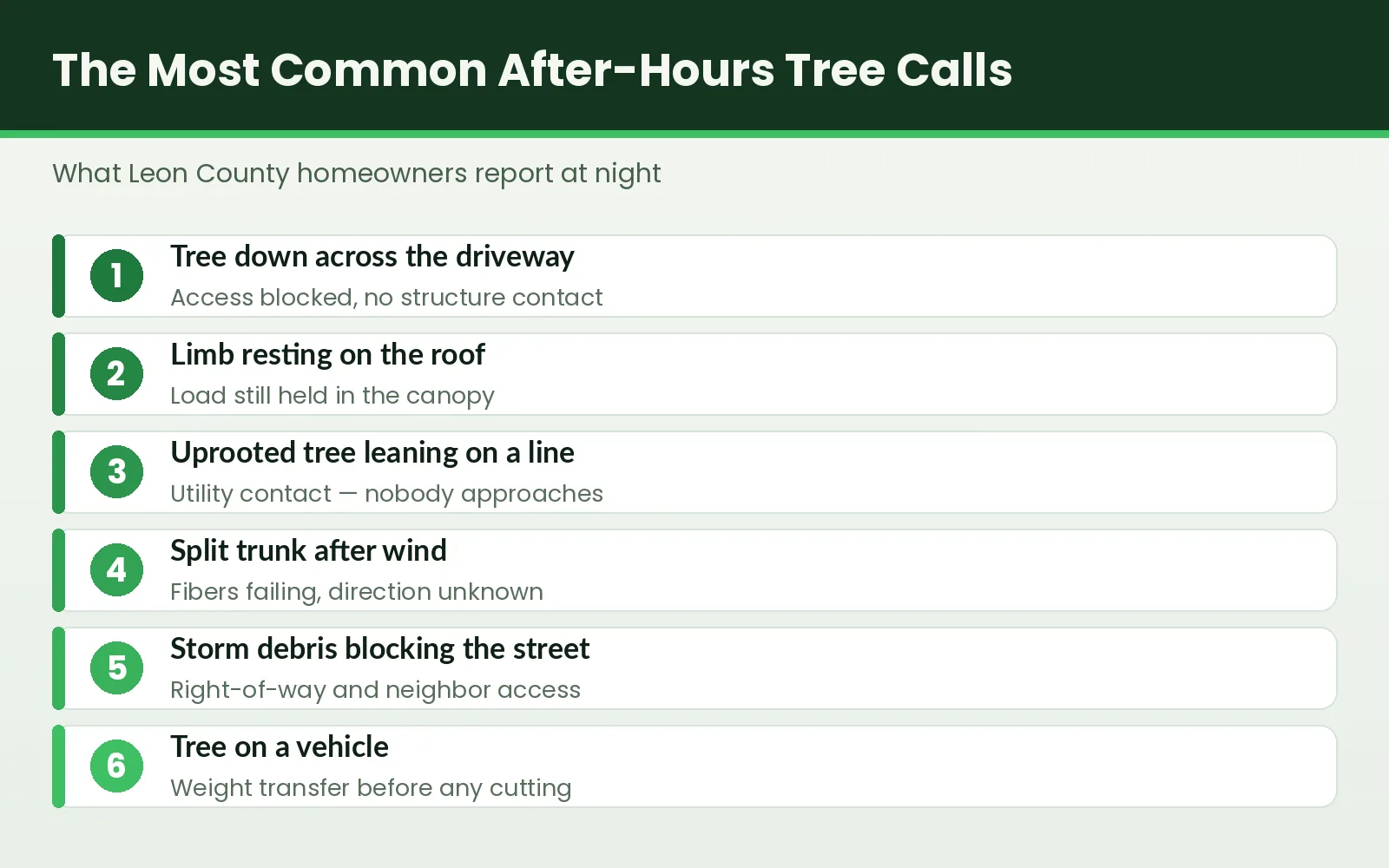
The 6 most common after-hours tree calls in Leon County
When the phone rings after hours around Tallahassee, it’s almost always one of these six scenarios — and each gets prioritized differently in triage.
1. Tree on the house
The highest-priority category. A tree that has fallen on or against the structure is doing damage every minute it sits there — water intrusion, wall load, possible interior damage. The crew you’re matched with prioritizes stabilization and documents everything for the homeowner’s insurance carrier. See fallen tree removal and roof tree removal.
2. Tree on a power line
A tree contacting an energized service drop or primary line is a dual emergency: tree response AND utility coordination. The pro coordinates with Talquin Electric or City of Tallahassee Utilities to de-energize the line before any saw work begins — no responsible crew climbs into energized territory. Time-to-resolution rides on the utility’s schedule, not the tree crew’s.
3. Blocked driveway or egress
A tree blocking the only access to or from the property is its own emergency category — emergency vehicles can’t reach the home and you can’t evacuate. The crew clears enough of the obstruction to restore access first; full removal gets scheduled in daylight if it can safely wait.
4. Imminent further failure
A tree that partially failed during a storm — half came down, half is still standing on a compromised trunk or a torn root plate. The remaining half will come down on its own schedule, and that schedule is often hours, not days. Crews stabilize the standing portion or, where safe, take it down preemptively before it causes structural damage.
5. Storm-damaged crown raining debris
The storm passes, but the crown is full of cracked branches that didn’t fall — yet. Hangers keep dropping for hours afterward. If the canopy hangs over a walkway, driveway, or play area, the imminent drop hazards get cleared first, often paired with a daylight follow-up for the larger removal. See hazardous tree removal.
6. Lightning-struck tree
A direct strike on a large tree creates immediate and delayed hazards: bark blown off, internal stem damage, possible smoldering deep in the trunk, and structural integrity compromised in ways that won’t be visible until daylight. The pro assesses, addresses any active fire risk, and either stabilizes for daylight removal or removes that night depending on severity.
Got a tree emergency right now? Photos sent by text speed up triage. Life-safety calls go to the front of the queue — and you’ll get a straight answer about what the response realistically looks like tonight.
📞 Call (858) 319-0022 — 24/7 dispatch24/7 dispatch line — availability depends on independent provider schedules and demand.*During the storm vs. after the storm — what crews can actually do
The hardest conversation in 24-hour tree work happens at 9 PM during an active storm: there’s a tree on the house, but the storm is still passing, and no crew can safely start until the worst of it clears. The honest answer is that climbers don’t climb in lightning, don’t work under canopies in sustained 40+ mph winds, and don’t run chainsaws in blinding rain when the ground crew can’t see. Pretending otherwise is how people die.
During an active storm with lightning, sustained high winds, or pelting rain: the call still gets answered. The situation gets documented by phone, you get walked through immediate steps to limit further damage (move the family away from affected rooms, photograph everything, call your insurance carrier), and the on-site response is queued for the moment conditions allow. How long that takes depends entirely on the storm.
As the storm passes — lightning clears, winds drop, visibility returns — crews mobilize. The first on-site pass prioritizes life-safety stabilization: securing what has fallen, eliminating drop hazards over occupied rooms, and handling any utility-line situation through Talquin or City Utilities. Full removal often waits for daylight if the tree is stable enough.
Post-storm, in daylight: the full toolbox opens up. Crane equipment becomes deployable where access permits — see crane tree removal — and multi-tree property assessments happen in this window. Most large removal work, even from emergencies that began the night before, actually happens in daylight the next day.
What this means for you: even with a 24/7 dispatch line, an active-storm tree-on-house response is a sequence, not an instant. Insurance documentation can begin immediately by phone and photo. On-site stabilization happens as soon as it’s safe. Full removal often comes the following day under daylight conditions. That’s not a failure of the service — that’s the physics of doing this work without getting someone killed.
Insurance coordination at 11 PM
Most Florida homeowner’s policies include a “reasonable steps to mitigate further damage” clause. When a tree has fallen on the house and is causing active water intrusion, the policy generally requires you to take prompt action to limit additional loss — and pays the reasonable cost of doing so, separately from the structural repair claim. That clause is the legal basis for emergency tree removal coverage.
The pro you’re matched with can provide the three forms of documentation adjusters look for:
- Call timestamp and dispatch record. The log shows when you first reported the damage and when a crew was engaged — the prompt-action timeline most policies require.
- On-site photographic documentation. Before any saw work begins, the crew photographs the damage from multiple angles — tree position, structural impact, point of contact, surrounding context — timestamped and provided to you before the work order is signed.
- Written work scope that separates mitigation from removal. Emergency stabilization (mitigation) is listed separately from structural removal (the full job). Many adjusters can pay the mitigation portion promptly under the emergency provisions while the larger structural claim processes. That separation matters for your cash flow mid-claim.
Authority source: the University of Florida IFAS Extension publishes storm-damage assessment and tree-insurance guidance that local arborists lean on — see edis.ifas.ufl.edu. Also see our tree service insurance coverage guide.
One boundary worth naming: nobody in this chain files the claim for you or acts as an adjuster. The pro coordinates documentation and hands you the paper trail; you file with your carrier — typically within 24 hours of the incident — using that documentation as the foundation.
What after-hours tree work runs in the Tallahassee market
These are typical local-market patterns, not our prices — we’re a dispatch service, and the licensed pro you’re matched with gives the binding written quote after seeing the tree. What the patterns consistently show is structure: after-hours work is scoped by the same factors as daylight work, plus a premium for the hour.
| Scenario | What moves the number in Leon County |
|---|---|
| Emergency stabilization (tree on structure) | Tree size, how it’s loaded on the structure, and whether rigging or a crane is needed to unload it safely. |
| Imminent-failure removal | Height and lean, what’s in the fall zone, and whether it can wait for daylight equipment. |
| Driveway / egress clearance | Trunk diameter and length blocking access; partial clearance tonight vs. full removal tomorrow. |
| Hanger removal from canopy | Number of hangers, height, and what’s underneath them. |
| After-hours dispatch premium | Local market pattern: roughly 25–50% over standard daytime scope. |
| Holiday or active-storm premium | Local market pattern: roughly 50–100% over standard, when demand spikes across the county. |
Market patterns referenced from HomeBlue Tallahassee data (March 2025) and ProMatcher, cross-checked against quote ranges homeowners report across Leon County during storm response. The written quote you approve always comes from the pro on-site, before work begins.
Why after-hours rates run higher: a crew woken at midnight works at premium pay, under reduced visibility, accepting elevated risk. Insurance carriers accept the premium — they’d rather pay more for prompt mitigation tonight than far more for the additional structural damage that accumulates if the tree sits on the roof until Monday. The math works in everyone’s favor. See the tree removal cost guide for the daylight-side factors.
What around-the-clock response actually looked like — recent Tallahassee storms
Hermine 2016 was the first major modern test. Hurricane Hermine made landfall Labor Day weekend and dropped trees across Killearn, Bradfordville, Lake Jackson, and Northwest Tallahassee. Tree crews across Leon County ran continuous shifts for the first 72 hours after the storm passed; most calls were tree-on-house and tree-on-driveway, and wait times stretched during peak demand.
Michael 2018 hit hardest in the Panhandle but sent damaging winds through the Big Bend. After-hours calls in the days following Michael skewed heavily toward hangers and partially failed trees still standing but compromised. That week was less about night calls and more about extended-hours daylight work, seven days a week.
Idalia 2023 made landfall in the Big Bend and dropped a different category of damage — trees uprooted whole rather than snapped. Root-plate failures became the dominant pattern, which favored crane removals over conventional climbing once daylight returned. Active-storm response during Idalia’s passage focused on stabilization and documentation.
The May 2024 EF-2 tornadoes cut directly through the Lafayette Heights and Levy Park corridor. Tree-on-house calls were dense in the affected zones and crews ran continuous response for the first 48 hours. Helene 2024 followed in September with landfall further east in the Big Bend, generating a sustained multi-day response window where dispatch lines across the region ran around the clock.
The January 2025 ice storm was the odd entry on the list. Ice load snapped large limbs and brought down trees in patterns no Tallahassee resident had seen before — and the failures kept coming for days as ice melted and trees rebalanced. Hangers and partial failures dominated the calls into the second week. If your trees came through any of these events, a tree risk assessment before the next season is cheap insurance.
How getting matched works
Before you call — three things that speed everything up
- Get people clear first. If a tree is on the house, move your family out of the affected rooms before you pick up the phone.
- Photograph the damage from multiple angles before anything is moved — tree position, point of contact, interior damage. Timestamps matter for the claim.
- Open a claim file with your carrier’s 24-hour line even if you don’t have full information yet. The timestamp establishes the prompt-action timeline your policy expects.
Then, on the call: species (roughly), what the tree is on or over, and whether anything is still moving. “A big water oak on the back corner of the roof, power line clear, nothing shifting” gets a sharper response than “a tree fell.” And if there’s no structural impact and no target underneath, say so — waiting until morning saves you the after-hours premium, and an honest dispatcher will tell you exactly that.
24-hour coverage across Tallahassee & the Big Bend
The dispatch network covers all of Leon County and most of the surrounding Big Bend region, around the clock, with the same triage standards everywhere: Killearn Estates · Killearn Lakes · Bradfordville · Lake Jackson · Myers Park / Betton Hills · Midtown · SouthWood · Northwest Tallahassee · Woodville · Crawfordville · Monticello · Quincy · Wakulla County · all of Leon County.
Frequently asked questions
Do you really answer the phone at 2 AM?
Yes. The dispatch line is answered around the clock — nights, weekends, holidays.* The dispatcher confirms whether your call meets the emergency category, asks for photos by text where possible, and gives you an honest read on what response looks like tonight. What you won’t get is an arrival time nobody can stand behind at 2 AM in a storm.
How fast can a crew be at my property?
There’s no honest fixed number — it depends on weather, demand, and independent crew availability. In accessible weather (no lightning, no sustained 40+ mph winds), response is fastest; during an active storm, crews can’t work safely until conditions clear, so stabilization queues for the moment they do. Photos sent by text during the first call are the single fastest way to sharpen triage.
What does after-hours emergency tree work cost in Tallahassee?
Local-market patterns show after-hours work running roughly 25–50% above standard scope, and holiday or active-storm response 50–100% above — those are market patterns, not our prices. The licensed pro you’re matched with gives the binding written quote on-site before work begins, and most legitimate after-hours response is at least partially covered by homeowner’s insurance under mitigation provisions when the tree caused covered structural damage.
Will my homeowner’s insurance pay for emergency tree removal?
It depends. Most Florida policies cover emergency tree removal when the tree caused covered damage to a covered structure, under the “reasonable steps to mitigate further damage” clause. Tree-to-ground failure with no structural damage usually isn’t covered. The pro you’re matched with provides time-stamped photos and a work order separating emergency mitigation from full removal — exactly the documentation adjusters expect.
Can a tree be removed from my house at night?
Often, partial removal happens at night for life-safety stabilization — securing what has fallen, eliminating drop hazards over occupied rooms, handling any utility situation. Full removal of a large tree from a house typically waits for daylight unless safety demands otherwise. The crew makes that call honestly based on what the structure and conditions require.
What if the tree is on a power line?
The pro coordinates with Talquin Electric or City of Tallahassee Utilities to de-energize the line before any tree work begins — no crew works energized territory, for the climber’s safety and the line’s. Time-to-resolution rides on utility response, which stretches during peak storm events when utility crews are overloaded too.
Related Tallahassee tree services
Emergency Tree Service
Fallen Tree Removal
Storm Cleanup
Storm Damage Tree Removal
Hazardous Tree Removal
Roof Tree Removal
Tree Branch Removal
Crane Tree Removal
Dead Tree Removal
Hurricane Tree Prep
Tree Risk Assessment
Tree Removal Cost Guide
Tree emergency in Tallahassee? Get connected now.
Call now and we’ll connect you with a vetted, licensed and insured local emergency tree pro. Free to use, no obligation, no sign-up — life-safety calls are triaged first.
📞 Call Now — (858) 319-0022Call now for a live match — 24/7 dispatch line*Tallahassee Tree Service Co. is a free dispatch and referral service. We are not a tree-service contractor and do not perform tree work ourselves. When you call, we connect you with an independent, licensed and insured local tree-care professional who carries their own license and insurance and provides any binding quote. Price information anywhere on this site is typical local-market information for planning only; people or scenes in images are illustrative.
References to “24/7,” “same-day,” or “emergency” describe call-handling and dispatch availability. Actual on-site response times depend on the independent professional’s schedule, crew availability, and weather, and are not guaranteed.