Tree Service in Ox Bottom, Tallahassee
Ox Bottom’s 1980s-era canopy is crossing from “mature and beautiful” into “structurally decisive” — the decade where good calls preserve a landscape and postponed ones get made by the weather. Call now and we’ll connect you with a vetted, ISA-certified local arborist who manages aging canopy for the long haul.
📞 Call Now — (858) 319-0022The trees and the neighborhood turned forty together. Plan accordingly.Ox Bottom — the Manor and its surrounding streets off Ox Bottom Road — built out in the 1980s on one-to-three-acre lots, and its trees have kept the schedule: the oaks and pines planted or preserved at development are now 40-plus years into their run. For live oaks that’s early adulthood. For the water oaks, laurel oaks, and fast pines that filled the gaps, it’s the far side of the curve — and the difference between those two categories is now the central question on almost every Ox Bottom property.
When is an Ox Bottom oak a keeper — and when is it done?
That’s the 40-year-canopy question, and it’s answered by assessment: preservation pruning extends the keepers, succession planting replaces the rest. Call now to get matched with an ISA-credentialed Tallahassee arborist for the keeper-vs-remove call.
What an aging canopy actually means
- “Structurally mature” is a turning point, not a compliment. Trees at this age carry their maximum wind sail on wood whose defects — old topping cuts, codominant stems, decay columns — have had four decades to develop. The assessment question shifts from “is it healthy” to “how is it built.”
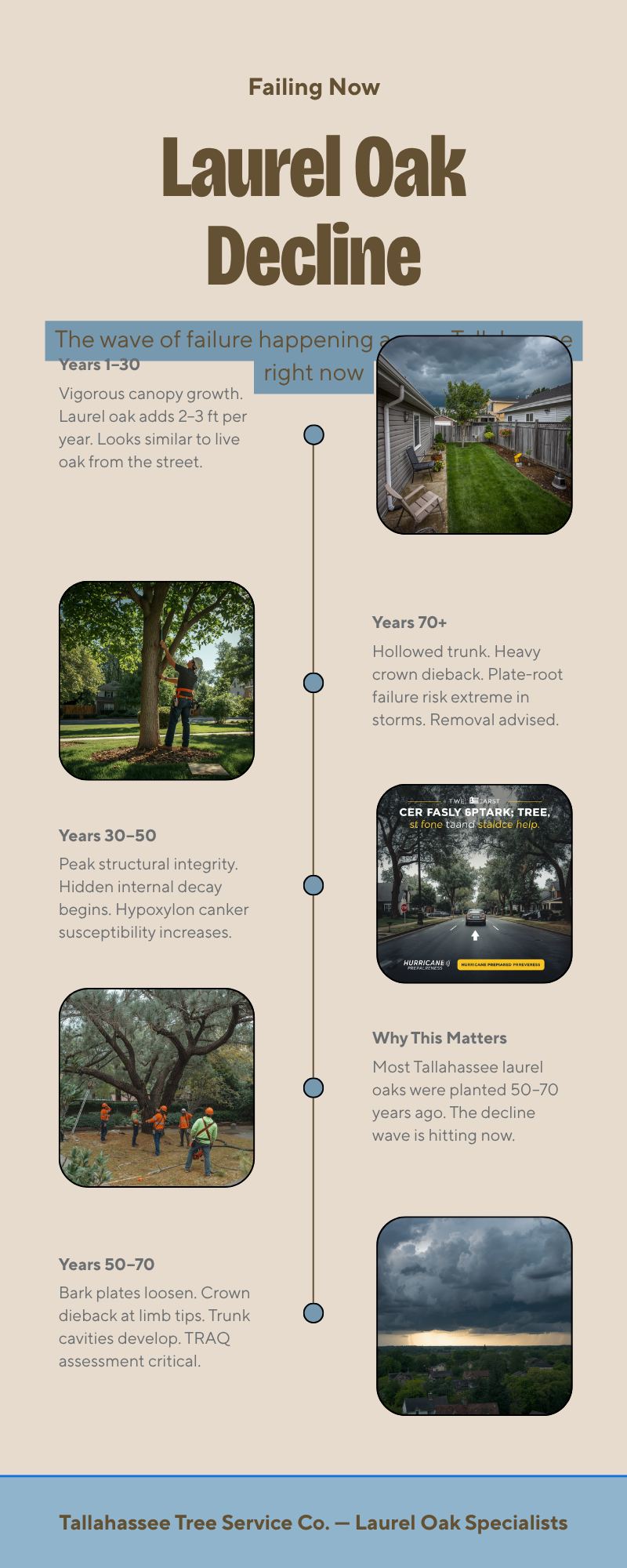
- The short-lived species are announcing themselves. Laurel and water oaks on 1980s lots are entering the same end-of-life wave documented across the city’s older neighborhoods — crown-down dieback, bark sloughing, conks at the base.
- Proactive beats reactive by an order of magnitude. A scheduled removal of a declining 70-footer is a controlled, priced event. The same tree failing onto a roof is a claim, a deductible, and an emergency crane at emergency staging.
- Succession planting is the long game. The owners who plant live oak, magnolia, and cypress now — while the old canopy still stands — hand the next decade a neighborhood that never looks bare. Waiting until removals force the issue means twenty gap years.
Long-tenure properties, long-memory care
Ox Bottom’s owners tend to stay — which changes tree care in quiet ways. Decades-long homeowner relationships with individual trees make removal decisions emotional as well as structural; the right provider respects that and brings options (reduction, cabling, monitoring) before the saw. Multi-decade property files — what was pruned when, which limb dropped in which storm — make every future assessment sharper, so ask for written records on every visit. And for owners eyeing an eventual sale: a documented, well-managed canopy is a selling asset, while a yard of visibly declining laurel oaks is a line item on the buyer’s inspection report. A baseline inspection starts the file; a formal risk assessment upgrades it where the stakes demand.
Same trees for twenty years and never had them formally assessed? That’s the most common Ox Bottom situation — and the easiest to fix.
📞 Call Now — (858) 319-0022Vetted local pros — availability depends on independent provider schedules and demand.*How getting matched works
What drives tree work cost in Ox Bottom
| Factor | The Ox Bottom angle |
|---|---|
| Tree size at 40 years | The canopy is at full scale now — removals are crane-and-rigging projects, not chainsaw afternoons. |
| Keep-or-remove complexity | Reduction and cabling on a keeper costs less than removal — the assessment determines who qualifies. |
| Access | Acre-plus lots with real driveways take equipment well; established landscaping needs protection planning. |
| Staging removals over years | Spreading three removals across three winters smooths budget and landscape impact — a plan enables it. |
| Succession scope | Species, planting size, and setup — installed right matters more than installed big. |
| Season | Winter reads structure and books easiest; pre-June corrections beat the storm queue. |
Frequently asked questions
Do I need a permit for removals in Ox Bottom?
The Ox Bottom area sits near the city-county line, so jurisdiction is parcel-specific — city rules on one side, Leon County’s stricter 12″ thresholds on the other. Providers confirm before quoting, and FS §163.045 hazard documentation works on single-family lots either way. See the permit guide.
How do I know if my 40-year-old oak is a keeper?
Species first: live oaks at 40 are young and almost always keepers. Laurel and water oaks at 40 get judged on structure — crown density, trunk condition, base fungus. The assessment sorts your canopy into those two piles quickly.
Can pruning extend an aging tree’s safe life?
Meaningfully, for the right trees — end-weight reduction takes leverage off old unions, crown cleaning removes the deadwood that fails first, and cabling backs up specific weak points. It’s the middle path between ignoring a tree and removing it.
When should succession trees go in?
Now — while the old canopy still shades and shelters them. A live oak planted this winter is fifteen feet tall when the declining laurel oak beside it finally comes out, and the landscape never reads as bare.
Is it worth documenting tree work for resale?
Yes — a written record of assessments, pruning, and removals reads as diligence to buyers and inspectors, and it neutralizes the “what about those big trees” negotiation move before it starts.
Should removals be batched or spread out?
Both have a case: batching saves mobilization cost; spreading across winters smooths budget and keeps the landscape from changing all at once. The five-year plan is what lets you choose instead of react.
Related Tallahassee tree services
Tree Service Summerbrooke
Tree Service Golden Eagle
Tree Service Bradfordville
Tree Pruning
Tree Inspection
Tree Risk Assessment
Dead Tree Removal
All Tallahassee Tree Services
Forty years of canopy. Time for the forty-year checkup.
Call now and we’ll connect you with a vetted, ISA-certified arborist who plans aging canopy instead of just cutting it. Free to use, no obligation, no sign-up.
📞 Call Now — (858) 319-0022Tallahassee Tree Service is a free referral service. Tallahassee Tree Service is not a licensed tree service provider and does not directly provide tree care services. All work is performed by independent, licensed and insured third-party providers in your area. Calls and form submissions placed through this site may be connected with a participating provider, and you may be contacted by that provider regarding your request. Same-day, emergency, and 24/7 availability are not guaranteed and depend on provider schedules, location, and demand. Service availability, pricing, licensing, and final response times are determined solely by the providers. It is the responsibility of the homeowner to verify that the hired contractor furnishes the necessary license and insurance required for the work being performed. All persons depicted in a photo or video are actors or models and not contractors listed on Tallahassee Tree Service.