Tree Service in Myers Park & Betton Hills
A 1920s canopy over Myers Park, a mid-century pine-and-laurel-oak mix over Betton Hills, red clay under both, and a Canopy Road running the eastern line. Call now and we’ll connect you with a vetted, ISA-certified local arborist who works these intown streets.
📞 Call Now — (858) 319-0022The oldest canopy in town needs the most deliberate decisions.Myers Park and Betton Hills share a fence line and a tree problem, but not the same one. Myers Park’s live oaks went in with the 1920s–30s streets — nearly a century old now, many at or past the city’s 36-inch protection threshold, standing over some of the closest house-to-house spacing in Tallahassee. Betton Hills built out in the 1950s–80s under planted pines and volunteer laurel oaks — and laurel oaks on a 50–70 year biological clock are now failing on schedule, one crown at a time.
Who handles tree work in Myers Park and Betton Hills?
These intown blocks carry some of Tallahassee’s oldest patriarch oaks, so the work leans toward preservation pruning, laurel oak end-of-life calls, and Canopy Road buffer rules. Call now to get matched with a licensed local crew for careful Tallahassee tree removal when a keeper can’t be saved.
Two neighborhoods, two profiles
| Myers Park | Betton Hills | |
|---|---|---|
| Canopy era | 1920s–30s live oaks — patriarch class | 1950s–80s pines + laurel oaks — end-of-life wave |
| Typical work | Preservation pruning, deadwood over roofs, cabling, careful removals in tight quarters | Laurel oak assessment and removal, pine beetle checks, replacement planting |
| Ground | Red Orangeburg clay — slow stump grinding, poor drainage in downpours | Same clay, slightly more room to stage equipment |
| Permit layer | City §5-83; 36″ DBH live oak threshold, patriarch designations | Same, plus the Centerville Road Canopy Road buffer on the eastern edge |
| Access | Narrow 1920s streets, small lots, cranes often can’t set up | Mid-century streets — workable, with mature plantings in the way |
The Centerville Road buffer most Betton Hills owners miss
Centerville Road is one of Tallahassee’s nine designated Canopy Roads, and its protection extends 100 feet from the centerline — which quietly captures front yards, side yards, and rear corners of properties along the neighborhood’s eastern boundary. Work inside the buffer adds Canopy Roads Citizens Committee review to the standard city permit, typically several extra weeks. The two calls that settle any question before a saw starts: City Growth Management (850) 891-6586 and Urban Forestry (850) 891-6500 — or start with the Tallahassee tree permit guide. On single-family lots citywide, FS §163.045 hazard documentation from an ISA-certified arborist remains the fast path for genuinely dangerous trees.
What intown tree work looks like here
- Patriarch preservation: crown cleaning, end-weight reduction, and structural pruning that keeps century oaks safe without disfiguring them — the opposite of topping.
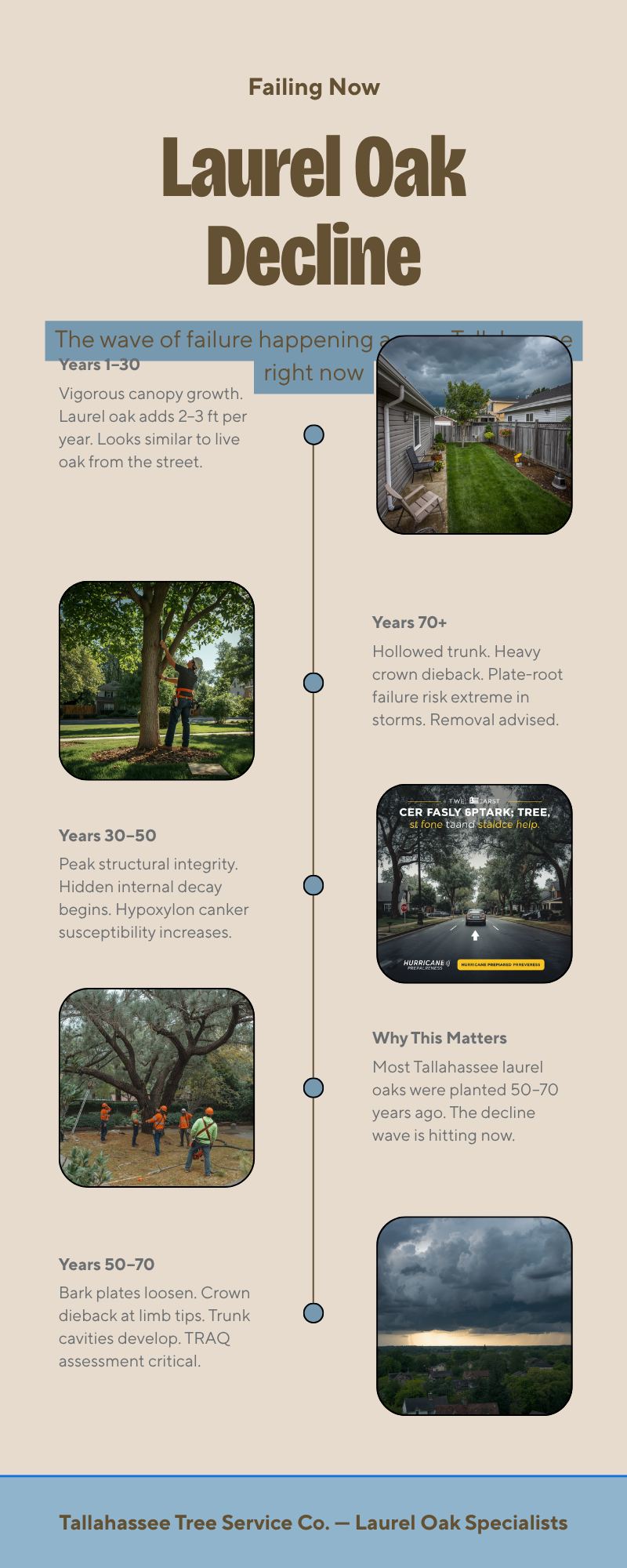
- Laurel oak triage: crown-down dieback, bark sloughing, and fungal conks separate the manage-it trees from the remove-it-now trees; a professional inspection makes the call defensible.
- Tight-access removals: Myers Park’s small lots often rule out crane setups — trees come down in rigged sections over roofs, fences, and gardens.
- Clay-soil realities: the red clay west of the Cody Scarp grinds slow and drains worse; root-zone compaction from decades of foot traffic is the quiet stressor on older lots.
- Storm response: mature canopy over dense housing produces the city’s heaviest post-storm workload — see storm cleanup.
Laurel oak thinning from the top down? That’s the species’ exit signature — get it assessed while removal is still a scheduled job, not an emergency.
📞 Call Now — (858) 319-0022Vetted local pros — availability depends on independent provider schedules and demand.*How getting matched works
What drives tree service cost in these neighborhoods
| Factor | The intown angle |
|---|---|
| Access | No crane setup means piece-by-piece rigging — more hours aloft, more control, higher scope. |
| Tree size & age | Ninety-year oaks carry enormous wood volume; even pruning them is a bigger job than removing a young tree. |
| Targets underneath | Roofs, additions, pools, and gardens under nearly every crown — protection and rigging time scale with what’s below. |
| Permit path | Standard §5-83 vs. Centerville buffer CRCC review vs. hazard documentation — each carries different timeline. |
| Clay-soil grinding | Stumps in Orangeburg clay grind slower than the sandy east side — same stump, more machine time. |
| Debris handling | Small lots hold no debris; everything hauls, and long carries from back yards add crew time. |
Frequently asked questions
Do I need a permit to remove a big oak in Myers Park?
If it’s a live oak at 36″ DBH or larger — and many Myers Park oaks are — the city’s §5-83 process applies, unless an ISA-certified arborist documents it as a danger under FS §163.045 on a single-family lot. Patriarch-designated trees carry additional protection regardless of species.
How do I know if my Betton Hills laurel oak is failing?
Watch the top: laurel oaks announce decline with upper-crown dieback, then bark sloughing and conks at the base. They fail from internal decay while still holding green leaves lower down — which is why the assessment matters more than appearances.
Does the Centerville Road buffer really reach my yard?
Measure 100 feet from the road’s centerline. Properties fronting Centerville are typically inside it entirely; lots one street back can still clip it at a rear corner. Confirm with Growth Management ((850) 891-6586) before scoping removals near the eastern edge.
Can a crane even work on Myers Park’s narrow streets?
Sometimes — but often not, which is why intown removals lean on climbing and rigging: the tree comes down in controlled sections lowered on ropes. Slower than a crane pick, and exactly why access is the first thing a provider assesses.
Should I replace a removed laurel oak with another one?
No — that restarts the same 60-year clock. Live oak, southern magnolia, and bald cypress are the long-lived local replacements arborists recommend; the city’s planting guidance favors them for exactly this reason.
Why is stump grinding slower on this side of town?
The red Orangeburg clay west of the Cody Scarp is dense, holds moisture, and packs around roots — grinder teeth work harder per inch than in the sandy soils east of town. Same machine, more time, which shows up in scope.
Related Tallahassee tree services
Tree Service Midtown
Tree Service Lafayette Park
Tree Pruning
Dead Tree Removal
Stump Grinding
Tree Inspection
Tallahassee Tree Permit Guide
All Tallahassee Tree Services
A century of canopy deserves a considered plan.
Call now and we’ll connect you with a vetted, ISA-certified arborist who knows Myers Park’s patriarchs and Betton Hills’ laurel oak clock. Free to use, no obligation, no sign-up.
📞 Call Now — (858) 319-0022Tallahassee Tree Service is a free referral service. Tallahassee Tree Service is not a licensed tree service provider and does not directly provide tree care services. All work is performed by independent, licensed and insured third-party providers in your area. Calls and form submissions placed through this site may be connected with a participating provider, and you may be contacted by that provider regarding your request. Same-day, emergency, and 24/7 availability are not guaranteed and depend on provider schedules, location, and demand. Service availability, pricing, licensing, and final response times are determined solely by the providers. It is the responsibility of the homeowner to verify that the hired contractor furnishes the necessary license and insurance required for the work being performed. All persons depicted in a photo or video are actors or models and not contractors listed on Tallahassee Tree Service.