Large Tree Removal in Tallahassee, FL
A four-foot live oak trunk twelve feet from the foundation. A 90-foot loblolly leaning over the neighbor’s roof. A hollow laurel oak nobody wants to climb. Call now and we’ll connect you with a vetted, licensed and insured local pro who has the crane, the rigging, and the certification to take a big tree down in pieces.
📞 Call Now — (858) 319-0022Not sure if it’s a crane job or a climb? Call now and we’ll connect you any hour.Tallahassee is a canopy city, and canopy cities grow big trees. Leon County sits in USDA Zone 8b with a long, wet growing season, and the live oaks, laurel oaks, water oaks, southern magnolias, longleaf and loblolly pines here routinely reach sizes that put them well outside what a two-person outfit with a saw and a pickup should be touching.
“Large” is not a marketing word in tree work — it is an engineering threshold. Once a tree passes roughly 60 feet of height or 30 inches of trunk diameter, the weight of a single section exceeds what a person can control by hand, and the job stops being cutting and becomes rigging. That is the tree this page is about, and it is the tree we route to pros with the equipment and the certification to handle it.
When a tree is officially “large”
There is no license plate on a tree, but the crews in our dispatch network generally treat a removal as a large-tree job when one or more of these is true:
- Trunk diameter over about 30 inches at chest height — a trunk you cannot get your arms halfway around.
- Height over about 60–70 feet, which in Tallahassee means most mature pines and any old live oak.
- Limb weight beyond hand control — a single live oak lateral can weigh more than a compact car. Green live oak runs roughly 60 pounds per cubic foot.
- No safe drop zone — the tree is taller than the distance to the house, the fence, the pool cage, or the power line.
- Structural compromise — hollow trunk, decay at the union, root-plate movement. A climber cannot trust a tree that cannot hold itself up.
Crane, bucket, or climb: how the method gets chosen
This is the single decision that shapes the whole job, and it is decided by access, not by preference.
| Method | When it fits a Tallahassee lot | What it needs |
|---|---|---|
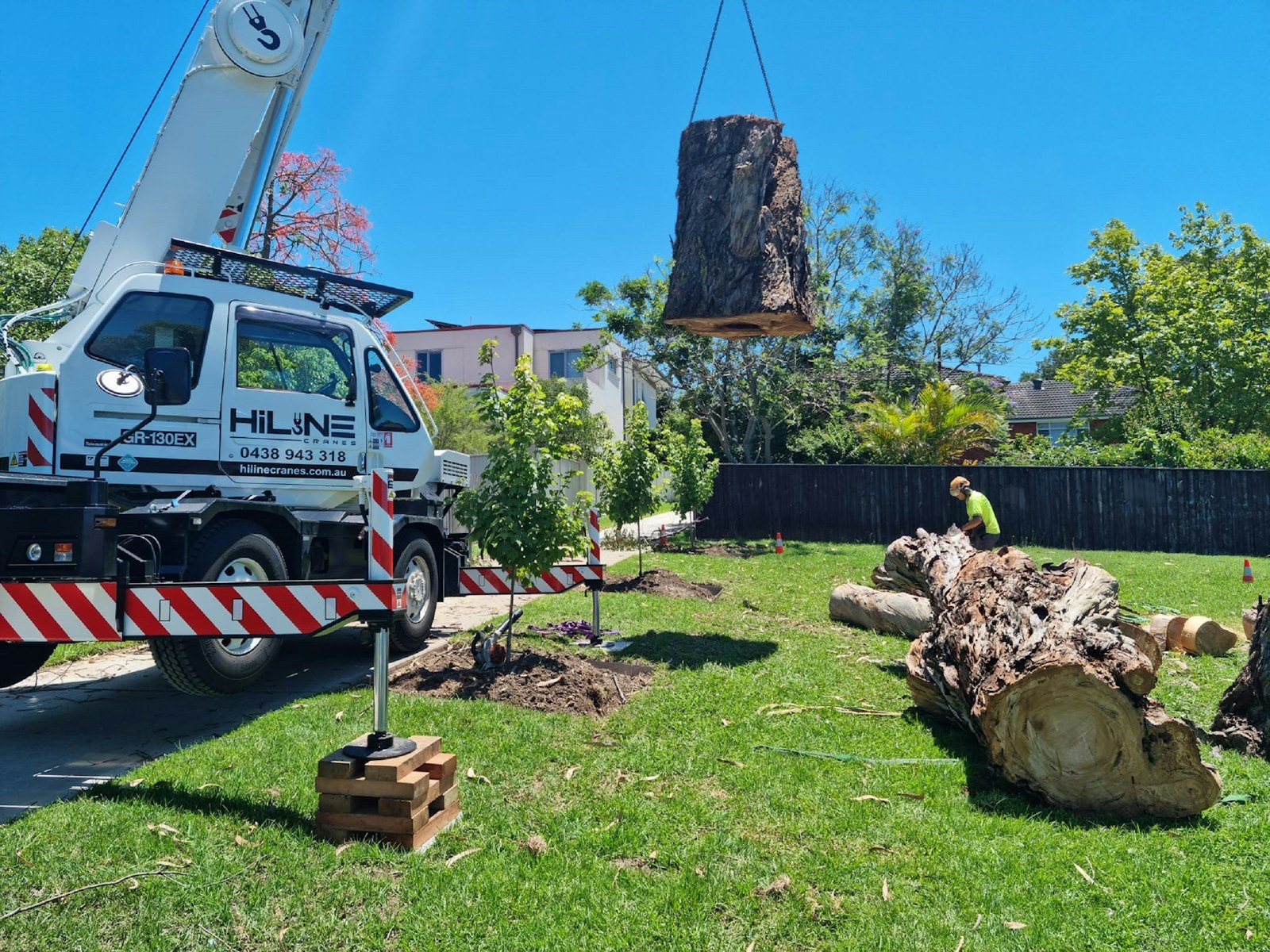
| Crane pick | Massive live oaks, tall pines, anything over a roof or a pool cage. Fastest and safest on the biggest trees. | A setup pad the outriggers can sit on and a clear swing path. Common in Killearn, SouthWood, Bradfordville; rare on tight Midtown lots. |
| Bucket truck | Street-side trees and front yards with a hard surface to park on. | Reach is limited by boom length and by whether the truck can get close enough. |
| Climb & rig | Backyards with no equipment path — the reality on a lot of older Betton Hills and Lafayette Park lots. | A sound tree that can be climbed, plus rigging points strong enough to lower sections. |
| Climb with a spider lift | Backyard access through a standard gate where the tree is unsafe to climb. | A gate the lift can pass and firm ground. Slower but it solves the hollow-tree-in-the-backyard problem. |
The reason this matters to you: two honest pros can quote the same tree very differently because they intend to use different equipment. That is not one of them gouging you — it is a different day of work. Ask each what method they plan to use and why. For the deep dive, see crane tree removal in Tallahassee.
What drives the scope of a large tree removal
The scope is set by the specific tree and the specific lot — the pro you’re matched with walks it and gives the binding written quote. These are the factors that move it most:
| Factor | Why it matters here |
|---|---|
| Species & wood density | Live oak is heavy, hard, and interlocked; a pine of the same height is a fraction of the weight. Species changes the rigging math. |
| Distance to targets | Ten feet from the house is a completely different job than fifty feet of open yard, even for the same tree. |
| Equipment access | No path for a crane or lift means everything is climbed and hand-lowered — hours, not minutes. |
| Utility conflicts | Service drops and primaries in the canopy may require the utility to de-energize before work starts. |
| Wood & debris volume | A big live oak produces an enormous amount of wood. Haul-off is truck trips; on-site chipping is chipper hours. |
| Stump | Grinding a 40-inch stump and its root flare is its own scope line. See stump grinding. |
| Permits | Protected and patriarch trees, and anything in a Canopy Road Protection Zone, may need City review before a saw touches it. |
Big tree already leaning, cracking, or lifting soil at the base? That is not a scheduling conversation. Keep people out of the fall zone and call now — hazard trees get triaged first.
📞 Call Now — (858) 319-0022Vetted local pros — availability depends on independent provider schedules and demand.*How getting matched works
The permit question on big trees in Tallahassee
This trips people up constantly, because Tallahassee protects its canopy more aggressively than most Florida cities. Removing a large, healthy tree is frequently not a decision a homeowner can make unilaterally.
- City of Tallahassee §5-83 governs protected trees and sets out when removal requires approval and when mitigation (replanting or a fee) is triggered.
- Patriarch trees — the truly large specimens, typically the old live oaks — get the highest level of protection.
- Canopy Road Protection Zones along the historic canopy roads add another layer entirely.
- Leon County Chapter 10 environmental management rules apply outside city limits.
- Florida Statute §163.045 provides a hazard exception: with documentation from an ISA-certified arborist or licensed landscape architect showing the tree poses an unacceptable risk, a residential homeowner may remove it without local approval. That documentation matters — get it in writing before the tree comes down, not after.
Any pro worth hiring will raise the permit question themselves. If a contractor waves it off, that is a signal. Full walkthrough: the Tallahassee tree permit guide and City of Tallahassee tree removal rules.

Insurance and credentials: what to actually verify
A large tree removal is the highest-liability job that happens in a residential yard. If an uninsured outfit drops a live oak section through your roof, that is your problem, not theirs. Before anyone climbs:
- Ask for the certificate of insurance directly from the insurer or agent — general liability and workers’ compensation. A PDF emailed from the contractor is not the same thing.
- Verify the ISA certification number yourself through the ISA’s public verification tool. Certification is a real credential with a real registry, and it takes two minutes to check.
- Check licensing through FDACS and the local jurisdiction as applicable.
- Get the scope in writing including what happens to the wood, the debris, and the stump.
We are a free referral service and the contract is between you and the pro — so verify these yourself, every time. See what ISA certification actually means.
Before you call — how to describe your tree
- Species, roughly. Oak with moss, oak with small leaves, or pine — that alone tells a pro a lot.
- Trunk size. Can you wrap your arms around it? Two people? Three?
- What is under it. House, garage, pool cage, driveway, neighbor’s fence, septic field, power line.
- Access. Is there a driveway or side path wide enough for equipment, or is it a fenced backyard only?
- Condition. Leaning, hollow, mushrooms at the base, dead limbs, soil lifting — say so. It changes urgency and method.
Frequently asked questions
How much does large tree removal cost in Tallahassee?
It is scoped to the individual tree — species, size, access, targets underneath, utility conflicts, and debris volume all move it, so there is no honest flat figure. The pro you’re matched with assesses on site and gives a written quote before any work begins. See our tree removal cost guide for the factor-by-factor breakdown.
Do I need a permit to remove a large tree in Tallahassee?
Often, yes. City §5-83 protects certain trees, patriarch trees get extra protection, and Canopy Road zones add more. Leon County has its own rules outside city limits. Florida Statute §163.045 creates a hazard exception when an ISA-certified arborist documents unacceptable risk — get that documentation in writing beforehand.
Do you always need a crane?
No. A crane is the safest option on the biggest trees and on anything overhanging a structure, but it needs a setup pad and a clear swing path. Plenty of Tallahassee backyards cannot accommodate one, so the pro climbs and rigs sections down instead, or brings in a spider lift. The access decides it, not the sales pitch.
Can a large tree be saved instead of removed?
Sometimes. Reduction pruning to lower end-weight, or cabling and bracing a codominant union, can retain a valuable tree that would otherwise be removed. A tree risk assessment is how that call gets made honestly rather than by whoever is holding the saw.
What happens to all the wood?
That is a scope decision you should make explicitly. Options are haul it all away, leave it bucked into rounds for firewood, or chip the brush and haul only the logs. A mature live oak produces several truckloads of wood, so this line item is not trivial — make sure it is written into the quote.
How long does a big tree removal take?
It varies enormously with method and access — a crane pick on an open lot moves quickly, while a hollow oak in a fenced backyard that has to be climbed and hand-lowered can take considerably longer. The pro will tell you what they expect after they walk it. We do not promise timelines on behalf of independent providers.
Related Tallahassee tree services
Crane Tree Removal
Tree Removal
Live Oak Removal
Pine Tree Removal
Hazardous Tree Removal
Tree Removal Cost
Stump Grinding
Tree Permit Guide
Big tree, small margin for error
Call now and we’ll connect you with a vetted, licensed and insured Tallahassee-area pro equipped for large removals. Free to use, no obligation, no sign-up.
📞 Call Now — (858) 319-0022Tallahassee Tree Service is a free referral service. Tallahassee Tree Service is not a licensed tree service provider and does not directly provide tree care services. All work is performed by independent, licensed and insured third-party providers in your area. Calls and form submissions placed through this site may be connected with a participating provider, and you may be contacted by that provider regarding your request. Same-day, emergency, and 24/7 availability are not guaranteed and depend on provider schedules, location, and demand. Service availability, pricing, licensing, and final response times are determined solely by the providers. It is the responsibility of the homeowner to verify that the hired contractor furnishes the necessary license and insurance required for the work being performed. All persons depicted in a photo or video are actors or models and not contractors listed on Tallahassee Tree Service.