Crawfordville · Wakulla County FL

Tree Service Crawfordville ISA-Certified Arborists

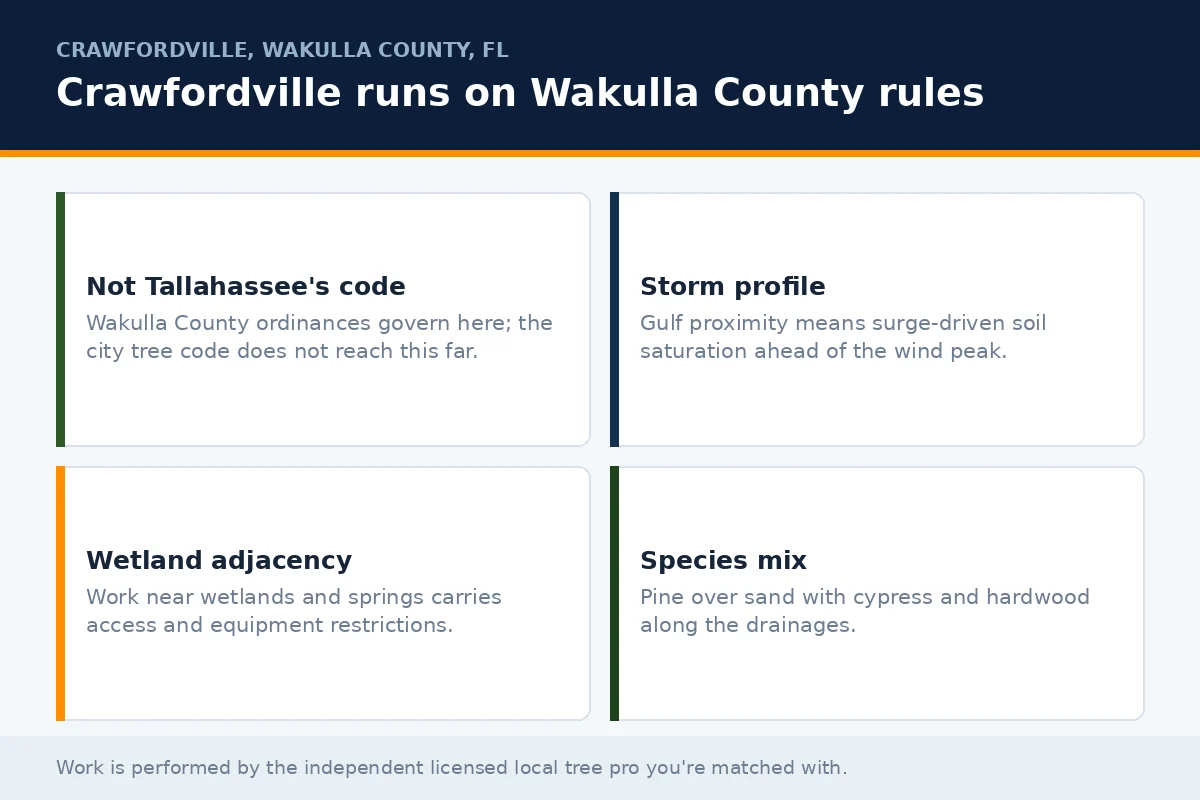
Crawfordville is Wakulla County — not Leon County and not the City of Tallahassee. Different permit framework, more direct Gulf storm exposure, and a pine flatwoods landscape that requires species-aware tree work. The arborists we dispatch handle Wakulla County permits, longleaf pine identification, and Gulf-corridor pre-storm assessment as standard practice.

ISA-Certified Arborists · Wakulla County Permit Specialists · Free Estimates
(850) 619-0000 Tap to Call · Free Estimate

No travel surcharge for Crawfordville and all of Wakulla County

✔ ISA-Certified Arborists ✔ Wakulla County Permits ✔ Gulf Storm Pre-Season ✔ 24/7 Emergency Dispatch
25 min From Tallahassee Dispatch
24/7 Emergency Dispatch
Wakulla County Jurisdiction
48–72hr Estimate Turnaround

Tree Service Across Crawfordville & Wakulla County

Free estimates with no travel surcharge across the Crawfordville area, the US-319 corridor, and surrounding Wakulla County communities.

Crawfordville US-319 corridor Wakulla Springs area St. Marks Panacea Sopchoppy Medart Wakulla River corridor Apalachicola Nat'l Forest edge St. Marks NWR edge All of Wakulla County

Crawfordville Is Wakulla County — Different Rules Than Tallahassee or Leon County

Crawfordville is the county seat of Wakulla County and one of only two unincorporated county seats among Florida's 67 counties. That single fact changes which permit framework applies to your property.

⚠️ Wakulla County Has Its Own Tree Ordinance — Not Tallahassee, Not Leon County

Crawfordville and effectively all of Wakulla County operates under county jurisdiction exclusively. Neither City of Tallahassee Growth Management rules ($273 LDC §5-83 fee) nor Leon County's §10-4.362 ordinance (12" DBH live oak threshold) apply here. Wakulla County has its own Land Development Code and tree protection framework administered by Wakulla County Planning and Community Development.

Wakulla County Planning & Community Development: (850) 926-0919 · 3093 Crawfordville Hwy, Crawfordville, FL 32327
Before any significant tree removal in Crawfordville or Wakulla County, contact Planning to confirm current permit requirements for your specific property and species
Florida Statute §163.045 applies throughout Wakulla County — ISA-certified arborist documentation of a hazard tree supports expedited or emergency removal without prior county permit in imminent-danger situations
National Forest and Wildlife Refuge adjacency: Properties bordering Apalachicola National Forest or St. Marks National Wildlife Refuge have federal land considerations separate from county requirements — boundary trees require jurisdiction clarification before any work

The arborists dispatched to Crawfordville are familiar with the county's permit framework and identify requirements during the on-site estimate.

Need a Wakulla County Tree Estimate?

The crews dispatched check Wakulla County permit framework, wetland buffer position, and access conditions before quoting — so the work happens within the rules, not around them. No travel surcharge for any Wakulla County address.

📞 (850) 619-0000

Gulf Storm Exposure — Why Crawfordville Tree Work Is Risk Management, Not Maintenance

Crawfordville's geography puts it in one of the highest direct-Gulf-exposure zones in north Florida. Understanding why drives how pre-storm tree work should be approached on Wakulla County properties.

🌀 The Crawfordville Storm Profile — Three Compounding Factors

Crawfordville sits roughly 10 miles inland from Apalachee Bay along the Gulf of Mexico — significantly closer to the coast than Tallahassee proper, which has approximately 25 miles of inland buffer. A hurricane making landfall near St. Marks or the Apalachee Bay area passes directly over or near Crawfordville before reaching Tallahassee, with minimal time over land to lose energy. The 1843 hurricane that destroyed Port Leon and led to the founding of Crawfordville on higher ground is the historical example. Wakulla County has been in the direct path of Gulf-origin storms more frequently than Leon County in modern record as well.

The three factors that compound the risk on Wakulla County tree properties:

1. Tall pines on shallow root plates. Slash pine and longleaf pine commonly reach 60–80 feet on Crawfordville residential lots. Both species develop relatively shallow root plates on sandy flatwoods soils, providing limited mechanical anchorage in saturated conditions.
2. Sandy flatwoods soils. Wakulla County sits east of the Cody Scarp on coastal plain sandy soils. These soils provide much less root anchorage than the upland clay soils west of the scarp (Killearn, Bull Run, Midtown). Trees on saturated sandy soils can fail at much lower wind speeds than the same species on clay.
3. Open canopy. Lower tree density across rural Wakulla County means individual trees don't benefit from the wind-shielding effect of dense urban canopy. Each tree experiences the full wind load rather than a portion buffered by surrounding trees.

The practical implication: pre-hurricane-season inspection (April–May, before June 1) and crown reduction or selective removal of compromised trees is standard preventive practice for Crawfordville properties, not optional maintenance.

Wakulla Springs & Wetland-Adjacent Properties — A Different Tree Service Picture

Wakulla Springs is one of the largest freshwater spring systems in the world. The Wakulla River it feeds creates a wetland corridor with unique tree conditions and unique permit considerations.

🌊 Trees Near the Wakulla River, Lakes, and Wetland Corridors

Properties adjacent to the Wakulla River, its tributaries, lake shorelines, and associated wetlands are subject to Northwest Florida Water Management District (NWFWMD) oversight for activities within designated wetland buffer zones. Tree removal within a wetland buffer may require NWFWMD review in addition to any Wakulla County requirements. NWFWMD contact: (850) 539-5999.

Three things to know about wetland-adjacent tree work in Wakulla County:

High water table changes root anchorage. Trees on properties with permanently or seasonally high water tables develop shallow, wide-spreading root plates with less mechanical anchorage than the same species on well-drained upland soils. Wind-throw risk is significantly higher than upland equivalents — even for apparently healthy trees.

Bald cypress and tupelo gum are different. These wetland-indicator species at the water's edge are adapted to inundation and are generally lower structural risk than upland species. However, very old bald cypress with compromised root systems in permanently saturated soils can still fail — particularly when root zones have been disturbed by fill, construction, or changes to water flow.

State park and refuge boundaries require clarification. Edward Ball Wakulla Springs State Park and St. Marks National Wildlife Refuge both border Wakulla County properties at multiple points. Boundary trees require survey-confirmed jurisdiction before any removal — state and federal trees are not homeowner-managed.

Pine Flatwoods Landscape — Identification and Southern Pine Beetle Risk

Crawfordville sits in Florida's pine flatwoods ecosystem. Pine identification matters for both permit purposes and for managing Southern Pine Beetle (SPB) risk in this pine-dominated landscape.

Slash pine, longleaf pine, and sand pine — knowing which is which

Wakulla County's residential and natural lots are dominated by three pine species. Slash pine (Pinus elliottii) is the most common — straight trunk, conical crown when young, needles 7–11 inches in pairs or threes. Longleaf pine (Pinus palustris) is Florida's signature native species — needles 8–18 inches in clusters of three, distinctive papery sheaths at the needle base, with a characteristic "grass stage" in juvenile years that looks like a grass clump rather than a tree. Sand pine (Pinus clausa) is more common here than in Tallahassee proper — shorter, often multi-trunked, shorter needles, adapted to deep sandy soils. The arborists dispatched confirm species at the estimate visit before any cutting plan is finalized.

Southern Pine Beetle — a real risk in pine-dominated Wakulla County

SPB is a real and ongoing risk in Wakulla County. FDACS 2025 monitoring data confirms active SPB pressure across the Big Bend region. An infested pine can fail 4–6 weeks after initial attack — often with damage hidden in the upper crown until it's too late. The signs to watch for are pitch tubes (popcorn-sized resin masses on the trunk), frass (sawdust-like material at the base), and crown fade (needles turning yellow then red, top-down).

On rural Wakulla County properties where pine stands often cross property lines, SPB is a neighborhood-level concern, not just a single-tree concern. Annual ISA arborist inspection is recommended for properties with 10+ pines, particularly between April and October when SPB flight activity peaks. When SPB is confirmed, prompt removal and on-site chipping per FDACS protocol limits spread to adjacent trees and adjacent properties.

Tree Services Available in Crawfordville & Wakulla County

All services include Wakulla County permit navigation, Gulf storm pre-season assessment, and wetland-adjacent property expertise as standard.

🌳

Tree Removal — Wakulla County Permit Navigation

All Wakulla County removal estimates include county permit framework confirmation before scheduling. Wetland buffer proximity checked for properties near Wakulla Springs, the Wakulla River, and coastal wetland corridors. Access route assessed for sandy coastal plain soils that affect equipment stability. No travel surcharge for any Wakulla County location.

Removal services →
🌀

Pre-Storm Assessment — Gulf Corridor Priority

Annual April–May ISA arborist assessment for Wakulla County properties before hurricane season. Coverage includes aging slash pines near structures, live oak root plate condition on sandy soils, and any tree within falling distance of an occupied structure. Wakulla County permit coordination for any pre-season removal included.

Storm prep guide →
🌲

Pine Identification & SPB Assessment

Longleaf pine, slash pine, and sand pine identification at the estimate visit. Annual SPB inspection for pitch tubes, frass, and crown fade — particularly valuable in Wakulla County's pine-dominated landscape where stands often cross property lines. On-site chipping per FDACS protocol when SPB is confirmed.

SPB guide →
🌊

Wetland-Adjacent Tree Service

Properties near Wakulla Springs, the Wakulla River, lakes, and wetland corridors require NWFWMD wetland buffer awareness. Buffer position checked at the estimate visit. Bald cypress and other wetland-indicator species assessed using species-appropriate criteria. Boundary tree jurisdiction clarified for properties adjacent to Edward Ball Wakulla Springs State Park or St. Marks NWR.

Arborist services →
✂️

Tree Trimming & Crown Reduction

ANSI A300 structural pruning for Wakulla County's mature live oaks and crown reduction for aging slash pines before storm season. The flat coastal plain soils make crown wind-load reduction particularly impactful for tree stability in high-wind events. April–May pre-storm window recommended.

Trimming services →
🚨

24/7 Emergency Storm Response

24/7 dispatch for storm damage throughout Wakulla County — Crawfordville, Panacea, Sopchoppy, St. Marks, Medart, and rural county corridors. Gulf-origin storms hit Wakulla County first; emergency response is planned for that geographic reality. Florida Statute §163.045 imminent-danger provisions allow emergency removal without prior permit when life or property is at immediate risk, with ISA documentation to follow.

Emergency service →

Storm-Damaged Tree, Active Hazard, or Pine Stand SPB Concern?

24/7 emergency dispatch across Wakulla County. Florida Statute §163.045 imminent-danger provisions handled with same-visit ISA-CA TRAQ documentation when applicable.

📞 (850) 619-0000

Tree Service Crawfordville — FAQ

Do I need a permit to remove a tree in Crawfordville?

Crawfordville is in Wakulla County — not Leon County and not City of Tallahassee. Wakulla County has its own Land Development Code and tree protection framework administered by Wakulla County Planning and Community Development. The county's framework is generally less restrictive than Leon County §10-4.362, but specific permit requirements vary by property zoning and tree size. Verify with Wakulla County Planning at (850) 926-0919 before authorizing removal of any significant tree. Florida Statute §163.045 hazard tree exemption applies statewide.

How much does tree service cost in Crawfordville?

Tree service Crawfordville pricing follows the broader Tallahassee market: tree removal $350–$7,000+, trimming $250–$1,800, stump grinding $100–$500 per stump, emergency response $500–$5,000+. Crawfordville's sandy flatwoods soils make stump grinding faster than the red Orangeburg clay soils west of the Cody Scarp. The 25-minute drive from Tallahassee is part of the standard service area for crews dispatched through this network — no travel surcharge applies for Crawfordville and Wakulla County.

What trees are most common in Crawfordville and Wakulla County?

Crawfordville sits in Florida's pine flatwoods ecosystem. Slash pine (Pinus elliottii) and longleaf pine (Pinus palustris) dominate the natural landscape, often 60–80 feet tall on residential lots. Sand pine (Pinus clausa) is more common here than in Tallahassee proper. Live oak (Quercus virginiana), water oak, and laurel oak are present but pines lead the canopy. Properties along lakes, rivers, and St. Marks Wildlife Refuge edges often include bald cypress (Taxodium distichum), which has its own removal and trimming considerations due to wetland adjacency rules.

How does hurricane risk in Crawfordville compare to Tallahassee?

Crawfordville sits roughly 10 miles from Apalachee Bay, with significantly more direct Gulf exposure than Tallahassee proper (which is buffered by approximately 25 miles of inland forest). Three factors compound the risk: tall slash and longleaf pines on shallow root plates, sandy flatwoods soils that lose anchorage in saturated conditions, and a relatively open canopy without the wind-shielding effect of dense urban tree cover. Pre-hurricane-season inspection (ideally before June 1) and crown reduction or selective removal of compromised trees is standard preventive practice.

How serious is Southern Pine Beetle in Wakulla County?

Southern Pine Beetle (SPB) is a real and ongoing risk in Wakulla County's pine-dominated landscape. FDACS 2025 monitoring data confirms active SPB pressure across the Big Bend region. An infested pine can fail 4–6 weeks after initial attack — often with damage hidden in the upper crown until it's too late. Annual ISA arborist inspection is recommended for properties with 10+ pines, particularly between April and October when SPB flight activity peaks. On-site chipping of infested material per FDACS protocol limits spread to adjacent trees and adjacent properties.

Can a Tallahassee tree service work in Crawfordville without a travel surcharge?

Yes — Crawfordville is approximately 25 minutes south of Tallahassee on US-319 and is part of the standard service area for this network. No travel surcharge applies for Crawfordville, Panacea, Sopchoppy, St. Marks, or anywhere in Wakulla County. The critical thing to verify with any contractor is jurisdictional knowledge: a contractor who only works City of Tallahassee or Leon County may not be familiar with Wakulla County's separate permit framework, which can create problems when permits are required.

Are there special rules for cypress trees on lake or wetland properties?

Yes — bald cypress and other wetland-adjacent trees may fall under Florida Department of Environmental Protection (FDEP) or Northwest Florida Water Management District (NWFWMD) wetland buffer rules in addition to any Wakulla County requirements. Trees within designated wetland buffers, on lake shorelines, or near regulated waterways generally require permit review before removal even if standard county rules don't apply. The arborists dispatched identify wetland buffer concerns during the on-site estimate and advise on which agencies need to be contacted before any cypress or wetland-adjacent removal proceeds.

Also Serving These Nearby Areas

Panacea Sopchoppy St. Marks Medart Wakulla Springs area Woodville (Leon County) SouthWood Tallahassee Bradfordville All of Wakulla County

Get a Free Tree Service Estimate in Crawfordville

On-site assessment with Wakulla County permit framework check, wetland buffer verification where applicable, and access route walk-through before any work is scheduled. No travel surcharge for Wakulla County.

(850) 619-0000 Mon–Sat 7am–7pm · 24/7 Emergency Dispatch
tallahasseetreeservice.co is an independent referral network connecting homeowners with vetted, ISA-certified tree service professionals serving Crawfordville, Wakulla County, and surrounding Big Bend areas. We do not perform tree services directly. Wakulla County tree permit information is administered by Wakulla County Planning and Community Development at (850) 926-0919 — verify current requirements before any removal. NWFWMD wetland buffer information reflects Northwest Florida Water Management District jurisdiction — verify at (850) 539-5999. Florida Statute §163.045 current through April 2026.
Call Now – Free Estimate