Deep Root Fertilization Tallahassee — Feed Stressed Mature Trees the Right Way
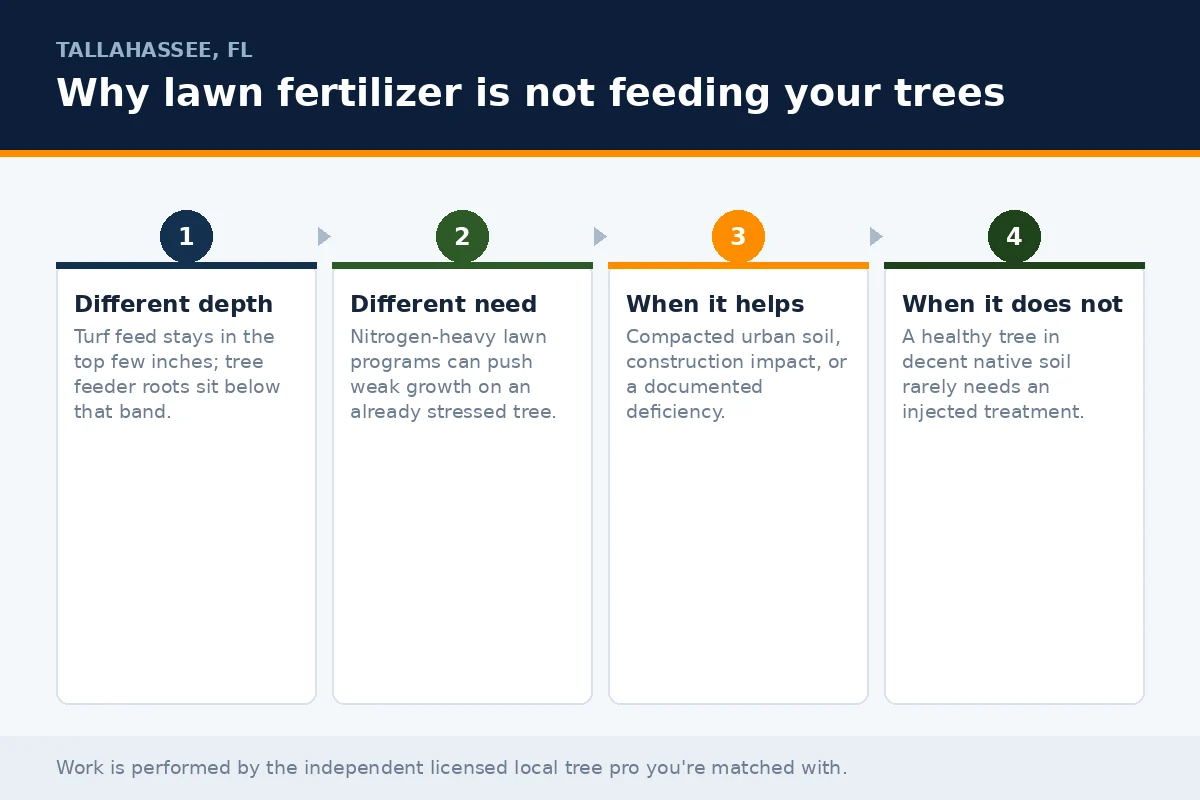
Surface lawn fertilizer doesn’t reach mature tree roots. Most North Florida turf fertilizers are formulated for grass, applied 1–2 inches deep, and never get to the 6–12 inch zone where mature feeder roots actually live. Our deep root fertilization Tallahassee service injects balanced nutrients and biostimulants directly into the root zone using high-pressure soil probes — the right delivery for stressed mature live oaks, water oaks, pines, and palms struggling from drought, construction impact, soil compaction, or post-storm stress.
What Deep Root Fertilization Actually Does
Deep root fertilization is supportive care for stressed mature trees — not a routine annual treatment, and not a substitute for proper site conditions or disease treatment.
Mature tree feeder roots in Tallahassee soils typically live 6–12 inches below the surface, spreading well beyond the dripline of the canopy. Surface-applied lawn fertilizer almost never reaches this zone — it gets locked up in the top few inches of soil where grass roots dominate, or it’s washed off by rain before percolating down. For mature trees, you need a delivery method that puts nutrients exactly where the feeder roots are. That’s what high-pressure deep root injection does: a soil probe penetrates 6–12 inches into the soil and pushes a liquid nutrient slurry directly into the root zone in a grid pattern across the dripline.
Done correctly, deep root fertilization Tallahassee crews deliver balanced macronutrients (typically a low-nitrogen blend — mature trees rarely need much nitrogen), micronutrients like iron, manganese, and zinc that Tallahassee soils often lack, biostimulants like humic and fulvic acids that improve nutrient uptake, and beneficial mycorrhizal fungi that extend the tree’s effective root system. The injection process also serves a second purpose: the high-pressure soil probe physically aerates compacted soil at every injection point, providing oxygen exchange that compacted urban soils desperately need.
It’s important to be clear about what deep root fertilization isn’t. It isn’t a cure for disease — if your tree has Hypoxylon canker, southern pine beetle, or root rot, fertilization won’t fix the underlying problem. See tree disease treatment for that. It also isn’t a replacement for proper site management — if your tree is suffering from soil compaction, root damage from construction, or chronic drought, those root causes need direct intervention. Fertilization is supportive care that helps an already-functional tree recover from stress and grow stronger.
Deep Root Fertilization vs. Lawn Fertilizer for Trees
Most homeowners assume their lawn fertilizer is also feeding their trees. It isn’t — and in some cases, it’s actually hurting them.
What Most Homeowners Use
Granular fertilizer broadcast across the lawn surface. Usually high-nitrogen, formulated for grass.
- Doesn’t reach 6–12 inch tree feeder root zone
- Dominated by lawn-targeted nutrient ratios (high N)
- Excess nitrogen promotes weak rapid tree growth
- Lacks micronutrients trees actually need
- No biostimulants or beneficial fungi
- No soil aeration benefit
- Can leach into stormwater systems
What Mature Trees Need
High-pressure liquid injection delivered 6–12 inches deep across the dripline.
- Lands directly in the active feeder root zone
- Tree-specific blends (low-nitrogen, balanced)
- Strong, well-balanced growth
- Includes Fe, Mn, Zn micronutrients
- Humic acids, fulvic acids, mycorrhizae
- Probe also aerates compacted soil
- Targeted, no runoff loss
When Deep Root Fertilization Makes Sense
Healthy unstressed mature trees rarely need fertilization. These are the situations where deep root fertilization Tallahassee homeowners should actually consider.
Recent Construction Impact
New driveway, addition, fence trenching, pool install, or utility work within the dripline. Root damage shows up as decline 1–5 years later. Fertilization helps the tree recover faster.
Compacted Urban Soils
Heavy foot traffic, vehicle parking on root zone, or fill dirt over native soil. Common in older Tallahassee neighborhoods where landscape changes accumulated over decades.
Post-Storm Recovery
Mature trees that survived major events (Hermine, Michael, Idalia, Helene) but show stress signs the next season. Fertilization supports recovery from wind damage to roots and crown.
Visible Mineral Deficiency
Yellowing leaves with green veins (iron chlorosis), small undersized leaves, premature fall color, or sparse canopy. Common on palms in Tallahassee’s alkaline pockets.
Drought-Stressed Trees
Mature trees that experienced an extended drought year. Fertilization supports recovery once normal rainfall returns. Doesn’t replace the need for actual watering during the drought itself.
Newly Pruned Major Work
After significant crown reduction, structural pruning, or storm-damage cleanup, fertilization supports recovery. Best 6–8 weeks after the cut, not immediately.
Newly Transplanted Trees
Trees moved within the last 2–3 years that haven’t fully re-established. Fertilization supports root regeneration and reduces transplant shock duration.
High-Value Specimen Trees
Heritage live oaks, established palms in landscape feature areas, or mature trees in occupied common areas where decline is unacceptable. Preventive maintenance program.
Tree Stressed? Schedule Root-Zone Feeding.
Same-week scheduling. ISA-Certified arborist assesses whether your tree actually benefits from fertilization or whether the issue is something else entirely.
How Deep Root Fertilization Works on Site
Every deep root fertilization Tallahassee visit follows the same general workflow — tuned to species and tree-specific needs.
Pre-Application Assessment
ISA-Certified arborist confirms fertilization is the right intervention — rules out disease, structural failure, or terminal decline. We don’t fertilize trees that won’t benefit.
Soil Test (Optional)
For high-value trees or ambiguous cases, soil test confirms pH and existing nutrient levels. Avoids over-applying nutrients already abundant in your soil.
Mix Site-Specific Blend
Fertilizer blend tuned to the species (live oak vs. pine vs. palm) and the diagnosis. Macronutrients, micronutrients, biostimulants, and mycorrhizae proportioned for the situation.
Mark Injection Grid
Grid pattern marked across the dripline area. Typical spacing: 24–36 inches between probes. Mature live oak with 50-foot dripline gets 30–60 injection points.
Inject at 6–12 Inch Depth
High-pressure soil probe drives 6–12 inches into the soil at each grid point. Liquid blend pumped under pressure into the root zone. Probe also creates aeration channel.
Avoid Hardscape & Utilities
Grid adjusted around irrigation, utility lines, hardscape, and tree root flares. Probe goes in soil only, never in turf-mounted irrigation heads or buried lines.
Light Watering After
Recommend light watering of the application area within 24–48 hours. Helps disperse the nutrient column and activates biostimulants. Heavy rain accomplishes the same.
Documentation & Follow-Up
Treatment record includes products applied, injection count, date, soil conditions, tree response baseline. Follow-up assessment 4–12 months later for response evaluation.
Best Seasons for Deep Root Fertilization in Tallahassee
North Florida’s growing season is long, but specific months work better than others for root-zone application.
For multi-year programs (post-construction recovery, transplant support, post-storm care), most Tallahassee trees benefit from spring + fall applications spaced roughly 6 months apart over a 1–3 year recovery window. Call (850) 555-0123 to scope the right cycle for your specific trees.
Common Tree Fertilization Mistakes to Avoid
More fertilization isn’t better. Wrong fertilization actively damages mature trees. These are the mistakes we see most often.
- Using high-nitrogen lawn fertilizer on mature trees. Excess nitrogen promotes weak rapid growth that’s storm-vulnerable, attracts pests, and increases disease susceptibility. Mature trees need balanced low-N blends.
- Fertilizing newly planted trees. New trees should establish on existing soil for 1–2 years before any fertilization. Fertilizing immediately stresses the tree and discourages root expansion.
- Fertilizing trees in active decline from disease. If the tree has Hypoxylon, root rot, or canker disease, fertilization wastes money and may accelerate decline. See disease treatment first.
- Annual or semi-annual scheduling on healthy trees. Healthy mature trees in good soil don’t need routine fertilization. Most Tallahassee trees do fine without supplemental feeding throughout their lives.
- Drilling fertilizer holes that damage roots. Pellet-stick drill holes used by some applicators damage feeder roots. Pressure injection is far less invasive and reaches more soil per probe.
- Skipping the dripline area. Mature tree feeder roots extend well beyond the visible canopy — sometimes 1.5–3x the dripline radius. Limited application near the trunk only misses where the action is.
- Fertilizing trees with structural defects. A tree with co-dominant leaders, included bark, or major decay isn’t made safer by fertilization — growth may actually accelerate the structural problem. Address structure first; see tree cabling.
Tree Recovery Starts at the Roots.
Skip the lawn fertilizer guessing game. Get an ISA-Certified arborist to assess whether root-zone feeding is the right intervention for your tree.
Deep Root Fertilization Pricing in Tallahassee
Pricing depends on tree size (dripline area = number of injection points), species-specific blend, and whether multiple trees are treated together.
| Tree Size / Type | Typical Range | Notes |
|---|---|---|
| Small to medium tree (under 30′) | $120 – $250 | Per tree; single visit |
| Mature tree (30–60′) | $200 – $400 | Most common Tallahassee scope |
| Large mature tree (60′+) | $350 – $650 | Mature live oak, large pine |
| Mature palm (per tree) | $100 – $250 | Different blend than hardwoods |
| Multi-tree property (4+ trees) | 10–20% per-tree discount | Same-day visit efficiency |
| Spring + fall annual program | $300 – $1,200/year per tree | Post-construction or stressed trees |
| Soil test add-on | $45 – $90 | UF/IFAS or private lab |
| Initial diagnostic visit | Free with treatment | $95–$175 standalone |
Deep Root Fertilization Tallahassee FAQs
How often should I deep root fertilize my trees?
For most healthy mature trees: never, or rarely. Healthy unstressed trees in decent soil don’t need supplemental feeding. For stressed trees, multi-year programs (1–3 years, twice annually) are typical, then taper to monitoring. Annual fertilization of healthy trees is rarely justified and not what we recommend.
Will deep root fertilization save a dying tree?
Probably not. If a tree is in active terminal decline from disease, structural failure, or root system collapse, fertilization won’t reverse it. Fertilization helps trees recover from stress — not from disease or terminal damage. An honest diagnosis comes first; see disease treatment and tree inspection.
How quickly will I see results?
Visible response usually takes 4–12 months. Stressed trees may show improved leaf color, fuller canopy, or restored growth in the next season. Don’t expect dramatic same-week change — this is supportive care, not stimulant. Multi-year programs show cumulative improvement over 2–3 years.
Is deep root fertilization safe for grass and other plants?
Yes. The injection delivers nutrients to the 6–12 inch zone where tree roots dominate. Surface grass and shallow-rooted ornamentals aren’t directly affected. Light watering after application disperses any residual surface material.
Can I do this myself with a home applicator?
Limited DIY products exist (root-feeder hose attachments, fertilizer stakes), but they don’t deliver high-pressure injection at the right depth or with the right blend. They also don’t aerate soil. For mature trees worth saving, professional application is much more effective per dollar spent.
Do I need a permit for deep root fertilization?
No. Tree maintenance and fertilization fall outside permit requirements. The City of Tallahassee §5-83 ordinance applies to tree removal, not maintenance. See our permit guide for removal-related requirements.
Does this work for palm trees?
Yes — but palms have different nutritional needs than hardwoods. Palms are particularly susceptible to potassium and magnesium deficiencies in Tallahassee soils. Palm-specific blends are used. Palms also benefit from less aggressive injection grids; we adjust technique to species. See palm tree trimming.
What about trees on a commercial property or HOA common area?
Yes — we provide deep root fertilization for commercial properties, HOAs, and property management portfolios. Multi-tree programs are common for high-value common-area trees and entrance feature trees. Master vendors get program pricing.
Will fertilization cause trees to grow into power lines?
Properly balanced low-nitrogen blends don’t cause excessive top growth. The goal is balanced root and canopy development, not rapid vertical growth. If you have utility line concerns, a structural pruning plan is the right intervention. See tree pruning.
Can fertilization help trees survive future hurricanes?
Indirectly. Healthy well-fed trees with robust root systems resist wind better than stressed trees. But the bigger storm-survival factors are species selection, structural pruning history, and proper canopy thinning. Fertilization supports overall health, not specific storm resistance. See hurricane tree prep.
Tallahassee Soils & Why They Matter for Tree Feeding
North Florida soils have specific characteristics that drive the case for — or against — deep root fertilization on a given property.
Most of Leon County sits on a mix of Plinthic Paleudults and Ultic Hapludalfs — sandy clay loam topsoil over heavier clay subsoils. The topsoil is decent for trees in undisturbed conditions, but it’s also low in organic matter, drains rapidly during rain events, and locks up micronutrients (especially iron and manganese) under certain pH conditions. Established neighborhoods like Myers Park & Betton Hills, Killearn Estates, and Northwest Tallahassee often show progressive nutrient depletion in soils that have supported mature canopies for 60–100 years — the trees have essentially mined the available nutrient pool over decades.
Newer neighborhoods like parts of Southwood, Bradfordville, and the Killearn Lakes developed areas often have trees planted into reworked construction soils — clay subsoil pushed to the surface, organic matter stripped during grading, and compaction from heavy equipment baked in. Trees in these conditions struggle for years even when species selection was appropriate. Deep root fertilization Tallahassee programs in newer-development properties focus heavily on biostimulants and mycorrhizal restoration alongside nutrient delivery, because the underlying soil biology is what’s actually missing.
Out in Wakulla County, Crawfordville, and the rural areas south and east of the city, sandy entisols dominate — very fast-draining, low-CEC soils that hold nutrients poorly. Pines and longleaf species native to these soils evolved to thrive on minimal nutrient input, so fertilization makes less sense for them. But ornamental trees and non-native species planted into these soils benefit from regular feeding since the soil itself isn’t holding nutrients between rain events. Even basic mulching practices have outsized impact on rural sandy soils because organic matter retention is the biggest single nutrient-holding lever you have, and a 2-to-3-inch layer of organic mulch refreshed annually does more for tree health on sandy soils than most chemical interventions ever will, and it’s essentially free if you have a chipper running. Call (850) 555-0123 to discuss whether your specific soil type and tree species combination warrants a fertilization program.
Multi-Tree Property Programs
For properties with multiple stressed mature trees — common after construction projects, storm damage, or in long-established neighborhoods with depleted soils — multi-tree treatment programs are more efficient and more economical than per-visit single-tree work.
A typical multi-tree property program covers 4–15 trees over a 1–3 year window, with applications scheduled in the optimal February–April and October–November windows. Pricing reflects the efficiency of doing all the trees in a single visit — mobilization, equipment setup, and on-site time are amortized across the tree count rather than charged per tree. Properties in Killearn Estates with 8–12 mature live oaks and water oaks are a common scope; so are post-construction recovery situations where 4–6 trees got hit by trenching or grading damage during a remodel.
For HOAs and commercial properties managing common-area trees, multi-tree programs roll into the existing HOA tree service or commercial tree service agreement. Call (850) 555-0123 for property-walkthrough scheduling and program scoping.
One thing worth noting on multi-tree programs: not every tree on a property necessarily benefits from fertilization, and a competent ISA-Certified arborist will tell you that during the walkthrough rather than treating everything just because it’s on the property. A typical 12-tree assessment might result in a recommendation to treat 5 trees actively, monitor 4 trees for the next year before deciding, and leave 3 trees alone because they’re healthy and don’t need intervention. That kind of selective treatment is usually 30–40% cheaper than blanket fertilization and produces better outcomes because the resources concentrate where they’ll actually help. The walkthrough cost is typically wrapped into the treatment cost when work proceeds, so you’re not paying twice to figure out what your trees need.
Related Tallahassee Tree Services
Deep root fertilization sits inside a broader plant-health-care toolkit. Most relevant pages below.
Feed the Roots, Save the Tree.
Deep root fertilization Tallahassee crews provide targeted root-zone feeding for stressed mature trees. ISA-Certified application, balanced tree-specific blends, and the discipline to recommend it only when it’ll actually help.