Tree Branch Removal in Tallahassee, FL
A limb scraping the roof every time the wind picks up. A broken branch hung up in the canopy that hasn’t come down yet. Call now and we’ll connect you with a vetted, licensed and insured local arborist who cuts to the collar — not flush, not into the bark.
📞 Call Now — (858) 319-0022Hanger limb in the tree? Call now — those get triaged ahead of scheduled work, any hour.A branch over the house, hanging into the driveway, scraping the shingles in every thunderstorm — that is the bread-and-butter tree call in Tallahassee. Branch removal sits between trimming (selective, many branches) and removal (the whole tree comes down). It is a single-target job: pick the branch, plan the cut, lower it cleanly, clean up the debris.
Done correctly it is a fraction of full tree work. Done incorrectly it shreds the bark below the cut, opens the tree to decay, and sets up the next failure. This page covers when single-branch removal is enough versus when it is a canary for whole-tree problems, the four-cut method that prevents bark tearing, how to spot a hanger before it drops, and how the local rules split power-line branches between you and the utility.
Is one branch the problem — or a symptom?
Sometimes a branch needs to come off and the rest of the tree is fine. Sometimes the branch that needs to come off is the third one this year from the same tree, and something bigger is going on. The diagnostic question is: why did this branch need to come off?
If the answer is “it grew into the driveway and the truck can’t get past it,” that is a clearance issue and branch removal solves it. If the answer is “wind came through last weekend and that one branch snapped,” that is a storm one-off, and branch removal solves it too — assuming the tree is otherwise sound.
If the answer is “this is the third branch in eighteen months and the tree just dropped them,” that is a different conversation. Spontaneous limb drop on a mature tree that was previously healthy is a warning sign. The usual culprit in Leon County is internal decay — hypoxylon canker on stressed oaks, heart rot on hardwoods generally. Once you have seen three failures, the tree is likely compromised throughout, and cutting the failed branch is treating the symptom. That is a tree risk assessment conversation, and possibly a removal one.
Signals worth mentioning when you describe the tree: when the branches failed (during wind, or in dead calm — calm-weather failure is worse), where they came from (outer canopy is normal aging; interior structural limbs is a red flag), how many failures recently, and what the tree looks like overall — full canopy or thinning, tight bark or sloughing bark, any fungal conks at the base or on the trunk.
Hangers and widow-makers — and why they kill people
A hanger (or widow-maker) is a branch that has broken or partly severed but is still suspended in the canopy: caught on another limb, hanging by a strip of bark, wedged in a fork. It has not fallen yet. It is going to.
The danger is the timing. A hanger can sit up there for weeks until a gust, a squirrel, or an afternoon thunderstorm dislodges it. Then it falls fast, with no warning, and lands wherever gravity puts it. Hangers have killed homeowners doing yard work underneath them, flattened cars, and gone through roofs.
How to spot one: walk around the tree and look up. Hunt for branches out of position — pointing down when they should point out, draped across other limbs, hanging at an odd angle. Fresh break points often show as lighter-colored exposed wood. Sometimes you only see it when the wind catches the branch and it moves differently from everything around it.
A hanger should come down promptly, and it should be lowered, not dropped — a rope goes on the branch, it is cut free from whatever is holding it, and it is let down under control so it does not take out what is below. That is rigging work, not ladder work.
Spotted a hanger? Don’t wait for it to fall. Keep people, cars, and pets out from under it, then call now — hanger limbs are triaged ahead of scheduled work.
📞 Call Now — (858) 319-0022Vetted local pros — availability depends on independent provider schedules and demand.*The four-cut method — how a branch comes off without tearing bark
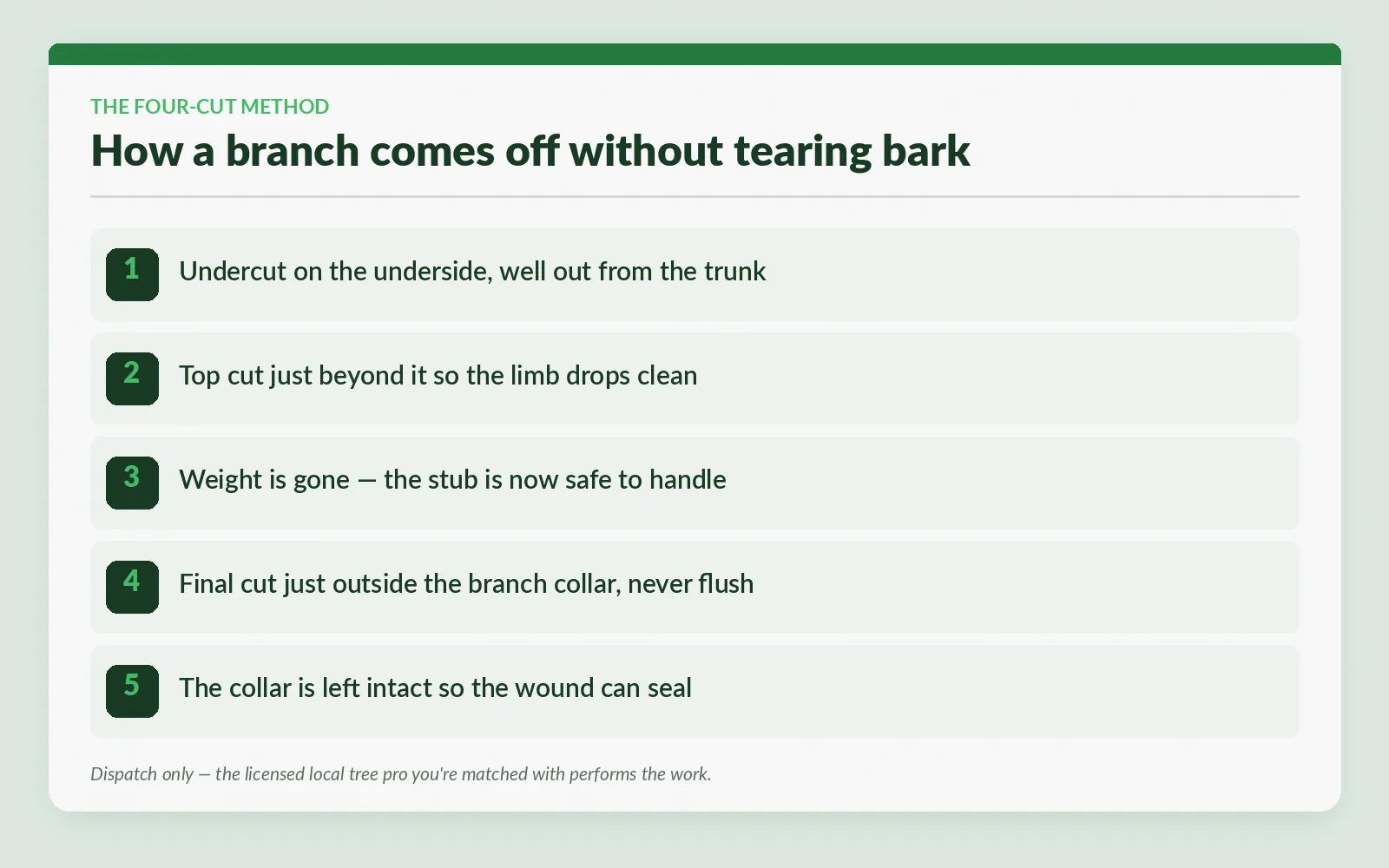
The goal of any branch cut is a wound the tree can compartmentalize and seal. The wrong cut tears bark below the cut, exposes the cambium, and opens a decay pathway that may never close. The right sequence is the four-cut method, and it is the same on a young dogwood and a 200-year-old live oak.
Cut one — the undercut. Roughly 18 inches out from the trunk (or from the parent limb), cut up into the underside of the branch, about a third of the way through. This is the whole trick: when the branch goes, the bark peels back to this cut and stops instead of ripping a strip down the trunk.
Cut two — the topcut. An inch or two further out, cut down through the branch until it releases. It falls, the bark tears back to the undercut and stops. You are left with a manageable stub.
Cut three — the final cut. This is the real removal cut, and the location is everything. It goes just outside the branch collar — the slight swelling where branch meets trunk. Not flush with the trunk: a flush cut removes the collar and destroys the tree’s ability to seal. Not too far out either: a long stub decays back into the trunk. The collar contains the chemistry the tree uses to wall off the wound. Preserve it.
Cut four — the cleanup (sometimes). If the final cut left a ragged flap of bark, a clean trim with a sharp knife finishes the wound. Most arborists do this only on high-value trees or where the bark visibly tore.
A homeowner with a sharp hand saw and a branch under two inches can do this correctly with a little practice. Anything larger, anything overhead, anything requiring a ladder — that is a pro’s job. The most common irreversible mistake we hear about in Tallahassee is exactly this: a flush cut that tore the bark and let decay straight into the trunk.
Storm-broken versus long-dead branches
They look similar from the ground and they are handled completely differently.
Storm-broken means fresh exposed wood and, often, a limb still under structural tension because it is partly hung up. The cut happens as soon as it can be done safely, using the collar cut, and the debris comes out before rain accelerates decay through the open wound. The tree usually responds well because the surrounding tissue is alive.
Long-dead means brittle wood and bark already sloughing. Dead wood cracks unpredictably under a saw and will not reliably hold a climber’s weight — which is why most dead-limb work in Tallahassee comes off from a bucket or a lift rather than from a climbing position out on the limb itself. And if dead branches are showing up in several places on the same tree, the trunk may be carrying decay throughout, and the cut may not seal. That is a whole-tree question, not a branch question. See dead tree removal.
Power lines: whose branch is it?
This is the part that saves Tallahassee homeowners real money, because the rules split the responsibility.
Primary distribution lines — the high-voltage lines running along the street or the back lot line — are maintained by the utility. City of Tallahassee Utilities, Talquin Electric, and Duke Energy all handle vegetation clearance on their own primary lines at no cost to you. If a branch is growing into a primary line, contact your utility through their published customer channel and they will schedule line clearance. You do not pay, and no tree contractor should be charging you for it.
Service drops — the lower-voltage line running from the pole to the meter on your house — are generally the homeowner’s responsibility. A branch growing into it, resting on it, or threatening it in wind is your problem to solve, and only a contractor with the right line-proximity qualification and insurance should be doing that work. That qualification is why service-drop branch work sits at the higher end of the local market range.
Practical order of operations: if you are not sure which kind of line it is, contact the utility first. They will tell you whether it belongs to them. If it is yours, call now and we will route you to a pro carrying the right coverage. Never let anyone — including yourself — put a saw near an energized conductor.
What drives the scope of a branch removal
Branch removal is scoped to the specific limb, not sold from a menu. These are the factors that move it in the local market — the pro you’re matched with gives the binding written quote:
| Factor | Why it moves the scope |
|---|---|
| Diameter & height | Under 3 inches and ground-reachable is a pole-saw job. Six inches at 30 feet is a rigging job. |
| What’s underneath | Open grass means it can be dropped. Over a roof, pool cage, or fence means every piece is roped and lowered. |
| Access | Bucket truck to the front yard versus climbing into a fenced backyard is a different half-day. |
| Hanger vs. attached | A partly-severed limb under tension takes extra rigging and gets triaged first. |
| Line proximity | Service-drop work requires specific qualification and insurance, which prices differently. |
| Multiple limbs | Several branches on one tree in one visit is usually more efficient than three separate trips. |
Those are local-market realities, not our prices — we do not perform the work and we do not set the number. For the broader picture, see the tree trimming cost guide.
How getting matched works
Branch patterns by Tallahassee neighborhood
Killearn Estates & Killearn Lakes. Heavy laurel oak density on Orangeburg clay. Most calls here are big mature-oak hangers after summer thunderstorms.
Bradfordville. Mixed oak and pine. Calls split between oak hangers and pine limbs over rooflines.
Betton Hills, Myers Park, Lafayette Park. Mature canopies, tight lot lines. The limb coming down is frequently over a neighbor’s garage or pool, so target protection and a conversation next door come first. See Betton Hills tree service.
SouthWood & Apalachee Ridge. Pine-dominant on sandier soil. Pine limbs are heavy, brittle, and fail without much warning — pine hangers are common here. See SouthWood tree service.
Midtown & downtown. Small lots and property-line trees. Half the job is often agreeing with the neighbor about who owns which limb before anyone cuts.
Indianhead Acres, Frenchtown, Mabry Heights. The May 10, 2024 tornado line hit hard here, and damaged trees keep shedding limbs for a year or more after the event. If your tree took wind damage in 2024, it is still worth a look.
Before you call — how to describe the limb
- Size. Wrist-thick, arm-thick, or bigger than your thigh? And how high up?
- Position. Attached and in the way, cracked and sagging, or fully broken and hung up in the canopy?
- Target. What is directly under it — roof, car, fence, pool cage, playset, or just grass?
- Lines. Anything within reach of a wire. Say it up front.
- History. Is this the first limb this tree has dropped, or the third?
Frequently asked questions
How much does tree branch removal cost in Tallahassee?
It is scoped to the specific limb — diameter, height, what is underneath, access, and line proximity all move it, so there is no honest flat figure and the ranges you see online are market chatter, not prices. The local arborist you’re matched with looks at the limb and gives a written quote before any cut.
What is a hanger limb and how urgent is it?
A hanger is a broken branch still suspended in the canopy. It will fall — nobody can say when. Keep people, pets, and vehicles out from underneath it and get it lowered under rope rather than waiting for gravity. Hangers get triaged ahead of scheduled work.
Can I cut the branch off myself?
If it is under about two inches, you can reach it from the ground, and nothing is under it, a sharp hand saw and the four-cut method will do it correctly. Anything overhead, anything requiring a ladder, anything near a wire, and anything hung up in the canopy is genuinely dangerous — that is where homeowners get hurt.
Why does a flush cut damage the tree?
The branch collar — the swelling where the branch meets the trunk — contains the tissue and chemistry the tree uses to wall off a wound. A flush cut removes the collar, so the tree cannot seal, and decay moves into the trunk. The cut should be just outside the collar, leaving it intact.
Who trims branches near power lines in Tallahassee?
The utility maintains clearance on its primary distribution lines at no cost to the homeowner — contact City of Tallahassee Utilities, Talquin, or Duke through their customer channels. The service drop from the pole to your meter is generally the homeowner’s responsibility, and it takes a contractor with line-proximity qualification and insurance.
My tree keeps dropping branches. Is that normal?
Shedding a small interior twig now and then is normal. Repeatedly dropping structural limbs — especially in calm weather — is not. That pattern often points to internal decay such as hypoxylon canker or heart rot, and it means the tree needs a risk assessment, not another branch cut.
Related Tallahassee tree services
Tree Trimming
Tree Pruning
Emergency Tree Service
Storm Damage Tree Removal
Dead Tree Removal
Tree Risk Assessment
Roof Tree Removal
Tree Debris Removal
Get the branch down the right way
Call now and we’ll connect you with a vetted, licensed and insured Tallahassee-area arborist. Free to use, no obligation, no sign-up.
📞 Call Now — (858) 319-0022Tallahassee Tree Service is a free referral service. Tallahassee Tree Service is not a licensed tree service provider and does not directly provide tree care services. All work is performed by independent, licensed and insured third-party providers in your area. Calls and form submissions placed through this site may be connected with a participating provider, and you may be contacted by that provider regarding your request. Same-day, emergency, and 24/7 availability are not guaranteed and depend on provider schedules, location, and demand. Service availability, pricing, licensing, and final response times are determined solely by the providers. It is the responsibility of the homeowner to verify that the hired contractor furnishes the necessary license and insurance required for the work being performed. All persons depicted in a photo or video are actors or models and not contractors listed on Tallahassee Tree Service.