๐ŸŒธ Flowering Dogwood Specialists โ€ข ISA-Certified Crews

Dogwood Tree Care Tallahassee โ€” Pruning, Disease & Health for Flowering Dogwoods

Flowering dogwood is the small ornamental tree of the Southern landscape — classic spring blooms, year-round structural beauty, and one of the trickiest trees to keep healthy in North Florida. Tallahassee’s heat, humidity, and seasonal drought push dogwoods harder than their natural Appalachian forest understory habitat. Stress-induced borer attacks and anthracnose are widespread. Our dogwood tree care Tallahassee crews handle pruning, disease and pest treatment, fertilization, removal, and replanting recommendations. ISA-Certified arborists oversee all work.

25′
Mature Height in Tallahassee
25–40 yr
Realistic Lifespan in N. Florida
ISA
Certified Arborists
7-Day
Standard Scheduling
โœ‚๏ธDogwood Pruning ๐Ÿ‚Anthracnose Treatment ๐ŸชฒDogwood Borer Control ๐ŸŒฑStress Recovery Programs ๐ŸชตRemoval When Needed

Why Dogwoods Are a Challenging Tree in Tallahassee

Flowering dogwoods belong in dappled woodland edges with cool moist organic soil. Tallahassee summers, full-sun lawn settings, and turf-irrigated soils stress them in ways their native habitat doesn’t.

Flowering dogwood (Cornus florida) is native to the eastern U.S. and historically a widespread understory tree throughout North Florida’s mixed hardwood forests. A mature specimen reaches 20–30 feet tall with similar spread, blooms in March–April with showy white or pink bracts, and produces red berries in fall that feed migrating songbirds. The tree wants what it gets in nature: filtered shade from mid-day sun, well-drained soil rich in organic matter, consistent moisture without waterlogging, and minimal disturbance around the root zone. Most Tallahassee landscape settings give dogwoods none of those things.

The result is that residential dogwoods in Tallahassee are usually under chronic stress — full afternoon sun in lawn settings, compacted soil, root competition from turfgrass, periodic drought stress when irrigation systems prioritize the lawn, and trunk damage from lawnmowers and string trimmers. That stress profile creates ideal conditions for the two diseases that kill most Tallahassee dogwoods: dogwood borer (Synanthedon scitula) attacks stressed bark and tunnels through the cambium, and dogwood anthracnose (Discula destructiva) infects foliage in cool wet springs and progresses down twigs into branches. Most residential dogwoods don’t reach the species’ potential 80-year lifespan — 25–40 years is the realistic ceiling for most Tallahassee landscape settings.

Dogwood tree care Tallahassee work is largely about stress reduction. Move stressed trees out of full afternoon sun if practical, establish proper mulch rings, reduce competition from turf, manage borer pressure with bark sprays, and accept that some sites will never sustain a healthy dogwood no matter what we do. Replacement species recommendations come up regularly for sites that have killed two or three dogwoods in a row.

Dogwood Varieties Common in Tallahassee

Most Tallahassee dogwoods are flowering dogwood (Cornus florida) or one of its cultivars. A few other species show up in landscape plantings.

Flowering Dogwood

Cornus florida

The native species. White bracts in early spring, red fall foliage, red berries. The default dogwood in older Tallahassee landscapes. Most stress-prone of the common varieties — needs filtered shade and good soil to thrive.

Pink Dogwood

Cornus florida 'Rubra' (and similar)

Pink-bracted cultivar of flowering dogwood. Same care needs and stress profile as white-flowered species. Slightly less vigorous on average. Common as specimen tree in landscape plantings since the 1960s.

Kousa Dogwood

Cornus kousa

Asian species with significant disease resistance. Blooms 3–4 weeks later than native, with pointed bracts. More heat- and sun-tolerant than native flowering dogwood. Increasingly common in newer Tallahassee landscape plantings as native dogwoods decline.

Cornelian Cherry Dogwood

Cornus mas

Yellow-flowered Eurasian species. Blooms in February before native dogwood. Edible red fruit in summer. Less common in Tallahassee but occasionally shows up in older European-style landscape plantings.

Hybrid Disease-Resistant Cultivars

Cornus x rutgersensis (Stellar series, Venus, Aurora)

Hybrid crosses between Cornus florida and Cornus kousa. Engineered for anthracnose resistance and improved heat tolerance. Best choice for new Tallahassee plantings on challenging sites where native flowering dogwood has historically failed.

Roughleaf Dogwood

Cornus drummondii

Native shrubby dogwood common in Florida wetlands and woodland edges. Multi-stemmed, smaller flowers, more like a large shrub than a tree. Sometimes confused with flowering dogwood; mostly seen in naturalized settings rather than landscape plantings.

Dogwood Tree Care Services We Provide

From routine pruning to full removal, the work spectrum a Tallahassee dogwood owner is likely to need.

โœ‚๏ธ

Dogwood Pruning

Light selective pruning, deadwood removal, structural shaping. Dogwoods don’t tolerate heavy pruning — minimal cuts done at the right time, with sterilized tools. See tree pruning.

๐Ÿ‚

Anthracnose Treatment

Fungicide spray programs in spring during cool wet weather. Cultural management (sanitation, improved air circulation through pruning) on supportive sites. See disease treatment.

๐Ÿชฒ

Dogwood Borer Control

Trunk bark sprays in May and August to prevent borer attack. Existing infestations can be suppressed but rarely cured — prevention beats cure. Most important treatment on stressed dogwoods.

๐ŸŒฑ

Stress Recovery Programs

Mulch ring establishment, deep root fertilization with balanced low-N blends, soil decompaction. Multi-year recovery support for declining trees. See deep root fertilization.

๐ŸŒฟ

Mulching & Bed Establishment

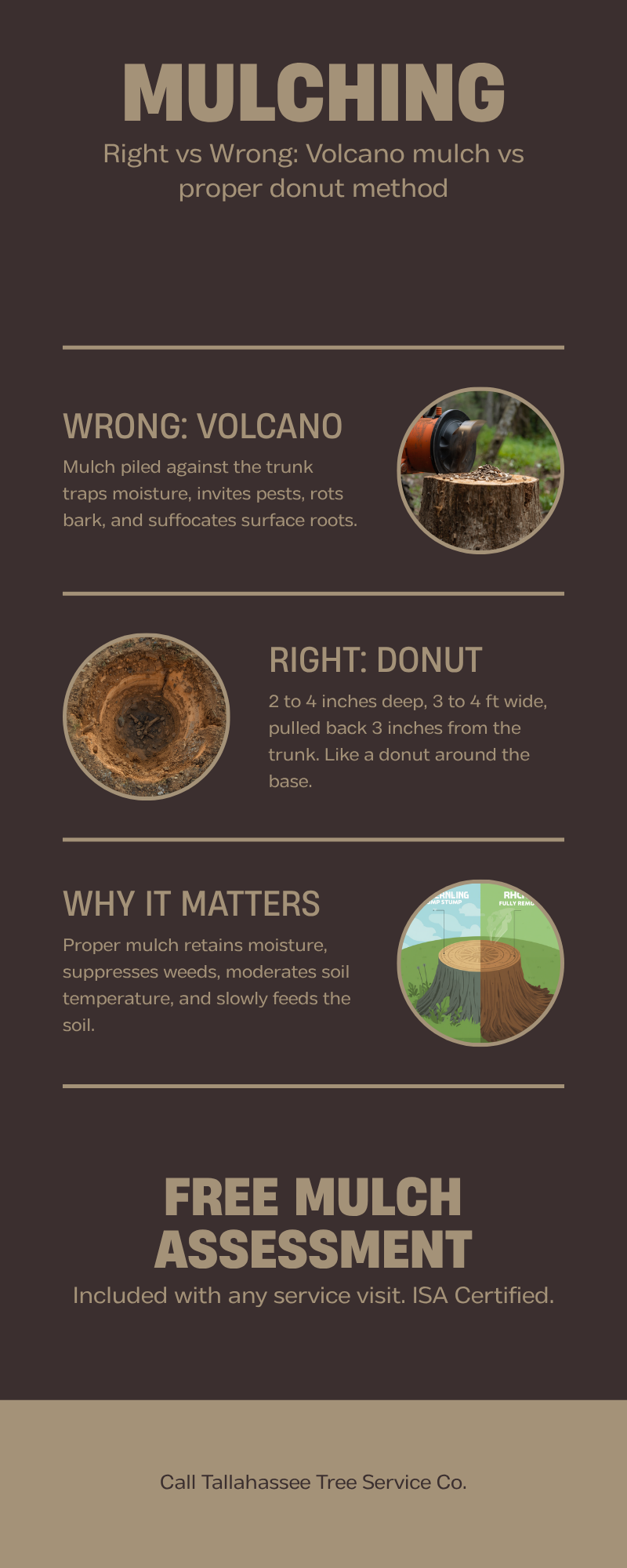
Proper mulch ring around dogwood’s sensitive shallow root system. Highest-leverage move on most established residential dogwoods. See mulching.

๐Ÿฉบ

Health Diagnosis

ISA-Certified arborist diagnoses canopy thinning, leaf yellowing, branch dieback, and other decline signs. Many dogwood “diseases” are actually environmental stress. See tree inspection.

๐Ÿชต

Dogwood Removal

When the tree is past saving, full removal. Dogwoods are small — most removals are straightforward and inexpensive compared to larger species. See tree removal.

๐ŸŒฒ

Replacement Recommendations

For sites where native dogwood has failed repeatedly, honest recommendations on replacement species: hybrid disease-resistant dogwoods, redbud, fringetree. See best trees to plant.

๐Ÿชบ

Stump Grinding

After removal, dogwood stumps are easy to grind. Most jobs combine seamlessly with replanting in the same visit. See stump grinding.

Common Dogwood Problems in Tallahassee

A handful of issues account for most dogwood tree care Tallahassee calls. Understanding what’s causing the decline points to whether the tree can be saved.

Dogwood Borer

SymptomsSawdust-like frass at base of trunk or in bark cracks, peeling bark exposing tunnels, branch dieback over 2–4 years. The single most common killer of Tallahassee dogwoods. Stress-attracted — healthy unstressed dogwoods rarely get attacked.

TreatmentPreventive: trunk bark sprays in May and August on stressed or high-value trees. Active infestations can sometimes be suppressed with systemic insecticides but advanced cases often unrecoverable. Stress reduction is the underlying long-term fix.

Dogwood Anthracnose

SymptomsTan or purple-rimmed spots on leaves in cool wet springs. Progresses to twig dieback, then branch dieback over multiple years. “Water sprouts” appear on trunk as tree tries to compensate. More severe in shaded high-humidity sites.

TreatmentPreventive fungicide sprays in spring during cool wet weather. Sanitation (rake and dispose of fallen leaves and infected twigs). Hybrid disease-resistant cultivars on new plantings. Most established cases are managed rather than cured.

Spot Anthracnose (vs. Dogwood Anthracnose)

SymptomsSmall purple-rimmed spots on flower bracts and leaves in spring. Different fungus (Elsinoe corni) than dogwood anthracnose; less serious. Mostly cosmetic damage to bracts during bloom; rarely causes branch dieback.

TreatmentUsually no treatment warranted on healthy trees. Spring fungicide sprays available for high-value specimens during bloom display, but most residential dogwoods don’t need this intervention.

Powdery Mildew

SymptomsWhite powdery coating on upper leaf surfaces in summer, especially in sites with poor air circulation. Causes premature leaf drop and reduced vigor. More common on mature trees in shaded locations.

TreatmentImprove air circulation through selective pruning. Fungicide sprays in early summer for severe cases. Resistant cultivars (Kousa, hybrids) available for replacement plantings. Most healthy dogwoods tolerate light powdery mildew without major decline.

Sun Scald & Heat Stress

SymptomsBleached or scorched leaves, especially on south and west exposures. Bark cracking on sun-facing trunk. Premature leaf drop in summer drought. Universal in Tallahassee dogwoods sited in full sun without shade trees overhead.

TreatmentMulch ring establishment, supplemental watering during drought, no chemical fix. Long-term: relocate to filtered shade if practical (only viable for younger trees), or accept reduced lifespan and plan for replacement.

Trunk Damage from Lawn Equipment

SymptomsBark damage at trunk base from string trimmers and lawnmowers. Wounds become entry points for borers and decay fungi. Compounding damage over years on unmulched trees. Common preventable killer of Tallahassee dogwoods.

TreatmentEstablish proper mulch ring 3–4 feet diameter to keep equipment away from trunk. Existing wounds rarely benefit from intervention — sealants and pruning paint don’t help. Prevent future damage with the mulch ring.

Construction Impact Decline

SymptomsDecline beginning 1–3 years after nearby construction. Dogwoods are extremely sensitive to root damage and grade changes within the dripline. Even minor changes (driveway extension, fence trenching, sod installation) can be terminal.

TreatmentOften unrecoverable if root damage was significant. Supportive care (mulching, fertilization, deep watering) extends life on marginal cases. Honest assessment before committing to multi-year recovery programs.

Iron & Manganese Chlorosis

SymptomsYellowing leaves with green veins. Common in dogwoods planted near concrete foundations, in alkaline soil pockets, or in disturbed construction soils. Stresses tree and reduces flowering.

TreatmentSoil acidifier (sulfur) applications and chelated iron foliar sprays. Long-term: improve soil pH through organic mulch and amendments. Severe cases benefit from deep root fertilization with iron-supplemented blends.

For detailed information on dogwood disease and pest management, the UF/IFAS EDIS plant database publishes peer-reviewed extension publications. The University of Tennessee Extension also maintains particularly detailed dogwood management resources given the species’ importance throughout the Southeast.

Dogwood Declining? Get a Real Diagnosis.

ISA-Certified arborist visits same-week, walks the tree, identifies what’s actually causing decline, and tells you whether the tree can be saved or whether replacement is the better call.

Right Site vs. Wrong Site for Dogwoods

Most Tallahassee dogwood failures are siting problems, not species problems. The right tree in the wrong spot will struggle no matter what care it gets.

โŒ Wrong Site

Where Dogwoods Struggle

Most Tallahassee residential settings fall into this category by default.

  • Full afternoon sun in lawn settings
  • South or west exposure with no overhead shade
  • Compacted lawn soil with turf right up to trunk
  • Near concrete foundations (alkaline soil)
  • Sites with construction history within 10 years
  • Wet poorly-drained low spots
  • Hot reflective hardscape (driveways, parking)
  • String-trimmer damage zones around trunk
โœ“ Right Site

Where Dogwoods Thrive

If you have one of these spots, dogwood will reward you for decades.

  • Filtered shade from larger overhead canopy
  • East-facing exposure (morning sun, afternoon shade)
  • Well-drained organic-rich soil
  • Existing woodland edge or naturalized bed
  • Mulched understory plantings (no competing turf)
  • Protected from prevailing winter wind
  • Adequate spacing from buildings and hardscape
  • Slope rather than flat low ground
๐Ÿ“Œ If you’ve killed two or three dogwoods in a row at the same spot, the problem is the spot, not the trees. Honest replacement species recommendations save money long-term.

When to Prune Dogwoods in Tallahassee

Dogwoods are sensitive to pruning timing — wrong-season cuts can reduce next year’s bloom or invite borer attack.

May–JunBest window. Just after bloom & spring leaf-out. Wounds heal cleanly before summer heat.
Oct–NovAcceptable for storm-damaged limbs only. Avoid heavy pruning.
AprAcceptable late month. Bloom finishing; light cleanup OK.
StormHazard limbs anytime — safety overrides season.

Healthy mature Tallahassee dogwoods need very little pruning — selective deadwood removal and minor shape adjustment is usually sufficient. Heavy pruning, topping, or aggressive shaping is harmful and rarely justified. The single best window is May–June, just after the bloom display ends but before summer heat and borer flight peaks.

How a Dogwood Care Visit Works

Whether the work is diagnosis, pruning, treatment, or removal, the on-site workflow follows a consistent structure.

On-Site Walkthrough

ISA-Certified arborist examines the tree and the site. Variety identification, age estimate, exposure analysis, soil conditions, signs of borer pressure or disease, surrounding landscape competition.

Honest Site Assessment

For declining dogwoods, the diagnosis often points back to the site rather than the tree. We’ll tell you when the location is fundamentally wrong for the species, and what alternatives might work instead.

Identify Right Intervention

Pruning, treatment, fertilization, removal, or relocation (only viable for younger trees). Sometimes the answer is just establishing a proper mulch ring — the highest-leverage low-cost intervention.

Written Quote

Itemized scope, products used (for treatments), expected outcome timeline, and price. Same-day for simpler scopes; 1–3 business days for multi-tree or complex scopes.

Schedule Within Right Window

Pruning gets scheduled in May–June where possible. Borer treatment hits May and August windows. Anthracnose spray hits cool wet spring conditions. Emergency work goes immediately regardless of season.

Execute With Species-Specific Technique

Sterilized pruning tools (dogwood spreads disease easily through unsanitized cuts), targeted bark sprays for borers, careful protection of root zones during any soil work.

Cleanup & Documentation

Brush chipped, pathways cleared, treatment record provided. Photos for the records on multi-year recovery programs. Final walkthrough with homeowner.

Follow-Up Plan

For multi-year stress recovery or borer prevention programs, next visit scheduled before crews leave. Most successful dogwood preservation in Tallahassee involves 2–3 year care commitment, not single visits.

Saving a Stressed Dogwood Starts With Diagnosis.

Site issues, borer attacks, anthracnose, or just plain age — an ISA-Certified arborist tells you what’s actually causing decline before you spend money on the wrong intervention.

Dogwood Tree Care Pricing in Tallahassee

Dogwoods are small trees, so most service pricing comes in well below larger-species equivalents. Multi-year programs are usually the realistic structure for stressed dogwoods.

ServiceTypical RangeNotes
Diagnostic visitFree with treatment / $95–$175 standaloneISA-Certified arborist walkthrough
Annual pruning (mature dogwood)$150 – $350Light deadwood + selective shaping
Anthracnose spray (per visit)$90 – $2002–3 visits in cool wet springs
Multi-year anthracnose program$250 – $600/yearSpring spray sequence + sanitation
Dogwood borer prevention (per tree)$125 – $275May + August bark sprays
Stress recovery program$350 – $900/yearMulch + fertilization + monitoring
Deep root fertilization$120 – $250Per tree, smaller dripline area
Dogwood removal (mature)$300 – $900Smaller tree; straightforward
Stump grinding (per stump)$75 – $200Often combined with replanting
๐Ÿ’ฐ Dogwood removal and replacement with a hybrid disease-resistant cultivar often costs $400–$1,200 total, which is comparable to 1–2 years of intensive care on a declining tree. For sites that have killed multiple native dogwoods, replacement is usually the better long-term economics.

Common Dogwood Care Mistakes to Avoid

A few patterns we see repeatedly that compound dogwood stress and accelerate decline.

  • Planting in full afternoon sun. The single biggest siting mistake in Tallahassee landscapes. Native flowering dogwood is an understory tree — full afternoon sun in lawn settings is functional torture for the species. Filtered shade from overhead canopy is essential.
  • Letting turfgrass grow to the trunk. Lawnmower and string-trimmer damage to bark creates entry points for borers and decay. Establish a 3–4 foot diameter mulch ring and keep it that way permanently.
  • Heavy pruning. Dogwoods don’t respond well to aggressive pruning. Topping, thinning, or shaping cuts beyond minimal selective work stress the tree and create disease entry points. Light is the right approach.
  • Pruning in dormant winter. Removes flower buds set on previous year’s wood, ruining the spring bloom display. Prune in May–June after bloom finishes if pruning at all.
  • Using unsanitized pruning tools. Anthracnose spreads easily on pruning tools that weren’t sterilized between cuts. Especially important on dogwoods given the prevalence of anthracnose in our climate.
  • Replanting in the same spot after a dogwood dies. If a dogwood died from anthracnose, borers, or site-specific stress, the replacement faces the same conditions. Either correct the site significantly or plant a different species.
  • Ignoring early borer signs. Sawdust frass and bark cracks at the trunk base in stressed dogwoods are early borer indicators. Caught at this stage, preventive bark sprays can save the tree. Caught at advanced dieback stage, the tree is usually unrecoverable.
  • Heavy nitrogen fertilization. Pushes weak rapid growth that’s pest-attractive and disease-susceptible. Dogwoods do better with balanced low-N feeding or no fertilization at all on healthy specimens.

Dogwood Tree Care Tallahassee FAQs

Why is my dogwood’s bark cracking and falling off?

Most likely dogwood borer attack — small caterpillars tunnel through the cambium layer just under the bark, causing the bark to slough off as tunnels collapse. Stressed trees in full sun are most vulnerable. Look for sawdust-like frass at the trunk base. Early-stage infestations can be treated with preventive bark sprays; advanced dieback usually means the tree is past saving. Call (850) 555-0123 for a borer assessment.

What are the brown spots on my dogwood’s leaves?

Likely dogwood anthracnose (or spot anthracnose, a less serious cousin). Appears in cool wet springs as tan or purple-rimmed spots. Dogwood anthracnose progresses to twig and branch dieback over years; spot anthracnose is mostly cosmetic. A diagnostic visit confirms which one and recommends appropriate treatment.

How long should a dogwood live in Tallahassee?

Realistically 25–40 years for most residential settings. The species has potential for 60–80 years in ideal conditions, but Tallahassee’s climate combined with typical lawn settings dramatically shortens the realistic lifespan. Trees in optimal sites (filtered shade, organic soils, mulched beds) can reach the longer range.

Can I move a stressed dogwood to a better spot?

Maybe, if it’s under 4 inches DBH and the timing is right (late winter dormancy). Larger trees rarely transplant successfully. If stress is already advanced (significant dieback, active borer attack), the energy cost of transplanting may finish what stress started. Honest assessment first.

Should I plant a Kousa dogwood instead of a flowering dogwood?

For challenging Tallahassee sites, yes. Kousa dogwoods (or hybrid Stellar/Aurora/Venus cultivars) have significant anthracnose resistance and handle heat better than native flowering dogwood. The tradeoff: bloom timing is later, bract shape is different, and they don’t support native pollinators and birds the way native dogwoods do. For ecological value, native is preferred where the site supports it.

How often should I fertilize my dogwood?

Healthy mature dogwoods rarely need fertilization. Stressed trees benefit from balanced low-N deep root fertilization in spring, paired with proper mulching. Avoid high-nitrogen lawn fertilizer near the dripline — it pushes weak growth that pests attack. Less is more on dogwood feeding.

Do I need a permit to remove a dogwood in Tallahassee?

Probably yes if the tree is over 4″ DBH on most properties. The City of Tallahassee ยง5-83 ordinance applies. Most mature dogwoods are 4–8″ DBH and fall under permit requirements. Always check before removal — see our permit guide for current requirements.

Why don’t my dogwoods bloom heavily anymore?

Several possibilities: pruning at the wrong time (winter pruning removes flower buds), anthracnose damage to flower bracts, site stress reducing flower production, or simply alternate-year bloom variation. A diagnostic visit identifies the actual cause — if it’s site stress, mulching and proper care often restore bloom over 2–3 seasons.

Can dogwoods grow in full sun anywhere in Tallahassee?

Native flowering dogwoods rarely thrive in full sun here. Heat-tolerant Kousa dogwoods and hybrid cultivars perform better in sun but still prefer some afternoon shade. If the site is full sun without options for overhead canopy, redbud or fringetree might be better species choices. See best trees to plant.

Do you serve areas outside Tallahassee city limits?

Yes — ISA-Certified dogwood tree care Tallahassee crews dispatch throughout Leon County and into Wakulla, Gadsden, and Jefferson Counties. Native dogwoods are common throughout the rural Big Bend region, particularly in shaded woodland-edge sites where the species naturally occurs. Call (850) 555-0123 for rural-property work.

Dogwoods Across Tallahassee Neighborhoods

Dogwood survival rates differ dramatically by neighborhood based on canopy cover, soil quality, and how landscapes have evolved over time.

In the older heavily-canopied neighborhoods — Myers Park & Betton Hills, Midtown, Killearn Estates, and shaded portions of Northwest Tallahassee — mature live oaks and pines provide the overhead canopy that native dogwoods need. These are the neighborhoods where dogwoods thrive long-term in Tallahassee. Most successful 30–50 year specimens are found here, growing as understory trees within established woodland-style landscapes. Dogwood tree care Tallahassee work in these neighborhoods focuses on preserving aging healthy specimens through low-intervention maintenance: mulching, occasional borer prevention, and minimal pruning.

In neighborhoods with less mature canopy — Southwood, Bradfordville, parts of Killearn Lakes, and most newer 2000s+ developments — dogwoods struggle in lawn-and-foundation-planting settings without overhead protection. Decline patterns in these neighborhoods are typically: planted in full sun in the front yard, declines visibly in 5–10 years, dies in 10–15 years. Replanting with the same species at the same spot repeats the cycle. For these settings, hybrid disease-resistant dogwoods or alternative ornamental species (redbud, fringetree, Carolina silverbell) are usually better long-term choices.

Out in the rural Big Bend — Wakulla County, Crawfordville, Monticello, Quincy — native dogwoods grow naturally along woodland edges and in natural understory locations. Properties bordering natural canopy often have healthy mature wild dogwoods that just need basic protection from deer browsing on younger trees and occasional borer prevention on stressed specimens. Rural Big Bend dogwoods typically have better long-term outcomes than residential city-lawn dogwoods because the surrounding ecosystem provides the conditions the species evolved in. Call (850) 555-0123 regardless of where your dogwood sits — we serve all of these areas.

Related Tallahassee Tree Services

Dogwood care intersects with most tree-care services. Most relevant pages below.

Care for Tallahassee’s Dogwoods the Right Way.

Dogwood tree care Tallahassee work is mostly about stress reduction: right siting, proper mulching, borer prevention on stressed trees, and honest replacement recommendations when sites can’t sustain the species. ISA-Certified arborists oversee all work, same-week scheduling, fair pricing on a small ornamental tree.

Tallahassee Canopy & Storm Context

Tallahassee's canopy-road system includes many of these trees, putting them under the City's ยง5-83 protected-tree ordinance. Hurricane Hermine (2016), Hurricane Helene (2024), and the May 2024 tornado each affected the species differently โ€” survival and decline patterns now inform how our ISA-certified crews assess and prune across Cody Scarp uplands and protected zones.

Call Now โ€“ Free Estimate