Roof Tree Removal in Tallahassee, FL
A laurel oak limb through the shingles, a loblolly leaning into the ridge line, a whole water oak laid across the back bedroom — call now and we’ll connect you with a vetted, licensed and insured local pro who rigs the tree off the roof instead of dropping it through it.
📞 Call Now — (858) 319-0022Roof already breached? Call now — life-safety and structural jobs are triaged first, any hour.There is a specific sound a Tallahassee homeowner never forgets: the crack, the half-second of silence, then the boom that shakes the ceiling. Roof strikes are the single most common structural tree emergency in Leon County, and they cluster hard — Hermine in 2016 dropped hundreds of them across Midtown and Betton Hills, Michael in 2018 shredded the pine belt, the May 10, 2024 EF-2 tornadoes cut a line of them from the west side through downtown, and Helene later that year finished off trees that had been quietly dying since.
If a tree is on your roof right now, the fastest safe move is not a chainsaw. It is getting a rigger with the right gear on the way while you get people out from under the load path. Call now and we’ll connect you with a vetted local pro. Below is exactly what to do in the meantime, what the work actually involves, and how the insurance side plays out in Florida.
The first 15 minutes — before anybody touches the tree
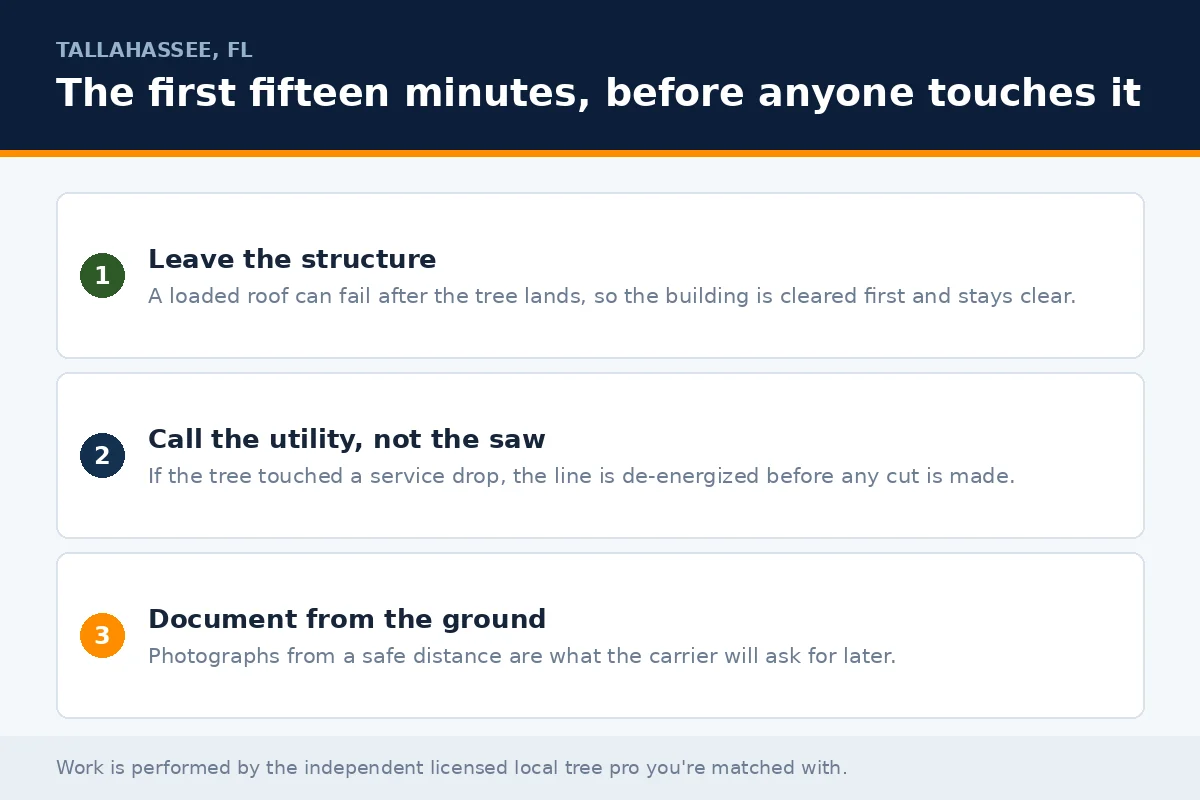
What you do in the first quarter hour decides whether this stays a repair job or turns into an injury.
- Get everyone out of the rooms under the impact. A tree that came to rest on a roof is still holding energy. Rafters that are cracked but not broken can let go hours later, usually at night when the wind picks back up.
- Assume the wires are live. If any limb is touching a service drop or a line, stay 30+ feet away and report it to the utility — City of Tallahassee Utilities or Talquin Electric, depending on your side of the county line. No tree pro will touch an energized limb, and none should.
- Smell for gas, look for water. If the strike pulled a vent stack, a gas riser, or a mast, leave the house.
- Photograph everything before anything moves. Wide shots of the tree on the structure, the base of the trunk, the interior ceiling damage, and any soaked drywall. Timestamped photos are the single most useful thing you can hand your adjuster.
- Do not tarp a roof you have to climb to reach. Wet shingles plus a shifted load is how homeowners get hurt after the storm is over. Interior containment — buckets, plastic over furniture — is the safer play until a pro is on site.
Why a tree on a roof is not a chainsaw job
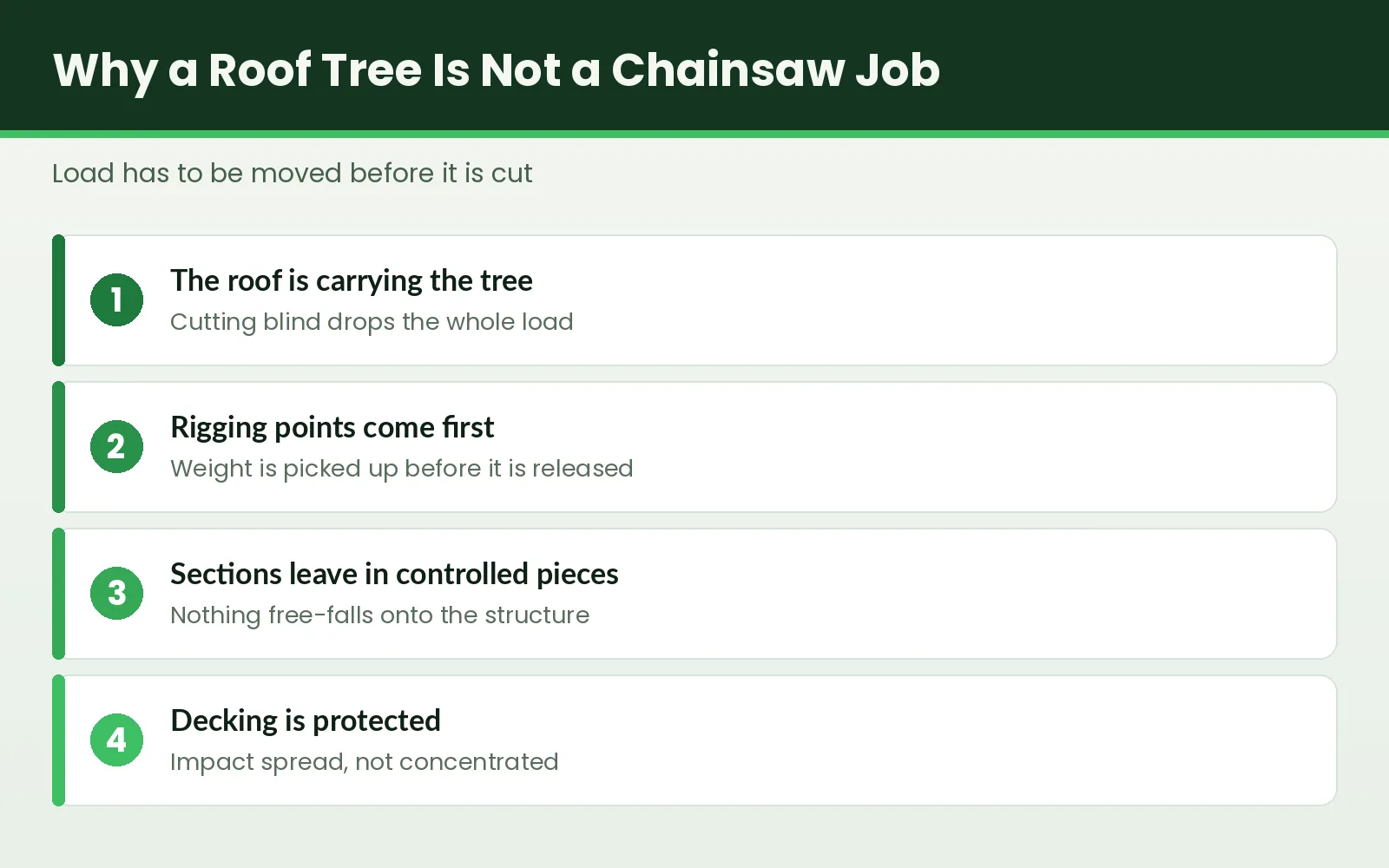
When a tree falls in an open yard it is dead weight. When it comes to rest on a house, it becomes a loaded structure: the trunk is a beam, the roof is a fulcrum, and the limbs underneath are compressed springs. Cut in the wrong order and the whole thing rolls, drops, or barber-chairs — and the second impact is usually worse than the first, because now it lands on a roof that has already lost its structure.
The pros in our dispatch network work the problem backwards. They read the load path first, decide what is holding what, then remove weight from the top down in pieces small enough that nothing shifts. On a mature live oak or a 90-foot loblolly, that means a crane or a big boom to pick sections straight up and away from the house rather than cutting them free and hoping. That equipment call is the whole ballgame — and it is the reason the neighbor with a pickup and a saw should not be the person you let up there.
What drives the scope of a roof tree removal in Tallahassee
Every roof strike is scoped to the specific tree and the specific house, so there is no honest flat figure. The pro you’re matched with walks the load, sets the rigging plan, and gives you the binding written quote. These are the factors that move it — knowing them helps you describe the job accurately:
| Factor | Why it matters on a Tallahassee roof |
|---|---|
| Species & size | A 36-inch live oak trunk on a ridge is a crane job. A laurel oak limb through a soffit may be a climb-and-rig morning. |
| How it is resting | Fully through the deck, bridged across the ridge, or hung up in a neighboring tree — each is a different rigging problem. |
| Crane access | Killearn and Bradfordville lots often have a driveway a boom can set up on. Midtown and Betton Hills bungalows on narrow lots frequently do not — that pushes the job to climbing and hand-rigging. |
| Utility involvement | If a service drop is caught in the canopy, the utility usually has to de-energize before anyone climbs. That is out of the pro’s hands. |
| Structural condition | A compromised truss changes the sequence — sometimes shoring goes in before the tree comes off. |
| Debris volume | Whole-tree removal plus haul-off is a different day than lifting one section clear so a roofer can dry-in. |
Tree through the roof, ceiling sagging, or the trunk still moving in the wind? That is a life-safety situation. Get clear of the load path, then call now — these get triaged ahead of scheduled work.
📞 Call Now — (858) 319-0022Vetted local pros — availability depends on independent provider schedules, location, and demand.*How getting matched works
Insurance: how roof-tree claims actually work in Florida
This is the part homeowners get wrong most often, and it costs them money.
The line most Florida policies draw: if a tree falls and damages a covered structure — house, garage, fence, sometimes a screened enclosure — removal of the tree from that structure is generally part of the damage claim. If the same tree falls in the middle of your yard and hits nothing, hauling it off is usually on you, often with a small allowance at best. That is why the photos matter: they establish that the tree struck the structure before anyone moved it.
Practical sequence that tends to go smoothest:
- Photograph and video before removal — exterior, interior, and the trunk base.
- Open the claim before the tree is cut up, if you safely can. Adjusters ask for the pre-removal condition.
- Keep every invoice, including tarp and containment materials.
- Ask the pro for a written scope that separates tree off the structure from yard debris and stump — carriers treat those lines differently.
- Do not let anyone pressure you into signing a broad assignment of benefits at the curb.
We do not adjust claims and we are not an insurer — but the pros we dispatch write roof-strike scopes constantly and know what documentation carriers in the Big Bend expect. For a deeper walk-through, see our guide to tree service insurance coverage in Tallahassee.
What actually lands on roofs here
Tallahassee’s roof strikes are not random. They are predictable enough that an arborist can usually tell you which tree in your yard is next.
Laurel oak is the number-one offender. It grows fast, decays from the inside on roughly a 60–80 year clock, and a whole generation of them planted in mid-century neighborhoods — Betton Hills, Lafayette Park, Indian Head Acres — is now in the failure window. A laurel oak that looks fine can be hollow at the union. See why laurel oaks are failing across Tallahassee.
Water oak is close behind, with the same short, brittle life history. Loblolly and slash pine snap rather than uproot, and a snapped pine top is a spear — it goes through a roof rather than resting on it. Live oak rarely fails whole, but when a live oak limb goes, the limb alone can weigh more than a car, which is why live oak strikes so often mean crane work rather than climbing.
North of the Cody Scarp — Killearn, Ox Bottom, Bradfordville — the red Orangeburg clay holds root plates tight, so trees tend to break rather than tip. South and west, on the sandier soils over karst, whole trees uproot and lay over. The failure mode changes the removal plan, which is why local knowledge is not a nice-to-have here.
Before you call — how to describe it
You will get a faster, tighter match if you can answer four things:
- What it hit. Roof deck, ridge, garage, carport, screen enclosure — and whether it is through the ceiling inside.
- How big. Rough trunk diameter at the cut (a dinner plate, a trash-can lid, wider than a car tire) and whether it is oak or pine.
- Wires. Anything touching a line, a mast, or a service drop. Say it first — it changes who has to show up before the tree pro can work.
- Access. Can a truck get to the back? Is there a gate, a fence, a slope, a septic drain field a crane cannot outrig on?
After the tree comes off
Getting the tree off the structure is the emergency. Two things usually follow. First, the roof needs a dry-in — tree pros clear the load; a roofer closes the hole. Second, whatever is left in the yard becomes a separate scope: storm cleanup and debris removal, and eventually stump grinding.
The smarter follow-up is the one most homeowners skip: have the arborist look at the trees that didn’t fall. A storm that takes one laurel oak has usually loosened its neighbors. A tree risk assessment after the event is the cheapest insurance you will ever buy, and pre-season prep on what remains is how you avoid a repeat next August.
Frequently asked questions
Should I try to get the tree off my roof myself?
No. A tree resting on a structure is a loaded system, not a woodpile. Cutting in the wrong order lets it roll, drop, or spring, and the second impact typically does more damage than the first — on a roof that has already lost structure. It is also how homeowners get seriously hurt. Get clear of the load path and get a rigging pro dispatched instead.
Does homeowners insurance cover removing a tree from my roof in Florida?
Generally, when a tree damages a covered structure, removing it from that structure is treated as part of the damage claim, while a tree that falls and hits nothing is usually the homeowner’s cost. Coverage depends entirely on your policy and carrier, so photograph everything before the tree is moved and open the claim early. We are not an insurer and do not adjust claims.
How fast can someone get here?
Roof strikes and life-safety situations are triaged ahead of scheduled work, and dispatch runs around the clock — but arrival depends on the independent provider’s schedule, your location, and how many homes were hit in the same storm. Nobody who is honest with you will promise a time window during a Big Bend storm event.
Do you need a crane for a tree on a roof?
Sometimes. A crane lifts sections straight up and away instead of cutting them loose over the house, which is the safest approach on large live oaks and tall pines — but only if there is a setup pad and a clear swing path. On tight Midtown lots the pro often has to climb and hand-rig instead. The pro decides after seeing the access.
Do I need a permit to remove a tree that fell on my house?
Hazard situations are handled differently from planned removals. Florida Statute 163.045 lets a homeowner remove a tree that documented arborist evidence shows poses an unacceptable risk, and City of Tallahassee rules under §5-83 have provisions for hazards — but Canopy Road zones and protected trees still have paperwork attached. The pro flags it when it applies. See the Tallahassee tree permit guide.
What if the tree is hung up on power lines?
Stay at least 30 feet back, keep everyone inside away from anything metal touching the structure, and report it to your utility — City of Tallahassee Utilities or Talquin, depending on your service area. No tree professional will cut an energized limb. The utility has to de-energize or clear the line before removal begins.
Related Tallahassee tree services
Emergency Tree Service
Storm Damage Tree Removal
Fallen Tree Removal
24-Hour Tree Service
Crane Tree Removal
Hazardous Tree Removal
Storm Cleanup
Tree Removal
Get the tree off your roof safely
Call now and we’ll connect you with a vetted, licensed and insured Tallahassee-area pro. Free to use, no obligation, no sign-up.
📞 Call Now — (858) 319-0022Tallahassee Tree Service is a free referral service. Tallahassee Tree Service is not a licensed tree service provider and does not directly provide tree care services. All work is performed by independent, licensed and insured third-party providers in your area. Calls and form submissions placed through this site may be connected with a participating provider, and you may be contacted by that provider regarding your request. Same-day, emergency, and 24/7 availability are not guaranteed and depend on provider schedules, location, and demand. Service availability, pricing, licensing, and final response times are determined solely by the providers. It is the responsibility of the homeowner to verify that the hired contractor furnishes the necessary license and insurance required for the work being performed. All persons depicted in a photo or video are actors or models and not contractors listed on Tallahassee Tree Service.