Tree Cabling & Bracing in Tallahassee, FL
ISA-certified structural support for codominant stems, split trunks, overextended branches, and storm-damaged trees — installed to ANSI A300 Part 3, with lightning protection systems available for heritage oaks. Call now and we’ll connect you with a vetted, ISA-certified local arborist who can tell you honestly whether cabling is the right tool or removal is the safer call.
📞 Call Now — (858) 319-0022Prefer to talk it through first? Call now and we’ll connect you any hour.What tree cabling & bracing actually does — and why Tallahassee trees need it
Most homeowners first hear about cabling after a storm nearly takes out a tree, or after an arborist flags a structural problem during an inspection. Tree cabling is a supplemental structural support system installed by ISA-certified arborists to reduce the risk of branch or stem failure in trees with specific structural defects. Cabling doesn’t cure disease or reverse decay — but for the right defect in the right tree, it can safely extend a structurally valuable tree’s life by decades.
Tallahassee’s urban canopy is dominated by live oaks (Quercus virginiana, the city’s official shade tree) and laurel oaks (Quercus laurifolia) — two species exceptionally prone to developing codominant stems with included bark, the most common defect requiring cabling in this region. Add hurricane-season wind loading, the documented 80–100 lightning strikes per square mile annually, and the sheer size mature oaks reach here, and structural support becomes one of the most cost-effective tree preservation investments available to local homeowners.
Types of tree structural support systems
A properly designed system typically combines more than one element. The arborist you’re matched with selects the combination based on defect type, tree age, species, and target zone.
Static steel cabling
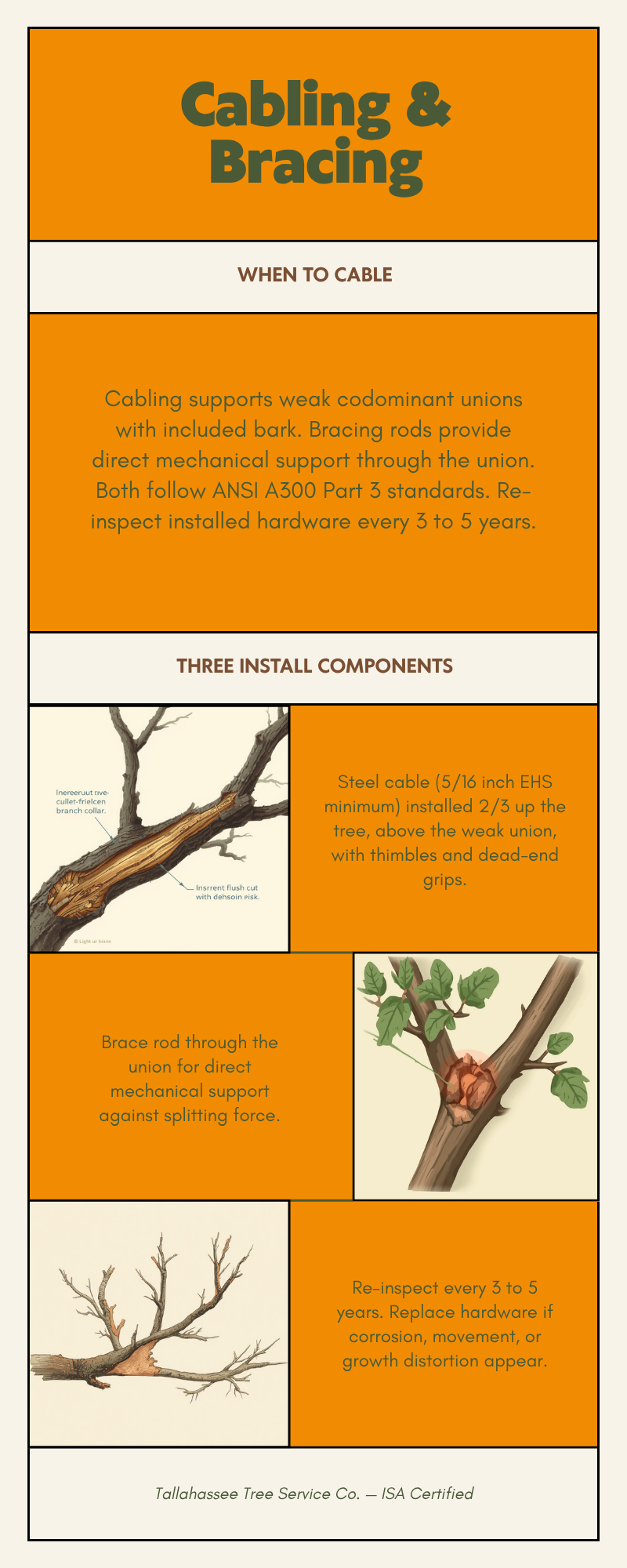
High-strength steel cables installed in the upper crown between major stems or branches to limit movement and prevent separation. The traditional method — effective, durable, and appropriate for mature trees where restricting movement is the primary goal. Installed at two-thirds of the distance from the defect to the branch tip per ANSI A300 Part 3. Periodic hardware inspection required. Best for: mature trees, severe codominant stems.
Dynamic cabling (Cobra / Dynalink)
Synthetic fiber rope systems that allow controlled natural movement while preventing failure at the defect point. Dynamic systems preserve the natural sway that stimulates trunk taper development — important for trees with remaining structural growth potential. Lower hardware-induced trauma and generally preferred for younger or more vigorous oaks. Best for: younger trees, proactive installation.
Brace rods
Threaded steel rods through-bolted through a split crotch or codominant union to physically prevent the stems from spreading apart. Used when cables alone can’t prevent a specific failure mode — particularly when the split is already initiated. Brace rods are almost always installed with at least one cable above the failure point for complete protection. Best for: existing splits, crotch repairs.
Lightning protection systems
Copper conductor systems installed from the crown to a buried ground rod, giving lightning current a low-resistance path into the ground instead of traveling explosively through the wood. ANSI A300 Part 4 governs installation. For mature oaks near structures in one of the most lightning-prone regions in the country, LPS is among the highest-value tree investments available. Best for: heritage oaks near structures.
Propping & guying
Ground-level props or anchored guy wires supporting leaning trunks or large overextended lateral branches that can’t be addressed from above. Less common than cabling but right for specific geometries — particularly long horizontal branches on mature live oaks extending over driveways or rooflines. Guy wires must be adjusted regularly to prevent girdling. Best for: leaning trunks, extreme lateral extension.
Periodic inspection & re-tensioning
All cable and brace-rod systems need inspection — typically annually or biennially — for hardware wear, cable fraying, anchor movement, and changes in the defect. As the tree grows, cables may need re-tensioning or repositioning. Neglected systems can become hazards themselves if hardware corrodes or the tree grows around anchor bolts.
Worried about a split or leaning tree near your house? Don’t wait for the next storm. The arborists we dispatch can assess whether cabling is the right tool — or whether removal is the safer call.
📞 Call Now — (858) 319-0022Vetted local pros — availability depends on independent provider schedules and demand.*Why Tallahassee’s dominant species are prone to structural defects
National cabling guides don’t account for Tallahassee’s specific canopy composition. These are the trees local arborists encounter most — and the failure modes each one develops.
Live oak — the most common cabling candidate
Quercus virginiana — Tallahassee’s official shade tree. Mature live oaks here commonly develop multiple codominant stems with included bark at 30–50 years old. The competing stems grow outward in opposite directions, putting the narrow included-bark union under increasing bending stress with every storm. A well-placed cable reduces the bending moment at the union and can safely maintain a structurally sound live oak for another 20–40 years. Given that a large live oak can represent five figures of appraised property and shade value, cabling is among the best ROI moves in arboriculture. The Lichgate Oak on High Road — a 300+ year heritage live oak — is a prominent example of the tree type that benefits most from preventive support.
Laurel oak — fast growth, early structural compromise
Quercus laurifolia — dominant in Killearn Estates, Betton Hills, Myers Park. Laurel oaks grow faster than live oaks with a more upright form — but that growth pattern produces narrow, acute branch attachments that are inherently weaker than spreading live-oak architecture. Laurel oaks run a 40–60 year lifespan and frequently hide internal decay that isn’t visible from the ground. The “Killearn wave” of laurel oaks planted from the mid-1960s through the 1980s is now in its end-of-lifespan failure window. Cabling suits laurel oaks in the first half of their lifespan; for mature specimens, an honest assessment often recommends planned removal instead — see laurel oak decline.
Water oak — wind failure, not structural defect
Quercus nigra — the most commonly fallen tree after Tallahassee storms. Water oaks don’t typically fail from crown defects — they fail at the root system. Sandy flatwoods soils east of the Cody Scarp (SouthWood, Buck Lake, Bradfordville) plus the water oak’s shallow root plate make it the most wind-susceptible major species in the area. Cabling is generally the wrong intervention for water-oak wind risk; crown and load reduction is usually the better tool. An arborist assessment distinguishes crown structural issues (potentially cableable) from root-plate stability issues (not addressable by cabling).
Slash & longleaf pine — lightning protection priority
Pinus elliottii / Pinus palustris — common in SouthWood, Killearn Lakes. Pines don’t develop the codominant issues that plague oaks, but their height (commonly 60–80 feet in residential areas) and single-crown architecture make them primary lightning targets. Structural cabling is rarely needed, but lightning protection is high-value for tall pines within about 10 feet of a structure — a strike traveling through the wood can shatter the trunk and throw debris across a wide radius.
Cable or remove? The honest decision framework
Cabling is the right answer for some trees and completely wrong for others. This is the same framework ISA-certified arborists use on-site:
| Tree condition | Cabling appropriate? | Reasoning |
|---|---|---|
| Codominant stems with included bark — no decay | Cable — good candidate | Wood structure is sound; the defect is purely architectural. Cabling reduces bending stress at the union. Excellent long-term outcome when installed early. |
| Codominant stems — significant decay at the union | Remove — cabling insufficient | Decayed wood can’t hold hardware anchor points reliably. Cabling a decayed union creates a false sense of security. Removal is the correct risk-management call. |
| Overextended lateral branch on mature live oak | Cable — good candidate | A cable supports the branch weight and reduces movement loading without removing the branch. Often paired with end-weight reduction pruning. |
| Existing crack in the crotch (initiated split) | Brace + cable — case-by-case | A brace rod through the split plus a cable above can stabilize it IF wood quality at the brace point is sufficient. Hands-on evaluation required — photo-only assessment isn’t appropriate. |
| Leaning after storm — root plate partially lifted | Remove — structural instability | Root-plate compromise can’t be corrected by above-ground cabling. The tree’s anchorage is damaged. Remove promptly — see the leaning tree guide. |
| Dead or severely declining tree | Remove — not applicable | Cabling preserves living trees with mechanical defects. Dead wood can’t be preserved — see dead tree removal. |
| Young live oak developing twin leaders | Cable proactively — best outcome | Dynamic cabling early in codominant development produces the best long-term results. Combined with structural pruning, early intervention is cheaper and more effective than waiting. |
| Any tree rated “extreme” risk (ISA TRAQ) | Remove — regardless | An extreme rating means probability and consequence of failure are both unacceptably high. Cabling should never justify keeping an extreme-risk tree over occupied space. |
Tree lightning protection in Tallahassee
Tallahassee averages 80–100 lightning strikes per square mile per year — Gulf moisture convergence makes the Big Bend among the most electrically active regions in the country. A strike to a large unprotected oak doesn’t just damage the tree: explosive steam expansion inside the wood can blow bark off in a 20-foot radius, throw shrapnel across the yard, and send ground current through wet soil toward nearby structures. Trees within 10 feet of a house carry the highest risk.
How an LPS works (ANSI A300 Part 4)
- An air terminal (copper tip) is installed at the highest point of the crown.
- A copper conductor cable runs from the terminal down through the crown and trunk.
- The cable connects to a buried copper ground rod driven 8–10 feet into the soil.
- Lightning current travels the low-resistance copper path to ground — bypassing explosive travel through the wood.
- The system is inspected periodically; ground rods are checked for soil contact.
Best candidates in Tallahassee
- Heritage live oaks within 10–15 feet of the house.
- Tall slash or longleaf pines adjacent to occupied structures.
- Any isolated large tree in an open yard.
- Trees over swimming pools or outdoor entertaining areas.
- Canopy Road heritage trees that can’t be removed even when they carry lightning risk.
What cabling & bracing runs in the Tallahassee market
Accurate pricing always requires an on-site assessment — these are typical local-market scope patterns, not our prices. The licensed arborist you’re matched with gives the binding written quote after seeing the tree:
| Scenario | What moves the number |
|---|---|
| Single cable — medium tree | One cable on a laurel oak or mid-size live oak codominant stem; height and access drive it. |
| Single cable — large oak | Mature live oak requiring aerial access; higher installation complexity. |
| Multi-cable system | Two to four cables on complex crown architecture; common for large heritage live oaks. |
| Brace rod installation | Through or dead-end rod for a split crotch; usually combined with a cable above. |
| Lightning protection system | Copper conductor plus ground rod; scope scales with tree height and conductor length. |
| Periodic inspection visit | Hardware inspection, tension check, condition assessment — scales with system size and access. |
How installation works — assessment to final inspection
A properly installed system is a multi-stage process governed by ANSI A300 Part 3:
1. ISA-certified arborist assessment
The arborist performs a visual inspection — defect type, wood condition at the failure point, root zone stability, overall health. For codominant stems, they assess the attachment angle and included bark. For trees near structures, they evaluate the consequence of failure (target zone). This assessment determines whether cabling is the right tool or removal is the honest recommendation.
2. System design & hardware selection
The arborist designs the cable layout — anchor points, static steel vs. dynamic synthetic, hardware specs per A300 Part 3. Systems combining cables and brace rods are engineered as a unit. Hardware is sized to tree dimensions and expected load — undersized hardware is a common failure point in DIY or non-standard installations.
3. Aerial installation by a certified climber
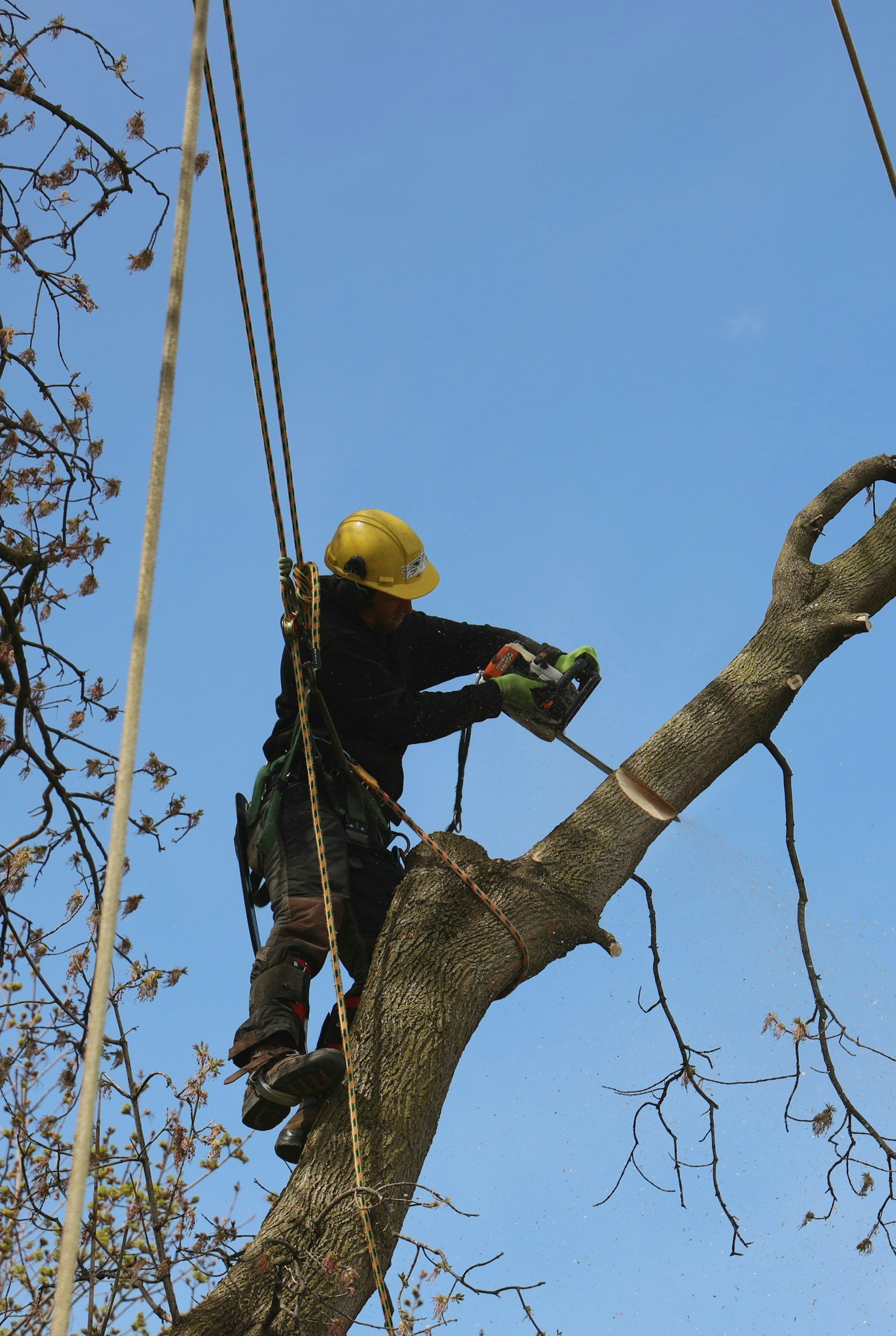
A certified climber works in the upper crown. Cables anchor at the ANSI-specified position — two-thirds of the distance from the defect to the branch tip. Brace rods are drilled and installed through the union. All hardware penetrations are sealed against moisture. Installation typically takes two to six hours depending on complexity.
4. Documentation & maintenance schedule
You receive documentation of what was installed, hardware specifications, and the recommended inspection interval — typically annual, more often for trees in high-consequence zones. Neglected systems can become hazards as the tree grows around hardware.
How getting matched works
Frequently asked questions
What is included bark and why does it matter for my live oak?
Included bark forms when two codominant stems press against each other as they grow, trapping bark between them at the attachment point. Instead of a solid wood-to-wood union, the stems are held together by compressed bark — which has no tensile strength and deteriorates with age. The result is a structurally weak attachment that looks solid from the outside but is fundamentally compromised. Tallahassee’s mature live oaks develop codominant stems with included bark more commonly than almost any other species in the Southeast.
Can I install tree cables myself?
Not safely or effectively. ANSI A300 Part 3 specifies exact placement positions, hardware specs, anchor requirements, and load calculations that demand both arboricultural knowledge and aerial access. DIY cabling with wrong hardware or placement creates a false sense of security — you believe the tree is protected when it isn’t — and badly installed anchor bolts can accelerate decay at the penetration site. This is an ISA-certified arborist service, not a hardware-store project.
Do I need a permit to cable a tree in Tallahassee?
No. City of Tallahassee LDC §5-83 governs removal and significant pruning of protected trees, not structural support installation. Cabling removes no biomass, so no permit is required from City Growth Management (850) 891-6586 or Leon County Development Services (850) 606-1300. On a Canopy Road tree (within the 100-ft buffer of Miccosukee, Old Bainbridge, Centerville, Old St. Augustine, Meridian, Pisgah Church, Sunny Hill, Old Magnolia, or Moccasin Gap), a courtesy notification to City Urban Forestry (850) 891-6500 is recommended. See the permit guide.
Does homeowner’s insurance cover tree cabling in Florida?
Standard Florida policies don’t cover preventive cabling — it’s maintenance, not a covered peril. But the documentation matters in the opposite direction: proof that you took reasonable action to mitigate a known hazard supports your legal position if a tree later causes third-party damage despite your efforts. FS §163.045 provides a hazard-tree exemption for protected trees, and it leans on the same kind of professional TRAQ documentation that supports cabling decisions.
How long does cabling last in Tallahassee’s climate?
Galvanized steel hardware in our humid subtropical climate should be inspected regularly for corrosion — particularly J-bolts, nuts, and thimbles. Well-installed systems typically run 10–15 years before hardware replacement. Dynamic synthetic systems (Cobra, Dynalink) resist corrosion better and may last longer. The tree keeps growing around the hardware, which is why inspections are essential — to prevent girdling at anchor points and re-tension as crown geometry changes.
Can cabling prevent hurricane failure?
Cabling reduces the probability of failure at a specific structural defect under wind loading — it does not make a tree hurricane-proof. It addresses crown architecture, not root-plate stability, soil saturation, or whole-tree windthrow. The best hurricane risk reduction is a TRAQ assessment before season (June 1–November 30) that combines cabling at weak points with strategic crown reduction — see hurricane tree prep.
Related Tallahassee tree services
Arborist Assessment
Tree Risk Assessment
Tree Inspection
Tree Trimming
Tree Pruning
Hurricane Tree Prep
Tree Removal
Emergency Tree Service
Storm-Damaged Trees
Leaning Tree Guide
Coverage across Tallahassee & Leon County: Midtown, Myers Park, Betton Hills, Killearn Estates, Killearn Lakes, SouthWood, Buck Lake, Bradfordville, Lake Jackson, Lafayette Park, Indian Head Acres, Centerville, Woodville, and Crawfordville.
Think your tree can be saved? Find out.
Call now and we’ll connect you with a vetted, ISA-certified Tallahassee arborist to evaluate cabling, bracing, or lightning protection. Free to use, no obligation, no sign-up.
📞 Call Now — (858) 319-0022Tallahassee Tree Service Co. is a free dispatch and referral service. We are not a tree-service contractor and do not perform tree work ourselves. When you call, we connect you with an independent, licensed and insured local tree-care professional who carries their own license and insurance and provides any binding quote. Price information anywhere on this site is typical local-market information for planning only; people or scenes in images are illustrative.
References to “24/7,” “same-day,” or “emergency” describe call-handling and dispatch availability. Actual on-site response times depend on the independent professional’s schedule, crew availability, and weather, and are not guaranteed.