Brush Removal in Tallahassee, FL
Fence lines swallowed by privet and greenbrier, a back half-acre gone feral, storm brush stacked at the curb the city won’t take — call now and we’ll connect you with a vetted, licensed and insured local pro with a chipper, a mulcher, or a truck, depending on what your lot actually needs.
📞 Call Now — (858) 319-0022Not sure whether it’s a chipper job or a mulcher job? Call now and we’ll connect you any hour.Brush in North Florida does not wait for you. Between the rain, the heat, and a growing season that runs most of the year, a fence line you cleared in March is a wall of greenbrier and Chinese privet by August. Add a storm season that snaps limbs by the truckload — Idalia in 2023, Helene in 2024, the May 2024 tornado line — and most Tallahassee properties end up with a brush problem that has quietly gotten out of hand.
Brush removal is not one job. It is at least four different jobs with four different machines, and matching the machine to the mess is the whole difference between a fair scope and a wasted day. Below is how to tell which one you have, what the local rules say about burning and curbside piles, and how to describe your lot so the pro you’re matched with can scope it accurately.
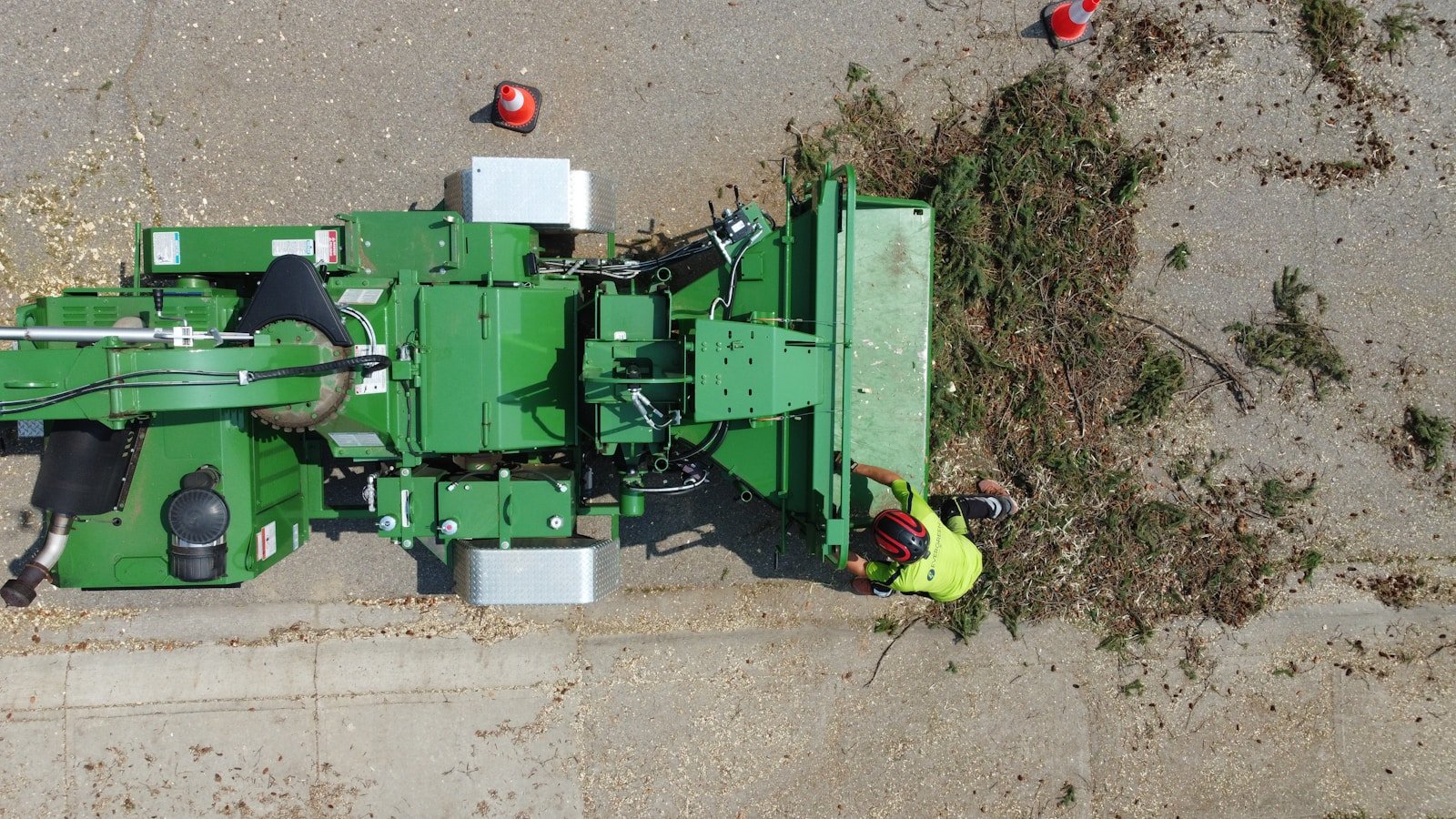
The four kinds of brush job in Leon County
Describe the right one and you get the right rig on the first visit.
1. Storm brush — limbs and debris from a specific event
Snapped laurel oak limbs, pine tops, a hedge crushed by a fallen branch. This is a chip-and-haul job. It is finite: there is a pile, and when the pile is gone, you are done. Related: storm cleanup and tree debris removal.
2. Overgrowth — the fence line, the ditch bank, the side yard
Woody understory that has been building for two to five years: privet, ligustrum, Chinese tallow, elaeagnus, wax myrtle, cherry laurel, and the greenbrier that ties it all together into something you cannot walk through. Hand crews with saws and a chipper handle this. It is slow, physical work, and the volume is usually double what the homeowner estimated.
3. Feral acreage — a half-acre or more gone to scrub
Once brush is thicker than a person can wade through and the stems are wrist-thick, hand clearing stops making sense. This is forestry-mulching territory: a track machine grinds standing brush and small trees into a mulch layer left in place. No burn pile, no haul-off, no ruts if it is done in dry conditions. Related: brush removal’s bigger siblings, land clearing and lot clearing.
4. Selective clearing — keep the good trees, take the junk
The most common request on wooded lots north of the Cody Scarp: keep the live oaks and the healthy longleaf, remove the tallow, the privet, the crowded slash pine, and the dead stuff. This is the job where hiring an actual arborist rather than a bushhog matters, because whoever is running the machine has to know which stems are worth saving.
What drives the scope of a brush removal job
There is no flat rate for brush — the same quarter-acre can be a morning or three days depending on what is in it. The pro you’re matched with walks the property and gives the binding written quote. These are the factors that actually move the number:
| Factor | Why it matters in Tallahassee |
|---|---|
| Stem diameter | Anything under about 2 inches is brush. Once stems hit 4–6 inches you are really doing small-tree removal, and the machine changes. |
| Density & vines | Greenbrier, kudzu, and muscadine tie the whole understory together. Vine-locked brush takes far longer to cut and drag than the same volume standing loose. |
| Disposal method | Mulched in place (cheapest, leaves a mulch mat), chipped on site, or hauled to a facility. Haul-off means truck trips and tipping fees. |
| Access | A chipper needs to get within dragging distance. A gate narrower than 60 inches or a fenced backyard with no side path means everything gets carried by hand. |
| Ground & slope | Wet bottomland near Lake Jackson or the St. Marks drainage can bog a track machine. Steep ravine lots off Meridian limit what can safely work the slope. |
| Terrain hazards | Septic drain fields, irrigation lines, wellheads, and buried invisible fence all restrict where heavy equipment can travel. |
Brush piled against the house, blocking an exit, or hiding a downed line? Treat that as a hazard, not a chore. Get people clear, then call now — hazard jobs are triaged first.
📞 Call Now — (858) 319-0022Vetted local pros — availability depends on independent provider schedules and demand.*How getting matched works
Burning, hauling, and the curb: the local rules
This is where Tallahassee homeowners most often get themselves in trouble.
Open burning. You cannot simply light a brush pile in Leon County because it is your land. Yard-waste burning generally requires authorization from the Florida Forest Service, and the rules tighten fast during drought and burn bans. Inside city limits the restrictions are stricter still. A pile smoldering into a neighbor’s yard on a dry March afternoon is how a brush chore becomes a wildfire report. If a contractor tells you they will “just burn it,” ask to see the authorization.
Curbside yard waste. The city and county do collect yard debris, but there are limits on length, diameter, and volume, and they are not designed to absorb a whole lot’s worth of clearing. Piles that exceed the limits sit there. After a declared storm event the rules loosen temporarily for storm debris, with separate collection passes — but everyday clearing debris does not qualify, and stacking it as if it does just means it stays at your curb for months.
Chipping and mulching on site sidesteps both problems entirely, which is why it is the default for most Tallahassee brush work. The mulch layer suppresses the invasives trying to come back and feeds the soil. Just keep it off the trunks — see our mulching guidance on why volcano mulching kills trees.
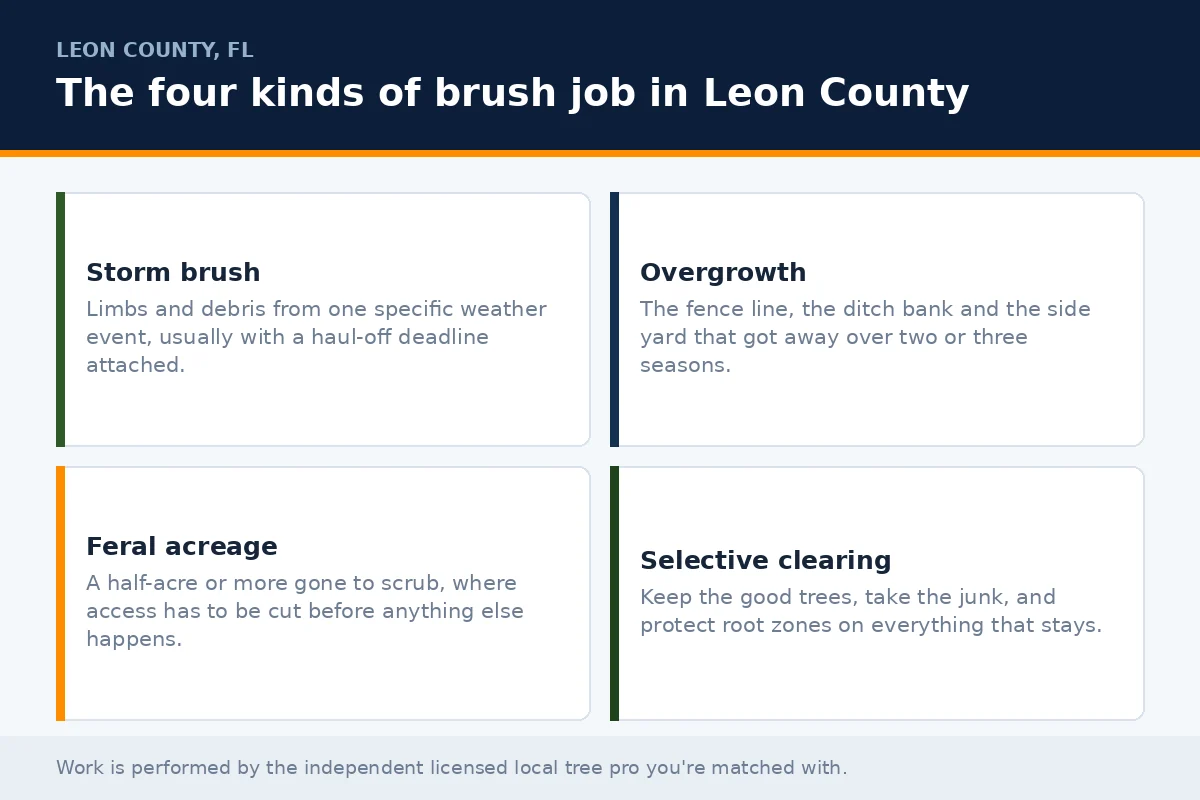
The invasives you are actually fighting
Knowing the plant tells you whether cutting it will fix anything.
- Chinese privet & ligustrum — the default understory weed of Tallahassee’s older neighborhoods. Cut it and it stump-sprouts into a denser thicket. Real control means cutting and treating the stump, or grinding the root mass.
- Chinese tallow (popcorn tree) — grows fast, seeds everywhere, and takes over disturbed ground and pond edges. Same story: cut alone is not control.
- Coral ardisia — the red-berried shade plant creeping through ravine slopes and yards near Miccosukee and the Cody Scarp. Pull it before it fruits or you are re-clearing forever.
- Kudzu & greenbrier — vines that turn brush into a solid mass. Greenbrier’s tubers laugh at a mower.
- Cherry laurel & camphor — volunteer trees that seed into every fence line and become removal jobs if ignored a few years.
If a pro tells you that clearing alone will not hold and the stumps need treatment, that is not an upsell — that is the biology of privet.
Timing: when to clear in North Florida
Late fall through early spring is the sweet spot. The vegetation is down, visibility is good, the ground is firmer, and — not a small thing — the snakes, ticks, chiggers, and yellowjackets that make a July brush job miserable are dormant. Clearing in the dead of summer is legal and doable, just slower and hotter, and hidden ground-nest wasps genuinely stop a crew mid-morning.
The one exception is storm brush: that gets cleared whenever it happens, because a pile of dry limbs against your siding through a Big Bend summer is a fire and pest problem, not a landscaping one.
Before you call — how to describe it
- Area. Rough dimensions or a fraction of the lot. “A 20-foot strip along 150 feet of fence” is worth ten photos.
- Thickness. Can you walk through it? Can you see through it? Are the stems finger-thick, wrist-thick, or arm-thick?
- What must survive. Flag the trees you want kept — that changes the machine choice completely.
- Disposal. Are you fine with mulch left in place, or does everything need to leave the property?
- Access. Gate width, slopes, septic, wells, sprinkler heads, and whether a truck and trailer can turn around.
Frequently asked questions
How much does brush removal cost in Tallahassee?
It is scoped to the lot, not sold by the yard — density, stem size, vines, access, and disposal method all move it, so no honest flat figure exists. The local pro you’re matched with walks the area and gives a written quote before any work starts. For the wider picture see our tree service cost guide.
Can I just burn my brush pile in Leon County?
Not automatically. Yard-waste burning generally needs authorization from the Florida Forest Service, restrictions tighten during drought and burn bans, and city limits are stricter still. Chipping or mulching on site avoids the permit question entirely and is usually faster than waiting on a burn window.
What is forestry mulching and do I need it?
A track machine grinds standing brush and small trees into a mulch layer left on the ground — no burn pile, no haul-off. It makes sense once the area is too thick or too large for a hand crew, roughly a quarter-acre and up of dense scrub. For a fence line or a storm pile, a chipper is the right tool.
Will the brush grow back?
If it is privet, tallow, or greenbrier and only the tops were cut, yes — fast. Those species stump-sprout aggressively. Lasting control means grinding the root mass or treating cut stumps, and keeping a mulch layer down. Ask the pro to tell you plainly which of your species will resprout.
Do you take away the debris?
The independent pro you’re matched with will scope disposal explicitly — mulched in place, chipped on site, or hauled off. Haul-off costs more because of truck trips and facility fees. Make sure the written quote says which one you are getting, because “clearing” alone does not always include removal.
When is the best time of year to clear brush here?
Late fall through early spring. Vegetation is down, the ground is firmer, visibility through the understory is far better, and the snakes, ticks, and ground-nesting wasps that slow a summer job are dormant. Storm brush, of course, gets handled whenever the storm happens.
Related Tallahassee tree services
Land Clearing
Lot Clearing
Tree Debris Removal
Storm Cleanup
Mulching Service
Stump Grinding
Tree Cutting
Tree Removal
Get your lot back
Call now and we’ll connect you with a vetted, licensed and insured Tallahassee-area brush removal pro. Free to use, no obligation, no sign-up.
📞 Call Now — (858) 319-0022Tallahassee Tree Service is a free referral service. Tallahassee Tree Service is not a licensed tree service provider and does not directly provide tree care services. All work is performed by independent, licensed and insured third-party providers in your area. Calls and form submissions placed through this site may be connected with a participating provider, and you may be contacted by that provider regarding your request. Same-day, emergency, and 24/7 availability are not guaranteed and depend on provider schedules, location, and demand. Service availability, pricing, licensing, and final response times are determined solely by the providers. It is the responsibility of the homeowner to verify that the hired contractor furnishes the necessary license and insurance required for the work being performed. All persons depicted in a photo or video are actors or models and not contractors listed on Tallahassee Tree Service.