Tree Removal Cost in Tallahassee, FL
Wondering what it’ll actually run to take down that oak? Here’s the straight local answer — typical 2026 Tallahassee ranges by tree size, access, and permits. When you’re ready for a real number, call now and we’ll connect you with a vetted, licensed and insured local pro whose written quote is the one that counts.
📞 Call Now — (858) 319-0022Prefer to talk it through first? Call now and we’ll connect you any hour.If you’re searching for tree removal costs in Tallahassee, you already know the national estimates you find online are essentially useless — they’re too generic to mean anything. They don’t account for Tallahassee’s specific conditions: red Orangeburg clay that makes stump grinding slower and harder, nine Canopy Roads that add a whole permit layer, massive live oaks that define this city’s character, or the tight-access Midtown lots where no machine can enter and a climbing crew does everything by rope and rigging. The ranges in this guide reflect typical Tallahassee-area market patterns from 2025–2026 jobs.
One thing before the numbers, so we’re straight with you: Tallahassee Tree Service Co. is a free dispatch and referral service, not a tree company — these are not our prices. Nobody can honestly quote your tree from a table, either. Treat the figures below as local-market planning information; the licensed, insured pro you’re matched with walks the property and gives the binding written quote.
Typical 2026 tree removal ranges on the Tallahassee market
The ranges below reflect what homeowners in the Tallahassee area typically pay for removal on the open market. These are complete job costs including stump grinding unless noted. Permit fees are separate.
| Job | Relative Cost Level | What’s behind it |
|---|---|---|
| Small tree — under 25 ft, trunk under 10″ DBH | Lowest | Young water oak, crepe myrtle, small pine. Open-yard access. Includes stump grinding. |
| Medium tree — 25–50 ft, trunk 10″–20″ DBH | Moderate | Mid-size laurel oak, sweetgum, slash pine. Varies with access and proximity to structures. |
| Large tree — 50–80 ft, trunk 20″–36″ DBH | High | Mature live oak, large water oak, old-growth slash pine. City permit required at 36″+. |
| Very large tree — 80+ ft, trunk over 36″ DBH | Highest | Patriarch-scale live oaks and big pines. Permit required; rises sharply with access constraints and rigging. |
| Tight-access premium (Midtown, older neighborhoods) | +20%–60% | No machine access — climbing crew, rigging, manual debris carry-out, added to the base range. |
| Stump grinding only (after a separate removal) | Low (priced per stump) | Red Orangeburg clay adds real time vs. sandy soils; depends on diameter and root density. |
| City of Tallahassee removal permit | Set by the FY2026 Growth Management fee schedule | Required over 36″ DBH in city limits or in any Canopy Road 100-ft buffer. Verify the current fee at (850) 891-6586. |
| ISA arborist assessment (permit documentation) | Low | Written assessment for patriarch-tree permits and Fla. Stat. §163.045 hazard documentation. |
Why these ranges are wide: tree removal in Tallahassee is priced by actual job conditions, not a formula. The same species and size of tree typically runs 60–80% more when it’s over a structure with no machine access vs. standing in an open yard. Any number given over the phone or from a photo, without an on-site visit, is a placeholder — not a real quote.
What drives tree removal cost in Tallahassee
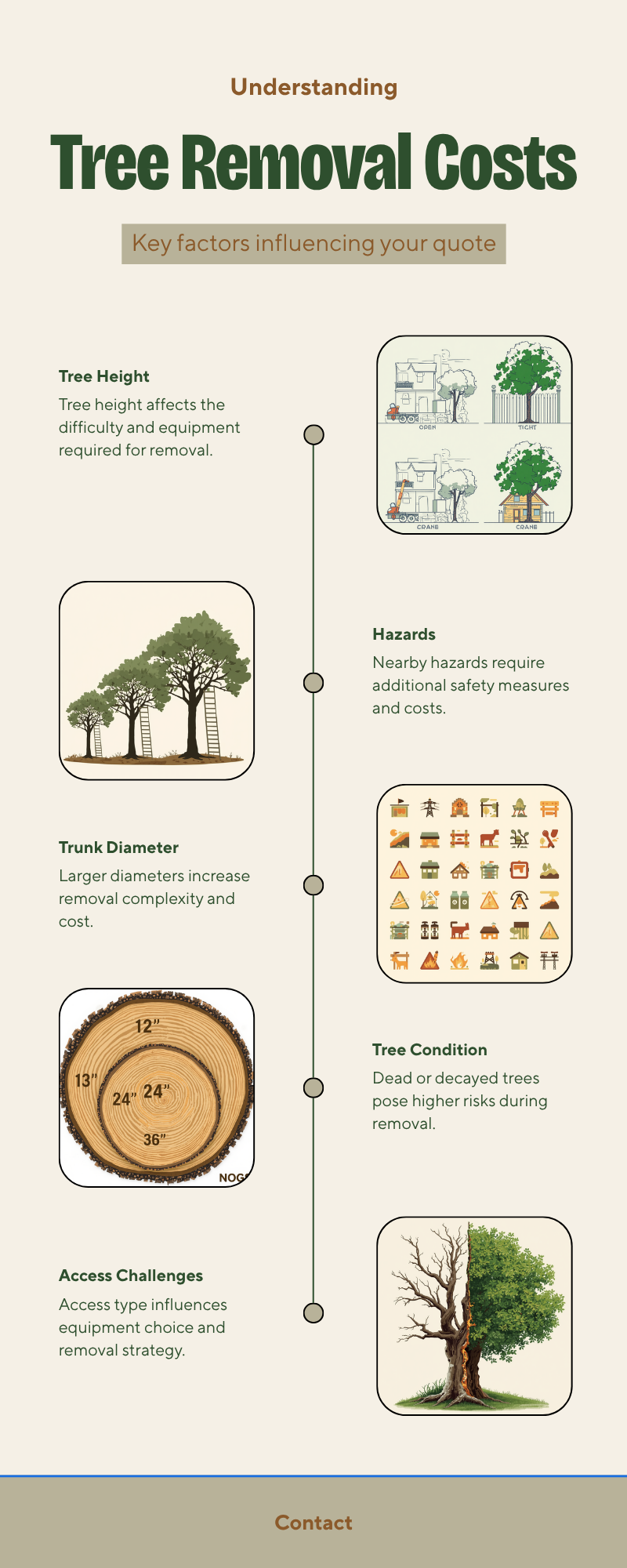
These are the factors that move the number up or down on every Tallahassee removal job. Understand them and you can read any quote intelligently — and spot the one that left something important out.
Tree size: height and trunk diameter — highest impact
The biggest single variable. Height determines how many sections have to be cut and how many trips a climber makes up the tree. Trunk diameter determines how long each cut takes, how much wood volume must be processed, and how difficult stump grinding will be. A 90-foot live oak with a 42-inch trunk may take a full crew an entire day. A 30-foot water oak with a 12-inch trunk takes 1–2 hours.
Access to the tree — highest impact
The Tallahassee-specific factor the national price guides ignore. Can a bucket truck, chipper, or log loader reach the tree? In Midtown, Los Robles, Betton Hills, and the older neighborhoods, the answer is often no — 8-foot side yards, overhead wires, decorative fencing, and adjacent plantings create tight-access conditions that require climbing crews and rigging systems. Tight-access jobs typically run 20–60% more than open-access jobs of equivalent size, and access can only be judged on-site.
Proximity to structures — high impact
A tree with clear fall space is straightforward. A tree over a house, garage, fence, or utility line requires sectional removal — cutting piece by piece from the top down, lowering each section by rope and rigging to protect what’s below. That’s 30–50% more labor-intensive than open-yard felling of the same tree. Budget accordingly when the tree is within falling distance of anything that matters.
Permit requirements — high impact, and very Tallahassee-specific
Inside City of Tallahassee limits, a permit applies to trees above 36″ DBH and to any tree inside a Canopy Road buffer (100 ft from the centerline of nine designated roads). In unincorporated Leon County — Bradfordville, Woodville — Leon County §10-4.362 triggers at just 12″ DBH for live oaks and longleaf pines. If the tree needs ISA arborist assessment documentation, budget for a modest additional line item on the local market. Timeline matters too: a standard city permit takes 5–15 business days, Canopy Road Conservation Committee review adds more, and emergency Fla. Stat. §163.045 hazard removals can proceed faster with ISA documentation in hand.
Tree species — moderate impact
Live oak is the toughest Tallahassee species to remove — extremely dense wood, heavy for its volume, complex spreading crowns. Slash pine produces more debris volume but cuts faster. Sweetgum and water oak fall in between. Species also sets the permit threshold: longleaf pine and live oak trigger county permits at 12″ DBH in unincorporated areas, regardless of how easy they are to remove physically.
Stump depth and soil type — moderate impact
Tallahassee’s red Orangeburg clay in the north and northeast neighborhoods is significantly harder on grinding equipment than the sandy flatwoods soils of south Leon County. Clay-embedded root systems on 50–80-year-old trees can add 1–2 hours to what would be a quick grind in sand. Flat-rate stump quotes that ignore soil type tend to end in change orders — or in a stump that never got ground to depth. More on that in the stump grinding guide.
Debris hauling vs. on-site chipping — lower impact
Most Tallahassee removals include chipping on-site with chips blown to the street or a spot on the property. Want logs kept for firewood or chips for mulch? Say so during the walk-through — it affects crew scheduling. Hauling full logs instead of chipping adds cost (separate truck, dump fees). And pine infected with southern pine beetle must be chipped on-site per FDACS protocol rather than hauled, to limit beetle spread.
Tree already on the roof, or a cracked trunk leaning over the house? That’s a priority-dispatch call, not a comparison-shopping situation — life-safety calls are triaged first.
📞 Call Now — (858) 319-0022Vetted local pros — availability depends on independent provider schedules and demand.*How Tallahassee’s Canopy Roads change the cost picture
Nine roads in Leon County carry a Canopy Road Protection Zone — a 100-foot buffer from the road centerline where all tree removal requires City of Tallahassee Canopy Road Conservation Committee (CRCC) review, regardless of tree size or DBH.
Here’s what that means in practice: a 20-inch water oak that would be freely removable without any permit anywhere else in the city needs a permit and CRCC review if it sits within 100 feet of Miccosukee Road, Old Bainbridge Road, Centerville Road, Meridian Road, or any of the other designated roads. Properties in Killearn Estates along Miccosukee, Betton Hills along Centerville, and northwest Tallahassee along Old Bainbridge are the most commonly affected.
If a tree needs both a standard permit and Canopy Road review — say, a 40-inch live oak inside the Miccosukee buffer — both reviews are typically run simultaneously to save time, but budget 3–6 additional weeks for dual-permit situations beyond the normal removal timeline. The full rules live in our Tallahassee tree permit guide.
What §163.045 means for your cost
Florida Statute §163.045 provides a pathway for removing a tree documented as hazardous by an ISA-certified arborist without standard permit pre-approval — including in Canopy Road zones and unincorporated Leon County. It matters for cost in two directions:
When it saves money: if your tree is a genuine structural hazard, §163.045 documentation (a modest added cost for the ISA assessment) can bypass the city permit fee and the 5–15-day wait. For urgent situations where waiting on a permit means living under ongoing risk, this is the correct path. It also reaches HOA-governed communities like SouthWood — a documented hazard tree can come down without HOA architectural review approval.
When it doesn’t apply: aesthetic removal — taking out a healthy tree you simply don’t want — does not qualify. Misrepresenting a healthy tree as hazardous to dodge a permit is a risk no legitimate ISA arborist will take. Standard permitting still applies for non-hazard removals. See hazardous tree removal and when to remove a tree for how that call gets made.
How getting matched works
Questions to ask before you hire any tree service in Tallahassee
Print this list and run it against every quote you collect:
- Did you walk the property, or is this a phone/photo number? Phone estimates in Tallahassee are unreliable — tight access, Canopy Road buffer position, and stump soil hardness can only be judged on-site.
- Is my tree inside the City of Tallahassee or unincorporated Leon County? The permit threshold difference (36″ city vs. 12″ county for protected species) dramatically changes the picture. The contractor should know which jurisdiction applies before quoting.
- Is the tree within 100 feet of any of the nine designated Canopy Roads? If yes, CRCC review is required regardless of size. Contractors who don’t know this create permit violations for their clients.
- Is the ISA arborist assessment fee included, or separate? For patriarch screening, §163.045 documentation, or Canopy Road permits, an ISA-certified assessment is a prerequisite — confirm whether it’s in the quote or billed separately (it’s a modest added line item either way).
- Is the stump grinding number based on my actual soil, or a flat rate? Red Orangeburg clay grinds slower than sand. A flat rate with no soil look is how change orders happen.
- What’s the ISA certification number of the arborist assessing the tree? Verify it at treesaregood.org. Anyone recommending removal of a significant protected tree without ISA credentials is a red flag — here’s how ISA certification works.
- What exactly does “cleanup” include? Confirm whether the price covers chipping, hauling, and stump grinding — or just the felling. Ask what gets left behind.
Frequently asked questions
How much does tree removal cost in Tallahassee in 2026?
On the local market, cost rises steadily with tree size: small trees are the most affordable tier, mid-size trees run moderate, large oaks and pines run high, and patriarch-scale trees are the highest tier. Those are typical market patterns, not our prices — we’re a free dispatch service, and the licensed pro you’re matched with gives the binding written quote after seeing the tree.
Why are some tree-removal quotes so much higher than others?
The two biggest drivers are access — climbing and roping every limb down vs. working from a bucket or crane — and debris volume, since haul-away runs per load. A licensed, insured crew also quotes higher than an unlicensed one for the same reason a licensed electrician does. The cheapest number on an uninsured crew can become the most expensive limb through your roof.
Does homeowner’s insurance cover tree removal?
Typically yes when the tree falls on a covered structure during a covered peril like wind or storm. Preventive removal of a standing hazard tree is usually not covered. The pro you’re matched with can document the damage for your claim — see the insurance coverage guide for how deductibles and documentation work.
Is the permit fee on top of the removal price?
Yes — in the City of Tallahassee the tree-permit fee (where required) is separate from the contractor’s removal quote. Some contractors handle the permit application as part of the job; others leave it to the homeowner. Ask which, before work is scheduled.
Can §163.045 save me the permit fee?
Only if an ISA-certified arborist documents the tree as a genuine hazard — then removal can proceed without standard permit pre-approval, which saves both the fee and the 5–15-day wait. Healthy-tree removals don’t qualify, and no legitimate arborist will paper over the difference.
How long does a tree removal take?
Most single-tree residential removals wrap up in a day; large or crane-assisted jobs can run 1–2 days. The bigger timeline factor in Tallahassee is permitting — 5–15 business days for a standard city permit unless the tree is hazard-documented under §163.045.
Related Tallahassee tree services & guides
Tree Removal Service
Crane Tree Removal
Stump Grinding
ISA Certified Arborists
Tree Trimming Cost
Tallahassee Tree Permit Guide
Insurance Coverage Guide
Free & Low-Cost Removal Options
Ready for a real number on your tree?
Call now and we’ll connect you with a vetted, licensed and insured Tallahassee removal pro who walks the property and gives the binding written quote. Free to use, no obligation, no sign-up.
📞 Call Now — (858) 319-0022Tallahassee Tree Service Co. is a free dispatch and referral service. We are not a tree-service contractor and do not perform tree work ourselves. When you call, we connect you with an independent, licensed and insured local tree-care professional who carries their own license and insurance and provides any binding quote. Price information anywhere on this site is typical local-market information for planning only; people or scenes in images are illustrative.
References to “24/7,” “same-day,” or “emergency” describe call-handling and dispatch availability. Actual on-site response times depend on the independent professional’s schedule, crew availability, and weather, and are not guaranteed.