Tree Trimming Cost in Tallahassee, FL
Two neighbors on the same street can get quotes that differ by a factor of four for what looks like the same job — and both quotes can be honest. The difference lives in species, spread, access, and rigging. Here is what actually moves the number, so you can read a quote like somebody who knows.
📞 Call Now — (858) 319-0022Want a real quote instead of a range? Call now — we’ll connect you any hour.Start with the thing most cost pages will not tell you: we are a free referral service, not a tree company. We do not trim trees and we do not set prices. Everything on this page describes how trimming work is typically scoped and what drives the number in the Tallahassee market. It is market context, not a price offer. The arborist you get matched with walks your canopy and gives you the binding written quote.
That distinction matters, because tree trimming is one of the least standardized services a homeowner buys. There is no menu. A “trim” can mean pulling three dead limbs off a crape myrtle or it can mean two climbers spending a full day reducing end weight on a 90-foot live oak over a slate roof. Those are not the same product and they should not carry the same number.
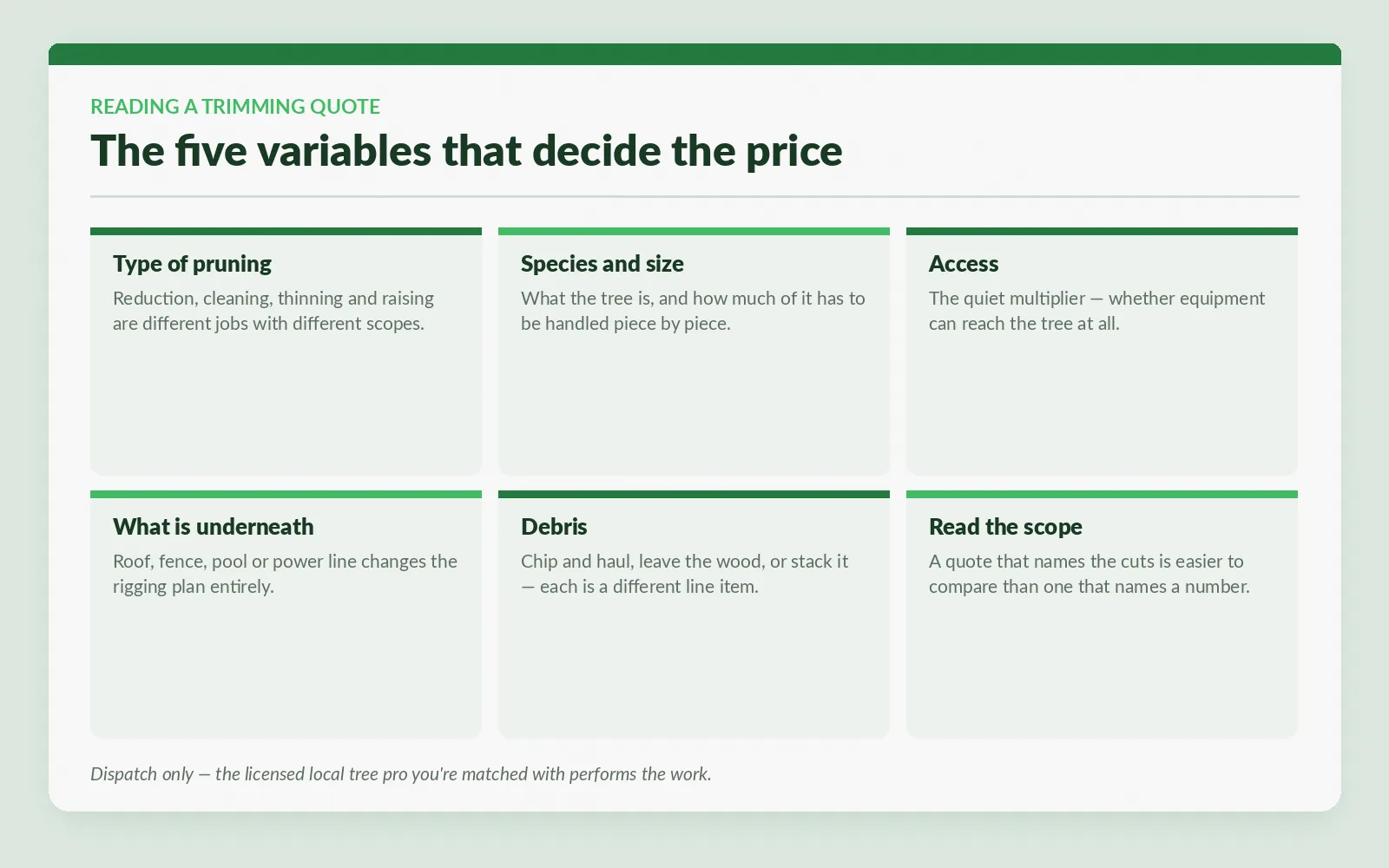
The five variables that decide the price
1. What kind of pruning are you actually buying?
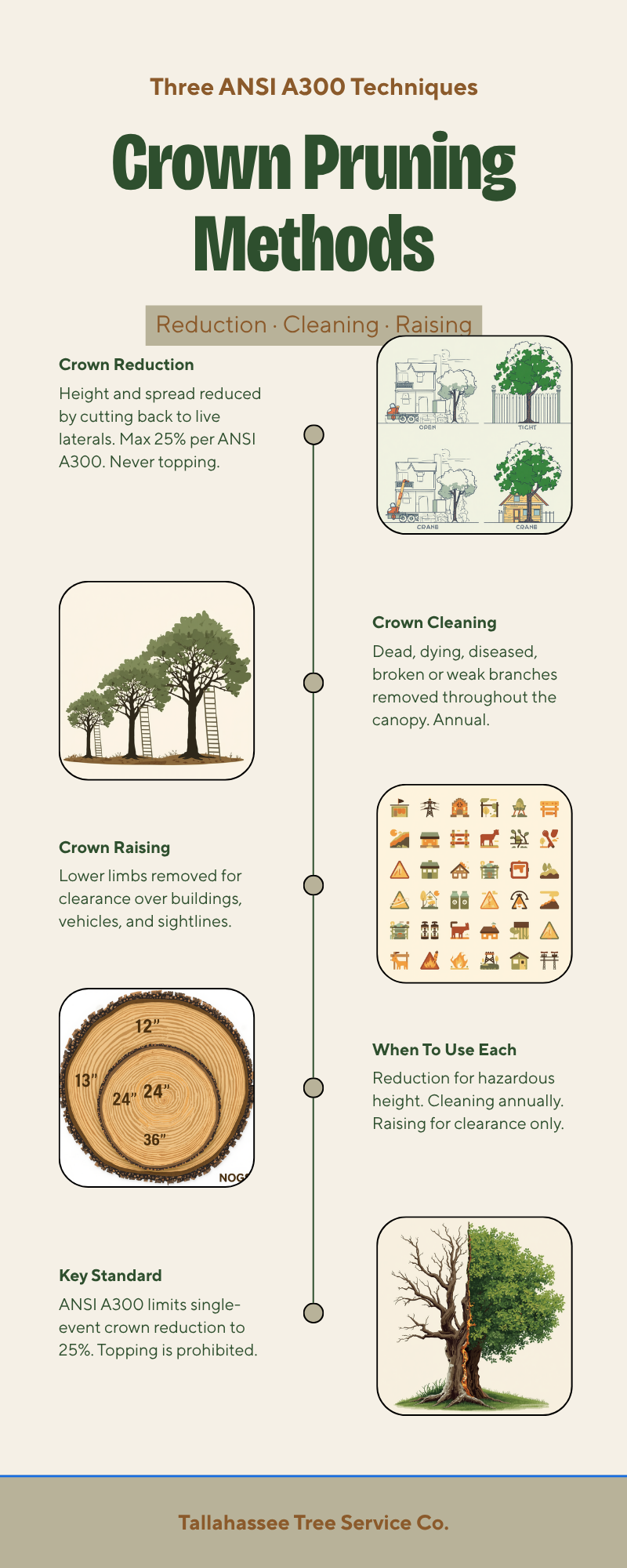
This is the biggest source of confusion. Ask any arborist to name the work and you should hear one of these ANSI A300 terms — and each one is a different amount of labor:
| Type of pruning | What it involves | Relative effort |
|---|---|---|
| Crown cleaning | Removing dead, dying, diseased, and broken branches. Nothing living and healthy comes off. | The lightest and most common. Highest value per dollar on a storm-prone tree. |
| Crown raising | Lifting the lower limbs for clearance over a driveway, a walk, a roof, or a mower. | Light to moderate. Depends on how many limbs and how big. |
| Crown thinning | Selectively removing interior branches to let wind pass through instead of catching it. | Moderate. Easy to overdo — a lion-tailed tree is a weaker tree. |
| Crown reduction | Shortening long limbs back to viable laterals to cut end weight and overall size. | The heaviest and most skilled. This is what a live oak over a roof usually needs. |
| Restoration | Rebuilding structure on a tree that was previously topped or storm-damaged. | Multi-year. Priced per visit. |
If a quote just says “trim tree,” you cannot compare it to anything. Make them name the work.
2. Species and size
A mature southern live oak in Betton Hills, sixty feet tall with an eighty-foot spread and limbs the diameter of a person, is a rigging operation. Every piece that comes off has to be roped, lowered, and controlled because there is a roof under it. That is climbers, ground crew, and hours. A crape myrtle in the front bed is a morning with a pole saw.
Species matters beyond size. Live oak is dense and heavy — a limb that looks manageable weighs far more than people expect. Laurel and water oak are full of deadwood and often internally decayed, which changes what is safe to climb. Pines are tall but simple. Palms are their own trade. Pecans have weak unions that dictate where the cuts can go.
3. Access — the quiet multiplier
If a bucket truck can park at the curb and reach the tree, the job is dramatically faster than if the same tree sits in a fenced back yard with a 36-inch gate. In that case a climber goes up on rope and every single limb gets lowered by hand and carried around the house. Access alone can double the labor on an otherwise identical tree.
Tallahassee has plenty of both. The newer Bradfordville and SouthWood lots often have room. Midtown, Los Robles, Betton Hills, and the older streets in and around the Canopy Roads frequently do not.
4. What is underneath the tree
Nothing under it? Cut and drop — fast and cheap. A roof, a fence, a screen enclosure, a driveway with cars, a pool, a neighbor’s prized camellias? Every piece gets rigged, and the pace slows to a crawl. And if there is a power service drop running through the canopy, the plan changes entirely — utility line clearance follows different rules and the utility may need to be involved before anyone gets near it.
5. Debris
A mature oak produces a genuinely surprising volume of material. Chipping it on site and blowing the chips into your beds is the cheapest disposal. Trucking it out to a facility costs more, because it is drive time plus tipping fees. Bucking the trunk wood into firewood lengths and leaving it stacked is somewhere in between. Say what you want up front — it is a real line item. See tree debris removal.
Already have one quote and want a second opinion? Call now and we’ll connect you with another vetted local pro. Free to use, no obligation.
📞 Call Now — (858) 319-0022Vetted local pros — availability depends on independent provider schedules and demand.*How to read a trimming quote like a pro
- It should name the pruning type. “Crown reduction, southeast quadrant, back to laterals, 15–20% of live crown” is a real scope. “Trim oak” is not.
- It should say what is coming off. Deadwood only? Specific limbs? A percentage of live crown? Anything over roughly 25% of live foliage in a season is a lot, and on a mature or stressed tree it is too much.
- It should say what happens to the debris. Chipped, hauled, stacked, or left.
- It should reference a standard. ANSI A300 for the pruning, Z133 for safety. A pro says these words unprompted.
- It should be in writing, before the saw. Not a handshake in the driveway.
- Insurance should be attached. General liability and workers’ compensation. Call the agent on the certificate yourself.
Why the cheapest quote is often the most expensive
A dramatically low bid on a mature oak usually means one of three things, and none of them are good news. It may mean no workers’ compensation coverage — in which case an injured climber in your tree becomes a claim against your homeowners policy. It may mean they intend to top the tree, which is fast, easy, and destroys it, forcing a much larger bill in five years and creating a hazard in the meantime. Or it may mean a lowball to win the job followed by a change order once the crew is on site and your driveway is blocked.
The honest middle quote from an insured, credentialed operator who names the cuts is almost always the cheaper number over the life of the tree. See the topping and ISA arborist pages for why.
Timing affects the price too
| When | What it means for scheduling and cost |
|---|---|
| Dec–Feb (dormant) | The right window for structural work on live oaks and hardwoods. Crews are working, schedules are more open than in storm season, and the tree handles the cuts better. |
| Mar–May | The pre-hurricane rush. Deadwood and end-weight reduction on storm-prone laurel and water oaks. Book earlier than you think — May gets busy. |
| Jun–Sep | Storm season. Emergency work takes priority over elective trimming, so scheduled jobs get pushed. Also the wrong time for major oak cuts. |
| Immediately after a named storm | The single worst time to shop for a routine trim. Demand across the Big Bend far exceeds crew capacity, and out-of-area operators flood in. Availability is entirely at the providers’ discretion. |
Ways to genuinely lower the cost
- Bundle trees. Mobilization is a real cost. Three trees on one visit costs much less than three separate visits.
- Take the chips. Letting them blow the chips into your beds saves haul-off and gives you free mulch.
- Do not wait. Deadwood cleaned out on a schedule is cheap. A storm-shattered canopy with a limb on the roof is not.
- Clear the access. Move the cars, unlock the gate, take down the trampoline. Crew time is the product you are buying.
- Book in the dormant season. The work is better for the tree and you are not competing with post-storm demand.
- Ask for scope, not price. “What is the minimum work this tree needs to be safe?” is a better question than “what is your cheapest number?”
What about the numbers you see online?
You will find plenty of published ranges for tree trimming, on national calculator sites and elsewhere. Treat them as typical local-market context and nothing more. They are not our prices — we do not perform the work and we do not set rates — and a national average is close to meaningless when your specific job is a 70-foot live oak with a roof under it and a 36-inch gate. The only number that matters is the written quote from the pro who has actually walked your tree. See also tree service cost and tree removal cost.
How getting matched works
Frequently asked questions
How much does tree trimming cost in Tallahassee?
It is scoped per tree — the type of pruning, species, size, access, what is underneath, and debris handling all move it, so there is no honest flat figure. Ranges published online are typical local-market numbers, not our prices. The arborist you are matched with walks the canopy and gives you the binding written quote.
Why did two quotes for the same tree differ so much?
Usually because they are quoting different work. One may be a light deadwood cleaning and the other a full crown reduction with rigging over the roof. Make each quote name the ANSI A300 pruning type and the percentage of live crown coming off, and the comparison becomes obvious.
Is it cheaper to trim several trees at once?
Yes, meaningfully. Getting the crew and equipment to your address is a fixed cost that gets spread across the work. If you have three trees that need attention, do them on one visit.
How often should a Tallahassee oak be trimmed?
For a mature, healthy live oak, a light structural pass every three to five years is typical, with deadwood cleaned as needed. Storm-prone species like laurel and water oak benefit from a look every year or two, ideally before June. Over-pruning on a short cycle is its own kind of damage.
Does insurance cover tree trimming?
Preventive trimming, essentially never — carriers treat it as maintenance. Removal of a limb that has already damaged an insured structure is a different question and may fall under the claim. See tree service insurance coverage.
Can I just have it topped to save money?
Please do not. Topping is cheap up front and produces weak regrowth, decay at every cut, and a genuinely more dangerous tree within a few years — then a much larger bill. Any ISA-certified arborist will refuse to top a healthy tree and offer reduction pruning instead.
Related Tallahassee tree services
Tree Trimming
Tree Pruning
Oak Tree Trimming
Palm Tree Trimming
Crepe Myrtle Trimming
Tree Service Cost
Tree Removal Cost
Hurricane Tree Prep
Get a real quote for your canopy
Call now and we’ll connect you with a vetted, licensed and insured Tallahassee-area arborist who will name the cuts before quoting. Free to use, no obligation, no sign-up.
📞 Call Now — (858) 319-0022Tallahassee Tree Service is a free referral service. Tallahassee Tree Service is not a licensed tree service provider and does not directly provide tree care services. All work is performed by independent, licensed and insured third-party providers in your area. Calls and form submissions placed through this site may be connected with a participating provider, and you may be contacted by that provider regarding your request. Same-day, emergency, and 24/7 availability are not guaranteed and depend on provider schedules, location, and demand. Service availability, pricing, licensing, and final response times are determined solely by the providers. It is the responsibility of the homeowner to verify that the hired contractor furnishes the necessary license and insurance required for the work being performed. All persons depicted in a photo or video are actors or models and not contractors listed on Tallahassee Tree Service.