Tree Service in Sopchoppy, FL
Slash pine snapped at twenty feet. A water oak leaning a little more after every storm. Cabbage palms full of dead fronds, and the Apalachicola National Forest sitting right on the property line. Call now and we’ll connect you with a vetted, licensed and insured Wakulla County arborist who works this coast.
📞 Call Now — (858) 319-0022Tree down across the driveway in the middle of the night? Call now — we route requests any hour.Sopchoppy is a different kind of tree town. Thirty-odd miles south of Tallahassee, hard against the Apalachicola National Forest, sitting on the black-water Sopchoppy River, with the Gulf close enough that a storm surge is a real conversation and not a hypothetical one. The trees here reflect all of it: pine flatwoods, cypress in the low ground, cabbage palm, live oak that has been shaped by salt wind, and titi thick enough to lose a dog in.
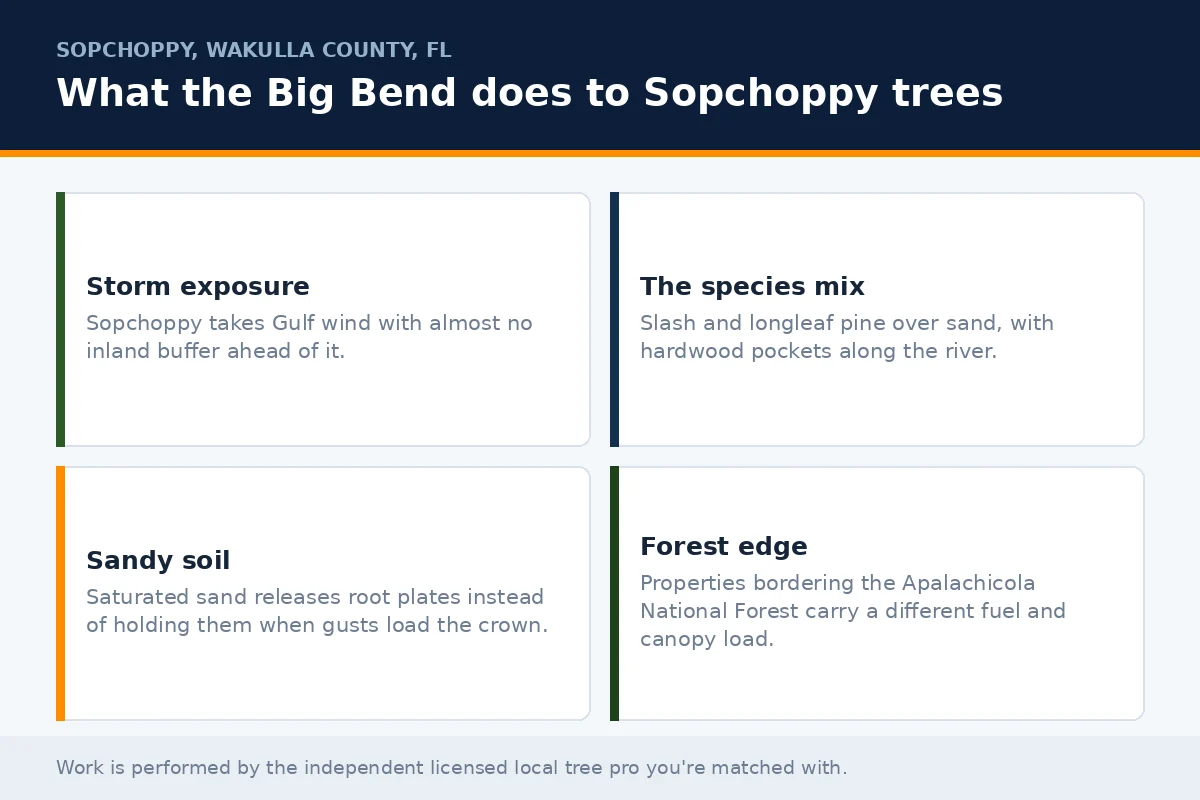
What that adds up to, practically, is a tree-risk profile that has almost nothing in common with a shaded lot in Midtown Tallahassee. The soil is sandy and the water table is high. The dominant tree is a pine that snaps rather than uproots. The nearest crew is often not down the street. And when a Gulf storm comes up the Big Bend, Wakulla County is not in the outer bands — it is in the eye-wall conversation.
We are a free referral service, not a tree company. Call now, describe what the tree is doing, and we connect you with an independent, licensed and insured pro who covers Sopchoppy, Crawfordville, Panacea, Medart, Shell Point, St. Marks, and the surrounding Wakulla County addresses. The quote and the work happen between you and them.
Who responds to storm damage in Sopchoppy?
Wakulla crews that clear storm-felled pines and haul debris after Gulf systems come through — small town, fast dispatch. Call now to get matched, or see how storm damage tree removal is prioritized after a blow.
The Big Bend storm reality
Nobody in Wakulla County needs to be told what a hurricane does. Hermine came ashore near St. Marks in 2016 and put the power out for a week and a half in places. Michael in 2018 was a different kind of monster inland. Idalia made landfall in the Big Bend in 2023. And Helene in 2024 ran right up this stretch of coast with a surge that rewrote what people around here consider a worst case.
Trees are the mechanism for most of that damage. In a coastal pine county, the failure modes are specific and predictable: slash and loblolly pine snap partway up the stem under sustained wind; saturated sandy soil around a shallow-rooted water oak lets the whole root plate lift and the tree goes over intact; cabbage palms shed fronds and occasionally lose their crown; and anything already weakened by decay, lightning, or previous storm damage becomes the thing that lands on the roof.
The work that actually prevents this happens in March, not in September. Pre-season deadwood removal, hazard-tree identification, canopy thinning where it is warranted, and honest assessment of the trees closest to the house. See hurricane tree prep and storm-damaged trees for the full checklist.
The trees you actually have out here
| Species | Where it grows around Sopchoppy | What it needs |
|---|---|---|
| Slash & loblolly pine | Everywhere. Flatwoods, planted stands, yard trees, the forest edge. | Deadwood and hazard limbs only — over-pruning stresses pines badly. Watch for beetle activity and for any pine leaning after a storm. |
| Longleaf pine | The better-drained sandhills and the Apalachicola National Forest. | Leave it alone unless it is dead or hazardous. Fire-adapted, deep-rooted, and one of the toughest trees on this coast. |
| Live oak | Yards, roadsides, the higher ground near the river. | Dormant-season structural pruning, end-weight reduction over structures. The single best storm performer if it is maintained. |
| Water & laurel oak | Low ground, wet edges, older yards. | The root-plate failures. Saturated sand plus wind equals a whole tree on its side. Inspect before June. |
| Cabbage palm (sabal) | Coastal edge, yards, roadsides — the Florida state tree. | Dead fronds and seed stalks only. Never hurricane-cut a palm to a feather duster; it weakens the crown. |
| Bald cypress | Along the Sopchoppy and Ochlockonee, in the swamps and river bottoms. | Rarely needs work. Do not disturb the root zone or the knees. |
| Sweetgum | Disturbed ground, fencerows, old fields. | Brittle and prone to limb drop. Deadwood regularly if it is near a structure. |
| Titi, wax myrtle, yaupon | The understory everywhere, and the reason lot clearing is a job. | Machine work, not climbing work. See lot clearing. |
Sandy soil changes the whole calculation
North of the Cody Scarp, up around Tallahassee, the red Orangeburg clay grips a root plate like concrete. Down here, past the scarp, you are into deep sands over a high water table and a limestone karst plumbing system underneath. A tree that would hold in clay lets go in saturated sand. That is why the water oak that has stood in your yard for forty years can go over in a storm that a comparable tree in Killearn rides out.
It cuts the other way too. Root damage from construction, driveway work, or a septic drainfield does more harm here because there is less soil volume to spare, and the karst means drainage patterns can change abruptly. If you are building, adding a slab, or trenching anywhere inside the drip line of a tree you want to keep, get an arborist to mark the critical root zone before the machine shows up. See tree health assessment.
Living next to the Apalachicola National Forest
Sopchoppy has a national forest on its doorstep, and that comes with a specific set of tree considerations that a suburban homeowner never thinks about.
- Prescribed fire. The Forest Service burns to maintain the longleaf ecosystem. That is good land management — and it means the trees along your boundary are adapted to fire in ways your ornamentals are not.
- Defensible space. A dense wall of pine and titi running right up to the house is a wildfire problem, not just a tree problem. Thinning the ladder fuels and clearing dead material near structures is real risk reduction. See brush removal.
- Southern pine beetle. Dense, stressed pine stands are exactly what the beetle wants. Fading crowns and popcorn-looking pitch tubes on the bark mean get somebody out now, because it moves through a stand fast. See southern pine beetle in North Florida.
- Property line trees. A tree standing on federal land is not yours to cut, even if the limbs hang over your roof. Know where the line is before anyone starts.
Pine on the house, limb over the bedroom, or anything touching a Talquin line? That is a life-safety call — those get triaged first. Say so when you submit.
📞 Call Now — (858) 319-0022Vetted local pros — availability depends on independent provider schedules and demand.*What the pros in the network handle here
Tree removal
Dead pines, storm-leaning oaks, hollow trunks, anything with a compromised root plate. Out here the access is often better than it is in town — more room, fewer neighbors, a real path for equipment — which can make a big removal simpler than the same tree in a historic district. But the trees are also frequently bigger, farther from the road, and closer to a power drop than they look. See tree removal.
Storm cleanup and debris
After a Gulf storm the volume is measured in truck-loads, not in limbs. Pine tops, snapped stems, whole canopies. Getting the driveway open and the roof clear comes first; the yard comes later. See storm cleanup and tree debris removal.
Palm trimming
Cabbage palms want dead fronds and seed stalks removed, and nothing else. The “hurricane cut” — stripping a palm back to a handful of vertical fronds — is a myth that actively weakens the tree by removing the photosynthetic capacity it needs to recover. See palm tree trimming.
Lot and land clearing
Building sites, pasture, food plots, fire breaks, and the endless titi. This is heavy-machine work with its own permitting and its own quote structure. See land clearing and lot clearing.
Stump grinding
Pine stumps grind easy. Old live oak stumps do not. Sandy soil makes the grinding faster but the chip volume is the same, and out here spreading the chips on site is usually more sensible than trucking them anywhere. See stump grinding.
What drives the scope of the job
| Factor | Why it matters in Wakulla County |
|---|---|
| Species and size | A 70-foot slash pine and a 70-foot live oak are completely different removals. The oak has a spread; the pine has height and a snap risk. |
| Condition | A sound tree can be climbed. A storm-damaged, beetle-killed, or hollow one cannot — that means a lift or a crane, which is a different cost class. |
| Access | Rural lots often have room to work, which helps. Soft, saturated sand after a wet week does not — heavy equipment sinks. |
| Distance | Sopchoppy is a haul from most crews’ yards, and the disposal sites are farther still. Drive time is real time. |
| Power lines | Talquin Electric Cooperative serves most of this area. Anything in contact with a conductor is a utility call before it is an arborist call. |
| Debris volume | Storm work in a pine county generates enormous volume. On-site chipping is often the sane answer. |
| Urgency | Post-storm demand across the Big Bend outstrips supply, badly. Life-safety work is triaged ahead of cleanup. |
Any dollar figures you find online for this work are typical local-market ranges, not our prices — we do not do the work and we do not set the price. The pro you are matched with walks the tree and gives you the binding written quote before anything starts. See the tree service cost guide.
Permits: Wakulla County, not Tallahassee
A useful thing to know: the City of Tallahassee’s tree ordinance and its Canopy Road Protection Zones do not govern your property in Sopchoppy. Wakulla County has its own land development code, and the City of Sopchoppy has its own small-municipality rules. Regulation here is generally lighter than in the city, which is genuinely good news for a homeowner with a hazardous pine — but “lighter” is not “none,” especially near wetlands, the river, or any protected shoreline.
Florida Statute §163.045 still applies statewide: a local government cannot require a permit for removal of a tree on residential property when a homeowner obtains documentation from an ISA Certified Arborist or a Florida-licensed landscape architect that the tree presents an unacceptable risk. That documentation is the piece most people do not know exists. See the permit guide and the ISA arborist guide.
Salt, wind, and coastal exposure
The closer you get to Ochlockonee Bay, Shell Point, and the St. Marks side, the more salt aerosol becomes a factor. Salt-tolerant species — live oak, cabbage palm, wax myrtle, yaupon holly, southern red cedar — hold up. Less tolerant ornamentals brown out on the windward side and decline. If you are replanting after a storm, plant for the exposure you actually have, not for the yard you saw in a magazine. And after a surge event, a tree that got its root zone flooded with salt water may look fine for a season and then die back in the second one — watch them.
Before you submit — how to describe your tree
- Pine or oak? That single answer changes the whole plan. If it is a pine, is the top still there?
- Is it leaning, and is it new? A long-standing lean with sound soil is one thing. Fresh soil heaving on the uphill side is a root plate failing right now — get people out of the fall zone.
- What is under it. Roof, well head, septic field, power drop, propane tank, the neighbor’s boat.
- Can a truck get to it? Sandy two-track after a wet week is a real constraint for anything on wheels.
Photos help more than any description. Two — one wide, one at the base — usually answer everything.
How getting matched works
Verify the pro yourself
After every Gulf storm, out-of-state crews arrive in Wakulla County within days. Some are legitimate. Some have no Florida registration, no general liability, and no workers’ compensation — and if one of them gets hurt in your pine, your homeowners policy is the one that hears about it. Ask for a certificate of insurance and call the agent named on it. Check the Florida business registration through the FDACS licensee search. If they claim ISA certification, get the individual’s name and look it up in the ISA’s public directory. Five minutes, and it is the whole ballgame.
Frequently asked questions
Do you actually cover Sopchoppy, or just Tallahassee?
Sopchoppy, Crawfordville, Medart, Panacea, Shell Point, St. Marks, and the rest of Wakulla County are inside the dispatch area. Call now and we route to a pro who covers your address. We are a free referral service, not the crew that shows up.
Do I need a permit to remove a tree in Wakulla County?
Generally the rules here are lighter than the City of Tallahassee’s ordinance, which does not apply to you. Wakulla County’s land development code and the City of Sopchoppy’s own rules govern, with more scrutiny near wetlands and the river. Florida Statute §163.045 also lets an ISA Certified Arborist’s risk documentation clear a genuinely hazardous tree on residential property.
Should I cut down the pines near my house before hurricane season?
Not automatically. A healthy pine with a sound root plate and a full top often rides out a storm better than a decayed hardwood next to it. What matters is condition and position, not species alone. Get the trees inside striking distance of the house assessed — the ones that are dead, beetle-hit, topped out, or already leaning are the ones to deal with.
Is a hurricane cut good for my palms?
No. Stripping a cabbage palm back to a few vertical fronds removes the food-producing capacity the palm needs and can weaken the crown. Take dead fronds and seed stalks. Leave the healthy green ones.
How much does tree service cost in Sopchoppy?
It depends on species, size, condition, access, drive distance, and debris volume. There is no honest flat number, and any range you see published is a typical local-market figure, not our price. The pro you are matched with gives the binding written quote after looking at the tree.
How fast can someone get out after a storm?
No one can promise a window, and anyone who does is guessing. After a Big Bend landfall the demand across Wakulla and Leon counties massively exceeds what the local crews can absorb. Availability depends entirely on the independent providers’ schedules. Life-safety situations are triaged ahead of routine cleanup.
Related tree services
Tree Removal
Emergency Tree Service
Storm Cleanup
Pine Tree Removal
Palm Tree Trimming
Land Clearing
Stump Grinding
Hurricane Tree Prep
Tree Risk Assessment
Arborist Services
Get matched with a Wakulla County tree pro
Call now and we’ll connect you with a vetted, licensed and insured local arborist who works the Sopchoppy area. Free to use, no obligation, no sign-up.
📞 Call Now — (858) 319-0022Tallahassee Tree Service is a free referral service. Tallahassee Tree Service is not a licensed tree service provider and does not directly provide tree care services. All work is performed by independent, licensed and insured third-party providers in your area. Calls and form submissions placed through this site may be connected with a participating provider, and you may be contacted by that provider regarding your request. Same-day, emergency, and 24/7 availability are not guaranteed and depend on provider schedules, location, and demand. Service availability, pricing, licensing, and final response times are determined solely by the providers. It is the responsibility of the homeowner to verify that the hired contractor furnishes the necessary license and insurance required for the work being performed. All persons depicted in a photo or video are actors or models and not contractors listed on Tallahassee Tree Service.