Tree Service Lafayette Park Tallahassee — Local Crews for One of Tallahassee’s Hardest-Hit Neighborhoods
Lafayette Park is one of Tallahassee’s most distinctive historic neighborhoods — bordered roughly by Park Avenue, Magnolia Drive, Lafayette Street, and Meridian Road, with a dense canopy of mature live oaks, water oaks, hickories, and pines that gave the neighborhood its character for nearly a century. The May 10, 2024 EF-2 tornado hit Lafayette Park as one of its most damaged neighborhoods, taking down hundreds of mature trees and reshaping the canopy overnight. Two years later, the neighborhood is still working through long-tail recovery: hazard tree removal on storm-stressed survivors, replanting programs, and ongoing care for the legacy trees that came through. Our tree service Lafayette Park Tallahassee crews handle removal, trimming, risk assessment, replanting recommendations, and post-tornado canopy management. ISA-Certified arborists oversee all work.
Lafayette Park’s Tree Canopy — Before, After, and Now
Lafayette Park’s identity has been tied to its canopy for nearly a century. Understanding what happened on May 10, 2024 and what’s happening now shapes how tree service Lafayette Park Tallahassee work is done in this neighborhood.
Lafayette Park sits east of downtown Tallahassee, roughly bordered by Park Avenue to the north, Magnolia Drive to the south, Lafayette Street to the east, and Meridian Road to the west. The neighborhood developed primarily in the 1920s through 1950s as Tallahassee expanded eastward, with the original tree canopy of live oaks, water oaks, southern magnolias, hickories, pines, and pecans largely predating most of the houses. Many properties had specimen trees 100–200+ years old well before the May 2024 tornado — trees that watched neighborhoods being built around them.
On May 10, 2024, an EF-2 tornado tracked through Tallahassee with peak winds estimated near 125 mph. Lafayette Park was directly along the tornado’s path. Hundreds of mature trees came down across the neighborhood within minutes. Streets were impassable for days. Power was out for over a week in some sections. The City of Tallahassee, county, and state emergency management responded with major debris removal operations through the summer of 2024, but the canopy loss was severe and immediately changed the neighborhood’s character.
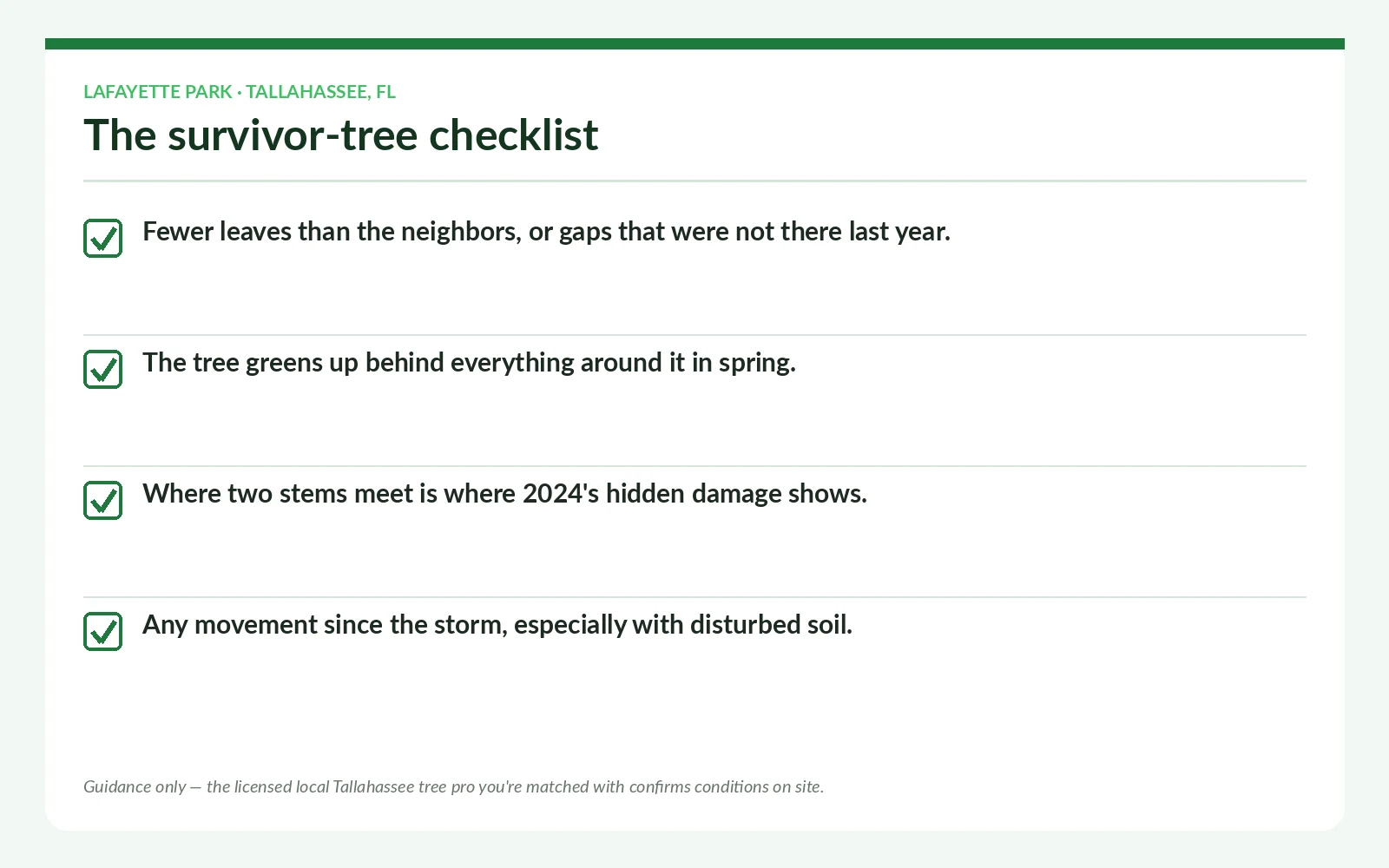
Two years later, Lafayette Park is in the long-tail phase of post-tornado recovery. Most acutely-damaged trees have been removed. The standing trees that survived are now showing delayed-stress decline — trees that took root damage, partial canopy loss, or vascular wounds in May 2024 are now revealing the long-term consequences. Routine tree service work in Lafayette Park today is overwhelmingly focused on three categories: hazard tree assessment on stressed survivors, ongoing canopy management as remaining mature trees adapt to changed light and wind exposure, and replanting recommendations as homeowners decide what to put in for the next century.
Where Lafayette Park Tree Work Stands Now
Tree work needs in the neighborhood have shifted significantly since May 2024. Different phases call for different responses.
Acute Cleanup Phase
Massive cleanup operation immediately following the tornado. Crews from across the Southeast staged in Tallahassee. Public debris removal handled by city/county contractors. Private tree removal, hazard limb work, and house-on-tree extractions. Scoping was triage-driven; pricing was emergency-rate.
Recovery Phase
Cleanup wrapped, slower-paced removal of damaged trees that didn’t come down but couldn’t be saved. Insurance-claim work continued. Stump grinding on completed removals. Initial replanting decisions started. Pricing returned to standard rates.
Delayed-Stress Phase
Where Lafayette Park is now. Trees that took moderate damage in May 2024 are showing delayed decline — vascular wounds becoming infection sites, partial root damage manifesting as canopy thinning, structural weaknesses revealing in subsequent storms. Risk assessment and selective removal dominate the work mix.
Canopy Restoration Phase
Long-term canopy rebuilding. Replanting programs (homeowners, city, civic organizations). Care for newly-planted trees during the first 5–10 establishment years. Continued monitoring on tornado-damaged survivors that are still adjusting structurally.
Tree Services for Lafayette Park Properties
Full-spectrum work for both immediate needs and long-term canopy management.
Tree Risk Assessment
ISA-Certified arborist evaluates storm-stressed survivors. Identifies vascular damage, root issues, structural defects. Documents which trees can be preserved vs. should be removed. Highest-leverage starting service in Lafayette Park. See risk assessment.
Tree Removal
Removal of declining storm-stressed trees, hazard trees, and mature specimens that have become liabilities. Crane access often used for tight-lot removals near historic homes. See tree removal.
Emergency & 24-Hour Response
Same-day response for new tree failures or hazard-tree emergencies. Common during summer thunderstorm season as already-stressed trees fail in subsequent events. See emergency tree service.
Storm-Damaged Tree Cleanup
Storm cleanup remains active in Lafayette Park as subsequent weather events affect already-stressed trees. Limb removal, hazard tree drops, debris hauling. Same-week or same-day response. See storm-damaged trees.
Canopy Trimming
Selective canopy trimming on surviving mature trees. Important for trees with partial canopy loss adjusting to changed light and wind exposure. Annual or every-other-year scheduling on legacy specimens. See tree trimming.
Stump Grinding
Stump grinding on completed removal work. Important for replanting plans. Older oak and hickory stumps can take significant equipment time but produce clean replanting sites. See stump grinding.
Tree Cabling & Bracing
Structural support for high-value heritage trees with storm-induced defects. Cabling extends the life of treasured specimens that would otherwise need removal. ISA arborist evaluation determines candidacy. See tree cabling.
Tree Planting
Replanting recommendations and installation as homeowners rebuild canopy. Native species selection for Lafayette Park’s soil and exposure conditions. Long-term canopy planning. See tree planting.
Permit Handling
City of Tallahassee §5-83 tree removal permits required for most trees over 4″ DBH on Lafayette Park properties. We handle the application as part of the removal scope. See permit guide.
Lafayette Park’s Heritage Trees
Many Lafayette Park trees qualify as “heritage trees” under City of Tallahassee §5-83 — specimens 36″ DBH or greater that get special treatment under tree ordinances. Understanding the heritage rules matters for both preservation and removal scenarios.
What heritage tree status means
Under City of Tallahassee §5-83, certain native species at 36″ DBH or larger qualify as heritage trees with additional protections. Live oak, southern magnolia, sweetgum, southern red oak, white oak, and several other native species get this treatment. Heritage trees receive specific protections during construction and development, additional permit scrutiny for removal, and prioritization for preservation in design decisions.
How many heritage trees are in Lafayette Park
Lafayette Park likely has the highest concentration of heritage-status trees of any Tallahassee neighborhood, both before and after the May 2024 tornado. Many properties have one or more 36″+ DBH live oaks, hickories, magnolias, or other qualifying natives. The 1920s–1950s development pattern preserved many existing canopy specimens that are now well past heritage threshold and approaching their second or third century of life.
What changed after May 2024
The tornado took down a significant fraction of Lafayette Park heritage trees. Replacement of these specimens isn’t a 5–10 year proposition — it’s a 50–100 year proposition. Trees newly planted in 2024–2026 will reach heritage threshold sometime around 2080–2120 depending on species and growing conditions. The neighborhood’s heritage canopy will be substantially diminished for decades to come.
How removal of heritage trees works now
For Lafayette Park properties needing heritage tree removal due to storm damage or post-tornado decline, the City of Tallahassee §5-83 permit process applies with additional documentation requirements. Permit fees are reported at $273 for the FY2026 cycle (confirm current rates with City Growth Management). Heritage tree removal often requires arborist documentation of the structural or health basis for removal. We handle the full permit application and arborist documentation as part of the removal scope.
For Lafayette Park property owners with questions about whether specific trees qualify as heritage status or what permit process applies, an ISA-Certified arborist visit can provide both diagnostic and documentation support. Call (850) 555-0123 for heritage tree assessment scheduling.
How a Lafayette Park Tree Service Visit Works
Whether the work is risk assessment, removal, or routine care, the on-site workflow follows a consistent structure tailored to the neighborhood’s specific conditions.
On-Site Walkthrough
ISA-Certified arborist examines the property. Identifies all trees present, evaluates structural condition, looks for tornado-related damage signatures (vascular wounds, root damage signs, structural cracks), and assesses risk priorities.
Heritage Tree Identification
Specifically flag any 36″+ DBH native specimens that qualify for heritage status. Document the trees that need preservation focus vs. those that may need removal due to storm damage. Heritage tree decisions get extra care.
Risk Prioritization
Trees ranked by failure risk, target proximity (house, vehicles, neighbors’ structures), and intervention timeline. High-priority hazards addressed first; lower-priority work scheduled across multiple visits if budget requires phasing.
Permit Verification
For trees requiring removal, City of Tallahassee §5-83 permit requirements verified for each specific tree based on size, species, and heritage status. Permit fees ($273 reported FY2026 rate, confirm with City Growth Management) factored into quote.
Written Quote
Itemized scope: removals, trimming, risk assessment documentation, permit fees, debris hauling, optional services. Same-day for simple scopes; 1–3 business days for multi-tree or technical access scopes.
Site Preparation
Lafayette Park lots are typically tight historic-development sizes with houses close to property lines. Site protection includes adjacent property notification, careful drop-zone planning, and coordination with neighbors when work extends near shared boundaries.
Execution With Specialty Equipment
Crane access often used for technical removal in tight Lafayette Park lots. Standard climber-cut techniques for accessible trees. ISA-Certified climbers for heritage tree work where preservation pruning is the goal rather than removal.
Follow-Up Plan
For multi-year canopy management programs, next visit scheduled before crews leave. Most Lafayette Park properties benefit from annual ISA-Certified arborist visits in the post-tornado phase to monitor delayed-stress trees and identify intervention opportunities early.
Lafayette Park Property Worth a Real Assessment.
ISA-Certified arborist visits same-week. Identifies which storm-stressed trees can be saved versus which need to come down. Worth scheduling even if nothing seems acutely wrong.
Tree Service Pricing in Lafayette Park
Pricing varies based on tree size, scope, access conditions, and whether crane equipment is needed. Lafayette Park’s tight historic lots and large mature specimens often add complexity.
| Service | Typical Range | Notes |
|---|---|---|
| Risk assessment visit | $95 – $300 | ISA-Certified arborist; written documentation |
| Small tree removal (under 30′) | $400 – $1,200 | Including stump treatment |
| Medium tree removal (30–60′) | $1,000 – $3,500 | Most common Lafayette Park size |
| Large mature tree removal (60–90′) | $2,500 – $7,500 | Often requires crane access |
| Heritage tree removal (36″+ DBH) | $3,500 – $12,000+ | Documentation + crane work typically required |
| Crane access fee (when needed) | $800 – $2,000/day | Common in tight Lafayette Park lots |
| Annual canopy trimming (mature specimen) | $400 – $1,200 | Selective deadwood + light shaping |
| Stump grinding | $150 – $600 | Larger stumps; mature tree size |
| Tree cabling installation | $300 – $1,200 | Per cable; structural support work |
| Tree planting (per tree) | $300 – $1,500 | Tree cost + installation labor |
| City §5-83 permit fee | $273 | Reported FY2026; confirm with City Growth Management |
Why Lafayette Park Properties Choose Our Crews
Tree service in this neighborhood requires specific competencies that don’t apply equally everywhere in Tallahassee.
- Tornado-experienced crews. Our arborists have worked Lafayette Park properties continuously since the May 2024 tornado. The patterns of delayed stress, vascular wound progression, and storm-survivor decline are familiar — we know what to look for.
- Heritage tree expertise. Lafayette Park has the highest density of heritage-qualified specimens in Tallahassee. Our crews handle the documentation, permit interaction, and preservation pruning that heritage tree work requires.
- Tight-lot crane access. Many Lafayette Park lots are too tight for standard removal techniques on large trees. Our crane partners work the neighborhood regularly and know which streets, setbacks, and overhead clearances allow crane positioning.
- ISA-Certified arborists. All risk assessments, heritage tree decisions, and complex preservation pruning supervised by ISA-Certified arborists. Documentation that holds up for insurance claims and city permit processes.
- Same-week scheduling. 7-day standard scheduling window for non-emergency work; same-day response on hazard situations. Lafayette Park’s post-tornado context produces urgent situations frequently — we’re set up to respond fast.
- Permit handling included. §5-83 permit applications, arborist documentation, and Growth Management coordination handled as part of every removal scope. No homeowner paperwork required.
- Multi-year canopy programs. For properties working through long-tail recovery, we offer annual care contracts that include risk monitoring, selective trimming, and replanting consultation. Locks in pricing and ensures continuity of arborist relationship.
- Insurance claim support. Documentation, photos, and arborist letters supporting homeowner insurance claims for tornado-related tree damage. Particularly relevant for delayed-stress claims that surface 1–3 years post-event.
Lafayette Park Trees Deserve Tornado-Experienced Crews.
ISA-Certified arborists, heritage tree expertise, crane access for tight lots, permit handling included. Tree service Lafayette Park Tallahassee work that meets the neighborhood where it actually is.
Tree Service Lafayette Park Tallahassee FAQs
Are you still doing post-tornado cleanup in Lafayette Park?
Acute cleanup wrapped in late 2024. Current work in Lafayette Park is delayed-stress tree management — trees that took moderate damage in May 2024 are now showing decline 18–24 months later. Risk assessment and selective removal of these stressed survivors is the dominant work mix in the neighborhood right now. Call (850) 555-0123 to schedule.
How do I know if my tree was damaged in the tornado but didn’t fall?
Signs include: visible cracks in trunk or major branches, areas of bark stripped or split, branches that died back during summer 2024, partial canopy thinning, leaning that wasn’t there before, fungal conks (shelf fungi) appearing on trunk in the past year, and unexplained sudden decline. ISA-Certified risk assessment evaluates these signs and determines whether intervention can save the tree or removal is needed.
Do I need a permit to remove a tree in Lafayette Park?
Almost certainly yes. City of Tallahassee §5-83 requires permits for tree removal on most trees over 4″ DBH. Most Lafayette Park trees exceed this threshold by a wide margin given the neighborhood’s mature canopy. Heritage trees (36″+ DBH on certain native species) have additional permit scrutiny. We handle the permit application as part of every removal scope. See our permit guide.
What does heritage tree status mean for removal decisions?
Heritage trees (36″+ DBH on certain native species under §5-83) have additional permit scrutiny but aren’t prohibited from removal when structural or health issues warrant it. Documentation requirements are higher — an ISA-Certified arborist evaluation supporting the removal decision is typically expected. Permit processing may take longer than standard tree removal applications.
How much does it cost to remove a large oak in Lafayette Park?
Mature oak removal in Lafayette Park typically runs $2,500–$7,500 for trees in the 60–90′ size range, plus $800–$2,000 crane access fees if needed. Heritage oaks (36″+ DBH) can run $3,500–$12,000+ depending on size, access, and required permit documentation. Site visit required for accurate quoting because tight Lafayette Park lots and structure proximity vary significantly between properties.
What should I plant to replace storm-damaged trees?
Native long-lived species: live oak, southern magnolia, hickory, southern red oak, sweetgum, water oak, or pignut hickory depending on site conditions. These match the historic Lafayette Park canopy character and have proven hurricane and storm survival in the region. Smaller-stature native alternatives include redbud, fringetree, and dogwood for understory positions. See our best trees to plant page.
Can damaged trees be saved with cabling or pruning?
Sometimes. ISA-Certified arborist evaluation determines candidacy. Trees with structural cracks at branch unions can sometimes be cabled to extend life. Trees with partial canopy loss can sometimes be selectively pruned to encourage healthy regrowth. Trees with significant trunk damage, vascular destruction, or root system damage usually can’t be saved long-term. The assessment is the highest-leverage starting service. See tree cabling.
Do you handle insurance claim documentation?
Yes — ISA-Certified arborist documentation, photos, and written assessments supporting homeowner insurance claims. Particularly relevant for Lafayette Park where delayed-stress claims (filing 1–3 years after the tornado for trees that finally died from May 2024 damage) require structural documentation of the causation. Insurance carriers vary on what they accept — we work with whatever your carrier requires.
How fast can you get out for an emergency in Lafayette Park?
Same-day response for hazard situations — trees on structures, blocking driveways, threatening utilities, or in active storm distress. Standard non-emergency scheduling is 7-day window. Call (850) 555-0123 for urgent situations and we’ll dispatch the next available crew.
Do you serve the entire Lafayette Park area?
Yes — throughout Lafayette Park boundaries (Park Avenue, Magnolia Drive, Lafayette Street, Meridian Road) plus the surrounding neighborhoods that share similar tree management profiles. ISA-Certified tree service Lafayette Park Tallahassee crews work the area regularly and know the streets, access patterns, and tree population well. Call (850) 555-0123.
Lafayette Park & the Surrounding Tallahassee Neighborhoods
Lafayette Park sits within a constellation of historic Tallahassee neighborhoods that share canopy character and tree management context.
Lafayette Park’s immediate neighbors include Myers Park & Betton Hills (just south, sharing similar 1920s–1950s development pattern and mature canopy), Midtown (just west, with overlapping tree species and similar permit context), and the emerging neighborhood we’ll be covering soon at Indianhead Acres (south of Magnolia Drive). All four were impacted by the May 2024 tornado to varying degrees, with Lafayette Park taking the worst hit and the surrounding areas experiencing meaningful but lesser damage.
For property owners with multiple Tallahassee locations or rental properties across several historic neighborhoods, our crews maintain consistent ISA-Certified standards and coordinated scheduling across the area. Multi-property owners often benefit from coordinated annual canopy management programs covering Lafayette Park, Myers Park, Midtown, and surrounding neighborhoods on a single visit cycle.
Beyond the immediate Lafayette Park area, the broader Tallahassee tree management context spans Killearn Estates, Killearn Lakes, Northwest Tallahassee, Bradfordville, and Southwood — each with distinct canopy character, development eras, and tree management profiles. Lafayette Park’s heavy heritage tree concentration and post-tornado context make it the most distinctive of the historic neighborhoods. Call (850) 555-0123 for any Tallahassee tree service work.
Related Services & Areas
Most relevant pages for Lafayette Park property owners.
Lafayette Park’s Canopy Will Take Decades to Rebuild. Let’s Care For What’s Left.
Tree service Lafayette Park Tallahassee work is about meeting the neighborhood where it actually is — two years post-tornado, in long-tail recovery, with heritage trees that need preservation focus and storm-stressed survivors that need honest evaluation. ISA-Certified arborists, tornado-experienced crews, permit handling, fair pricing.