Tree Service in Killearn Estates, Tallahassee
Heritage oaks, big established lots, and HOA standards — Killearn trees need a local touch. Call now and we’ll connect you with a vetted, licensed and insured pro who works this side of town.
📞 Call Now — (858) 319-0022Prefer to talk it through first? Call now and we’ll connect you any hour.Killearn Estates sits north of the Cody Scarp on red Orangeburg clay — the firmer, better-draining soil that lets the neighborhood’s big live oaks and laurel oaks reach impressive size. That mature canopy is the reason people love Killearn, and also the reason tree work here is rarely small: specimen oaks needing structural pruning, aging laurel oaks reaching the end of their span, and tall pines that catch hurricane wind over two-story homes.
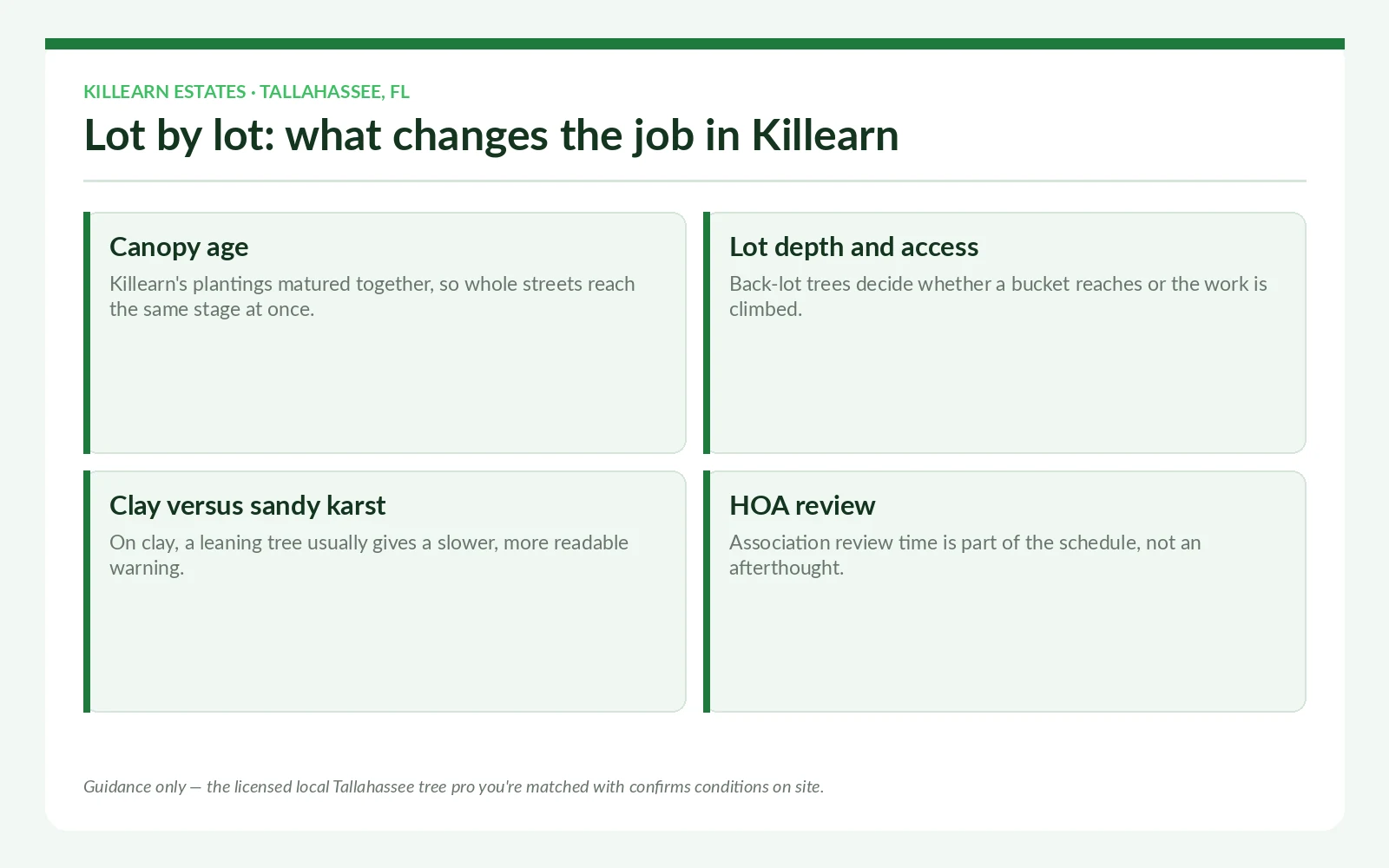
Because lots back up to common areas and golf frontage, and the Killearn Homes Association maintains community standards, the pros we dispatch are used to staging equipment on established properties and keeping work tidy. On clay soil, leaning trees tend to give a slower, more readable warning than the sudden plate failures common on the sandy karst south of town — but a heavy laurel oak over a roofline still deserves a real look.
What Killearn homeowners ask for most
Killearn lot by lot: what changes the job
Forty-plus years of canopy growth means the neighborhood’s tree work has patterns you can almost map:
- Golf-frontage and common-area lots. Backyards that open onto Killearn Country Club fairways or association green space give a takedown crew a clean drop zone — but anything falling toward the common side needs coordination, and debris can’t just be staged on association ground. Pros who work Killearn plan the drop direction at the quote, not on the morning of.
- Lakefront trees on Killarney and Kanturk. Trees at the water’s edge lean toward the light — over the lake — and their root plates sit in wetter soil than the rest of the lot. Removals here often mean rigging away from the water and hauling debris uphill; nothing gets dropped in the lake.
- The original 1960s–70s sections. The oldest streets carry the oldest laurel oaks — the species’ 50–70-year structural lifespan is arriving on schedule, which is why laurel-oak removals cluster here. See laurel oak problems for the decline signs.
- Corner lots on the through streets. Shamrock and the other collector streets carry sight-line and right-of-way considerations — low limbs over sidewalks are the city’s clearance rules, not just aesthetics.
Big oak over the roof, or a laurel oak you’ve stopped trusting? Call now and describe the tree — the matched pro brings the right rig for an established Killearn lot.
📞 Call Now — (858) 319-0022Vetted local pros — availability depends on independent provider schedules and demand.*The Killearn tree calendar
| Season | The smart move on a Killearn lot |
|---|---|
| Nov–Feb (dormant) | Structural pruning on live oaks; big-canopy reduction work; best scheduling availability of the year. |
| Mar–May | Pre-season deadwooding, end-weight reduction on limbs over roofs, pine hazard checks — before the June rush. |
| Jun–Nov (storm season) | Monitoring, post-storm triage, emergency response. Crews book out fast once a storm is named in the Gulf. |
| Any time | Dead or hazardous trees — those don’t wait for a season. See hazardous tree removal. |
Permits & HOA in Killearn
Killearn Estates is inside City of Tallahassee limits, so §5-83 applies: non-patriarch trees up to 36 inches DBH are generally exempt on a single-family lot, while larger or patriarch trees and anything in a Canopy Road Protection Zone (parts of the area sit near Centerville and Old Centerville Roads) need a permit. On top of city rules, the Killearn Homes Association may have its own expectations — a local pro factors both in. See the Tallahassee permit guide.
How getting matched works
Our role, stated plainly: we’re a free referral line, not the crew. The independent pro carries the license and insurance and gives the binding quote. Verifying credentials takes two minutes — the Florida license-verification guide shows how, and it’s worth doing before anyone stages a crane on your driveway.
Frequently asked questions
Do you cover all of Killearn?
Yes — Killearn Estates plus nearby Killearn Lakes, Golden Eagle, Summerbrooke, and Ox Bottom. Call now and we match you with a pro who works your street.
Why are so many Killearn laurel oaks failing?
Laurel oak is a relatively short-lived oak, and many were planted in the same era as the neighborhood developed — so they’re reaching the end of their structural life around the same time. See laurel oak problems.
Do I need a permit to remove a Killearn oak?
Inside city limits, a non-patriarch oak up to 36 inches DBH is generally exempt; larger or patriarch oaks need a §5-83 permit. A §163.045 arborist hazard letter can bypass the permit for a genuine hazard.
Does the HOA have to approve tree removal?
The Killearn Homes Association’s covenants focus on community appearance; practices vary by section, so check your covenants or ask the association before a visible front-yard removal. City permit rules apply regardless of what the HOA says.
What happens after a named storm hits Killearn?
Triage order: anything on a structure or blocking a drive first, hung limbs second, downed-but-harmless material last. Describe your situation when you call now — genuine hazards move to the front of the dispatch queue. See storm damage removal.
Can lakefront trees on Lake Killarney be removed?
Usually yes with the normal permits, but expect the work plan to differ — rigging away from the water, no debris in the lake, and wetter root-zone soil affecting equipment placement. A pro who has done lake lots quotes it accordingly.
Tree services we cover in Killearn
Tree Removal
Tree Trimming
Stump Grinding
Emergency Service
Hurricane Prep
Live Oak Care
Cabling & Bracing
HOA Tree Service
Killearn tree on your mind?
Call now and we’ll connect you with a vetted, insured local pro who knows this side of Tallahassee.
📞 Call Now — (858) 319-0022Tallahassee Tree Service Co. is a free dispatch and referral service. We are not a tree-service contractor and do not perform tree work ourselves. When you call, we connect you with an independent, licensed and insured local tree-care professional who carries their own license and insurance and provides any binding quote. Price information anywhere on this site is typical local-market information for planning only; people or scenes in images are illustrative.
References to “24/7,” “same-day,” or “emergency” describe call-handling and dispatch availability. Actual on-site response times depend on the independent professional’s schedule, crew availability, and weather, and are not guaranteed.