HOA Tree Service in Tallahassee, FL
Board packets, COIs, itemized bids, completion sign-offs — association tree work runs on paperwork as much as chainsaws. Call and we’ll connect you with a vetted, ISA-certified local tree contractor who already works to that standard.
📞 Call Now — (858) 319-0022Bid-ready documentation for your next board meeting — not a handshake and a lump sum.A homeowner can hire someone with a chainsaw on a Saturday and call it done. A community association can’t. When a board authorizes tree work on common areas, it is exercising a fiduciary duty to the whole membership — which means competitive bids where the governing documents require them, approval recorded in the minutes, insurance certificates on file before a truck arrives, and documentation that the work met industry standard. The tree contractors we connect Tallahassee-area associations with are ones who treat that paper trail as part of the job, not an annoyance.
Why HOA tree work is different from residential
Three things separate association work from a single-family job in Killearn or Midtown:
- Liability runs to the board. If an under-insured contractor’s worker is hurt on association property, the association’s general liability policy becomes the deep pocket — and board members can face personal exposure if the vendor-vetting steps in the governing documents were skipped. The certificate of insurance is not a formality; it is the single most important document in the file.
- The permit math changes. Florida’s well-known arborist-letter exemption (FS §163.045) applies to residential single-family property. Common areas owned by the association — entrances, medians, retention ponds, buffer strips — generally do not qualify, so removals on City of Tallahassee common parcels usually route through the city’s tree-permit process, and unincorporated communities like Killearn Lakes route through Leon County (Development Support: (850) 606-1300). Boards that assume the single-family exemption covers the clubhouse oak find out otherwise at enforcement time.
- Scale and residents. Association work is dozens of trees across acres of common area, with staging plans, resident notice, and multi-day scheduling — closer to a small civil project than a backyard trim.
The documentation standard your board should require
Whoever your association hires — through us or anyone else — the file for every significant job should contain:
- Certificate of insurance (COI) delivered before work begins, with the association named as additional insured on request. Verify it directly with the carrier; the call takes two minutes and faked COIs, while rare, exist.
- Workers’ compensation coverage on every person on the crew — verifiable on the same COI. In tree work this is the coverage that actually gets tested.
- An itemized written bid — line-by-line scope, quantities, and pricing a board can compare meaningfully against competing bids, not a lump sum.
- A written scope of work signed by both parties, plus a completion sign-off noting any deviations.
- Photo documentation before, during, and after — it goes straight into the next month’s board packet.
- ISA-certified arborist sign-off on hazard calls, structural assessments, and any keep-or-remove recommendation, so the board has a documented professional opinion on file.
When you request a match through this site, the providers you’re connected with are licensed, insured local companies accustomed to producing exactly this package — and it is still the association’s responsibility to verify license and insurance before signing, which is the point of the package.
Common-area tree work associations schedule
- Cycle maintenance: scheduled pruning, deadwood removal, and crown cleaning on community-owned trees — annual or two-year cycles fit most Tallahassee associations.
- Hazard removals: declining or structurally unsound common-area trees taken down under board approval, with the arborist’s written call in the packet. See hazardous tree removal.
- Storm response: post-event clearing of roads, gates, amenity areas, and drainage; multi-property portfolios get sequenced by priority. See storm cleanup.
- Tree inventories and audits: a per-tree inventory of common areas with condition ratings and a prioritized maintenance schedule — the single most useful budgeting document a board can commission.
- Entrances and medians: crepe myrtles, ornamentals, and feature oaks at gateways and boulevards — the trees residents and appraisers see first.
- Buffers and perimeters: mature edge trees along public roads and neighboring parcels — statistically the highest-risk trees an association owns, because targets sit on both sides of the line.
- Ponds, trails, and amenity areas: playgrounds, pool decks, and walking trails need conservative pruning cycles because the targets underneath are people, daily.
- Formal risk assessments: TRAQ-format documentation for contested or high-stakes trees — board defense, insurance support, permit support. See tree risk assessment.
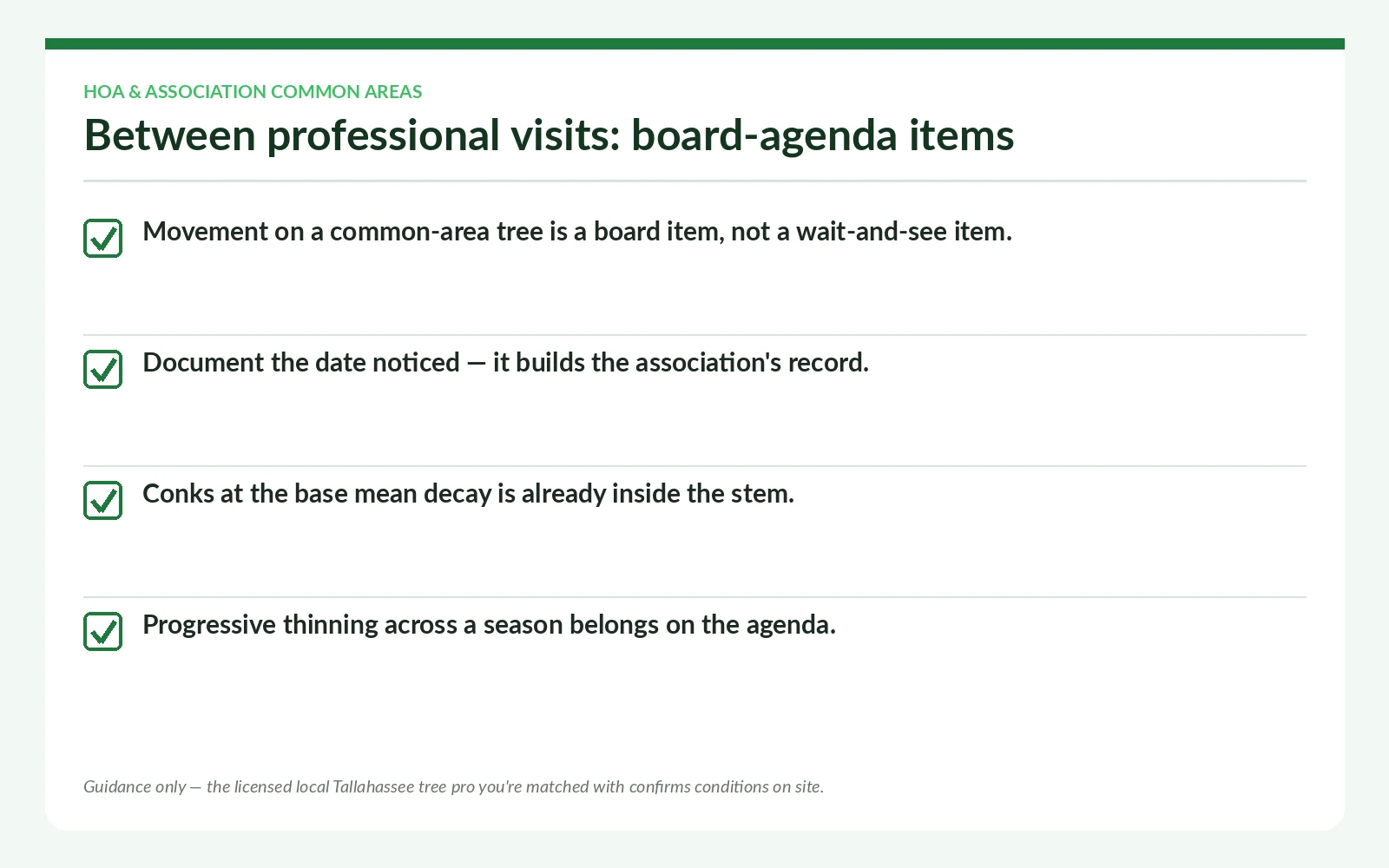
Need a bid your board can actually vote on? Get matched with a provider who delivers itemized scopes and COIs before the meeting, not after the deposit.
📞 Call Now — (858) 319-0022Vetted local pros — availability depends on independent provider schedules and demand.*How getting matched works
What drives cost on association tree work
Providers quote association work in writing after the walk. No two communities price alike; these are the levers that move the number:
| Factor | Why it matters |
|---|---|
| Tree count and acreage | Forty scattered common-area oaks across a 300-lot community is a different project than one entrance median. |
| Access and staging | Gated entries, narrow amenity paths, soft pond banks, and irrigation heads dictate equipment choice and ground protection. |
| Documentation depth | A findings summary costs less to produce than per-tree inventory records or TRAQ reports for the packet. |
| Contract vs. one-off | Annual maintenance agreements smooth pricing and lock scheduling; emergency one-offs ride the storm queue. |
| Debris volume and haul | Whole-canopy reductions across a boulevard generate truckloads; on-site chipping vs. full haul-away changes scope. |
| Season and timing | Pre-June structural work books at normal pace; post-storm response follows priority sequencing across the whole city. |
Where Tallahassee association work concentrates
The heaviest association tree loads in this market sit in the big master-planned and amenity communities: Southwood’s boulevards and park chains, Killearn Estates’ mature canopy streets, Killearn Lakes’ wooded common tracts up in unincorporated Leon County, Ox Bottom and Summerbrooke’s estate-lot perimeters, and Golden Eagle’s golf-frontage oaks. Each carries its own wrinkle — Southwood’s design standards, Killearn Lakes’ county (not city) permit jurisdiction, golf communities’ tee-time-aware scheduling — and the local providers in our network already work inside those constraints. If your community sits over the line in Wakulla or Gadsden County, the same matching works there; see Wakulla County and Quincy.
Frequently asked questions
Does Florida’s tree-removal exemption (FS §163.045) cover our common areas?
Generally no. The statute’s protection — removal without a local permit when a qualified arborist documents the tree as a danger — is written for residential, single-family property. Association-owned common parcels typically fall outside it, so plan on the City of Tallahassee or Leon County permit process for common-area removals.
Who should request bids — the manager or the board?
Either can request them; the governing documents control who approves. Most Tallahassee associations run vendor selection through the property manager with board approval recorded in the minutes once bids cross the documents’ spending threshold.
How many bids does our board need?
Check your governing documents — many require two or three competitive bids above a set amount. Itemized, line-by-line bids are what make that comparison meaningful; lump sums can’t be compared.
What insurance documentation should we collect before work starts?
A current COI showing general liability and workers’ compensation, with the association named as additional insured on request — delivered before the crew arrives, and verified with the carrier if there’s any doubt.
Can we get priority after a hurricane?
Providers sequence post-storm work by hazard, then by standing relationships — communities on annual maintenance contracts are typically worked before one-off calls. Availability always depends on provider schedules and event severity.
What is a tree inventory and is it worth it?
A per-tree record of the association’s common-area trees — species, condition, recommended action, priority. It converts tree care from surprise special assessments into a line item the budget committee can plan three years out.
How should residents be notified before work?
Set it in the scope: which streets, which days, where trucks stage, and who gets door notices. Experienced association contractors brief crew leads on resident-notice requirements before day one.
Related Tallahassee tree services
Commercial Tree Service
Property Management Tree Service
Tree Risk Assessment
Tree Inspection
Hazardous Tree Removal
Storm Cleanup
Tree Pruning
Tallahassee Tree Permit Guide
Put a real bid in the next board packet.
Call and we’ll connect you with a vetted, ISA-certified Tallahassee-area tree contractor who works to association documentation standards. Free to use, no obligation, no sign-up.
📞 Call Now — (858) 319-0022Tallahassee Tree Service is a free referral service. Tallahassee Tree Service is not a licensed tree service provider and does not directly provide tree care services. All work is performed by independent, licensed and insured third-party providers in your area. Calls and form submissions placed through this site may be connected with a participating provider, and you may be contacted by that provider regarding your request. Same-day, emergency, and 24/7 availability are not guaranteed and depend on provider schedules, location, and demand. Service availability, pricing, licensing, and final response times are determined solely by the providers. It is the responsibility of the homeowner to verify that the hired contractor furnishes the necessary license and insurance required for the work being performed. All persons depicted in a photo or video are actors or models and not contractors listed on Tallahassee Tree Service.