Dead Tree Removal Tallahassee FL
Hazard Prevention Experts
Dead tree removal Tallahassee homeowners need before the next storm — proactive hazard removal of pine bark beetle-killed pines, Hypoxylon-cankered laurel oaks, end-of-life water oaks, and any standing dead tree threatening your home, vehicle, or family. Every removal includes ISA-certified diagnosis, FS 163.045 documentation, complete debris haul, and optional same-day stump grinding. Serving all of Leon, Wakulla, Gadsden, and Jefferson counties.
Pine Removal · Laurel Oak Removal · Water Oak Removal · Stump Grinding
assessment on-site
documentation
for hazard removals
Gadsden · Jefferson
Why dead tree removal Tallahassee homeowners delay almost always ends badly
Dead tree removal Tallahassee residents put off is the most common preventable property damage we respond to every storm season. A standing dead tree looks stable for months, sometimes years, after it dies. The trunk is still upright. The branches are still attached. From the ground, the only visible change is that the leaves stopped coming back. Then a 35 mph wind knocks it onto a roof, a vehicle, or a power line — and what would have been a $900 scheduled removal becomes an $18,000 insurance claim, a totaled car, or worse.
The biology behind this is straightforward. The moment a tree dies, decay fungi begin breaking down the lignin in the wood. The structural integrity of a hardwood declines by roughly 25-40% in the first year, and by 60-75% within three years. Pines decline even faster — Southern pine beetle-killed loblollies and slash pines lose holding strength inside 12-18 months as the wood dries and sapwood honeycombs. By the time a dead tree visibly leans, the failure is already in motion. Tallahassee's red Orangeburg clay holds dead root plates longer than the sandy soils south of the Cody Scarp, but neither soil type holds them indefinitely.
Compounding the problem: Tallahassee gets named tropical systems, EF-2 tornadoes, and ice-load winter events on a regular schedule. Every dead tree on your property is a hazard scheduled to fail — the only unknown is when. Proactive hazard removal eliminates the risk on your timeline, with permits handled, drop zones planned, and crews working in calm weather. Reactive removal happens at 2 a.m. with a tree on your bedroom and an insurance adjuster on the phone.
What kills trees in Tallahassee — the four most common causes
- Southern pine bark beetle (SPB) infestation. Loblolly and slash pines hit by SPB die within 2-4 weeks once symptoms show. Reddish-brown crowns, popcorn-textured pitch tubes, and woodpecker damage are the diagnostic signs. SPB pines need removal within 30 days to prevent spread to neighboring pines.
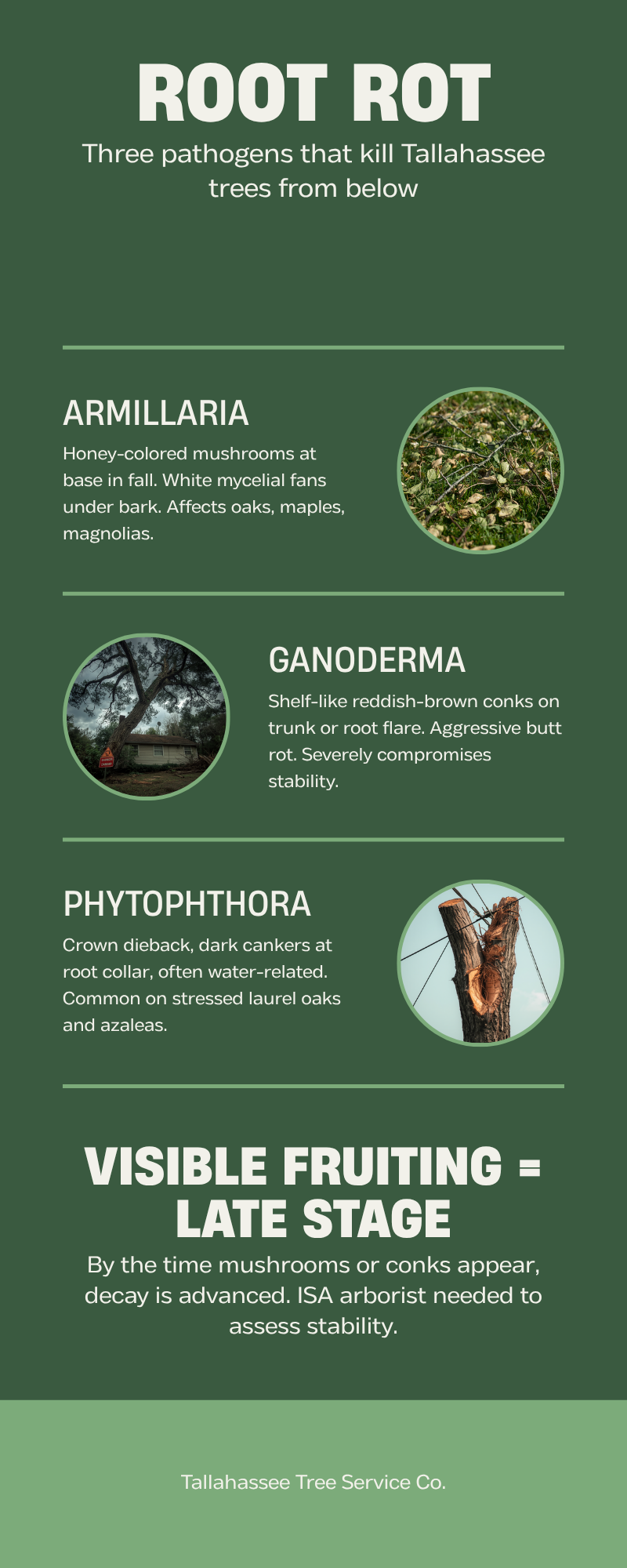
- Hypoxylon canker. The fungal disease that ends most laurel oaks and water oaks in Tallahassee, typically after drought stress. Bark sloughs off in plates, exposing silvery-gray fungal mat underneath. Trees are usually structurally compromised by the time symptoms are visible.
- End-of-lifespan decline. Laurel oaks live 50-70 years. Water oaks live 60-80 years. The Killearn Estates and Betton Hills neighborhoods planted in the 1960s and 70s are now seeing entire street rows hit lifespan ceiling at the same time.
- Storm damage that didn't kill outright. A tree that lost 40% of its canopy in Idalia or the May 2024 tornado outbreak may keep limping along for 1-2 seasons before dying from accumulated stress and decay entry through the wound sites.
A standing dead tree that has started to lean is in active failure mode. Call (850) 555-0123 for same-day or next-day assessment. We document leaning hazard trees with FS 163.045 paperwork, which bypasses the standard §5-83 permit timeline and lets us remove within hours rather than days.
Six warning signs you need dead tree removal Tallahassee service this year
If you see any of the following on a tree on your property, schedule a free hazard assessment before the next storm season.
No Spring Leaf-Out
If a hardwood didn't push leaves by mid-April in Tallahassee, it's almost certainly dead. Live oaks should be fully leafed by late March, laurel and water oaks by early April. Dead tree confirmation by May 1.
Bark Falling Off in Plates
Sloughing bark exposing the wood underneath signals decay or Hypoxylon canker. On pines, look for popcorn-textured pitch tubes — the diagnostic sign of southern pine bark beetle attack.
Mushrooms or Fungal Brackets
Conks (shelf-like fungal growths) on the trunk or major limbs mean decay fungi are advanced inside the tree. Ganoderma at the base on oaks is a near-certain death sentence within 1-3 years.
New or Increasing Lean
Take a photo today. Compare to the same angle in 30 days. Any visible change in trunk angle means root plate failure is in motion. Same-day assessment is critical.
Heavy Woodpecker Activity
Pileated and red-bellied woodpeckers target dead and dying wood. Sudden bird activity on a tree that didn't have it before is a strong indicator the tree is dead or actively dying.
Hollow Sound on Trunk Tap
A solid hardwood trunk should sound dense when tapped. A hollow drum-like sound on a major section of trunk indicates internal decay — often invisible from outside. ISA arborists carry resistograph tools to confirm.
Spotted any of these signs on your property?
📞 (850) 555-0123Free on-site hazard assessment. ISA-certified diagnosis. No pressure to remove if the tree's still safe.
What's killing trees across Tallahassee right now
Each of these conditions accounts for hundreds of removals across Leon County every year. Recognizing which one is affecting your tree changes the urgency timeline.
Loblolly and Slash Pine Killer
SPB attacks stressed pines, kills within 2-4 weeks once symptoms appear. Diagnostic signs: reddish-brown crown fade, popcorn pitch tubes on trunk, woodpecker bark stripping. Affected pines need removal within 30 days to prevent spread to surrounding pines via beetle pheromones. See our Southern pine beetle North Florida guide for detection and treatment.
The End of Most Laurel and Water Oaks
Hypoxylon atropunctatum is a stress-pathogen fungus endemic to North Florida and documented by UF/IFAS Extension. Drought weakens the oak; the fungus completes the kill. Diagnostic sign: bark sloughs off in plates, exposing silvery fungal mat underneath. Common in laurel oaks past 50 years and water oaks past 60. See our laurel oak problems guide.
Silent Killer of Mature Oaks
Ganoderma fungal infection enters through root or trunk wounds. Conks (shelf-like brackets) appear at the tree base. Internal decay can progress for years before any external symptoms — the first sign is often catastrophic failure during a storm. ISA arborist services include resistograph testing to confirm before symptoms.
Spreading Across the Panhandle
Phytoplasma disease transmitted by planthopper insects, fatal to Sabal palmetto, Canary Island date, and several other palm species. Symptoms: spear death, then progressive bronzing of fronds from oldest to newest. No cure. Affected palms need removal within months. See our palm tree trimming page.
The Killearn / Betton Hills Wave
Laurel oaks live 50-70 years; water oaks 60-80. The neighborhoods planted in the 1960s and 70s — Killearn Estates, Betton Hills, Myers Park — are now seeing entire street rows reaching lifespan ceiling. Mass dead tree removal is becoming a years-long neighborhood-scale project.
Trees That Survived Idalia / Helene Won't All Make It
A tree that lost 40%+ canopy in a major storm often dies from accumulated stress 1-2 seasons later. Decay enters through wound sites. Watch storm-damaged trees closely for two full growing seasons after the event before assuming they've recovered.
The five types of dead tree removal jobs we handle in Tallahassee
Job category determines equipment, crew size, FS 163.045 eligibility, and cost. Free on-site assessment categorizes every tree.
Standard Backyard Dead Tree
Mid-size dead hardwood or pine in an open backyard with safe drop zone. Typical job: 1-3 hours, 3-person crew, no crane. Most common removal type. $450–$1,200 depending on size.
Tree Near Structure
Dead tree within drop range of a home, garage, or fence. Requires technical climbing and rigging — sections are cut and lowered piece by piece rather than dropped. $900–$2,500 depending on access.
Crane-Assisted Removal
Large dead tree in tight space with no safe drop zone. Crane sets sections down precisely. Most expensive but often the only safe option for 60+ ft trees in tight backyards. $2,000–$5,500+.
Tree Near Power Lines
Coordinate with utility for line drop or de-energization before any work. Required for any dead tree within 10 ft of energized conductors. Premium pricing reflects coordination and crane requirement. $1,500–$4,000+.
Multiple Dead Trees (Lot)
SPB outbreaks, Hypoxylon waves, and end-of-lifespan declines often produce 3-10+ dead trees on a single property. Day-rate pricing or per-tree volume discount. Removal scheduled across 1-3 days. $2,500–$15,000+ depending on count.
Dead Palm Removal
Lethal bronzing-killed palms or weevil-infested Canary Island dates. Different equipment than hardwood removal — palms are cut in sections from the top down. Stump grinding requires specialized fibrous-trunk technique. $300–$1,200.
Before & after — actual hazard tree removals across Leon County
Real jobs from real Tallahassee neighborhoods. Local landmarks visible — confirmation that we're a local crew with Leon County experience.

Killearn Estates — SPB-Killed Pine
65-ft loblolly, classic SPB symptoms: reddish crown, pitch tubes, woodpecker damage. Removed within 14 days to prevent spread to neighboring pines.

Betton Hills — Hypoxylon Laurel Oak
Late-stage Hypoxylon canker, bark sloughing, structural compromise confirmed by resistograph. 163.045 documented, removed in 2 days.

SouthWood — Multi-Tree Lot Cleanup
Four end-of-lifespan water oaks on a single lot. Day-rate pricing. All four removed in 2 days, stumps ground, area sodded same week.
Replace placeholder images with real job photos in WordPress Media. Alt text is pre-written and SEO-optimized — match filenames or update paths.
How FS 163.045 makes dead tree removal Tallahassee homeowners need legal in hours
Florida Statute §163.045 (amended 2022) is the most useful tool in the dead tree removal toolkit, and most homeowners have never heard of it. The statute prohibits local government from requiring a permit, fee, or mitigation for tree removal on single-family detached residential property when the owner holds written documentation from an ISA-certified arborist stating the tree poses an "unacceptable risk" per ANSI/ISA Tree Risk Assessment BMP, Second Edition (2017).
For a confirmed dead tree, this is almost always the right path. A standing dead tree meets the "unacceptable risk" definition by default — the question isn't whether it will fail, it's when. Our ISA arborist services include the 163.045 documentation as part of every dead tree assessment, free of charge when the tree clearly qualifies. The documentation is a 1-2 page risk letter that the homeowner files with their records — no submission to the city, no waiting period, no permit fee.
What 163.045 covers — and what it doesn't
Covered: Dead trees, dying trees with structural compromise, leaning trees with confirmed root failure, hollow trees with major decay, storm-damaged trees with stem cracks. Also covers preemptive removal of healthy trees that pose unacceptable risk due to location and target (rare but real, e.g., a 90-ft pine 6 ft from a bedroom).
Not covered: Healthy trees the homeowner just wants gone for view, light, or aesthetics. HOA common areas. Commercial or multifamily property. Trees in rights-of-way. The statute is narrower than its name suggests, and we're honest with homeowners about which path applies — sometimes the standard §5-83 permit is the right answer.
What happens when 163.045 doesn't apply
For dead trees that don't qualify for 163.045 — usually because the property type is excluded — we file the standard City of Tallahassee §5-83 tree removal permit on your behalf. The permit fee is reported at $273 for up to 10 trees (confirm current amount with City Growth Management). Standard processing takes 5-10 business days. We handle the paperwork; you sign and pay only the city fee. See our Tallahassee tree removal permit guide for full details on §5-83 and protected species categories.
The 163.045 path requires the arborist documentation before removal. Cutting a tree first and seeking documentation after exposes you to §5-83 penalties: 3× replacement mitigation for a first offense, 5× for subsequent — turning a $1,200 dead tree removal into a $4,000+ problem. Always call us first; we document, then remove.
How much does dead tree removal Tallahassee service cost?
Published market ranges from HomeBlue Tallahassee data (March 2025). Your actual quote depends on access, species, height, and structure proximity. See our full cost guide for breakdowns by height tier.
A scheduled hazard removal in clear weather costs roughly half what an emergency removal of the same tree costs after it falls. Add structural damage to a roof or vehicle and the difference becomes 10x or more. Removing a confirmed dead tree before storm season is the single highest-ROI tree maintenance expense for most Tallahassee homeowners.
What happens when you call us for dead tree removal in Tallahassee
You call
Coordinator captures address, tree count, suspected cause (SPB? Hypoxylon? Just leafless?), and any structure concerns.
Free assessment
ISA-certified arborist on-site within 24-48 hours. Confirms dead/dying status, identifies cause, evaluates structural risk.
Documentation
FS 163.045 risk letter prepared if applicable, or §5-83 permit filed on your behalf if standard path is needed.
Written estimate
Itemized scope by tree, species, method (climb/crane), debris, and stump grinding option. Valid 30 days.
Removal & cleanup
ANSI A300 / Z133 execution. Crew schedules within the same week. Complete debris haul and optional stump grinding included.
Where we provide dead tree removal Tallahassee service
Different neighborhoods have different dominant dead-tree problems. Killearn and Betton Hills are seeing the laurel oak end-of-life wave. Bradfordville and Northwest Tallahassee see SPB pine kills. Surrounding areas get a mix of all conditions.
- Killearn Estates
- Killearn Lakes
- Bradfordville
- Myers Park & Betton Hills
- Midtown Tallahassee
- SouthWood
- Northwest Tallahassee
- Lake Jackson
- All of Leon County
- Crawfordville (Wakulla)
- Quincy (Gadsden)
- Monticello (Jefferson)
- All of Wakulla County
- Woodville
- Indianhead Acres · Frenchtown · Buck Lake · Ox Bottom Manor
Don't see your area? Call (850) 555-0123 — we serve every community within 30 miles of Tallahassee.
Other services we handle alongside dead tree removal
Our full service hub — every type of tree work we handle.
Removal of healthy or living trees that need to come down for other reasons.
For trees that already came down — emergency response within 90 minutes.
Round-the-clock dispatch for urgent tree hazards of any type.
Loblolly, slash, longleaf — pine-specific removal techniques and SPB protocol.
The Killearn / Betton Hills end-of-life wave — laurel oak specialty service.
Hypoxylon-affected and end-of-lifespan water oaks across Tallahassee.
Same-day stump grinding after removal — $3/inch, ground 8-12" below grade.
Trees compromised by storms but not yet dead — assessment and pruning options.
ISA risk letters, second opinions, and tree health evaluations.
§5-83 ordinance details and FS 163.045 permit-bypass documentation.
Full breakdown of removal pricing across every scenario in Leon County.
Frequently asked questions about dead tree removal in Tallahassee
How do I know if my tree is actually dead and needs removal?
Six warning signs: no spring leaf-out by mid-April, bark falling off in plates, mushrooms or fungal brackets on the trunk, new or increasing lean, heavy woodpecker activity, and hollow sound when you tap the trunk. Any one of these warrants a free on-site assessment from an ISA-certified arborist. The combination of two or more is almost always a confirmed dead tree.
How urgent is dead tree removal Tallahassee homeowners actually face?
It depends on the cause and location. Pine bark beetle-killed pines need removal within 30 days to prevent spread. Hypoxylon-cankered laurel oaks should come down within 6-12 months because structural integrity declines fast. End-of-lifespan oaks with no visible decay can sometimes be monitored for a year, but only if they're not within drop range of a structure. A leaning dead tree with active root failure is a same-week priority.
Do I need a permit to remove a dead tree in Tallahassee?
Often no, thanks to Florida Statute 163.045. The statute exempts removal of trees posing unacceptable risk on single-family residential property when documented by an ISA-certified arborist. A confirmed dead tree almost always qualifies. Our arborist services include this documentation free with every hazard removal. For situations where 163.045 doesn't apply (HOA common areas, commercial property, multifamily), the standard §5-83 permit is required — fee reported at $273 for up to 10 trees, processed in 5-10 business days. We handle the paperwork either way.
Does insurance cover dead tree removal Tallahassee homeowners need?
Generally no. Florida homeowners insurance typically only covers tree removal when a tree has already fallen and damaged a covered structure — and even then, only with a $500-$1,000 debris removal sublimit. Proactive removal of a standing dead tree is treated as routine property maintenance and is not covered. The math still favors proactive removal: a $900 scheduled removal is much cheaper than a $20,000 claim on your home, plus your hurricane deductible, after the dead tree falls in the next storm.
How much does it cost to remove a dead tree in Tallahassee?
Standard backyard dead tree with open drop zone: $450-$1,200. Dead tree near a structure requiring climbing/rigging: $900-$2,500. Crane-assisted removal: $2,000-$5,500+. Multiple dead trees on a single lot: $2,500-$15,000+ with day-rate or volume pricing. Dead palms: $300-$1,200. Stump grinding adds $3/inch with a $150 minimum. Free written estimates always — and the FS 163.045 risk letter is included free when the tree qualifies.
Should I remove a dead tree before hurricane season?
Yes, if at all possible. The hurricane season opens June 1 in Florida. Tropical systems become possible from late May onward. A standing dead tree at the start of June has roughly a 40-60% chance of failing during the season depending on storm activity and tree condition. Pre-season removal in April or May costs the standard rate; post-storm reactive removal often runs 1.5-3x the standard rate due to crew demand and emergency surcharges. Schedule pre-season hazard removals as early in the year as possible.
Can I cut down a dead tree myself with a chainsaw?
Strongly discouraged for any tree taller than head-height. Dead trees behave unpredictably during felling because internal decay changes how the trunk fails. A live hardwood hinges cleanly when properly notched; a dead hardwood can split, twist, or shatter mid-fall. Branches drop spontaneously from above during cutting. Chainsaw injuries from dead tree work account for a major share of arboriculture fatalities every year. If the tree is small (under 15 ft) and clear of structures, DIY is feasible with proper PPE; for anything else, hire a crew.
Will you remove the stump after dead tree removal?
Yes, on request. Stump grinding is a separate service typically scheduled the same day as the removal: $3 per inch of stump diameter with a $150 minimum, ground 8-12 inches below grade so you can sod or replant over the spot. We also handle palm stump grinding (different equipment for fibrous trunks). See our stump grinding Tallahassee page for full details.
My neighbor's dead tree is leaning toward my house — what can I do?
Three steps. First, document the lean and condition with timestamped photos. Second, send your neighbor a written, certified-mail request to address the hazard, citing the documented condition. Third, if the neighbor doesn't act, contact City of Tallahassee Code Enforcement (for properties inside city limits) or Leon County Code Enforcement (unincorporated). Florida case law generally holds that a property owner who receives written notice of a hazardous tree and fails to act assumes liability for damage when it falls. Keep copies of everything.
Dead tree removal Tallahassee FL — free hazard assessment, same-week scheduling
ISA-certified diagnosis. FS 163.045 documentation. ANSI A300 & Z133 standards. Serving Tallahassee and all surrounding areas across Leon, Wakulla, Gadsden, and Jefferson counties.
📞 (850) 555-0123Serving all of Leon County · Killearn · Midtown · SouthWood · Bradfordville · Crawfordville · Havana · Quincy · Monticello · Surrounding Areas