Water Oak Removal in Tallahassee, FL
Water oaks grow fast, rot early, and shed limbs without warning — and Tallahassee is full of them. Call now and we’ll connect you with a vetted, licensed and insured local arborist who will tell you straight whether yours has run out of time.
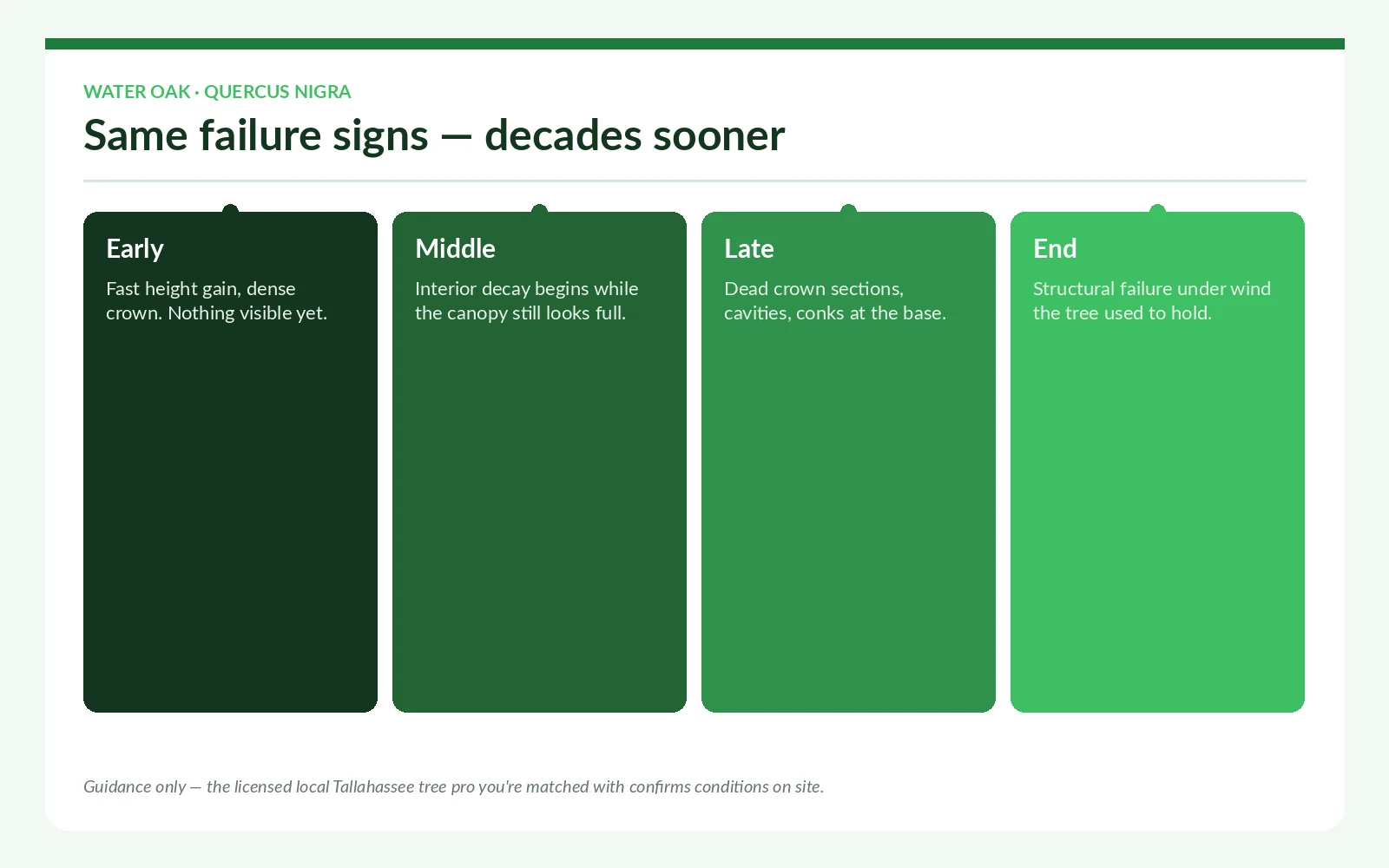
📞 Call Now — (858) 319-0022Limbs dropping in calm weather? Call now — hazard trees are triaged first, any hour.The water oak (Quercus nigra) is the tree Tallahassee homeowners most often mistake for a keeper. It looks like a proper shade oak: tall, upright, full canopy, spade-shaped leaves. What it actually is, structurally speaking, is a short-lived pioneer species that grows fast in disturbed ground, hollows out early, and then comes apart — usually somewhere between 40 and 60 years old, which is to say, right about now for most of the ones standing in Leon County yards.
Water oaks and laurel oaks are the two species behind the large majority of storm-season structural failures here. If you have one leaning over a roof, a driveway, or a bedroom, this page is about how to tell whether it is still holding, and what removal actually involves.
Know your oak: water, laurel, or live?
Getting the species right changes the entire recommendation, and people mix these up constantly.
| Water oak | Laurel oak | Live oak | |
|---|---|---|---|
| Leaf | Spatula- or spade-shaped, widest near the tip, often with a rounded lobed end. | Longer, narrower, mostly smooth-edged, sometimes wavy. | Small, thick, leathery, dark green, evergreen. |
| Habit | Fast, upright, weedy — volunteers everywhere. | Fast, upright, oval crown. | Slow, wide, sprawling. |
| Sound structure | Roughly 40–60 years. | Roughly 50–70 years. | Centuries. |
| Decay tendency | High — hollows early, often from the base up. | High. | Low — dense, rot-resistant wood. |
| Storm behavior | Sheds large limbs; whole-tree failure on wet soils. | Sheds large limbs; trunk snaps. | Usually survives; sheds occasional big limbs. |
If you are not sure what you have, that is a perfectly good reason to get an arborist to look. See also laurel oak removal and live oak care.
Why water oaks fail here specifically
Three Tallahassee-specific factors stack against them.
Soil. Water oaks earn the name — they favor bottomland and wet ground, and they are everywhere on the sandier, wetter soils south and west of the Cody Scarp: Woodville, Apalachee Ridge, the Lake Munson and St. Marks drainages. Saturated soil after a week of Big Bend rain reduces root-plate anchorage, and a top-heavy, decayed water oak in soaked ground is a tree that tips rather than breaks.
Growth rate. Fast growth means low-density wood. Low-density wood decays quickly and holds fungal infection well. Every wound — a topping cut, a lawnmower strike on the flare, a limb torn off in a storm — becomes a decay column.
Storm exposure. Hermine (2016), Michael (2018), Idalia (2023), the May 10, 2024 EF-2 tornadoes, and Helene (2024) each put load on trees that were already compromised. Damage from those events keeps expressing itself for years: a water oak that took a twist in 2024 may be the one that fails in 2027.
The warning signs
- Cavities at the base or at branch unions. Water oaks hollow from the bottom up more often than the top down.
- Fungal conks or mushrooms at the root flare. Ganoderma and Armillaria both show up here. A conk means the decay is already well advanced.
- Limbs dropping in calm weather. The single most serious sign.
- Deadwood standing above the canopy line. Stag-heading — the tree can no longer feed its own crown.
- Included bark at a V-shaped union. Bark pinched between two codominant stems instead of a proper branch collar. These split.
- Soil cracking or heaving on the opposite side of a lean. That is a root plate moving. Treat it as an emergency — see leaning trees.
- Carpenter ants streaming from the trunk. They follow decay; they do not cause it, but they confirm it.
Cracked trunk, lifting soil, or a limb already over the roof? Get people and cars out of the fall zone, then call now — life-safety situations are triaged first.
📞 Call Now — (858) 319-0022Vetted local pros — availability depends on independent provider schedules and demand.*Can a water oak be saved?
Sometimes — and it is worth asking rather than assuming.
A structurally sound water oak, well away from any target, is a legitimate shade tree with maybe a couple of decades left in it. Reduction pruning to lower end-weight, deadwood removal, and cabling a codominant union can meaningfully extend its useful life. That is a real option and a good arborist will offer it.
What cannot be fixed is decay. Hollow wood does not regrow. If the trunk is substantially compromised and the tree stands over something you care about, the honest answer is removal — and the practical question becomes when, on your schedule and your budget, rather than at 2 a.m. in a tropical storm. A tree risk assessment is how that gets decided honestly instead of by whoever wants to sell you the job.
What removal involves
Removing a decayed water oak is technically harder than removing a healthy tree of the same size:
- It may be unsafe to climb. A climber’s life depends on the wood holding. Decayed unions cannot be trusted, which pushes the job to a crane or a lift — see crane tree removal.
- Decayed wood behaves badly under a saw. It does not hinge predictably. Pieces let go early.
- They are usually right over something. Almost every removal here is a controlled dismantle over a roof, a fence, or a driveway.
- Wet ground limits equipment. On the soils these trees favor, a heavy machine can bog or rut. Timing and matting matter.
What drives the scope
| Factor | Why it matters |
|---|---|
| Trunk diameter & height | Water oaks reach 50–80 feet routinely. Size is the biggest single driver. |
| Extent of decay | More decay means less climbing and more crane or lift. |
| Targets | House, garage, pool cage, fence, power drop — each adds rigging steps. |
| Ground condition | Saturated soil restricts equipment and may push the job to a drier window. |
| Access | Backyard-only access with a narrow gate changes the whole method. |
| Wood, debris & stump | Haul-off and stump grinding are separate scope lines — get them in writing. |
These are local-market realities, not our prices. The pro you’re matched with walks the tree and gives the binding written quote. See the tree removal cost guide.
How getting matched works
Permits and the hazard exception
A large water oak may be a protected tree under City of Tallahassee §5-83 or Leon County’s Chapter 10 rules, and Canopy Road Protection Zones add a further layer — even for a tree in visible decline. Florida Statute §163.045 is the relief valve: a residential property owner may remove a tree without local approval when documentation from an ISA-certified arborist or licensed landscape architect establishes an unacceptable risk. Get that documentation in writing before the tree comes down. See the permit guide and City tree removal rules.
Before you call — how to describe it
- Leaf shape if you can grab one — spade-like and widest near the tip suggests water oak.
- Trunk size — arms around it, or two people?
- The signs — cavity, conks, calm-weather limb drop, cracks, soil movement.
- Targets — what is within falling distance.
- Ground — does the area stay soggy after rain? That affects equipment.
Frequently asked questions
How long do water oaks live in Tallahassee?
They can persist longer, but their structurally sound life is roughly 40 to 60 years. After that, internal decay is common even when the canopy still looks full. That is why so many of them are failing in Leon County neighborhoods right now.
How do I tell a water oak from a laurel oak?
Water oak leaves are spatula- or spade-shaped, widest near the tip, often with a rounded lobed end. Laurel oak leaves are longer, narrower, and mostly smooth-edged. Both are fast-growing, upright, and decay-prone, so the practical management advice is similar — but an arborist can confirm.
My water oak looks healthy. Should I be worried?
A full green canopy does not rule out internal decay — water oaks hollow while still leafing out. Look at the base for cavities and conks, watch for limbs dropping in calm weather, and get an assessment if the tree is over a structure and is 40-plus years old.
Can a leaning water oak be straightened or saved?
A long-standing lean with a sound root plate can sometimes be managed with end-weight reduction and cabling. But if soil is cracking or heaving on the side opposite the lean, that is root-plate failure in progress — keep people out of the fall zone and treat it as an emergency.
How much does water oak removal cost in Tallahassee?
It is scoped to the tree — size, decay, targets underneath, ground conditions, access, and stump all move it, so there is no honest flat figure. The arborist you’re matched with assesses on site and gives a written quote before any work begins.
Do I need a permit to remove a water oak?
Possibly — City §5-83, Leon County Chapter 10, and Canopy Road zones can all apply depending on size and location. Florida Statute §163.045 allows removal without local approval when an ISA-certified arborist documents unacceptable risk. Get the written determination first.
Related Tallahassee tree services
Laurel Oak Removal
Live Oak Removal
Pine Tree Removal
Hazardous Tree Removal
Leaning Tree Guide
Tree Risk Assessment
When to Remove a Tree
Stump Grinding
Find out what your water oak is really doing
Call now and we’ll connect you with a vetted, licensed and insured Tallahassee-area arborist. Free to use, no obligation, no sign-up.
📞 Call Now — (858) 319-0022Tallahassee Tree Service is a free referral service. Tallahassee Tree Service is not a licensed tree service provider and does not directly provide tree care services. All work is performed by independent, licensed and insured third-party providers in your area. Calls and form submissions placed through this site may be connected with a participating provider, and you may be contacted by that provider regarding your request. Same-day, emergency, and 24/7 availability are not guaranteed and depend on provider schedules, location, and demand. Service availability, pricing, licensing, and final response times are determined solely by the providers. It is the responsibility of the homeowner to verify that the hired contractor furnishes the necessary license and insurance required for the work being performed. All persons depicted in a photo or video are actors or models and not contractors listed on Tallahassee Tree Service.