Tree Risk Assessment in Tallahassee, FL
A risk assessment isn’t a removal job — it’s a standalone professional evaluation with a written report: risk ratings, failure-mode analysis, and management recommendations under the ISA’s TRAQ methodology. Call now and we’ll connect you with a vetted, TRAQ-qualified Tallahassee arborist who gets paid for the assessment — not for selling you a removal.
📞 Call Now — (858) 319-0022Prefer not to type? Just call now — 24/7 dispatch line*The tree risk assessment Tallahassee homeowners book is its own service category, separate from tree removal, hazardous tree removal, or pruning. The deliverable is a written report, not a tree on the ground. The ISA-certified arborist you’re matched with walks the property, evaluates each significant tree, and produces a document you can use for management decisions, insurance posture, real-estate transactions, or HOA documentation requirements.
The methodology is the International Society of Arboriculture’s Tree Risk Assessment Qualification (TRAQ) — the industry-standard framework for evaluating tree risk in residential and commercial settings, recognized by insurance carriers, courts, municipalities, and the City of Tallahassee Growth Management office. A TRAQ report is not a contractor’s opinion; it’s a structured evaluation with documented methodology, defined risk categories, and traceable reasoning.
Why the distinction matters: a contractor’s no-cost sales visit has an obvious financial incentive baked in — the recommendation tends to skew toward removal, because removal is the work. A paid risk assessment works the opposite way. The arborist is paid for the evaluation regardless of the outcome. Healthy trees? The report says so and you save money. Compromised trees? The report says that too, with documented reasoning. That independence is what makes the report usable for insurance, real estate, and legal purposes.
Tallahassee context: Helene 2024 and the January 2025 ice storm both left significant numbers of compromised-but-not-yet-failed trees across Killearn, Bradfordville, Lake Jackson, SouthWood, and Northwest Tallahassee. Many homeowners wanted professional documentation of which trees were now hazardous before the next hurricane season — partly risk management, partly insurance posture, and partly because the city’s §5-83 ordinance and Fla. Stat. §163.045 interact with arborist-documented risk in ways that change what permits any later removal needs.
Who books a tree risk assessment in Tallahassee — and why
🏠 Homeowners (pre-storm or post-storm)
Owns the property, lives on it, suspects certain trees are compromised. The common booking windows are May–June (pre-hurricane season) and October–February (post-storm). Wants to know which trees are actually risky, which can stay, and which removals to budget for — often following up with hazardous tree removal on anything rated high or extreme.
🔑 Buyers (real-estate due diligence)
Under contract on a property with significant tree cover. A standard home inspection does not address trees, so the buyer’s agent or inspector recommends a tree risk assessment as part of due diligence — especially common on Killearn, Bradfordville, and Myers Park properties with mature canopies. The report becomes the basis for negotiating repair credits or walking away. Time-sensitive work inside a 7–14-day inspection window.
🏷 Sellers (pre-listing documentation)
Listing the property and wants to head off tree issues during the buyer’s due-diligence window. A pre-listing report documents the condition of significant trees at the time of sale, identifies any work worth doing before closing, and hands the buyer professional documentation that often eliminates a renegotiation point. Increasingly standard on higher-value Tallahassee listings with heavy canopy.
🏢 HOAs and property managers
Manages common areas or a rental portfolio with significant tree cover. Books assessments on an annual or biannual cycle to maintain risk-management documentation and meet fiduciary-duty standards. Reports become part of the management file and support board decisions on tree-care budgets.
⚖ Attorneys and insurance adjusters
Engaged in tree-related litigation, claim disputes, or pre-claim documentation. The TRAQ report format is recognized in Florida courts and by major carriers. Expert documentation comes from the assessing arborist; testimony engagements are handled separately, often with a specific scope of work from counsel.
📋 Permit & statute documentation
Fla. Stat. §163.045 allows removal of unacceptable-risk trees on single-family residential property without a §5-83 permit when a qualified arborist documents the risk in writing. The standalone risk assessment report is the document that triggers the statute — the permit guide covers the full §5-83 framework.
The ISA TRAQ risk matrix — how trees get rated
TRAQ assigns each evaluated tree to one of four risk tiers based on three combined factors: likelihood of failure, likelihood of impact, and consequence severity.
| Rating | What it means | Typical recommendation |
|---|---|---|
| Low | Structurally sound, no significant defects, low likelihood of failure within the assessment period. Most healthy Tallahassee live oaks land here. | Continue the normal pruning cycle; reassess every 3–5 years. |
| Moderate | Defects or stress indicators worth monitoring; failure plausible but consequence severity limited. Many mid-decline laurel oaks land here. | Targeted pruning, annual reassessment, or specific mitigation. |
| High | Failure likely within the assessment period AND the tree threatens a structure, person, or high-value target. | Removal generally recommended unless aggressive mitigation is feasible. Qualifies for §163.045 documentation on single-family residential property. |
| Extreme | Imminent failure expected with severe consequences — active root-plate failure, severe lean toward a structure, major structural compromise. | Prompt removal, not a future schedule. Qualifies for §163.045 documentation. |
How the rating gets calculated: the arborist evaluates three factors and combines them through the TRAQ matrix. Likelihood of failure — how probable is it the tree (or part of it) fails within the assessment period? Likelihood of impact — if it fails, how likely is it to hit a person or property of value? Consequence severity — if it hits, how bad is the damage? The combination drives the final rating, never a single factor in isolation.
What’s actually in the report
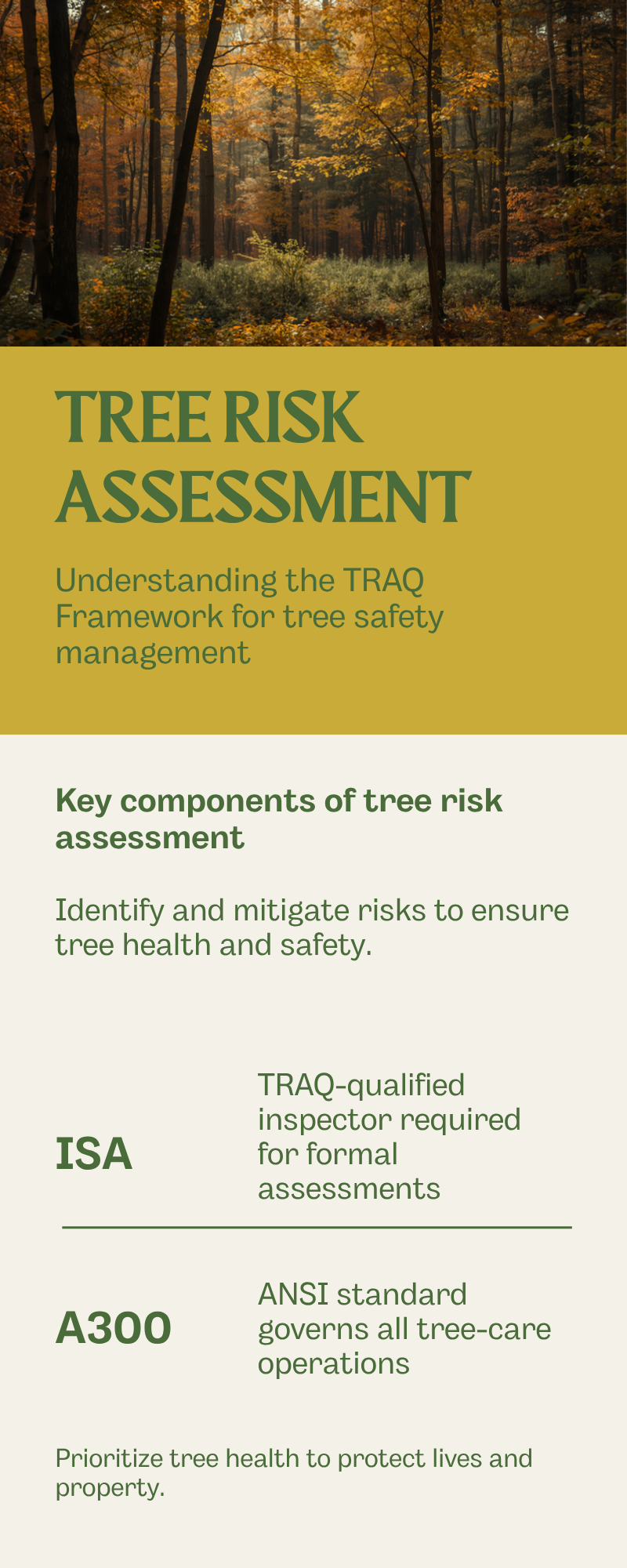
The deliverable is a structured written document — typically 8–20 pages — produced by an ISA-certified arborist using TRAQ methodology:
- Property identification. Address, parcel ID, assessment date, the arborist’s name and ISA certification number, and the methodology used (TRAQ Level 1 limited visual, Level 2 basic, or Level 3 advanced, per scope).
- Tree-by-tree inventory. Each significant tree gets its own entry: species with botanical name, DBH, approximate height, location relative to structures and targets, condition, observed defects, and its TRAQ rating.
- Failure-mode analysis. For every tree rated moderate or higher — the most likely failure mode (whole-tree windthrow, branch failure at a union, trunk failure at a decay column, root-plate rotation) and the conditions under which failure is most probable.
- Photographic documentation. Multiple angles per significant tree, with annotated callouts on visible defects — cracks, conks, lean measurements, deadwood, root-plate indicators — plus timestamps and GPS where applicable.
- Management recommendations. Per tree: continue routine maintenance, schedule specific pruning, schedule removal, or reassess within a set window — grouped urgent / near-term / routine.
- Statute and ordinance documentation. Where applicable, explicit reference to Fla. Stat. §163.045 for trees rated high or extreme on single-family residential property — the documentation that bypasses the §5-83 permit pathway for those removals.
- Limitations statement. TRAQ Level 1 and 2 assessments are visual, from the ground; they can’t detect every internal defect. The report states exactly what was and wasn’t included — important for later legal or insurance use.
- Signature and credential block. ISA credential number, TRAQ qualification, license/insurance info, and signature — the block that makes the report acceptable to carriers, courts, and the city. (Verify any credential yourself at treesaregood.org.)
Authority source: the TRAQ methodology is published by the International Society of Arboriculture; UF/IFAS Extension publishes complementary Florida tree-assessment guidance at edis.ifas.ufl.edu.
Visible lean, heaving soil, conks at the base, or a big limb that cracked in the last storm? Don’t wait for a scheduled report — life-safety situations are triaged first.
Get matched with a local pro — call now24/7 dispatch line — availability depends on independent provider schedules and demand.*What a risk assessment typically costs in Tallahassee
Risk assessment is priced like a professional service — think home inspection, not tree job. The figures below are typical local-market patterns, not our prices: Tallahassee Tree Service Co. is a free dispatch service, and the TRAQ-qualified arborist you’re matched with quotes their own fee in writing after a short scoping call.
| Assessment scope | Property profile | Relative Cost Level |
|---|---|---|
| Single-tree TRAQ Level 2 assessment | One tree of concern | Lowest |
| Small property, full inventory | Up to 5 significant trees | Low |
| Standard property, full inventory | 5–15 significant trees | Moderate |
| Large property, full inventory | 15–30 significant trees | High |
| Estate property, full inventory | 30+ significant trees | Highest |
| Pre-purchase real-estate assessment | Standard property, expedited | Moderate to High |
| Pre-listing seller documentation | Standard property | Moderate |
| Annual recurring (HOA / property mgmt) | Per visit, contracted | Custom quote from the pro |
| TRAQ Level 3 advanced (resistograph, etc.) | Per-tree add-on | Moderate Add-on |
| Litigation-grade expert documentation | Custom scope | Highest (Custom Scope) |
Market data referenced from published Tallahassee-area pricing sources (2025) and cross-checked against Leon County rates the dispatch network sees. Assessment fees pay for the evaluation itself, regardless of whether any subsequent tree work is recommended or booked.
Why a paid assessment beats a contractor’s sales visit: a no-cost visit from a tree contractor is, structurally, a sales call — the incentive is to find work, and recommended removals skew high. A paid assessment buys independent judgment. On a property with 15 mature trees, a report that recommends removing 3 trees instead of the 7 a sales-driven visit might push can save a homeowner substantially on unnecessary removal work, net of the assessment fee.
When to book — the six windows where the math works hardest
🌀 Pre-hurricane season (May–June)
Hurricane season opens June 1. The May–June window catches problems while there’s still time to schedule corrective hurricane tree prep or hazardous removal before storms threaten — the single highest-value booking window in Tallahassee, and it fills weeks ahead.
🌪 Post-storm (October–February)
After Helene 2024, Idalia 2023, the May 2024 EF-2 tornadoes, or any major event, mature trees often carry hidden damage that doesn’t show for weeks or months. A post-storm assessment catches the compromised-but-still-leafing-out trees before the next season. Common pairing: assessment in October, removals in December–January.
🔑 Pre-purchase due diligence (under contract)
The inspection window is typically 7–14 days, so this is time-boxed work: scope on the buyer’s timeline, walk the property, deliver the report in time to drive negotiation or contingency decisions. Especially common on Killearn, Bradfordville, and Myers Park properties.
🏷 Pre-listing (seller documentation)
Booked 30–60 days before listing. Identifies trees worth addressing pre-sale, documents the condition of the rest, and hands the buyer a professional baseline — removing a classic renegotiation lever.
⚠ After visible warning signs
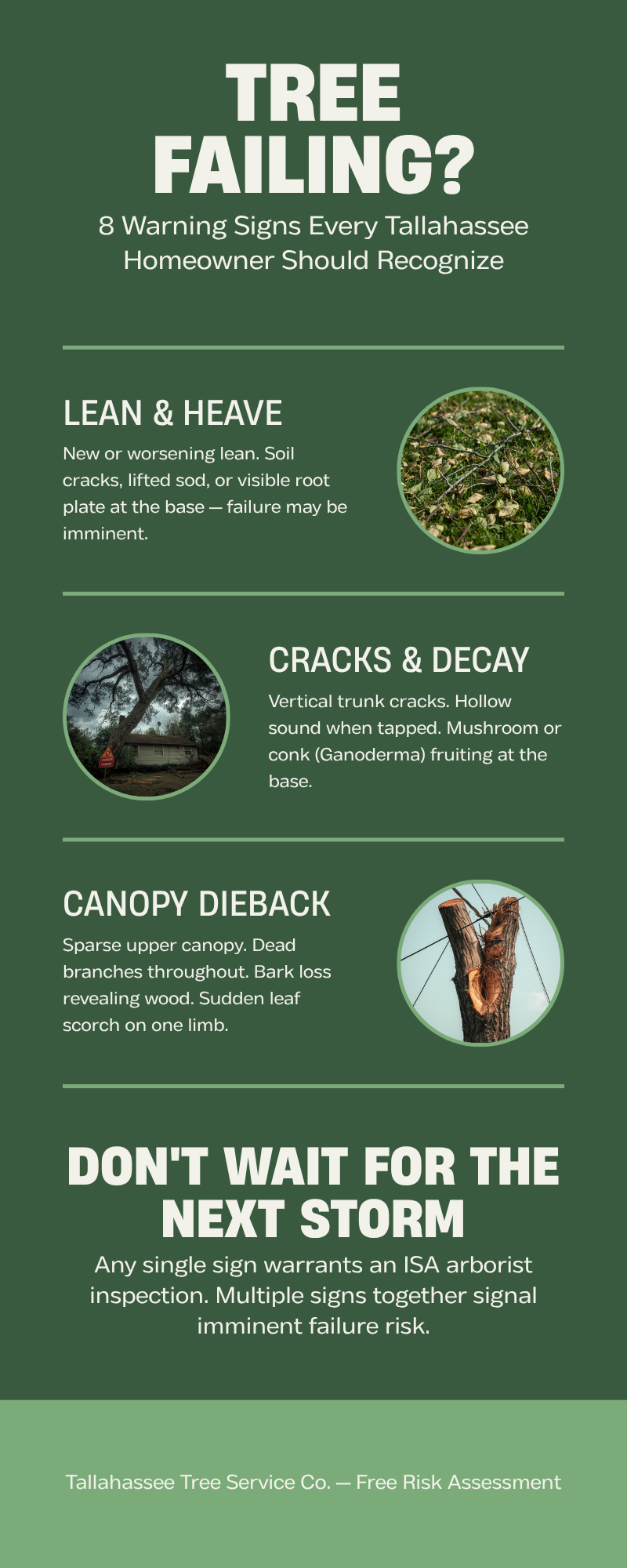
Visible lean, heaving soil, mushrooms or conks at the base, hollow trunk, vertical cracks, codominant unions, dead branches in a living crown — the classic seven from the hazardous tree removal guide. Book the assessment to find out whether removal is warranted and to secure §163.045 documentation if it is.
📅 Recurring schedule (HOAs, estates)
Annual or biannual TRAQ cycles document changing conditions, support fiduciary standards for boards, and build a defensible record of risk-management activity on properties with heavy canopy.
How getting matched works
Two things homeowners ask after the report lands
What if the report recommends removing trees I want to keep?
The report is a professional opinion, not a mandate — you make the final decision. Plenty of homeowners receive recommended removals and leave the trees standing; the report then serves as documentation of the advice provided. From an insurance and liability standpoint, the documentation often matters more than whether you act on it — and some owners specifically use a report to push back against someone else’s removal demand.
Can the same arborist who assessed the trees do the removal?
The arborists in the network are independent professionals — they can be engaged for follow-up work, but there’s no obligation and no tied-to-removal sales requirement. Some homeowners keep the same pro because the relationship is established; others use the report to bid the work competitively. Either path is fine.
Frequently asked questions
How is a risk assessment different from a contractor’s no-cost visit?
A contractor’s sales visit exists to find work, and recommended removals skew high. A paid TRAQ assessment buys independent professional judgment — the arborist is paid for the evaluation regardless of any later work, and the deliverable is a written report, not a removal quote.
How much does a tree risk assessment cost in Tallahassee?
Typical local-market patterns, low to high: single-tree assessments are the most affordable tier; small and standard properties fall in the moderate range; large and estate properties run highest; expedited pre-purchase work and Level 3 instrument testing add a premium on top. These are market patterns, not our prices — the arborist you’re matched with quotes the fixed fee in writing.
What is ISA TRAQ and why does it matter?
TRAQ (Tree Risk Assessment Qualification) is the International Society of Arboriculture’s structured methodology for evaluating tree risk. It requires specific training and an exam — only a subset of ISA-certified arborists hold it — and it’s recognized by insurance carriers, courts, and the City of Tallahassee. A TRAQ report carries weight a non-TRAQ contractor opinion doesn’t.
Can the report be used for §163.045 documentation?
Yes, when applicable. Fla. Stat. §163.045 allows removal of unacceptable-risk trees on single-family residential property without a §5-83 permit when a qualified arborist documents the risk in writing. A TRAQ report rating a tree high or extreme on such a property satisfies that requirement, and the report references the statute explicitly where it applies.
Will my insurance company accept the report?
Major Florida carriers — State Farm, Citizens, Allstate, Tower Hill, Heritage among them — generally accept TRAQ-qualified reports for tree-risk documentation. The credential block (ISA number, TRAQ verification, license/insurance info, signature) is what adjusters look for.
Does the assessment guarantee my trees won’t fail?
No — and any arborist who says otherwise is misrepresenting the methodology. TRAQ Levels 1 and 2 are visual, ground-based evaluations; they can’t detect every internal defect or predict every failure, and the report says so in its limitations statement. What you get is the best available professional judgment on observable conditions, with documented reasoning.
Related Tallahassee tree services & guides
Hazardous Tree Removal
Tree Removal
Dead Tree Removal
Tree Pruning
Tree Branch Removal
Hurricane Tree Prep
Storm-Damaged Trees
Crane Tree Removal
Tree Permit Guide
Laurel Oak Problems
ISA Certified Arborists
Tree Removal Cost Guide
Want a straight answer on your trees — in writing?
Call now and we’ll connect you with a vetted, ISA-certified, TRAQ-qualified Tallahassee arborist serving Killearn, Bradfordville, Lake Jackson, Midtown, Myers Park, Betton Hills, SouthWood, Woodville, and all of Leon and Wakulla Counties. Free to use, no obligation, no sign-up.
📞 Call Now — (858) 319-0022Or call now — 24/7 dispatch line*Tallahassee Tree Service Co. is a free dispatch and referral service. We are not a tree-service contractor and do not perform tree work ourselves. When you call, we connect you with an independent, licensed and insured local tree-care professional who carries their own license and insurance and provides any binding quote. Price information anywhere on this site is typical local-market information for planning only; people or scenes in images are illustrative.
References to “24/7,” “same-day,” or “emergency” describe call-handling and dispatch availability. Actual on-site response times depend on the independent professional’s schedule, crew availability, and weather, and are not guaranteed. Statute information is general reference, not legal advice.