Killearn Lakes · NE Tallahassee FL

Tree Service Killearn Lakes Storm-Ready ISA-Certified Arborists

Killearn Lakes has the most documented storm tree damage in recent Tallahassee history — including a confirmed tornado in April 2025 and an 80 mph straight-line wind event. The arborists dispatched know this community's lakes, its wind exposure, its dominant species, and its tree failure patterns from the ground up.

ISA-Certified Arborists · Storm Specialists · Lake-Edge Access Crews · 24/7 Dispatch
(850) 619-0000 Tap to Call · Free Estimate

Most Killearn Lakes estimates scheduled within 48–72 hours · 2–4 hr emergency target

✔ Killearn Lakes & Golden Eagle ✔ April 2025 Tornado Response ✔ Lake-Edge Climbing Crews ✔ 24/7 Emergency Dispatch
🚨 April 7, 2025: A confirmed tornado touched down in Killearn Lakes — trees through structures on Deerlake Road. If you haven't had your trees assessed since then, call before the next storm season.
April 2025 Tornado Confirmed
80 mph Straight-Line Winds
24/7 Emergency Dispatch
2–4 hr Storm Response Target

Tree Service Across Killearn Lakes & the Lake Iamonia Corridor

Areas served within the Killearn Lakes corridor and adjacent NE Tallahassee communities:

Killearn Lakes Golden Eagle Lake Iamonia area Deerlake Road corridor Bannerman Road Thomasville Rd N. corridor Bradfordville (adjacent) Killearn Estates (adjacent) Buck Lake (adjacent)

Why Killearn Lakes Has the Most Documented Recent Storm Tree Damage in Tallahassee

If you've lived in Killearn Lakes for any length of time, you already know this community takes a hit when storms roll through. It's not bad luck — it's geography. Understanding exactly why helps you make better decisions about which trees on your property are genuinely high-risk before the next event.

🌊 The Lake-Crossing Wind Effect — Killearn Lakes' Defining Storm Risk Factor

Killearn Lakes Plantation wraps around five private lakes including Lake Iamonia. Storm cells tracking northeast — the dominant severe weather track for Tallahassee — accelerate as they cross open water and slam into the wooded residential neighborhoods on the far shore. Trees in the water-facing rows of lakefront properties absorb that accelerated wind load first, and they're also the trees most likely to have saturated root zones before the storm even arrives. A tree with a wet, soft root plate loses its anchorage just when it needs it most.

What the storm record actually shows. On April 7, 2025, a confirmed tornado struck the Killearn Lakes community, bringing a tree through a bedroom wall on Deerlake Road and snapping multiple trees across the neighborhood. A separate storm event produced confirmed 80 mph straight-line winds through the same community — exceeding Category 1 hurricane-strength winds at the point of measurement. These are not once-in-a-generation events. They are the baseline risk profile for a neighborhood positioned exactly where Tallahassee's storm track converges with open-water wind acceleration and dense residential canopy.

What this means for your specific property. If your home faces one of the lakes, an annual pre-hurricane-season arborist assessment of every significant tree on the lake-facing side of your lot is the appropriate posture. Slash pines over 40 feet within striking distance of a structure should be assessed for SPB infestation and structural integrity every spring. Water oaks near the lake edge are your highest storm-failure risk — they have the shallowest root systems of the major oaks and they're the most commonly downed tree in Tallahassee storm events.

Storm-Damaged Tree, Active Hazard, or Lakefront Concern?

24/7 emergency dispatch with 2–4 hr response target for structural emergencies in Killearn Lakes. Florida Statute §163.045 imminent-danger documentation handled with same-visit ISA-CA TRAQ assessment when applicable.

📞 (850) 619-0000

Killearn Lakes Storm Damage History — Documented Events

These are verified events — not estimates or generalizations. This is the documented baseline that defines the Killearn Lakes tree risk picture.

Confirmed Tornado · April 7, 2025

Confirmed Tornado — Deerlake Road

A confirmed tornado struck the Killearn Lakes community on the morning of April 7, 2025. One Tallahassee family had a large tree smash through their bedroom window. Multiple trees were snapped mid-trunk — the characteristic failure signature of true tornadic winds versus straight-line winds. The National Weather Service surveyed the damage corridor the following day. Leon County Emergency Management dispatched crews to assist with road clearing. Several homes sustained structural damage from direct tree strikes.

80 MPH Straight-Line Winds · NWS-Confirmed

Severe Thunderstorm — 80 MPH Straight-Line Winds

A separate severe weather event produced confirmed 80 mph straight-line winds across Killearn Lakes. Chainsaws could be heard throughout the night as residents self-organized to clear roadways and driveways. Heavy debris alongside roads and visible structural damage to homes was documented the following morning. The National Weather Service ultimately determined this event did not produce a tornado but confirmed the 80 mph wind measurement — exceeding Category 1 hurricane-strength at the point of measurement.

Lake Iamonia Corridor · Documented

Lake Iamonia Corridor — Multiple Damage Events

The Lake Iamonia area has documented repeated storm damage across multiple events. The lake's position in the northeast portion of the Killearn Lakes community places it directly in the path of northeast-tracking storm cells. Properties along the lake's southern and eastern shores have the highest documented damage frequency in the corridor. Any tree on the lake-facing exposure of a property in this zone should be professionally assessed annually before hurricane season opens June 1.

📋 What to Do Immediately After Any Storm in Killearn Lakes

Before you call a tree service: If a tree has fallen on your home, get everyone out of the impact zone and any adjacent rooms. Call 9-1-1 if anyone is injured. Call your utility provider immediately if any power lines are involved — do not approach the tree if power lines are down. Then photograph everything from a safe distance before any cleanup begins — your insurance adjuster needs this documentation.

After photographing: Call to dispatch a crew. 24/7 dispatch to Killearn Lakes with priority response for structures — the target is 2–4 hours for tree-on-structure emergencies. Document the date and time you called.

Insurance note: Standard Florida HO-3 policies typically cover tree removal when the tree fell onto an insured structure. Trees that fall in the yard without hitting a structure are generally not covered. The arborist crews dispatched provide the written condition documentation your adjuster requires.

Killearn Lakes Tree Species — Storm Risk Guide

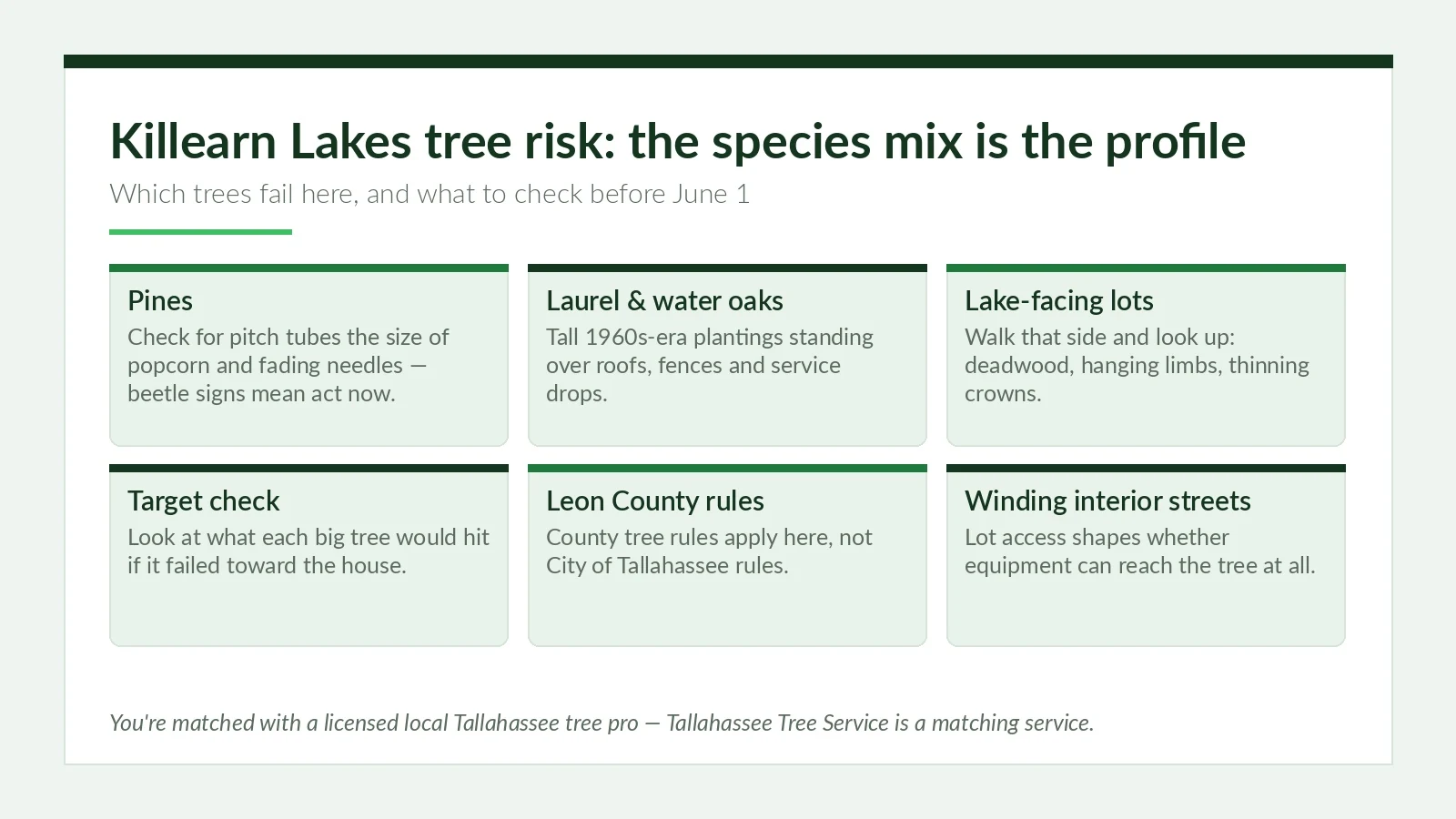
Killearn Lakes' younger canopy (1990s–2000s development) is predominantly water oak, slash pine, and laurel oak — three species with very different storm failure profiles. Here's what each one does and what to watch for.

SpeciesStorm RiskHow It FailsWarning SignsAction
Water Oak
Quercus nigra
HIGHComplete uprooting — shallow root plate loses anchorage in saturated soil, especially on lake-adjacent lots. Most common downed tree in Tallahassee storms.Any crown thinning; soil cracking or mounding at base; tree was leaning before storm; lake-facing exposure on saturated groundAnnual pre-storm assessment if near structure. Crown reduction to reduce wind sail. Removal if root plate is compromised.
Slash Pine
Pinus elliottii
HIGH (Tornadic)Mid-trunk snapping in tornado-force winds — produces large, dangerous projectile debris. Common in Killearn Lakes' 1990s-era pine stands.Pitch tubes on bark (SPB infestation); crown fading green to yellow-brown; leaning; previous crown damage from prior stormsSPB inspection every spring. Remove any pine within one tree-length of an occupied structure if over 50 feet tall and showing decline.
Laurel Oak
Quercus laurifolia
MEDIUMCodominant stem failure at the union — particularly dangerous at 30–50 mph sustained winds when the attachment is weakened by included bark or internal decay.Two stems of equal size meeting at narrow angle; silver-gray bark patches (Hypoxylon canker); crown thinning in one quadrantISA arborist assessment to check for included bark. Consider cabling if structurally sound. Removal if internal decay found.
Live Oak
Quercus virginiana
LOWERVery wind-resistant when structurally sound. Rare whole-tree failure except in direct tornado path. Main risk is overextended lateral branches under sustained high winds.Very long horizontal branches over structures; visible split or crack in major crotches; root plate heave after recent floodingAnnual pruning to maintain end-weight balance. Cabling for overextended lateral branches. Structural assessment every 5 years for mature specimens.
Bald Cypress
Taxodium distichum
LOWESTAmong the most wind-resistant trees in Florida — evolved for hurricane conditions. Rarely fails structurally even in direct storm paths.Ganoderma conks at base; significant trunk decay; root damage from trenching or construction near the baseInspect base annually for fungal conks. Otherwise low intervention needed.

🌊 Lake-Proximity Tree Rules for Killearn Lakes Properties

25–50 feet from lake edge: Root zones are seasonally saturated — water oaks and slash pines in this zone have dramatically lower storm anchorage than the same species 100 feet back from the water. Annual pre-storm assessment recommended. Consider proactive removal of any tree showing decline within striking distance of the structure.
Wetland buffer zones: Northwest Florida Water Management District (NWFWMD) buffers protect vegetation within designated wetland boundaries — which can include lake shoreline vegetation. Work in these buffers may require NWFWMD coordination. NWFWMD: (850) 539-5999. The arborists dispatched will identify any wetland-adjacent constraints during the on-site estimate.
Equipment access on lake-side: Most Killearn Lakes lake-edge properties have decorative fencing between the home and the water, limiting machine access to the water-facing side. Climbing crews are typically required for any work on the lake-facing side — budget accordingly and confirm access during the estimate.
Lightning exposure: Isolated trees on open lakefront lots are primary lightning targets — they're the tallest objects in an open area. Trees within 10 feet of the home on lakefront lots should be considered for lightning protection systems. Tallahassee averages 80–100 lightning strikes per square mile annually — among the highest in the US.

Killearn Lakes Permits — Leon County Framework, Not City of Tallahassee

An important jurisdictional distinction: Killearn Lakes is different from Killearn Estates for tree permit purposes. Confirming which framework applies to your specific street is the first step before authorizing any significant removal.

Killearn Lakes is primarily unincorporated Leon County. Most of Killearn Lakes Plantation sits outside City of Tallahassee limits — meaning Leon County §10-4.362 applies, not City LDC §5-83. This is a meaningful difference: Leon County protects live oak (Quercus virginiana) and longleaf pine (Pinus palustris) at 12 inches DBH (much smaller than the City's 36" threshold), and protects dogwood at 4 inches DBH. Many trees that would be exempt from a City permit require Leon County review.

Some streets may have been annexed at different times. Residential annexations into the City of Tallahassee have happened in stages over the decades. The most reliable approach is to verify your specific address with both Leon County Development Services at (850) 606-1300 and City Growth Management at (850) 891-6586 before authorizing removal of a significant tree. The arborists dispatched will note jurisdictional ambiguity during the on-site estimate.

Florida Statute §163.045 hazard tree exemption applies regardless of jurisdiction. An ISA-certified arborist documenting a tree as a structural hazard provides statutory support for expedited or emergency removal. This applies the same way in Killearn Lakes (Leon County) as it does in Killearn Estates (City) — but the documentation is filed with the relevant agency for your specific property.

Tree Services Available in Killearn Lakes

All core services with Killearn-Lakes-specific knowledge — storm damage response, lake-edge access constraints, NWFWMD wetland buffer awareness, and 1990s-era slash pine SPB monitoring — built into every estimate.

🚨

Emergency Storm Response — Priority Dispatch

Killearn Lakes is one of the highest-priority emergency dispatch areas because of its documented storm damage history. 24/7 dispatch for fallen trees, trees on structures, hanging widow makers, and blocked driveways. Target 2–4 hour response for structural emergencies. During named storm events, Killearn Lakes properties with active structural damage are prioritized.

Emergency service →
🌳

Tree Removal — Killearn Lakes

Water oak, slash pine, and laurel oak removal across all Killearn Lakes sub-areas. Lake-adjacent removal requiring NWFWMD coordination handled — buffer position checked during the estimate. Climbing crews available for lake-facing sides where machine access is blocked by fencing. Leon County permit handling for protected species.

Removal services →
✂️

Pre-Storm Season Trimming

April–May is the critical trimming window for Killearn Lakes — before hurricane season opens June 1. Crown reduction on water oaks, deadwood removal from laurel oaks, and end-weight reduction on overextended live oak branches reduces the wind sail that leads to storm failure. Annual pre-storm trimming of high-risk trees near structures is among the highest-ROI tree investments here.

Trimming services →
🌿

ISA Arborist Risk Assessment

Post-storm assessment to identify hidden damage — trees that look intact after a storm event may have root plate compromise or internal splitting that isn't visible from outside. Pre-storm seasonal assessments to identify which trees are high risk before they become emergencies. Written reports for insurance, HOA, or permit applications.

Storm damage guide →
🪲

Slash Pine SPB Inspection

Killearn Lakes' 1990s-era slash pine plantings are now in the peak SPB vulnerability window (25–35 yr old pines). Spring inspection for pitch tubes, frass, and crown fade. On-site chipping per FDACS protocol when SPB confirmed. FDACS 2025 monitoring data confirms active SPB pressure across the Big Bend.

SPB guide →
🔗

Tree Cabling & Lightning Protection

Structural cabling for laurel oaks with codominant stems before they fail in the next storm event. Lightning protection for tall slash pines and oaks on open lakefront lots — isolated lakefront trees are primary lightning targets in Tallahassee's 80–100 strike/sq mi annual environment. ANSI A300 Part 3 standard installation.

Cabling services →

Pre-Storm Season Assessment Before June 1?

April–May is the critical window for pre-storm tree work in Killearn Lakes. Lake-facing tree assessment, slash pine SPB inspection, and crown reduction on overextended branches — scheduled before hurricane season demand peaks.

📞 (850) 619-0000

Killearn Lakes Pre-Hurricane Season Tree Checklist

Walk this checklist every April — before June 1 hurricane season opening. The trees flagged by this walk-through are your storm-season risk items.

🌊 Walk the lake-facing side of your property. Look for any water oak or pine that has developed a new lean since last storm season. A tree that was straight last fall and is tilting this spring may have root plate compromise from winter soil saturation.
🪲 Inspect slash pine trunks for SPB pitch tubes. Small resin blobs about the size of popcorn on the lower trunk bark are the clearest visible sign of Southern Pine Beetle infestation. Any pine showing pitch tubes needs an immediate arborist assessment — SPB moves fast and can spread to neighboring pines.
🌳 Check water oaks for crown thinning. A water oak that was dense green last fall showing gaps or thinning this spring is in decline — often Hypoxylon canker stress or root zone damage. Declining water oaks near structures should be assessed before storm season.
🪵 Look up for dead branches still hanging from last storm. The April 2025 tornado left snapped branches lodged in canopy across Killearn Lakes that weren't immediately visible from the ground. A windy day is all it takes for a suspended branch to drop. Binoculars help for examining upper canopy from a safe distance.
Check tall isolated trees near the house for lightning protection. Any pine or oak taller than 40 feet within 15 feet of your home that lacks a lightning protection system is a candidate for LPS installation — especially on open lakefront lots.
📋 Schedule an ISA arborist walk-through if any box above is checked. Early April appointment availability is better than May. By the time the first named storm of the season is approaching, arborist schedules are full and emergency crew wait times are measured in days.
🏡 Document all significant trees with photos now. Photograph every major tree near your home — date stamped — before storm season. This baseline documentation is valuable for insurance claims and liability purposes if a tree fails later in the season.

Tree Service Killearn Lakes — FAQ

How is Killearn Lakes different from Killearn Estates for tree service?

Three meaningful differences. First, jurisdiction: Killearn Lakes is primarily unincorporated Leon County, subject to Leon County §10-4.362 (12" DBH protection threshold for live oak and longleaf pine). Killearn Estates is inside City of Tallahassee limits, subject to City LDC §5-83 (36" DBH threshold, $273 permit fee). Verify your specific street with both agencies. Second, canopy age: Killearn Lakes was built primarily 1990s–2000s, so canopy is 25–35 years old. Killearn Estates was built 1960s–1980s, putting it in the laurel oak end-of-life wave. Third, dominant species: Killearn Lakes has more slash pine and lakefront water oak; Killearn Estates has more laurel oak and mature live oak.

Why does Killearn Lakes get hit so hard by storms compared to other Tallahassee neighborhoods?

Killearn Lakes sits in northeast Tallahassee along the Lake Iamonia corridor — a position that creates specific meteorological risk. Storm cells tracking northeast across the lakes experience reduced friction over open water, allowing winds to maintain or accelerate before hitting the densely treed residential neighborhoods on the far shore. The northeast Tallahassee corridor also sits in the path of the most common Tallahassee severe weather track. In April 2025 alone, Killearn Lakes experienced a confirmed tornado that brought a tree through a resident's bedroom wall on Deerlake Road. A separate storm event produced 80 mph straight-line winds across the same community.

What trees are most likely to fail in Killearn Lakes during storms?

Three species dominate the Killearn Lakes storm damage profile. Water oaks (Quercus nigra) — common residential trees near the lakes — have shallow root systems that make them exceptionally prone to complete uprooting in high winds rather than branch breakage. Slash pines (Pinus elliottii) snap mid-trunk in tornado-force winds, producing dangerous projectile debris. Laurel oaks (Quercus laurifolia) with codominant stems or included bark fail at the union during sustained 60+ mph winds. Lake-adjacent trees are typically the first to fail in storm events — their root zones are often in seasonally saturated soil that reduces anchorage just before the storm arrives.

Do I need a permit to remove a tree in Killearn Lakes?

Most Killearn Lakes properties are in unincorporated Leon County, where Leon County §10-4.362 applies. This protects live oak and longleaf pine at 12" DBH and dogwood at 4" DBH — significantly more restrictive than City of Tallahassee's 36" DBH threshold. Some streets in or near Killearn Lakes may have been annexed into City of Tallahassee at different times — verify your specific address with Leon County Development Services at (850) 606-1300 or City Growth Management at (850) 891-6586. Florida Statute §163.045 hazard tree exemption applies regardless of jurisdiction. The arborists dispatched will identify which framework applies during the on-site estimate.

How much does tree service cost in Killearn Lakes?

Tree service Killearn Lakes pricing follows the broader Tallahassee market: tree removal $350–$7,000+, trimming $250–$1,800, stump grinding $100–$500 per stump, emergency response $500–$5,000+. Killearn Lakes sits at the transition zone near the Cody Scarp — soils range from sandy flatwoods (easier grinding) to partially clay-influenced soils (harder). Lake-edge properties often require climbing crews instead of bucket trucks because of decorative fencing — this can add 25–40% to lake-side jobs. Post-storm pricing on emergency calls reflects after-hours dispatch and crane requirements when applicable.

How do I identify Southern Pine Beetle on my Killearn Lakes pines?

Three visible signs of SPB infestation. First, pitch tubes — popcorn-sized resin masses on the trunk bark, typically in the lower to middle trunk. Second, frass — sawdust-like material at the base of the tree from beetle galleries beneath the bark. Third, crown fade — needles transitioning from green to yellow then red, generally working from the top of the tree down. An infested pine can fail 4–6 weeks after initial attack — often with damage hidden in the upper crown until it's too late. FDACS 2025 monitoring data confirms active SPB pressure across the Big Bend. Killearn Lakes' 1990s-era slash pine plantings are now in the peak SPB vulnerability window.

Can crews get equipment through Killearn Lakes' winding roads to my property?

Yes, for the roads themselves — Killearn Lakes' winding residential streets are navigable for full-size bucket trucks and stump grinders, though some tighter cul-de-sacs and curves require careful maneuvering. The more common access challenge is backyard access on lakefront properties, where decorative aluminum or PVC fencing between the home and the lake limits equipment entry to the water-facing side of the lot. For lake-facing tree work, climbing crews rather than bucket truck access are typically required. The crew coordinator will ask about gate width, fence type, and backyard dimensions during the estimate call so the right equipment is dispatched from the start.

Also Serving These Nearby Areas

Killearn Estates Bradfordville Buck Lake Golden Eagle Ox Bottom Bull Run Centerville Midtown All of NE Leon County

Get a Free Tree Service Estimate in Killearn Lakes

On-site assessment with lake-edge access walk-through, NWFWMD wetland buffer verification where applicable, and Leon County permit framework check before any work is scheduled. 24/7 emergency dispatch for storm damage.

(850) 619-0000 Mon–Sat 7am–7pm · 24/7 Emergency Dispatch · 2–4 hr Storm Response Target
tallahasseetreeservice.co is an independent referral network connecting homeowners with vetted, ISA-certified tree service professionals serving Killearn Lakes, Golden Eagle, and the wider Tallahassee area. We do not perform tree services directly. April 2025 tornado and 80 mph straight-line wind event references reflect public reporting from the National Weather Service Tallahassee and Leon County Emergency Management. Leon County tree permit information administered by Leon County Development Services at (850) 606-1300; City of Tallahassee Growth Management at (850) 891-6586. NWFWMD wetland buffer information reflects Northwest Florida Water Management District jurisdiction — verify at (850) 539-5999. Florida Statute §163.045 current through April 2026.
Call Now – Free Estimate