Storm-Damaged Trees in Tallahassee, FL
Split trunks, hangers in the canopy, a laurel oak leaning that wasn’t leaning yesterday. Call now and we’ll connect you with a vetted, licensed and insured local arborist — and use the triage guide below to know what is urgent and what can wait.
📞 Call Now — (858) 319-0022Tree on the house or a wire down? Get clear of it, then call now — life-safety calls are triaged first, any hour.The Big Bend takes a beating. Hermine (2016) put trees through roofs across Midtown and Betton Hills. Michael (2018) tore up the pine belt. Idalia (2023) came up the coast. On May 10, 2024, three tornadoes — including an EF-2 — cut a line across Tallahassee and left tens of thousands without power for days. Helene followed later that year. Every one of those events left behind a second wave of damage that shows up months and years later, in trees that took a twist and never told anyone.
This page is the triage guide: what is an emergency, what is urgent, what can wait, what you can safely do yourself, and how the insurance side actually works.
Triage: what is actually an emergency
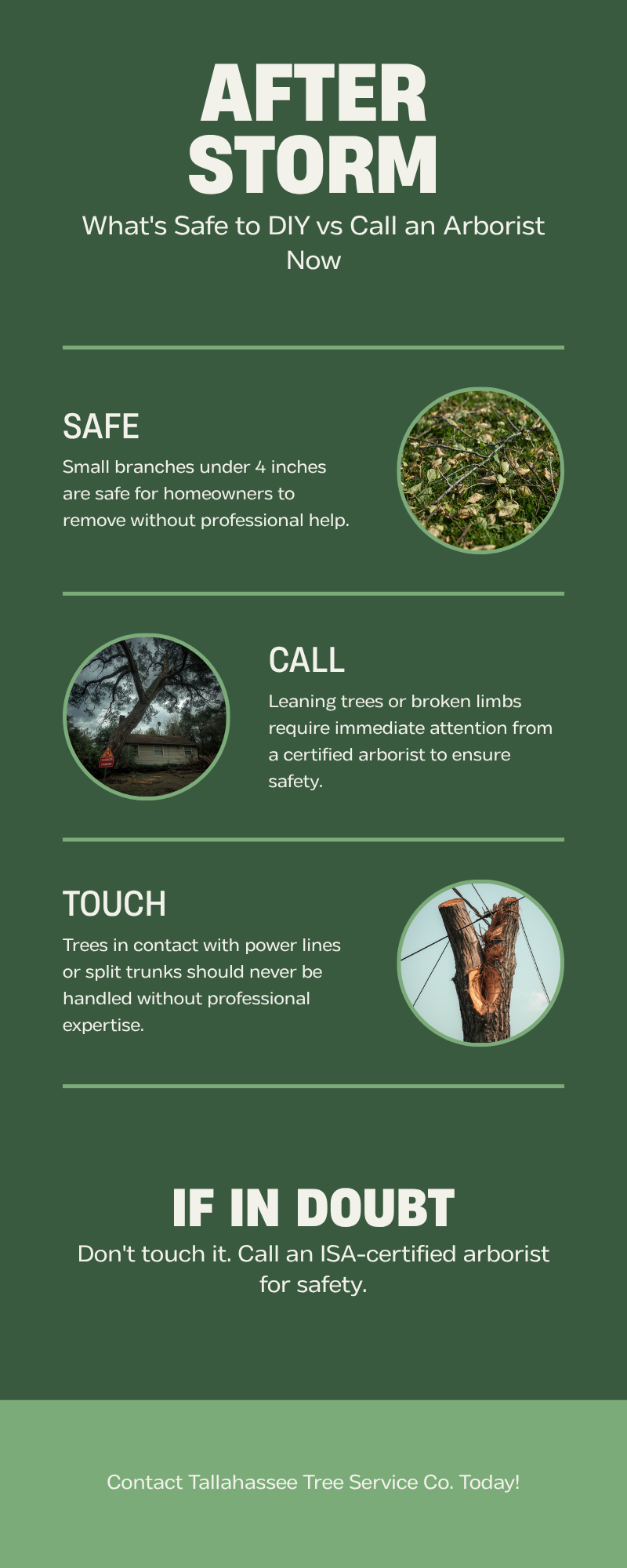
Emergency — stop and get help now
- Any tree or limb touching a power line. Stay 30+ feet back. Do not touch anything metal that contacts the structure. Report it to the utility — City of Tallahassee Utilities or Talquin, depending on your service area. No tree pro will cut an energized limb.
- A tree on the house — particularly if it is through the roof deck or the ceiling is sagging. Get everyone out from under the impact. See roof tree removal.
- A tree leaning with soil lifting or cracking at the base. That is a root plate failing in real time. Keep the fall zone clear — and remember the fall zone is longer than the tree is tall.
- A split trunk or a torn-out major union still standing. It is holding by fiber and will let go.
- Blocked egress — a tree across your only exit door or the only driveway.
Urgent — days, not weeks
- Hangers — broken limbs caught in the canopy. They fall without warning. Park elsewhere, keep kids and pets out from underneath.
- A fresh lean with no soil movement.
- Large cracks in a trunk or a main limb.
- A tree over a play set, a car, or a walkway with any of the above.
Can wait — but do not forget
- Limbs down in an open yard, hitting nothing.
- Cosmetic damage — torn small branches, stripped leaves.
- A yard full of debris. Annoying; not dangerous. See storm cleanup and debris removal.
Tree on the structure, a wire involved, or soil lifting at the base? Get people clear of the fall zone first. Then call now — life-safety situations are triaged ahead of scheduled work.
📞 Call Now — (858) 319-0022Vetted local pros — availability depends on independent provider schedules, location, and demand.*What you can safely do — and what you should not
Safe: photograph everything before anything moves. Drag small limbs out of the driveway. Tarp interior damage — buckets, plastic over furniture. Turn off power to a flooded area at the breaker if you can do it from a dry position. Check on neighbors.
Not safe, and it is where people get hurt after the storm has passed:
- Chainsawing anything under tension. A bent, pinned, or hung-up limb is a loaded spring. It does not cut like firewood.
- Climbing onto a wet roof to tarp it, especially with a tree resting on it and the load path unknown.
- Going near any wire. Assume every downed line is live. Assume a fence or a puddle touching one is live too.
- Ladder work with a saw. More people are injured this way after storms than during them.
- Working alone. If you do nothing else, do not do it alone.
Which Tallahassee trees fail, and how
| Species | Typical storm failure |
|---|---|
| Laurel oak | The number-one failure here. Hollows by 50–70 years, sheds huge limbs or snaps. See laurel oak problems. |
| Water oak | Same short, decay-prone life history. Tips on saturated soils south of the Cody Scarp. |
| Loblolly & slash pine | Snap in the upper trunk. The broken top falls like a spear — roof punctures rather than roof resting. |
| Live oak | Usually survives. When it fails, it is a single massive limb — which means crane work. |
| Bradford pear & similar | Split at the codominant union. Reliably. Almost every storm takes some. |
| Recently construction-damaged trees | Any species. Root-plate damage from a driveway, trench, or pool shows up as a failure two to four years later. |
Damaged tree, or dead tree? Deciding what stays
Not every storm-damaged tree needs to come down. An arborist looks at what is left, not just at what broke:
- How much canopy is gone? A tree that lost roughly half its crown or more is in serious trouble — it cannot feed itself while trying to seal enormous wounds.
- Is the main stem intact? Broken limbs are survivable. A split trunk generally is not.
- Has the root plate moved? If soil has lifted, that tree will not re-anchor to the same strength. It is a candidate for removal even if the canopy looks fine.
- What are the tear wounds like? Clean pruning back to the collar heals. Long strips of torn bark down the trunk do not.
- What is underneath it? The same damaged tree is a keeper in a back pasture and a removal over a bedroom.
A tree risk assessment is how this gets decided honestly. And be wary of anyone who tells you every tree on the lot has to go — see the storm-chaser section below.
How getting matched works
Insurance: what usually gets covered
The general Florida pattern — and your policy governs, not this page:
- Tree hits a covered structure (house, garage, fence, sometimes a screened enclosure): removal of the tree from that structure plus the repair is typically part of the claim.
- Tree falls and hits nothing: removal is usually the homeowner’s cost, sometimes with a small allowance.
- Tree blocks a driveway or a ramp: some policies contribute. Ask.
- Preventive removal of a hazardous tree before it fails: generally not covered.
Practical steps that make the claim go smoothly: photograph and video before anything is moved; open the claim early; keep every receipt including tarps; ask the pro to separate tree off the structure from yard debris and stump in the written scope; and do not sign a broad assignment of benefits handed to you at the curb. More detail: tree service insurance coverage.
Storm chasers — the other hazard after a storm
After every Big Bend event, out-of-state trucks appear in Tallahassee neighborhoods. Some are legitimate. Many are not. Protect yourself:
- Ask for the certificate of insurance from the insurer or agent directly — general liability and workers’ compensation. If an uninsured worker is hurt in your yard, that becomes your problem.
- Verify the ISA certification number through ISA’s public lookup. It takes two minutes.
- Get a written scope before work begins. “We’ll figure it out” means the number changes at the end.
- Do not pay large cash deposits up front.
- Be skeptical of “every tree here has to come down.” That is a sales pitch, not an assessment.
The pros in our dispatch network are vetted, licensed, and insured — but you should still verify credentials yourself. The contract is between you and them.
The damage you will not see for two years
The most under-appreciated fact about Tallahassee storms: the failures keep coming after the cleanup crews leave. A tree that survived a tornado’s wind may have hairline cracks in the wood, a partially torn root plate, or a twisted union. It leafs out the next spring and looks fine. Then it fails in an ordinary summer thunderstorm three years later.
If a storm went through your neighborhood — May 2024 tornado corridor, Helene’s track, anywhere Michael reached — a post-event inspection of the trees that survived is the highest-value thing you can do. See tree inspection and, ahead of the next season, hurricane tree prep.
Before you call — how to describe it
- What failed — whole tree, big limb, top snapped out.
- What it hit — house, car, fence, nothing.
- Wires — anything touching a line. Say it first.
- Is anything still moving in the wind, or hung up in the canopy?
- Access — can a truck reach it, or is it a fenced backyard?
Frequently asked questions
How fast can someone get to me after a storm?
Life-safety situations — trees on structures, blocked exits, hazards over people — are triaged ahead of scheduled work, and dispatch runs around the clock. But actual arrival depends on the independent provider’s schedule, your location, and how many homes were hit in the same event. During a major Big Bend storm, no one honest will promise you a time window.
Should I cut the fallen limbs up myself?
Limbs lying loose in an open yard, hitting nothing, with no tension in them — that is reasonable if you are comfortable with a saw. Anything bent, pinned, hung up in the canopy, on a roof, or near a wire is not. Storm wood is under load, and it does not cut like firewood.
Will insurance pay to remove my storm-damaged tree?
Typically yes when the tree damaged a covered structure — removal from the structure is part of that claim. A tree that fell and hit nothing is usually the homeowner’s cost. Preventive removal of a risky tree is generally not covered. Photograph everything before it is moved, and check your policy. We are not an insurer and do not adjust claims.
My tree looks fine after the storm. Could it still be damaged?
Yes, and this is the one people miss. Hairline cracks, partially torn root plates, and twisted unions do not show up in the canopy. The tree leafs out and looks normal, then fails in an ordinary thunderstorm a year or two later. A post-storm inspection of the survivors is worth doing.
A crew knocked on my door after the storm. Should I hire them?
Only after verifying. Ask for the certificate of insurance from the insurer or agent directly — general liability and workers’ compensation — and check the ISA certification number through ISA’s public lookup. Get a written scope before any work starts, and do not pay a large cash deposit up front.
What do I do about a tree on a power line?
Stay at least 30 feet away, keep everyone away from anything metal touching the structure, and report it to your utility — City of Tallahassee Utilities or Talquin, depending on your service area. No tree professional will cut an energized limb; the utility must de-energize or clear the line first.
Related Tallahassee tree services
Emergency Tree Service
Storm Damage Tree Removal
Fallen Tree Removal
Roof Tree Removal
Storm Cleanup
24-Hour Tree Service
Hurricane Tree Prep
Tree Risk Assessment
Get the damage looked at properly
Call now and we’ll connect you with a vetted, licensed and insured Tallahassee-area arborist. Free to use, no obligation, no sign-up.
📞 Call Now — (858) 319-0022Tallahassee Tree Service is a free referral service. Tallahassee Tree Service is not a licensed tree service provider and does not directly provide tree care services. All work is performed by independent, licensed and insured third-party providers in your area. Calls and form submissions placed through this site may be connected with a participating provider, and you may be contacted by that provider regarding your request. Same-day, emergency, and 24/7 availability are not guaranteed and depend on provider schedules, location, and demand. Service availability, pricing, licensing, and final response times are determined solely by the providers. It is the responsibility of the homeowner to verify that the hired contractor furnishes the necessary license and insurance required for the work being performed. All persons depicted in a photo or video are actors or models and not contractors listed on Tallahassee Tree Service.