Home / Tree Removal Tallahassee
ISA-Certified Arborists · Permits Handled · §5-83 + FS 163.045Tree Removal in Tallahassee, FL
Permit-Handled, Priced Honestly
Connect with ISA-certified, licensed, and insured tree removal crews serving Leon, Wakulla, Gadsden, and Jefferson counties. Every job is performed to ANSI A300 pruning standards and ANSI Z133 safety standards. Call now for free estimate over the phone — typical removals run $400 to $1,800, with §5-83 permits filed at cost.
(850) 555-0123 📞 Call or Text · 24/7 Emergency · Free Phone Estimatesrange, Tallahassee
on every job
life-safety calls
Leon County market
What tree removal actually costs in Tallahassee, FL — by height and access
Published ranges from HomeBlue Tallahassee (March 2025). Your actual quote depends on height, species, access constraints, §5-83 permit requirements, and whether crane rigging is needed. We publish the math — no mystery pricing. Call (850) 555-0123 for a free phone estimate.
City average: approximately $1,100. Range: $400–$1,800 for most residential tree removal jobs. Projects involving crane work, tight access, or live power lines can exceed this range significantly. Call (850) 555-0123 and we tell you the reason in plain English before a saw is started.
Do I need a permit to remove a tree in Tallahassee? The §5-83 answer for single-family lots
City of Tallahassee Land Development Code §5-83 governs tree removal on all city-limits lots. The exemption most homeowners qualify for reads verbatim: "The removal of non-patriarch trees up to 36 inches in diameter at breast height, located on lots developed with single-family detached residential units." In plain terms: if your tree is under 36 inches DBH (diameter measured at 4.5 feet above ground), is not a patriarch tree, and your property is a single-family detached home inside city limits — you do not need a permit to remove it.
If you are in unincorporated Leon County, the rules are stricter. Leon County §10-4.362 protects any live oak or longleaf pine at or above 12 inches DBH, and any dogwood at or above 4 inches DBH. Bradfordville, Centerville, and Chaires residents fall under county rules, not city rules. Permits for unincorporated lots are filed through DSEM at tlcpermits.org.
§5-83 imposes 3× replacement mitigation for a first unpermitted removal offense, 5× for subsequent offenses, plus 2× the normal application fee. A $1,200 permitted live-oak removal becomes a $4,000–$6,000+ violation if done without the correct paperwork. We file the permit as part of every qualifying tree removal job — the $273 fee is passed through at cost.
Source: City of Tallahassee LDC §5-83, confirmed current through April 2026. $273 fee per FY2026 Growth Management schedule effective October 1, 2025 — confirm current amount at talgov.com/growth before filing. Next CPI adjustment: October 1, 2026.
Florida Statute 163.045 — the ISA arborist letter that eliminates the tree removal permit
Florida Statute §163.045(2) (last amended ch. 2022-121, effective July 1, 2022) states verbatim: "A local government may not require a notice, application, approval, permit, fee, or mitigation for the pruning, trimming, or removal of a tree on a residential property if the property owner possesses documentation from an arborist certified by the ISA or a Florida licensed landscape architect that the tree poses an unacceptable risk to persons or property."
The "unacceptable risk" standard is defined precisely: removal must be the only practical means of mitigating the tree's risk below "moderate" per the ISA Best Management Practices — Tree Risk Assessment, Second Edition (2017). This is not a general "the tree looks dangerous" letter — it requires a site visit, a documented risk assessment following the ISA BMP methodology, and a signed arborist statement. Our ISA-certified arborists perform this assessment and generate the documentation on-site when a tree qualifies. Post-storm, this path takes hours rather than the days a §5-83 permit needs — which matters when a stressed pine is leaning toward a bedroom and you need emergency tree removal in Tallahassee today.
SouthWood's zero-lot-line townhome rows, duplex sections, and any property that is not a single-family detached residential lot actively used for single-family purposes fall outside §163.045. Removals on those properties go through standard §5-83 review regardless of risk level. If you are unsure whether your property qualifies, call (850) 555-0123 and our ISA arborists assess it on-site before any permit paperwork is filed.
Protected tree species in Tallahassee — what they cost in mitigation and why
Every removal job on a city-limits lot that exceeds the §5-83 exemption threshold triggers a mitigation calculation. The City assigns "debit units" per protected tree removed, then requires equivalent "credit units" through replanting, transplant, or fee-in-lieu at 1.18× the assessed value of the mitigated portion. The species table below is the most important information for Tallahassee homeowners planning a tree removal — and not a single competitor publishes it on their service page.
Source: City of Tallahassee LDC §5-83 Plant Lists A–D and §5-83(c)(7) invasive exemption. "Patriarch tree" status requires Urban Forester determination — §5-83(c) single-family exemption does NOT apply to patriarch trees regardless of DBH. Verify current Plant List classifications with City Growth Management (850-891-7150) before filing.
The 2025 Florida Forest Service forecast (FDACS) assigned Leon County an 8.6% SPB infestation probability, Gadsden County 17.9%, and Wakulla County 21.2% — the highest in the state. Loblolly pine is the preferred SPB host. Stressed, SPB-infested pines lose structural integrity rapidly and qualify for FS 163.045 hazard documentation. If you have loblolly pines showing pitch tubes, sawdust, or crown browning on Bradfordville or Killearn lots, call (850) 555-0123 for an ISA arborist assessment before the tree becomes an emergency removal.
When tree removal is the right call — species lifespans and decay biology
Not every tree needs to come down. Not every tree that needs to come down should wait. The honest answer depends on species biology, site conditions, and risk assessment — not on whether a homeowner wants the tree gone or wants to save money by delaying. Here is how our ISA-certified arborists evaluate the four most-removed species in Tallahassee:
The two decay fungi to know in Tallahassee
Hypoxylon canker is North Florida's most common fatal oak disease. It is opportunistic — attacking drought-stressed or construction-damaged oaks — and there is no chemical treatment. The diagnostic sign is a gray-white crust with embedded black dots (fruiting bodies) on exposed wood under peeling bark. When fruiting bodies are visible, the tree is unsavable. Immediate removal prevents structural failure and potential hazard.
Ganoderma butt rot (Ganoderma zonatum) affects all palm species and is universally lethal with no treatment. The diagnostic sign is a reddish-brown shelf conk at the base of the trunk. Per UF/IFAS PP100: remove and incinerate the stump and grindings — do not use as backfill or mulch. Never replant a palm in the same location. Laurel wilt (present in the panhandle since ~2005) is a separate lethal fungus killing redbay and sassafras.
Our five-step tree removal process in Tallahassee
We tell you which step you are at before we move to the next one. You approve the written estimate before any saw moves.
You call
Coordinator captures tree species, estimated height, ZIP, and urgency. Life-safety triage if the tree is on a structure or blocking egress — 90-minute dispatch for those calls.
On-site assessment
ISA-certified arborist walks the job, measures DBH, checks for patriarch designation, flags §5-83 or CRPZ requirements, and prepares FS 163.045 documentation if the tree qualifies.
Written estimate
Line-item quote with access plan, permit costs passed through at cost, and debris-hauling scope defined. You approve in writing before any equipment is staged.
Permit filing
We file the §5-83 application or CRCC paperwork, or complete the FS 163.045 risk assessment documentation — whichever path applies. Typical city permit turnaround: 3–5 business days for standard jobs.
Removal & cleanup
ANSI A300 / Z133-compliant rigging, sectional felling or full fell based on site. Debris chipped or hauled. Insurance billing documentation prepared for adjuster submission if applicable.
Questions on a §5-83 permit, a 163.045 letter, or your specific tree?
We walk through §5-83 exemption status, 163.045 eligibility, and crane-vs-boom access questions before any paperwork is filed. No charge, no obligation.
📞 (850) 555-0123Red clay vs. sand — how the Cody Scarp determines your tree removal approach
Tallahassee is split by the Cody Scarp — an ancient Pleistocene shoreline escarpment running east-west near Tram Road. North of the scarp, soil is red Orangeburg clay (the Tallahassee Red Hills). South of it, soil shifts to thin sandy Lakeland and Ortega series over Suwannee limestone karst. This distinction drives every equipment and rigging decision on a Tallahassee tree removal job:
Orangeburg, Dothan, Norfolk series Killearn Estates, Killearn Lakes, Golden Eagle, Ox Bottom, Bradfordville, Betton Hills, Midtown, Myers Park, Lafayette Park, Waverly Hills, Indianhead Acres (upper), Lake Jackson area Failure mode: whole-tree uproot — clay saturates and loses shear strength under sustained rain, root plate tips like a carpet. Crane access: good traction in dry conditions; soft after multi-day rain. Removal timing: schedule large removals in dry spells; post-storm urgent jobs need mat boards if soil is saturated.
Lakeland, Ortega, Leon, Albany series Woodville, SouthWood, Apalachee Ridge, Crawfordville, lower Lake Jackson basin, most of Wakulla County, Monticello (Jefferson) Failure mode: snap or sudden plate failure without warning — shallow anchor in sandy soil over karst. Crane access: significant bog risk on soft sandy soils; crane mats required for large machines in Wakulla County. Removal timing: sandy-soil trees that survive a storm sometimes look intact but have compromised root plates — an assessment 30–90 days post-storm is often necessary.
Tree removal across Tallahassee — Killearn cul-de-sacs to SouthWood alleys to Crawfordville post-Helene
A single "tree removal Tallahassee" quote does not account for the fact that a job in Killearn Estates, a job in SouthWood, and a job in Crawfordville are three completely different equipment and logistics challenges. Here is what our coordinator considers when matching a crew to your address:
Full neighborhood coverage — tree removal Tallahassee and surrounding areas
- Killearn Estates
- Killearn Lakes Plantation
- Golden Eagle Plantation
- Ox Bottom Manor
- Summerbrooke
- Bradfordville
- Betton Hills
- Midtown
- Myers Park
- Lafayette Park
- Los Robles
- Waverly Hills
- Indianhead Acres
- Forest Heights
- Piney-Z / Buck Lake
- SouthWood
- Apalachee Ridge
- Lake Jackson area
- Lakeshore Estates
- Welaunee / Bannerman Rd
- Crawfordville (Wakulla)
- Woodville / Wakulla Station
- Havana / Quincy (Gadsden)
- Monticello (Jefferson)
Insurance billing and adjuster documentation we handle for you
Florida HO-3 homeowners insurance covers tree removal only under a specific and narrow set of conditions. Understanding what is and is not covered before you file a claim prevents surprises — and our crews document every job to the standard adjusters need.
GPS-stamped photographs of: tree position before removal, point of impact on the structure, trunk diameter measurement (DBH), species identification, all rigging points, debris piles before chipping, and post-removal site condition. We provide a written job description in adjuster-ready format. Several Florida carriers accept direct billing from the removal crew — we coordinate that where the policy allows it.
If a tree is on a power line, call the utility first — always
ANSI Z133 prohibits any tree work within 10 feet of an energized conductor. Before our crew can touch a tree that is contacting or near a live line, the utility must confirm de-energization in writing or in the field. Call first:
Before & After — tree removal in Tallahassee and surrounding areas
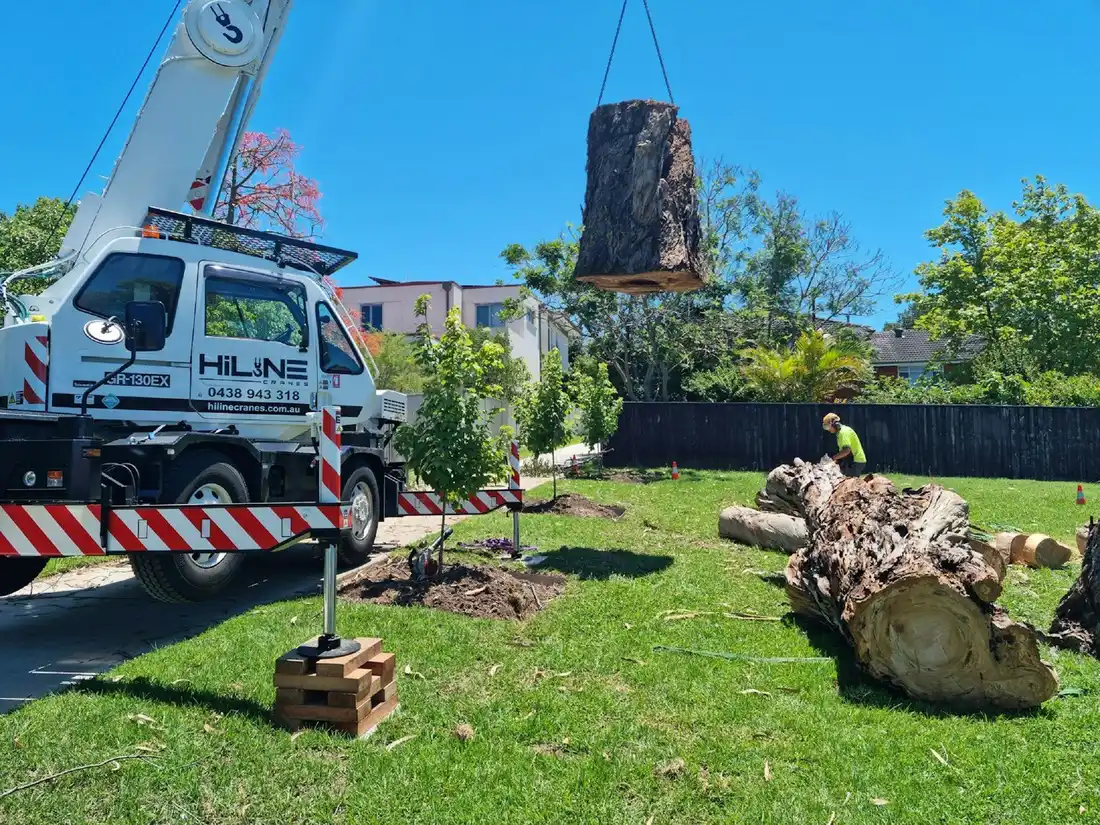
Every photo is from an actual Leon County or Wakulla County removal job. The Tallahassee landscape in these photos proves the crews are local — not a call center dispatching strangers.

Myers Park — 70-ft Live Oak Over Roof
46" DBH live oak, §5-83 permit filed and approved. Crane-assisted sectional removal over pool cage. Root plate monitoring recommended for remaining adjacent oaks.

Betton Hills — End-of-Life Laurel Oak
65-year laurel oak, 34" DBH (exempt under §5-83), significant internal decay. FS 163.045 documentation completed on-site. Stump ground to 10" below grade same day.

Killearn Estates — Post-Storm Emergency Removal
Loblolly pine snapped at 55 ft after Helene, blocking driveway. Emergency dispatch — 90-minute response. Insurance adjuster documentation prepared same day.
Replace placeholder images with actual job photos. WebP format, 280×180px minimum. Alt text is pre-written for SEO and ADA compliance — adapt to match the specific job shown.
Free phone estimate for tree removal in Tallahassee, FL
ISA-certified arborists, §5-83 permits filed at cost, FS 163.045 hazard letters on-site, and 24/7 emergency dispatch. Call now — coordinator answers in under 60 seconds during business hours.
📞 (850) 555-0123Tree removal FAQ — Tallahassee, FL
How much does tree removal cost in Tallahassee, FL?
Tree removal in Tallahassee averages around $1,100 and ranges from $400 to $1,800 for most residential jobs per HomeBlue Tallahassee data (March 2025). Crew rates run $190–$250/hr for a 3-person team. Small trees under 30 ft run $230–$650. Large live oaks and pines over 70 ft in tight Midtown or Killearn lots requiring crane work can exceed $1,730. The $273 §5-83 permit fee (FY2026, confirm before filing) is passed through at cost on jobs that require it. Call (850) 555-0123 for a free phone estimate — we publish the math before any equipment moves.
Do I need a permit to remove a tree in Tallahassee?
On a single-family detached residential lot inside city limits, City LDC §5-83 exempts removal of non-patriarch trees up to 36 inches DBH from permit requirements. Over 36 inches, any patriarch tree, or any tree inside a Canopy Road Protection Zone requires a permit filed with City Growth Management. The stand-alone permit fee is reported at $273 for up to 10 trees per the FY2026 fee schedule (effective October 1, 2025 — confirm current amount before filing). In unincorporated Leon County, §10-4.362 protects live oaks and longleaf pines at or above 12 inches DBH and dogwoods at 4 inches DBH or above. Florida Statute §163.045 can bypass permit requirements entirely when an ISA-certified arborist provides written documentation that the tree poses an unacceptable risk per the ISA BMP Tree Risk Assessment, 2nd Edition (2017).
What is Florida Statute 163.045 and how does it help with tree removal in Tallahassee?
Florida Statute §163.045(2) (last amended July 1, 2022) prevents local governments from requiring any permit, fee, or mitigation for tree removal on a single-family detached residential property when the owner holds written documentation from an ISA-certified arborist that the tree poses an "unacceptable risk" — meaning removal is the only practical way to reduce the tree's risk below "moderate" per the ISA Best Management Practices Tree Risk Assessment, Second Edition (2017). The arborists we dispatch are ISA-certified and can generate this documentation on-site during the initial assessment visit. This path bypasses §5-83 review entirely and typically takes hours rather than the 3–5 business days a permit needs — critical when a compromised pine is leaning toward a bedroom. Note: §163.045 applies only to single-family detached residential lots. HOA common areas, multifamily, commercial, and rights-of-way are excluded.
Does homeowners insurance cover tree removal in Tallahassee?
Florida HO-3 homeowners insurance covers tree removal only when a fallen tree has damaged a covered structure, with a standard debris-removal sublimit of $500–$1,000 per tree. Routine removal of a standing tree — even one that is clearly hazardous — is not covered. Damage to the tree itself from wind is not covered. Florida's named-storm percentage deductibles (typically 2–5% of dwelling coverage) frequently exceed the debris-removal benefit outright. Additionally, if a neighbor's tree falls on your property, you bear the removal cost from your own policy — you would need to prove the neighbor knew the tree was hazardous and failed to act to pursue their insurance. We document every insured job to adjuster standard and bill carriers directly when the policy permits it.
Can I remove a live oak in Tallahassee?
Yes, with the right approach. On a single-family detached city lot, live oaks at or under 36 inches DBH that are not patriarch trees can be removed without a permit under §5-83. Over 36 inches or any patriarch live oak requires a permit and mitigation through City Growth Management. In unincorporated Leon County, live oaks at or above 12 inches DBH are protected under §10-4.362 regardless of lot type. For any live oak that poses a documented hazard on a single-family lot, Florida Statute §163.045 offers a permit-bypass path via ISA arborist documentation. Live oak (Quercus virginiana) is Tallahassee's official shade tree and carries the highest mitigation debit of any locally protected species under the Plant List C classification — which is why understanding the permit path before starting work saves significant money.
How much does it cost to remove a large tree in Tallahassee?
A large tree (70–80+ ft) in Tallahassee typically runs $790–$1,730 for the removal itself, plus $273 if a §5-83 permit is required. The wide range is driven almost entirely by access: an 80-ft longleaf pine on an open Bradfordville lot with drive-up boom access runs the low end; the same height tree in a tight Killearn cul-de-sac or over a Myers Park pool cage requiring crane rigging runs the high end. Crane jobs over structures or power lines can push well above the HomeBlue range — typically 2–3× standard rate for the rigging component. Call (850) 555-0123 and we tell you which category your specific job falls into before any work is approved.
When is the best time to remove a tree in Tallahassee?
For non-emergency removals, the best windows are late October through February (dormant season, dry-soil access for equipment) and April through May 31 (before hurricane season opens June 1). Dormant-season removal is preferred for large oak jobs on red-clay lots north of the Cody Scarp — dry clay provides stable footing for cranes and boom trucks. Avoid scheduling large removals immediately after multi-day tropical rain events on clay soils — saturated Orangeburg clay significantly reduces crane traction. Emergency tree removal in Tallahassee is available 24/7 year-round with 90-minute response for life-safety calls.
Is stump grinding included with tree removal in Tallahassee?
Stump grinding is typically quoted as a separate line item, not included in the base removal price. Standard stump grinding in Tallahassee runs $3 per inch of stump diameter, $150 minimum, ground 8–12 inches below grade. For most homeowners, scheduling the stump grind on the same trip as the removal saves the $150 minimum and reduces yard disturbance — we can quote both on the same estimate. Ganoderma-infected palm stumps (per UF/IFAS PP100) require grinding plus complete chip removal from the site — never backfill with infected palm tissue — and you should not replant a palm in the same location.
Who pays when a neighbor's tree falls on my property in Florida?
In Florida, each property owner bears the cost of removing a fallen tree from their own property, regardless of which property the tree originated from. Your homeowners insurance covers removal from your property when the tree hits a covered structure (subject to your deductible and sublimit). To pursue your neighbor's insurance or hold them liable, you would generally need to prove they had prior knowledge the tree was hazardous and failed to act — a difficult legal standard. If you have documented that a neighbor's tree is hazardous in writing (ISA assessment letter, previous requests to remove) and they have not acted, consult a Florida real estate attorney before the tree falls.
After tree removal — or instead of it
Tree Trimming Tallahassee
If the tree may still be saveable with pruning — ISA-certified crown reduction, structural pruning, and ANSI A300 standard crown work.
Stump Grinding Tallahassee
After the tree is removed — stump ground 8–12" below grade, $3/inch transparent pricing, same-trip discount when booked with removal.
Emergency Tree Service
Fallen tree on your house right now — 24/7 dispatch, 90-minute life-safety response, insurance billing coordinated.
Tree removal in Tallahassee, FL — permit-handled, priced honestly
ISA-certified arborists. §5-83 permits filed at cost. FS 163.045 hazard letters on-site. Transparent height-tier pricing. Insurance billing documented. 90-minute emergency response. Tallahassee and all surrounding areas.
📞 (850) 555-0123Serving all of Leon County · Killearn · Betton Hills · Midtown · Myers Park · SouthWood · Bradfordville · Crawfordville · Havana · Quincy · Monticello · Surrounding Areas