Storm Cleanup in Tallahassee, FL
When a hurricane, tornado, or ice storm rolls through Tallahassee, your yard turns into a tangle of downed pines, snapped oak limbs, and shredded fence panels overnight. Call now and we’ll connect you with a vetted, licensed and insured local cleanup crew — saws, trucks, chippers, and ISA-certified arborists — to get the property cleared, hauled, and walkable again.
📞 Call Now — (858) 319-0022Prefer not to type? Just call now — 24/7 dispatch line*What storm cleanup in Tallahassee actually includes
Storm cleanup is the heavy, methodical work that happens after the immediate emergency is over. Once power is restored and the road crews have moved on, you’re left staring at a yard full of debris that nobody else is coming to fix. That’s the call this page is for.
There’s a real difference between emergency tree service — the active hazard, the tree on the roof at 2 AM — and the full-property storm cleanup Tallahassee homeowners need a few days later. By the time you’re calling for cleanup, the danger is usually past. What’s left is a debris field: limbs across the driveway, root balls in the side yard, brush piled along the fence line, and at least one tree that didn’t fall but probably will the next time the wind picks up.
The crews we dispatch handle the whole picture in one visit: cutting down what’s leaning, sectioning what’s on the ground, hauling everything off site, and raking the lawn back into a usable yard. A good cleanup crew doesn’t leave a brush pile at the curb and call it a day — you’ve already got enough on your plate after a storm.
Downed & leaning trees
Pines snapped at 30 feet, oaks toppled with the root ball still attached, sweetgums leaning hard toward the house — cut, sectioned, and removed. Species pages: laurel oak, water oak, sweetgum, live oak.
Limbs & branch debris
Live oak limbs that snapped under wind load, broken branches dangling 40 feet up, and the tangled mess of brush across the lawn — all chipped and hauled.
Yard & fence wreckage
When trees go down, they take fences, sheds, and gutters with them. The arborists we dispatch clear the tree debris so you’ve got a clean site for your fence or roofing contractor.
Root ball & stump removal
A toppled tree leaves a crater and a six- to ten-foot root mass. Crews can grind the stump flush or pull the whole root plate out with the boom truck — see stump grinding.
Insurance documentation
Date-stamped property notes, an ISA-certified arborist’s written opinion on the cause of failure, and an itemized work scope your adjuster can actually use.
Whole-neighborhood cleanup
If your street took a beating, coordinated cleanup across multiple homes is a real option — see commercial & HOA service and the HOA section below.
Tallahassee’s storm history — why local cleanup crews matter
If you’ve lived in the Big Bend more than a couple of years, you already know — we get hit. Hurricane season opens June 1st, and from mid-August through October the eastern Gulf is basically a runway. Throw in the occasional ice storm and the May 2024 tornadoes, and you’ve got a city that keeps storm cleanup crews on speed dial.
Hurricane Hermine — September 1, 2016 (Cat 1, ~80 mph)
Hermine was the first hurricane to hit Florida in over a decade and dropped a wall of pines across midtown and northeast Tallahassee. Three weeks of cleanup work for most crews in town.
Hurricane Michael — October 10, 2018 (Cat 5 landfall)
Michael made landfall as a Category 5 at Mexico Beach. The eastern Big Bend — including parts of Gadsden and Jefferson Counties — took Cat 3 winds. Storm cleanup work in the Tallahassee area stretched into 2019.
Hurricane Idalia — August 30, 2023 (Cat 3, 100+ mph at the coast)
Idalia tracked through Wakulla and into Madison. Coastal communities took the worst of it; cleanup crews from Wakulla County up through Monticello were booked solid for two months.
Three EF-2 tornadoes — May 10, 2024
The National Weather Service confirmed three EF-2 tornadoes across central Tallahassee — Lafayette Heights, Levy Park, Country Club Drive — with documented 75-foot tree snaps at 115 mph wind speeds. Crews were still running cleanup in those neighborhoods six months later.
Hurricane Helene — September 26, 2024 (Cat 4 landfall)
Helene made landfall as a Cat 4 at Perry. Tallahassee saw sustained tropical-storm-force winds for hours, not minutes. Whole canopy roads needed clearing, and cleanup demand in Killearn, Northwest Tallahassee, and Bradfordville didn’t taper off until Christmas.
North Florida ice storm — January 2025
Different kind of damage. Ice loading snapped live oak limbs that had survived every hurricane on this list. We don’t get them often, but when we do, the cleanup work is just as heavy as a tropical event.
The point is this: local storm cleanup crews don’t need a tutorial. They know how live oaks fail, where laurel oaks tend to drop their tops, and which neighborhoods always lose pines first. See the storm-damaged trees guide for the species details.
Got a yard full of storm debris? Don’t spend the weekend cutting up an oak with a homeowner chainsaw. A matched local crew handles the whole property — saws, chipper, haul-off, documentation.
Get matched with a local pro — call now24/7 dispatch line — availability depends on independent provider schedules and demand.*What a full cleanup visit looks like
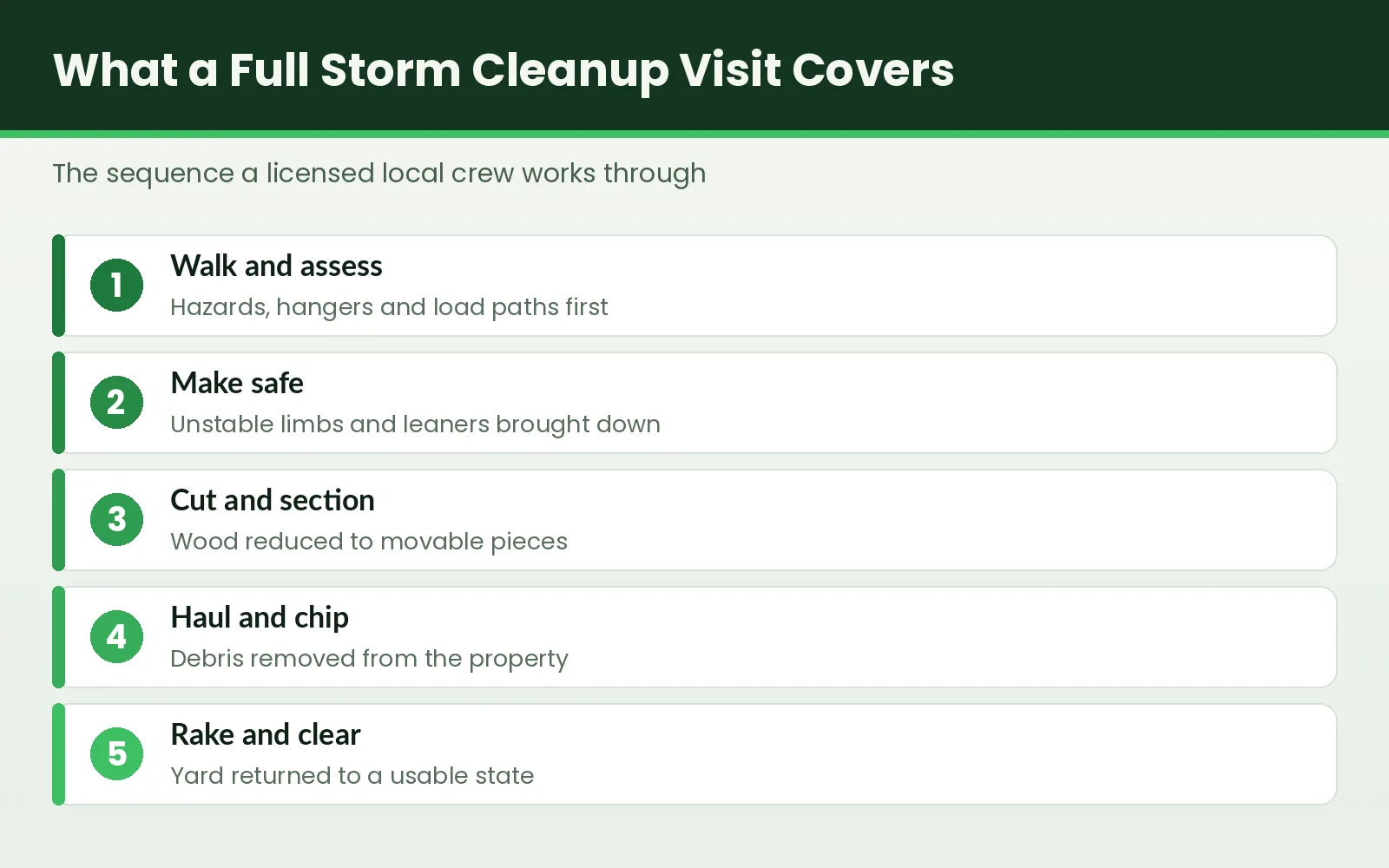
Every storm cleanup call starts the same way: a phone conversation, a property walkthrough, and a clear written scope before any saws come out. Here’s the sequence the crews actually run:
1. Phone triage
The dispatcher sorts out fast whether you need emergency dispatch tonight, a 24-hour crew, or scheduled storm cleanup later in the week.
2. On-site walkthrough
An ISA-certified arborist walks the property with you, identifies every hazard tree and debris zone, and flags anything that needs formal risk assessment.
3. Written scope & quote
You get a line-by-line scope from the pro: trees to remove, limbs to clear, debris to haul, fence-line and turf cleanup. You approve it before the work starts — the quote is between you and the crew.
4. Hazard removal first
Leaning trees, hanging limbs (“widow-makers”), and any tree threatening the structure come down first — sometimes with crane assistance if access is bad.
5. Sectioning & chipping
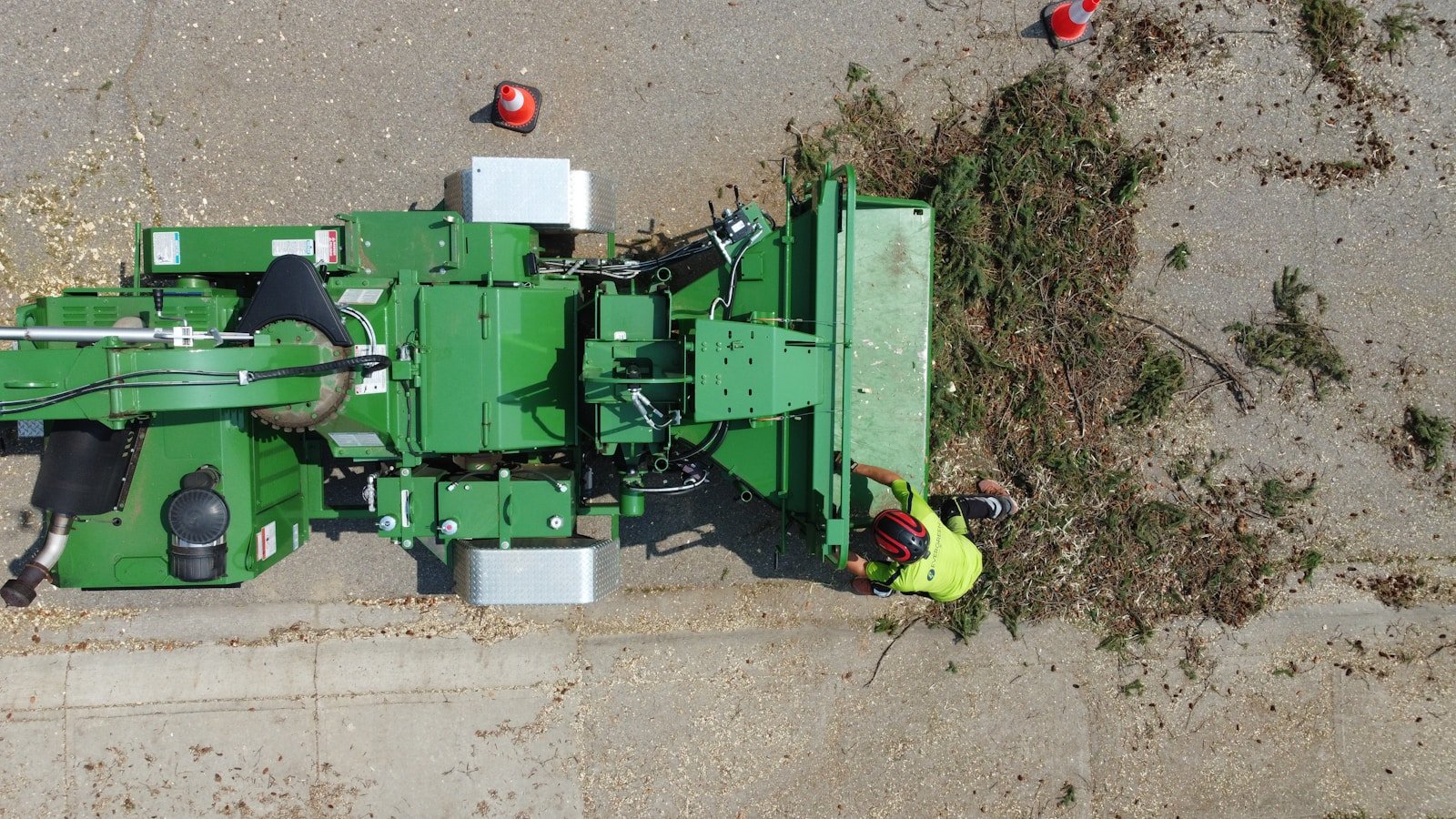
Downed trees get sectioned with chainsaws, brush goes through the chipper, and trunks get loaded onto the boom truck for haul-off — not piled on your curb.
6. Stump & root ball
If a tree toppled with the root ball attached, the crew either pulls it or grinds the stump flush. Your call — see stump grinding options.
7. Yard restoration
Rake the lawn, blow off the driveway, sweep the road in front of the house. Storm cleanup isn’t finished until your yard looks like a yard again.
8. Documentation
Final paperwork for your insurance file: written cause-of-failure note from the arborist, completed scope, and a final walkthrough sign-off.
What storm cleanup crews haul off
Every storm leaves behind a different mix of debris. Pines drop pieces, oaks throw whole limbs, sweetgums shed gumballs and small branches, and palms drop fronds the size of car hoods. Here’s the rundown:
- Whole downed trees — pine, laurel oak, water oak, sweetgum, and the occasional live oak when the soil saturates.
- Snapped limbs & widow-makers — live oak limbs that broke under wind load but didn’t fall yet. These are the most dangerous part of any storm cleanup.
- Brush piles & small branches — chipped on site and hauled in the chip truck, not left at the curb for the City to maybe pick up in three weeks.
- Root balls & soil mounds — toppled trees leave craters. Crews can fill the hole, grind the root ball, or both.
- Pine straw & oak debris — the slick layer of needles and leaves that turns your driveway into a hazard. Blown clean.
- Damaged fence panels & gutter pieces — the tree-impacted sections that have to come out before your fence contractor can work.
- Hangers in the canopy — broken limbs still wedged 30+ feet up, waiting to drop. Climber removal or crane work, depending on access.
- Palm fronds & fruit clusters — sabal palms shed massively after high winds. See palm trimming.
📌 If you’ve already piled brush at the road expecting City of Tallahassee Solid Waste to pick it up, check the current debris collection schedule first — major storm pickups can take weeks. Most homeowners arranging private storm cleanup don’t want to wait that long.
What storm cleanup runs in the Tallahassee market
Storm cleanup cost depends on three things: how much debris is on the property, what kind of access the crew has (front yard versus tight backyard), and whether any leaning hazards are still standing. These are typical local-market scope patterns, not our prices — the licensed pro you’re matched with gives the binding written quote at the walkthrough:
| Cleanup scope | What moves the number |
|---|---|
| Light yard debris (limbs, brush, small branches) | Usually a half-day, single-truck job — volume and haul distance drive it. |
| One downed tree, full removal & haul | Size, species, and whether equipment can reach it or it’s a climb-and-carry. |
| Multiple trees down, moderate yard impact | One- to two-day crew; chipper time and truckloads hauled. |
| Major property cleanup (3+ trees, root balls, debris field) | Multi-day with chipper and boom truck; root-ball extraction adds scope. |
| Tree on structure (house, roof, fence) | Often needs crane assist and careful unloading — see roof tree removal. |
| Hazard tree still standing | Height, lean, decay, and targets underneath — see hazardous removal. |
| Stump grinding (per stump) | Diameter and root flare; larger oaks run higher — see stump grinding. |
For more detail on the factors, see the tree removal cost guide and tree trimming cost guide. Market conditions shift after major events when regional demand spikes — the written quote you approve at the walkthrough is the only number that counts.
Insurance documentation cleanup crews provide
If a tree fell on your house or your carrier is covering part of the cleanup bill, the documentation matters as much as the work itself. Adjusters need specifics — and the arborists we dispatch provide them:
- Date-stamped property notes from the on-site walkthrough, identifying every tree involved and its location relative to the structure.
- ISA-certified arborist’s written cause-of-failure opinion — wind load, soil saturation, prior decay, or root-plate failure. This single document carries weight with adjusters that homeowner photos do not.
- Itemized scope of work matching the written quote, so the adjuster sees exactly what was billed against the claim.
- Florida Statute §163.045 documentation when applicable — the state law allowing ISA-certified arborist documentation to bypass the City of Tallahassee §5-83 permit on single-family residential property for trees presenting unacceptable risk.
- Final completion sign-off with date and crew-lead signature for your file.
The City of Tallahassee charges a permit fee for removals under §5-83 (one application covers up to 10 trees on the FY2026 schedule) — confirm the current amount with City Growth Management before assuming. After a declared disaster, hazard trees on residential property are commonly handled under §163.045 without the standard permit, which is one more reason the arborist’s written documentation matters. For deeper background, see the Tallahassee tree removal permit guide.
Neighborhood-wide & HOA storm cleanup
Major storms don’t hit one house — they hit a neighborhood. After Helene and the May 2024 tornadoes, entire streets in Killearn Lakes, Southwood, and Myers Park & Betton Hills needed coordinated cleanup — not one crew at a time.
When an HOA, property manager, or neighborhood association calls, we can line up coordinated dispatch across multiple homes, common areas, and entry medians — one scope, one crew schedule, one point of contact. For commercial property managers handling multi-site cleanup, the commercial tree service page covers contracted maintenance and dispatch agreements. Crews also handle lot clearing and land clearing on larger acreage when the damage warrants it. Coverage runs throughout Leon County and into Wakulla, Gadsden, and Jefferson Counties — coastal communities like Crawfordville often take harder hurricane hits than the city itself.
How scheduling actually works after a big event
Big events overload the local market — right after Helene, every legitimate crew in Leon County was booked solid within the first 72 hours. The first 24–48 hours after a major storm get triaged the way an ER does: life-safety calls (tree on house, road blocked, power line tangled) go to emergency dispatch first. Cleanup calls without an active hazard typically get scheduled for days 3 through 10. By week two, most calls are running normal scheduling.
If you call within 48 hours of a major event, expect the dispatcher to ask three questions: Is anyone in danger? Is the structure compromised? Is the road blocked? Any “yes” gets triaged forward. If it’s a yard cleanup with no hazard, you’ll get a scheduled slot as demand allows — the earlier you call, the better your position in the queue. And homeowners who booked hurricane tree prep before the season consistently find themselves at the front of the post-storm line — it’s the closest thing to a fast lane this market has. Building your own prep plan first? Our free Hurricane & Storm Tree-Prep Guide covers which Big Bend species fail first, a printable checklist, the seasonal timeline, and City of Tallahassee & Leon County permit and insurance basics.
What NOT to do after a storm
Storm cleanup is the leading cause of post-hurricane injuries in Florida — not the storm itself. Most of those injuries are preventable, and they happen to homeowners trying to do the work themselves:
- Don’t cut a tree under tension. A bent or pinned trunk stores enormous spring energy. One wrong chainsaw cut and the trunk releases — usually toward the cutter. Leave tensioned trees to a crew with rigging gear.
- Don’t touch any limb near a power line. Period. Even a downed line that looks dead can re-energize without warning when crews restore power upstream.
- Don’t climb a damaged tree. Storm-damaged trees have invisible cracks in the union, the trunk, and the lateral limbs. Anything you stand on can fail.
- Don’t work alone. If something goes wrong — chainsaw kickback, a falling limb, a slip off a ladder — you need someone within shouting distance.
- Don’t wait days on a leaning tree. Saturated soil keeps shifting after the storm passes. A tree that’s 10 degrees off vertical on Sunday may be on the house by Wednesday. See the leaning tree guide.
- Don’t hire the crew that knocks on your door right after a storm. Storm-chaser scams are real. Verify ISA certification, get a written quote, and check that the crew is local before signing anything.
For deeper guidance on tree health after a storm, the UF/IFAS EDIS plant database publishes peer-reviewed information on storm-damaged tree recovery in Florida — the single best non-commercial source for post-storm tree biology questions.
How getting matched works
Frequently asked questions
Will my insurance cover storm cleanup costs?
It depends on your policy and what got hit. Most homeowners’ policies cover removing a tree only if it landed on a covered structure (house, garage, fence). Trees down in the yard with no structure damage are typically not covered, though some policies include limited debris-removal allowances after a named storm. The crew you’re matched with provides the documentation your adjuster needs — written cause-of-failure opinion, itemized scope, completion sign-off — so the claim has the best possible footing.
Do I need a permit for storm cleanup tree removal in Tallahassee?
Often, no. Florida Statute §163.045 allows ISA-certified arborist documentation to bypass the City of Tallahassee §5-83 permit on single-family residential property for trees presenting an unacceptable level of risk. After a declared disaster, this is the path most hazard removals take. For trees that aren’t imminent hazards, the standard City permit may still apply — confirm with City Growth Management. See the permit guide.
Can I burn or pile storm debris at the curb instead?
Burning is restricted under Florida open-burn rules and prohibited inside Tallahassee city limits without specific permits. Curb-piling for City Solid Waste pickup is allowed, but after a major storm the City’s schedule can run weeks behind. Most homeowners don’t want a 12-foot brush pile sitting at the road for a month — a private crew chips and hauls in one visit.
What’s the difference between storm cleanup and emergency tree service?
Emergency service is for active hazards in progress — tree on the house at 2 AM, road blocked, immediate threat. Storm cleanup is the larger, scheduled work that follows: clearing yard debris, removing downed trees that aren’t threatening structures, hauling brush, and restoring the property. Most properties need both after a serious storm: emergency dispatch first, then full cleanup later that week.
How do I avoid storm-chaser scams after a hurricane?
Three quick checks: (1) verify ISA certification of the lead arborist on the job — not just a company claim; (2) get a written, line-by-line scope and quote before any payment; (3) make sure the crew is local — ask where their yard is and whether they were doing tree work in Tallahassee before the storm. Out-of-state storm chasers typically fail at least one of the three.
Can a leaning tree that hasn’t fallen yet be removed?
Yes — and sooner is better. A leaning tree in saturated-soil conditions is one of the most dangerous post-storm hazards in Tallahassee. Soil keeps shifting for days after the rain stops, and a 10-degree lean on Sunday can become full failure by midweek. See hazardous tree removal and the leaning tree decision guide.
Related Tallahassee tree services
Free Hurricane Tree-Prep Guide
Emergency Tree Service
24-Hour Tree Service
Hurricane Tree Prep
Storm-Damaged Trees
Storm Damage Tree Removal
Hazardous Tree Removal
Crane Tree Removal
Fallen Tree Removal
Tree Debris Removal
Stump Grinding
Ready to get your yard back?
Call now and we’ll connect you with a vetted, licensed and insured Tallahassee storm cleanup crew. Free to use, no obligation, no sign-up — hazard calls are triaged first.
📞 Call Now — (858) 319-0022Or call now — 24/7 dispatch line*Tallahassee Tree Service Co. is a free dispatch and referral service. We are not a tree-service contractor and do not perform tree work ourselves. When you call, we connect you with an independent, licensed and insured local tree-care professional who carries their own license and insurance and provides any binding quote. Price information anywhere on this site is typical local-market information for planning only; people or scenes in images are illustrative.
References to “24/7,” “same-day,” or “emergency” describe call-handling and dispatch availability. Actual on-site response times depend on the independent professional’s schedule, crew availability, and weather, and are not guaranteed.