Tree Planting in Tallahassee, FL
Tree planting here is more than digging a hole. Native species selection, the Cody Scarp soil divide, and the November–February window separate trees that thrive for 200 years from trees that quietly die in their fourth summer. Call now and we’ll connect you with a vetted, ISA-certified local arborist who plants for the long game.
📞 Call Now — (858) 319-0022Free to use, no obligation — the arborist sets the quote after seeing the site.A planted tree is a 50-to-200-year decision made in an afternoon. Get the species, the spot, and the season right and you’re planting the canopy your grandkids stand under. Get any one of the three wrong and you’re watering a slow failure. This page covers the free tree programs most Tallahassee residents have never heard of, the planting calendar that’s backwards from what northerners expect, the Cody Scarp soil divide that decides which species thrive on your street, and the five installation mistakes that kill most young trees here.
Start here: Tallahassee’s free tree programs
Before spending anything on tree planting, check whether you qualify for a free one. Both Leon County and the City of Tallahassee run annual Adopt-A-Tree programs that most residents don’t know about.
Leon County Adopt-A-Tree — unincorporated county residents
- Who qualifies: residents outside city limits in unincorporated Leon County.
- 2026 species: pawpaw (Asimina triloba), blackgum (Nyssa sylvatica), and American elm (Ulmus americana) — all native, all right for North Florida.
- Where it goes: between your house and any publicly maintained road (or private road with public access).
- Your commitment: water 3 times per week for one year after planting.
- Timing: the 2026 cycle closed January 31; watch for the 2027 announcement in fall 2026. First-come, first-served, and supply runs out.
City of Tallahassee Adopt-A-Tree — city residents
- Who qualifies: residents inside Tallahassee city limits.
- Species: varies by cycle — typically native canopy species aligned with the Urban Forest Master Plan, including live oak and American elm.
- Where it goes: usually the right-of-way between sidewalk and curb; City Urban Forestry determines placement and typically handles planting, staking, and initial mulching.
- How to apply: talgov.com/AdoptATree, or City of Tallahassee Urban Forestry at (850) 891-6500.
Both programs fill before their deadlines most years. Set a September–October reminder to check both sites — early applicants get the best species selection. If you want a species the programs don’t offer — live oak on your own terms, longleaf pine, southern magnolia — that’s where a professional planting comes in.
The Tallahassee planting calendar — backwards from what you learned up north
If you’re from up north, your instinct says plant in spring. That instinct kills trees in Tallahassee. The right window is November through February: soil is still 60–65°F at depth (roots keep establishing), the canopy is dormant and not pulling water, and winter rainfall is more reliable than the feast-or-famine summer pattern. A November tree gets a full cool season of root growth before its first North Florida summer.
A March-planted tree faces 90°F+ heat and the July–September drought gaps just 60–90 days after transplant, before roots have established — frequently fatal. UF/IFAS explicitly recommends fall planting for most North Florida landscape trees.
| Month | Verdict | Why |
|---|---|---|
| November | Best | Cool air, warm soil, dormancy starting — ideal root establishment |
| December–January | Excellent | Fully dormant canopy, workable soil, consistent cold-front moisture |
| February | Good | Last of the prime window — plant before early-March bud break |
| March–April | Marginal | Spring warming; only with a committed irrigation plan |
| May–September | Avoid | Summer heat and hurricane season — highest transplant mortality |
| October | Getting good | First cool fronts; fine for drought-tolerant species |
The Cody Scarp divide — which side of it is your yard on?
Tallahassee’s most important planting factor is the geology under your specific neighborhood. The Cody Scarp — an ancient shoreline escarpment cutting diagonally through the area — splits the city into two fundamentally different ecosystems.
West/upland of the Scarp — red clay zone
Killearn Estates · Bull Run · Midtown · Myers Park · Betton Hills · NW Tallahassee. Well-drained red Orangeburg clay over limestone. Drought is the stress to plan for, not flooding. Best species: live oak, longleaf pine, sand live oak, American elm, southern sugar maple, native dogwood, Chickasaw plum, persimmon.
East/flatwoods of the Scarp — sandy zone
SouthWood · Buck Lake · Bradfordville · Killearn Lakes · East Tallahassee. Sandier, shallower soils with seasonally high water tables June–September; many yards hold standing water after heavy rain, which drowns upland species. Best species: slash pine, bald cypress, blackgum, American elm, swamp chestnut oak, sweetbay magnolia, red maple, loblolly pine.
Killearn replanting note: if you’ve just removed a 50–60-year-old laurel oak in Killearn Estates, Betton Hills, or Myers Park, do not replant another laurel oak — the wind-failure rate is why the removal wave is happening. Switch to live oak: same canopy goal, dramatically better hurricane survivability. See laurel oak problems in Tallahassee for the failure pattern.
Not sure which side of the Cody Scarp you’re on? An ISA-certified arborist reads your soil, drainage, and sun before recommending a species.
📞 Call Now — (858) 319-0022Free to use — the arborist gives the quote after a site walk. Timing depends on provider schedules.5 planting mistakes that kill Tallahassee trees in the first 3 years
1. Planting too deep — the biggest killer. The root flare must sit at or slightly above finished grade. Deep-planted trees develop girdling roots, oxygen-starved crowns, and fungal disease — and symptoms hide for 3–5 years. Nurseries often pot trees with the flare buried; dig it out before planting.
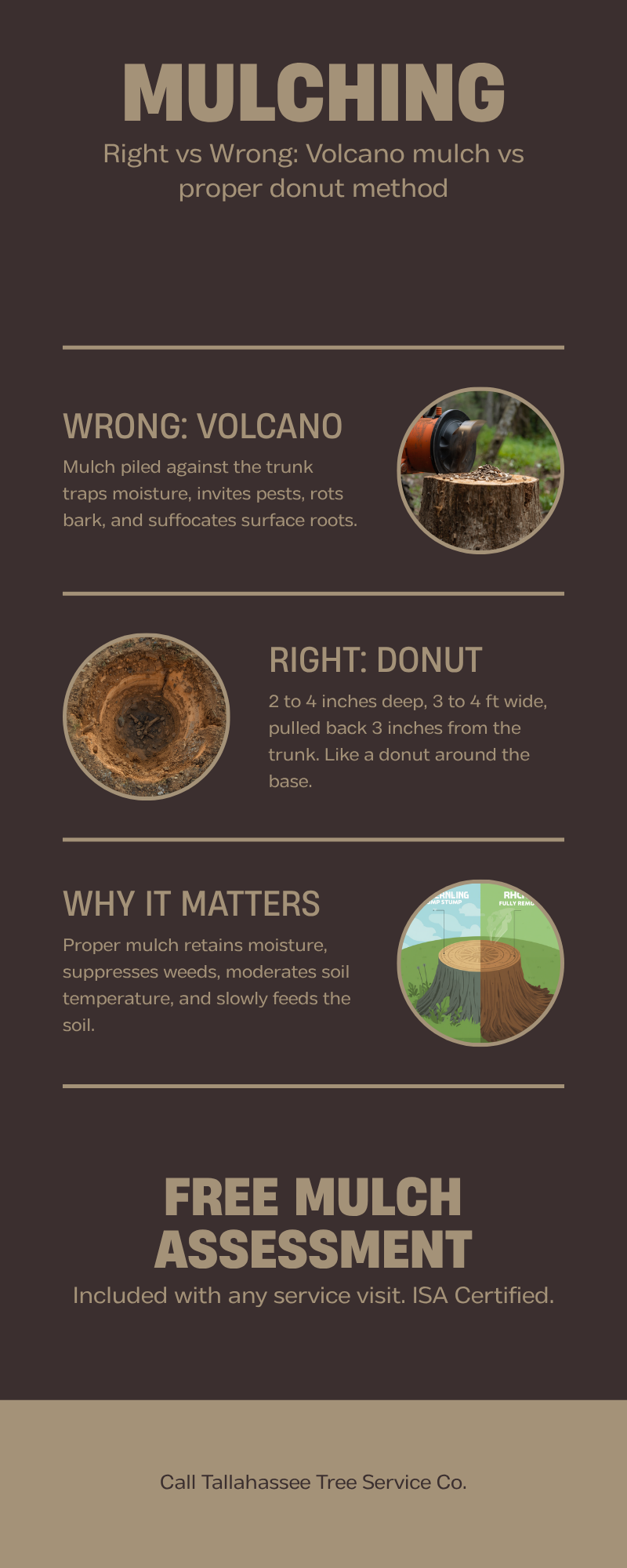
2. Volcano mulching. Pine bark piled 8–12 inches against the trunk keeps bark permanently moist, invites rot, and suffocates the root collar. Mulch 2–3 inches deep in a ring 3–6 feet wide, starting 4 inches away from bark. Donut, not volcano — see the full Tallahassee mulching guide.
3. Digging the wrong hole shape. Roots spread laterally — they need a wide, shallow zone. Dig a saucer 2–3× the root-ball width but only as deep as the ball measured to the flare, and score the sides in clay.
4. Summer planting without a committed irrigation plan. A new tree in a Tallahassee summer needs 3–5 gallons of slow, deep water every other day for 4–6 weeks — and thunderstorms can miss your street for weeks. Plant in the cool window instead, or commit to a drip ring.
5. Leaving staking hardware on too long. Stakes past 12 months prevent natural trunk taper and can girdle the trunk. In this climate a tree usually outgrows its stakes in 6–8 months. Inspect at 6 months; everything off by 12. Tie loosely — the tree should sway.
Best trees to plant in Tallahassee — the short list
| Species | Mature size | Best zone | Why plant it |
|---|---|---|---|
| Live oak (city official tree) | 50–80 ft, huge canopy | West/upland | Multi-century lifespan, the defining Tallahassee tree; grows faster here than its reputation |
| Longleaf pine | 60–100 ft, narrow | West/upland | Florida’s keystone species; 200+ year lifespan; protected by county ordinance once mature |
| Native dogwood (city flowering tree) | 15–30 ft | Both, partial shade | Spring blooms, fall color; needs afternoon shade — see dogwood care |
| American elm | 60–80 ft | Both | Adopt-A-Tree species; fast-growing vase shape, adaptable |
| Blackgum | 30–80 ft | Both | Best fall color in North Florida; plant small container stock only |
| Bald cypress | 50–70 ft | East/wet | Handles standing water that drowns oaks — see cypress care |
| Pawpaw | 15–20 ft | Both | Edible fruit, zebra swallowtail host; plant in clusters |
| Chickasaw plum | 12–25 ft | West/upland | First bloom of the year (February); drought-hardy wildlife tree |
UF/IFAS Gardening Solutions publishes the tree selection database the City and County reference for their own species lists — worth a look before you fall in love with an ornamental that doesn’t belong here.
Mitigation planting — when a City permit requires replacement trees
When the City of Tallahassee issues a removal permit for a protected tree — over 36 inches DBH per LDC §5-83, patriarch trees, or trees inside the 100-foot Canopy Road buffer — the permit often carries a mitigation requirement: replant on the property, or pay into the City’s Tree Bank at 1.18× the assessed value of the mitigated portion. Urban Forestry reviews species, minimum caliper (typically 2-inch for canopy trees), location, and installation method before closing the permit.
- Native or approved species from the City’s list — not landscape ornamentals
- Planted where it contributes to canopy cover, not tucked in a corner
- Correct depth and mulching, documented
- Urban Forestry inspection before the permit closes
- Fee-in-lieu alternative when on-site planting isn’t feasible
Confirm your permit’s exact requirements with City Urban Forestry at (850) 891-6500. The arborists in this network install to the City’s mitigation specs and coordinate the compliance inspection — passing the first visit costs far less than replanting after a failed one. Full permit context: the Tallahassee tree permit guide.
What a professional planting includes
Tree planting in Tallahassee — FAQ
Will a live oak I plant now give shade in my lifetime?
Yes — sooner than you think. In this climate a fall-planted young live oak reaches 12–15 feet with a 10–12-foot spread in 8–10 years and is a substantial shade tree in 20. The canopy Tallahassee is famous for was planted by people thinking exactly like you.
How far from my house should a shade tree go?
At least 75% of the mature canopy radius from any structure — for a live oak with a 70-foot spread, plant 25–30 feet out. The money position is 25–40 feet southwest of the house, intercepting May–September afternoon sun. Keep large trees 15+ feet from foundations, 20+ from septic fields, 25+ from underground utilities.
Does a tree I plant satisfy my City mitigation requirement?
Only if it meets the permit’s specs — species, caliper, location, and installation are all reviewed by Urban Forestry before the permit closes. An ornamental won’t satisfy mitigation for a removed 40-inch live oak.
I just removed a laurel oak in Killearn. What replaces it?
Live oak — same canopy goal, far better hurricane survivability, multi-century lifespan. If the spot is too tight for its eventual 70-foot spread, southern magnolia or American elm are next best. Don’t replant laurel or water oak.
What does professional planting cost in Tallahassee?
It varies with species, caliper, soil, and access — the big movers are stock size and site prep. The arborist quotes after seeing the property. If you qualify, the free County and City Adopt-A-Tree programs above are the lowest-cost path.
When is the best time to plant a tree in Tallahassee?
November through February. Warm soil plus dormant canopy equals root establishment without transplant stress. Spring planting — the northern habit — puts an unestablished tree into its first 90°F summer and is the most common avoidable cause of transplant death here.
Can I plant a tree myself?
Small container stock, absolutely — follow the five-mistakes list above. Where the pros earn it: 2-inch-plus caliper stock, mitigation-spec installs with City inspection, and species/site calls on tricky lots.
Related Tallahassee tree services
Tree trimming Tallahassee
Best trees to plant in Tallahassee
Live oak care
Magnolia care
Deep-root fertilization
Mulching service
Tree permit guide
Plant the right tree, the right way, in the right season.
Call now and we’ll connect you with a vetted, ISA-certified Tallahassee arborist for species selection, ISA-standard installation, mitigation compliance, and a written aftercare plan. Free to use, no obligation, no sign-up.
📞 Call Now — (858) 319-0022Tallahassee Tree Service is a free referral service. Tallahassee Tree Service is not a licensed tree service provider and does not directly provide tree care services. All work is performed by independent, licensed and insured third-party providers in your area. Calls and form submissions placed through this site may be connected with a participating provider, and you may be contacted by that provider regarding your request. Same-day, emergency, and 24/7 availability are not guaranteed and depend on provider schedules, location, and demand. Service availability, pricing, licensing, and final response times are determined solely by the providers. It is the responsibility of the homeowner to verify that the hired contractor furnishes the necessary license and insurance required for the work being performed. All persons depicted in a photo or video are actors or models and not contractors listed on Tallahassee Tree Service. Free tree program details are provided for informational reference — contact Leon County Public Works or City of Tallahassee Urban Forestry directly for current availability.