Laurel Oak Removal in Tallahassee, FL
Tallahassee planted laurel oaks by the thousand in the 1950s and 60s. They are all reaching the end of their lives at once — hollow, dropping limbs, and standing over roofs. Call now and we’ll connect you with a vetted, licensed and insured local arborist who will tell you honestly whether yours is one of them.
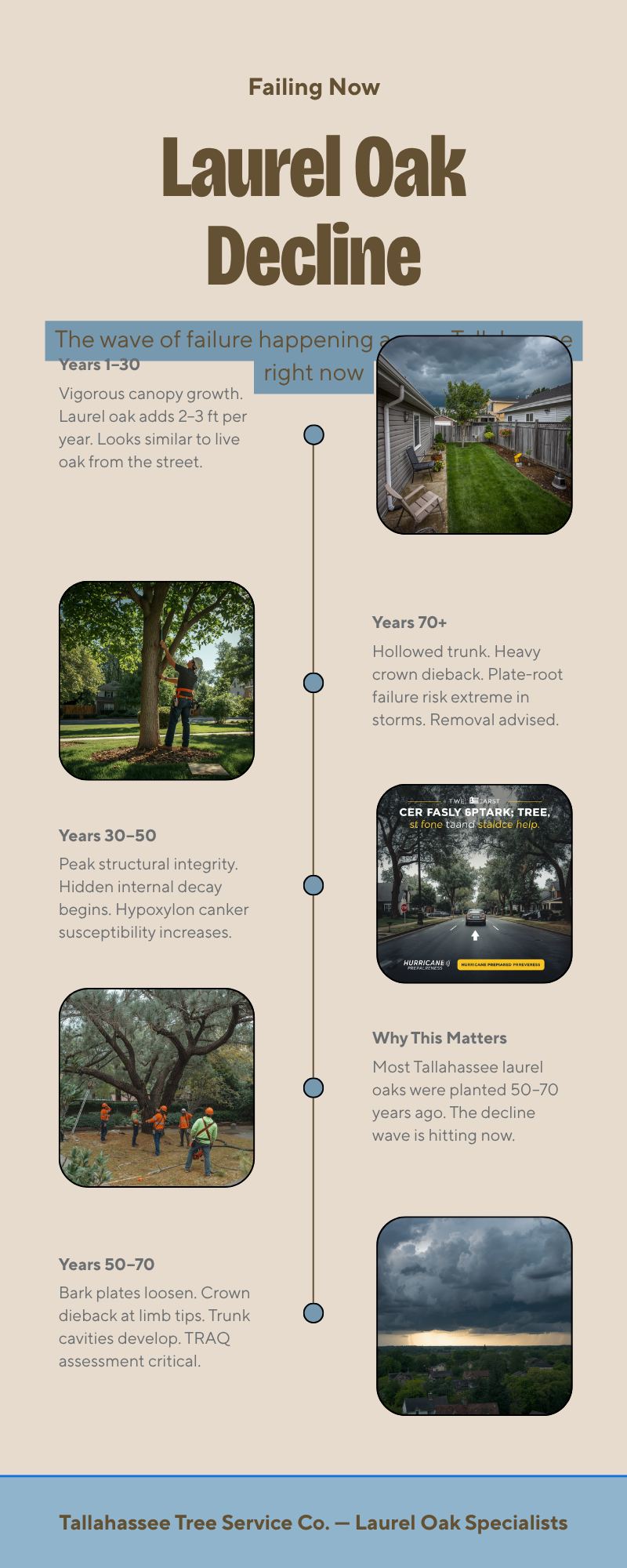
📞 Call Now — (858) 319-0022Limbs already coming down in calm weather? Call now — hazard trees are triaged first, any hour.If you live in Betton Hills, Lafayette Park, Indianhead Acres, Myers Park, Levy Park, or almost any Tallahassee neighborhood platted between about 1945 and 1970, there is a good chance the big shade oak in your yard is a Quercus laurifolia — a laurel oak. It was planted because it grows fast and shades a new house within fifteen years. Nobody mentioned the other half of the deal: laurel oaks are structurally finished at roughly 50 to 70 years old, and they decay from the inside while still looking green on top.
Leon County is now living through the back half of that bargain. What looks like a healthy shade tree can be a shell around a column of rot, and the failure comes without much warning — often in a summer thunderstorm, sometimes on a still afternoon.
How to tell a laurel oak from a live oak
This matters, because the two get confused constantly and the difference is the difference between “keep it for another century” and “this needs a plan.”
| Laurel oak (Q. laurifolia) | Live oak (Q. virginiana) | |
|---|---|---|
| Leaves | Larger, thinner, often with a wavy edge; drops most leaves briefly in late winter. | Small, thick, leathery, dark green; holds leaves nearly year-round. |
| Form | Tall and upright, oval crown, straighter trunk reaching for light. | Wide, low, spreading — branches often sweeping to the ground. |
| Bark | Smoother and darker when young, becoming furrowed. | Blocky, deeply ridged, gray-brown. |
| Lifespan | Roughly 50–70 years of sound structure. | Centuries. A 200-year-old live oak is unremarkable here. |
| Wood | Weaker, decays readily, prone to internal cavities. | Dense, strong, resists decay well. |
Rule of thumb for Tallahassee: if it is a big oak, it is tall and upright rather than sprawling, and the house was built in the mid-20th century, treat it as a laurel oak until an arborist tells you otherwise. See our deeper write-up on laurel oak problems in Tallahassee, and compare with live oak care.
The warning signs that a laurel oak is done
Laurel oaks give signals. They are just easy to miss because the canopy stays green while the trunk hollows.
- Cavities and hollow sound. Openings at branch unions or at the base. A trunk that sounds hollow when struck is not a maybe.
- Fungal conks. Shelf fungi on the trunk or at the root flare mean the decay is already extensive — the mushroom is the fruiting body of something that has been eating the inside for years.
- Calm-weather limb drop. A structural limb falling with no wind is the single most alarming sign a tree can give you.
- Deadwood in the upper canopy. Bare branches poking above the leaves — “stag-heading” — means the tree is losing the ability to supply its own crown.
- Bark sloughing in plates from the trunk with no obvious injury.
- Carpenter ants or heavy insect traffic at the trunk — they do not cause the rot, but they follow it.
- Soil heaving or cracking on one side of the base. That is root-plate movement, and it is an emergency.
One sign means get it looked at. Three means stop parking under it.
Why removal is often the honest answer
We would rather see a tree saved. But a laurel oak with significant internal decay cannot be repaired — decayed wood does not regenerate. Cabling can support a weak union on a sound tree; it cannot hold together a hollow trunk. Reduction pruning lowers the load on a compromised limb; it does not restore the wood.
The question an ISA-certified arborist actually answers is not “is the tree sick?” but “what is the likelihood of failure, and what would it hit?” A hollow laurel oak in the middle of five open acres is a wildlife tree worth keeping. The same tree twenty feet from a child’s bedroom is a different calculation entirely. That framing — likelihood of failure, likelihood of impact, consequences — is the TRAQ approach, and it is what a tree risk assessment is for.
Soil lifting at the base, a fresh crack in the trunk, or a limb hanging over the roof? Keep people out of the fall zone and call now — that is a life-safety triage, not a scheduling call.
📞 Call Now — (858) 319-0022Vetted local pros — availability depends on independent provider schedules and demand.*What makes laurel oak removal a technical job
Removing a declining laurel oak is harder than removing a healthy tree of the same size, and it is worth understanding why the quote reflects that.
- The tree may not be climbable. A climber’s rigging depends on wood that will hold. Hollow or decayed unions cannot be trusted, which pushes the job to a crane or a lift.
- Sections come apart unpredictably. Decayed wood does not hinge the way sound wood does. Cuts behave differently, and pieces can let go early.
- They are usually right on top of something. These trees were planted next to houses in neighborhoods that are now dense with houses. Almost every removal is a controlled dismantle over a target.
- They are big. A mature laurel oak is a large-tree job — see large tree removal and crane tree removal.
What drives the scope
| Factor | Why it matters in Tallahassee |
|---|---|
| Trunk diameter & height | A 40-inch laurel oak at 70 feet is materially more work than a 20-inch one. |
| Extent of decay | Heavier decay pushes the job away from climbing and toward a crane or lift. |
| Targets below | House, garage, pool cage, driveway, neighbor’s fence — each one adds rigging. |
| Access | Mid-century neighborhoods often have no equipment path to the backyard. That changes everything. |
| Debris & wood volume | Big oaks make a lot of wood. Haul-off is truck trips. |
| Stump | Grinding a wide laurel oak flare is its own line — see stump grinding. |
| Permit | Protected-tree and Canopy Road rules may apply even to a declining tree. The hazard exception has documentation requirements. |
Those are the local market realities; the pro you’re matched with gives the binding written quote after seeing the tree. For the wider picture see the tree removal cost guide.
The permit question on a declining laurel oak
City of Tallahassee §5-83 and Leon County’s Chapter 10 environmental rules protect trees above certain sizes, and Canopy Road Protection Zones add another layer. A big laurel oak may well be a protected tree on paper even though it is structurally failing.
The relief valve is Florida Statute §163.045: a residential property owner may remove a tree without local approval when documentation from an ISA-certified arborist or a Florida-licensed landscape architect shows the tree presents an unacceptable risk. The key word is documentation — get the written risk determination before the tree comes down, not after somebody asks about it. Any pro worth hiring will raise this themselves. See the Tallahassee tree permit guide.
How getting matched works
What to plant instead
The mistake worth not repeating is planting another fast, weak, short-lived shade tree in the same hole. In Tallahassee’s Zone 8b, better long-term choices include live oak (slow, but it will outlive your mortgage several times over), southern magnolia, bald cypress on wetter ground, shumard or nuttall oak, and native longleaf pine where you have room. Plant it away from the house’s eventual drip line, mulch it as a donut and never a volcano (see mulching), and give it a decade — you are planting for the next owner as much as for yourself.
Before you call — how to describe it
- Trunk size. One person’s arms around it? Two? Three?
- The signs. Cavity, conks, calm-weather limb drop, dieback up top, cracks, soil lifting.
- The targets. What is within falling distance — house, garage, power line, neighbor’s roof.
- Access. Front yard with driveway, or fenced backyard with a 36-inch gate?
- Urgency. Is anyone sleeping under it? Say so.
Frequently asked questions
How do I know if my oak is a laurel oak?
Laurel oaks are tall and upright with an oval crown and larger, thinner leaves that mostly drop for a few weeks in late winter. Live oaks are wide and sprawling with small, thick, leathery evergreen leaves. If the big oak in a mid-century Tallahassee neighborhood is upright rather than spreading, assume laurel oak until an arborist says otherwise.
Why are so many Tallahassee laurel oaks failing at once?
They were planted en masse in the post-war building boom for their fast growth, and laurel oaks are structurally finished at roughly 50 to 70 years. A whole generation of them across Leon County reached that window at the same time, so the failures cluster — especially after storms like Hermine, Michael, Idalia, and Helene.
Can a hollow laurel oak be saved?
Decayed wood does not regenerate, so a substantially hollow trunk cannot be repaired. Cabling supports a weak union on a sound tree; it cannot hold a shell together. Sometimes reduction pruning can retain a tree in a low-target location for a while. Where it stands over a house, removal is usually the honest call.
Do I need a permit to remove a laurel oak in Tallahassee?
Possibly. City §5-83, Leon County Chapter 10, and Canopy Road zones can all apply. Florida Statute §163.045 allows removal without local approval when an ISA-certified arborist documents unacceptable risk — obtain that written determination before removal.
How much does laurel oak removal cost in Tallahassee?
It is scoped to the tree — size, extent of decay, targets underneath, equipment access, wood volume, and stump all move it, so there is no honest flat figure. The arborist you’re matched with assesses on site and gives a written quote before any work begins.
What should I plant to replace it?
Not another fast, weak shade tree. Live oak, southern magnolia, shumard or nuttall oak, bald cypress on wet ground, or longleaf pine where there is room are all far better long-term choices for Zone 8b. Site it away from the house’s future drip line and mulch it properly.
Related Tallahassee tree services
Laurel Oak Problems
Water Oak Removal
Live Oak Removal
Hazardous Tree Removal
Dead Tree Removal
Tree Risk Assessment
Large Tree Removal
Tree Removal Cost
Find out what your laurel oak is really doing
Call now and we’ll connect you with a vetted, licensed and insured Tallahassee-area arborist. Free to use, no obligation, no sign-up.
📞 Call Now — (858) 319-0022Tallahassee Tree Service is a free referral service. Tallahassee Tree Service is not a licensed tree service provider and does not directly provide tree care services. All work is performed by independent, licensed and insured third-party providers in your area. Calls and form submissions placed through this site may be connected with a participating provider, and you may be contacted by that provider regarding your request. Same-day, emergency, and 24/7 availability are not guaranteed and depend on provider schedules, location, and demand. Service availability, pricing, licensing, and final response times are determined solely by the providers. It is the responsibility of the homeowner to verify that the hired contractor furnishes the necessary license and insurance required for the work being performed. All persons depicted in a photo or video are actors or models and not contractors listed on Tallahassee Tree Service.