Certified Arborist in Tallahassee, FL
Tree health evaluations, TRAQ risk assessments, disease diagnosis, permit reports, neighbor-dispute documentation — call now and we’ll connect you with a vetted, ISA-certified Tallahassee arborist who knows this canopy and puts findings in writing.
📞 Call Now — (858) 319-0022Prefer to talk it through first? Call now and we’ll connect you any hour.Quick answer
An ISA-certified arborist has passed a credential exam covering tree biology, risk assessment, and pruning standards — not every company calling itself a “tree service” employs one. Call now and you’ll be matched with a certified arborist in the Tallahassee area for risk assessments, TRAQ evaluations, or diagnosis work, and you can verify any credential in under a minute before hiring.
Most people call a “tree service” when they need a tree cut down. But there are situations where what you actually need is a certified arborist — a specialist who assesses first, then recommends. Knowing the difference saves you money, protects your trees, and keeps you legally covered. Tallahassee has the densest urban canopy of any capital city in the Southeast, and the ISA-certified arborists we route to spend their careers in it.
Arborist vs. tree crew in Tallahassee — what’s the difference?
🌿 What an ISA Certified Arborist does
- Trained in tree biology, disease pathology, and structural mechanics
- Produces legally defensible written tree risk assessment reports
- Diagnoses disease and pest infestation — and recommends treatment vs. removal honestly
- Provides the arborist documentation required for Fla. Stat. §163.045 permit exemption
- Performs tree appraisals for property value, insurance, and legal disputes
- Develops cabling, bracing, and preservation plans for structurally valuable trees
- Can serve as an expert witness in HOA disputes and neighbor tree legal actions
- Credential verifiable at treesaregood.org by ISA certification number
🪓 What a standard tree crew does
- Performs physical tree work — removal, trimming, stump grinding
- Quotes jobs based on size, access, and complexity
- May hold ISA certification — but many crews don’t; always ask and verify
- Generally cannot produce legally defensible written risk assessments
- Not trained to diagnose tree disease — may recommend removal when treatment would work
- Cannot perform formal tree appraisals for insurance or legal purposes
- Bias risk: the financial incentive favors removal over preservation in ambiguous cases
- “Certified” on a website is not the same as ISA certification — verify the number
The practical rule for Tallahassee homeowners: for routine removal of a clearly dead or storm-fallen tree, a qualified tree crew is appropriate. For anything involving legal documentation, an insurance claim, a City of Tallahassee permit application, a neighbor dispute, or uncertainty about whether a tree can be saved — get a certified arborist’s written assessment first.
Local note: Not every “arborist” in Tallahassee is credentialed the same way, and a business card isn’t proof of a license. Florida’s Department of Business and Professional Regulation maintains a public lookup at MyFloridaLicense.com so homeowners can verify a contractor’s license status before any tree work begins near a structure or property line.
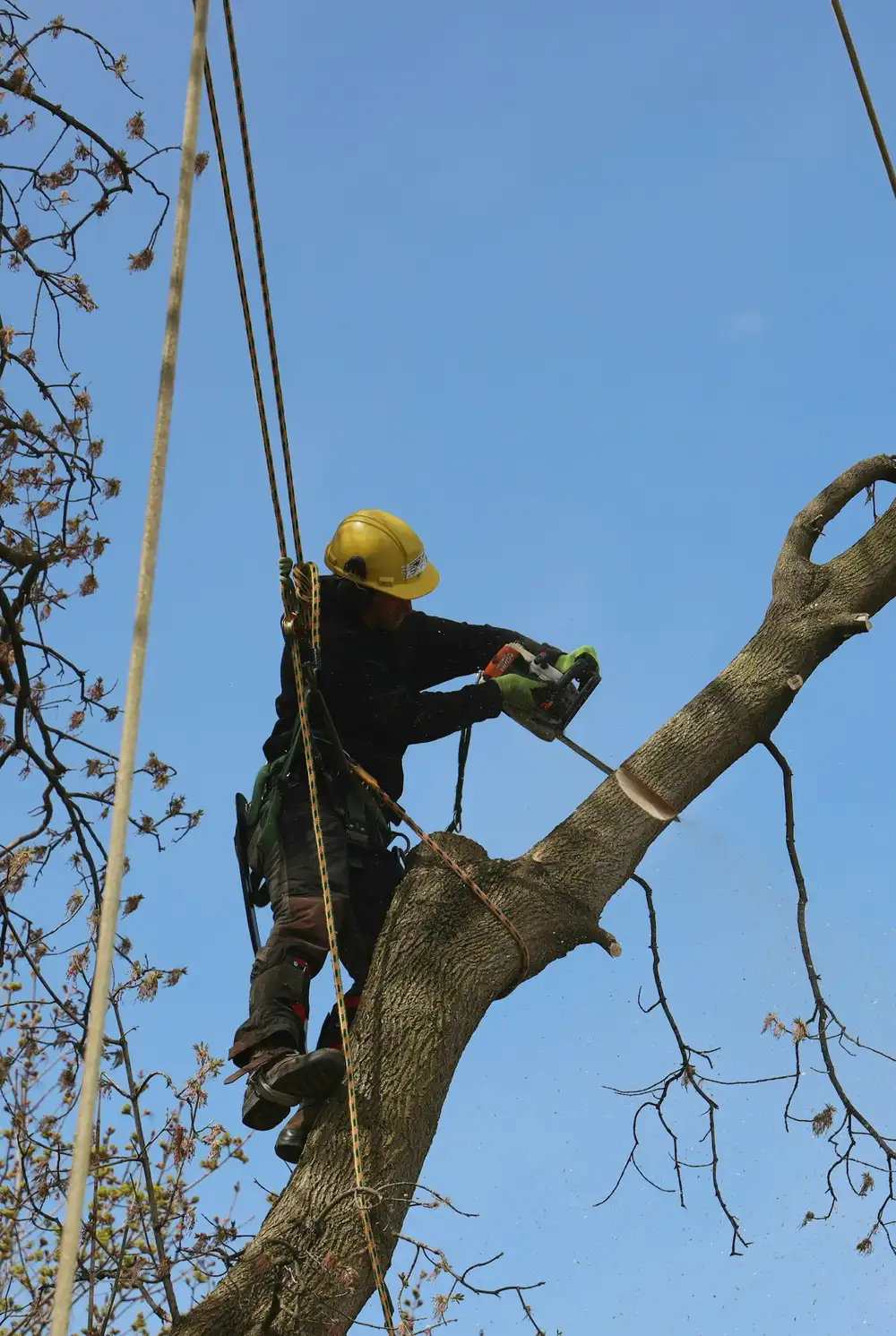
6 situations in Tallahassee where you need an arborist — not just a saw
Each of these scenarios requires a written, professionally credentialed opinion. A contractor’s verbal assessment won’t hold up in any of them.
1. Fla. Stat. §163.045 — emergency removal documentation (legally required)
Before removing a tree without a city permit under Florida’s “homeowner protection” statute, a qualified arborist must document in writing that the tree poses an unacceptable risk. That written documentation is what protects you from city enforcement action after the removal. Without it, you’ve removed a potentially protected tree with no legal cover.
2. Canopy Road permit application (permit required)
Trees within the 100-foot protection buffer of Tallahassee’s nine designated Canopy Roads require City Growth Management review before removal, and applications require an arborist’s condition assessment in the submission package. The city permit fee is separate from the arborist report. Removing a Canopy Road tree without this documentation risks fines and mandatory mitigation replanting — see the permit guide.
3. Insurance claim for tree damage (strongly recommended)
Florida HO-3 adjusters frequently require a professional arborist’s written assessment of the tree’s condition before the storm event — specifically to determine whether pre-existing decay or disease contributed to the loss. Without it, insurers may deny or reduce structural claims by arguing the loss was foreseeable. A post-event report documenting the failure mechanism is standard practice for storm claims on large mature trees — more in the insurance coverage guide.
4. Neighbor tree disputes (highly recommended)
Under Florida common law you may trim branches and roots crossing your property line at your own expense — but compelling a neighbor to remove or treat a hazardous tree requires documentation that the tree is actually hazardous. An ISA-certified arborist’s written report is the factual foundation for any demand letter, HOA complaint, or legal action. It also protects you if the neighbor later claims their tree was healthy before you intervened.
5. Home sale — tree disclosure & valuation
A mature live oak in good condition adds measurable, documentable value to a Tallahassee property. An arborist’s health report and formal appraisal protects the seller from post-sale claims that a hazardous tree went undisclosed, and supports the asking price when a buyer’s agent questions large trees near structures. Pre-listing arborist reports are increasingly requested by Tallahassee real estate attorneys on properties with significant canopy.
6. Tree preservation during construction (development requirement)
Active development in SouthWood, Midtown infill, and northwest Tallahassee regularly threatens mature trees during grading, trenching, and foundation work. An arborist’s tree preservation plan — protection zones, permitted root-pruning limits, monitoring requirements — is often required by the city for development permits involving protected trees. Without one, construction damage to root systems can trigger enforcement and mandatory replacement mitigation.
Leaning trunk, mushroom conks at the base, or a limb that cracked in the last storm? Describe it on the call — hazard situations are triaged first.
📞 Call Now — (858) 319-0022Vetted local pros — availability depends on independent provider schedules and demand.*Understanding ISA credentials — and how to verify them
Not all “certified arborist” claims are equal. Here’s what each ISA credential level represents, and when it matters:
ISA Board Certified Master Arborist (BCMA) — highest tier
The highest ISA certification available: 6+ years of full-time arboricultural experience, an ISA Certified Arborist credential held for years, and a rigorous advanced exam. Florida has a limited number of BCMAs. Appropriate for complex litigation support, heritage-tree appraisal, high-value property assessments, and contested permit applications — a BCMA consultation typically costs more on the local market, but the report carries maximum professional weight in legal settings.
ISA Certified Arborist (CA) — the core professional credential
Requires 3 years of full-time tree-care experience and a comprehensive exam covering tree biology, identification, pruning, installation, risk assessment, and tree protection. This is the baseline credential for any report you’ll use for City of Tallahassee permits, §163.045 documentation, or insurance claims. Every ISA Certified Arborist has a unique credential number.
ISA TRAQ — Tree Risk Assessment Qualified
A supplemental qualification for performing structured tree risk assessments using ISA Best Management Practices. TRAQ-qualified arborists produce the formal Level 1–3 risk assessments used for municipal inventories, insurance documentation, and legal proceedings — the City of Tallahassee’s own Urban Forestry Specialists are required to hold TRAQ within a year of hire. When you need a formal risk report, ask specifically whether the arborist holds TRAQ — the tree risk assessment guide explains the levels.
How to verify any credential in 30 seconds: go to treesaregood.org (the ISA’s consumer site) and use the “Find an Arborist” tool — search by ZIP code or verify a specific certification number. Don’t rely on a company website’s claim alone. ISA certification must be renewed, so a lapsed credential won’t show as active. The ISA-certified arborists we route to expect you to check — it’s the sign of an informed client.
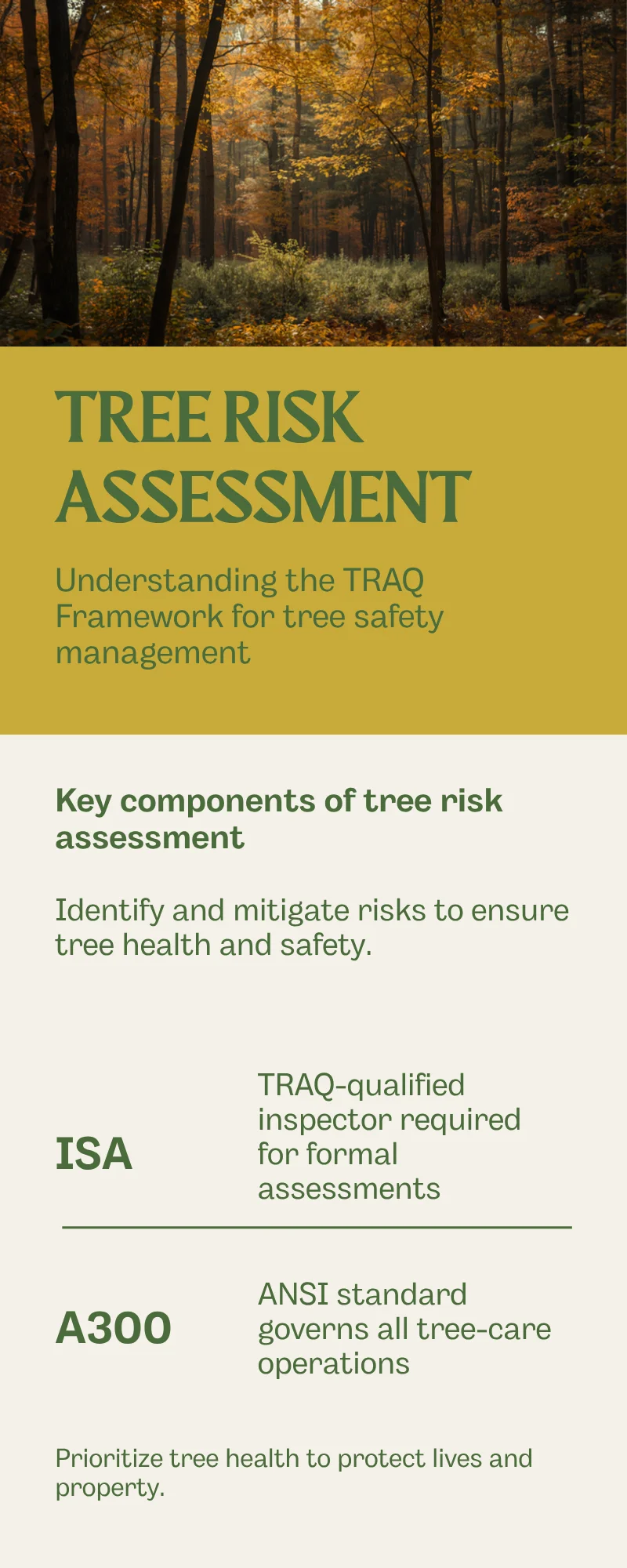
Tallahassee tree disease & pest guide — what the arborist is looking for
Tallahassee’s dominant canopy species each face species-specific threats. Knowing the warning signs helps you request an assessment before the problem becomes terminal.
Southern pine beetle (Dendroctonus frontalis) — act immediately
Affects slash, longleaf, and loblolly pine. The most destructive forest insect in the Southeast — a single infested tree can spread to neighboring pines within weeks, and FDACS confirmed elevated SPB activity in North Florida through 2025. Warning signs: popcorn-sized pitch tubes on the trunk, sawdust-like frass at the base, crown fading green → yellow → red-brown, S-shaped galleries under loosened bark. More in the SPB guide.
Hypoxylon canker (Biscogniauxia atropunctata) — act immediately
Affects water, laurel, and post oak — the leading cause of sudden decline in Tallahassee’s most common landscape oaks. It’s a stress pathogen: trees weakened by drought, root damage, or construction injury become vulnerable, and once it’s established in the cambium the disease is incurable. Warning signs: bark sloughing off in patches revealing a silver-gray crust, powdery tan/gray spore masses on the trunk, crown thinning with no storm damage. See also laurel oak problems.
Ganoderma root & butt rot (Ganoderma spp.) — act immediately
Affects palms, live oak, laurel oak, and most hardwoods. A wood-decay fungus that destroys structural roots and the base of the tree — by the time the varnished reddish-brown conks appear at the trunk base, substantial internal decay has already happened. Extremely common in Tallahassee’s older neighborhoods. Warning signs: shelf-like conks at the base, white spore powder around the trunk, a lean with no storm cause, spongy wood when probed.
Laurel wilt — schedule an assessment
A lethal vascular wilt vectored by the redbay ambrosia beetle; affected trees often die within weeks of first symptoms. Primarily devastating to redbay and swamp bay, but it threatens any laurel-family tree in the landscape. Warning signs: rapid wilting where leaves brown but stay attached, toothpick-sized boring-dust tubes on the trunk, blue-black streaking in cut sapwood.
Bacterial wetwood / slime flux — schedule an assessment
Affects elm, maple, oak, and mulberry. Bacterial fermentation inside the tree forces foul-smelling sap through cracks and branch unions, staining the bark brown. Not immediately lethal, but it signals internal infection and weakened wood — structurally significant in large trees over structures.
Oak wilt (Bretziella fagacearum) — monitor annually
Confirmed in isolated pockets of Florida and spreading. A vascular disease that cuts off water transport in all oak species. Not yet widespread in Tallahassee, but worth monitoring any oak with unexplained summer leaf wilt, especially after pruning wounds or root damage. Pruning oaks during spring sap flow raises infection risk — schedule major oak work for winter dormancy. Diagnosis and treatment options in the disease treatment guide.
Florida neighbor tree law — where a written report changes the outcome
Arborists get called into Tallahassee neighbor disputes constantly. Here’s how Florida law treats the common situations:
| Situation | How it plays out under Florida law |
|---|---|
| Neighbor’s branches overhang my yard | Florida follows the Massachusetts Rule — you may trim branches and roots that cross the line, at your own expense, up to the property line. You can’t compel the neighbor to act while the tree is healthy. Keep every cut at the line; cutting deeper into their canopy creates liability for you. |
| Neighbor’s tree looks hazardous — I’m worried it’ll hit my house | This is where the arborist report is essential. A tree owner generally isn’t liable for a fallen tree unless they had actual notice of the hazard. A demand letter accompanied by an ISA-certified arborist’s written report provides that notice — if the tree then falls, liability shifts hard toward the neighbor who ignored the documented warning. |
| Neighbor’s healthy tree fell on my property in a storm | A healthy tree’s owner generally isn’t liable for storm damage, wherever it lands — your own policy handles cleanup and repairs. If you believe the tree wasn’t healthy, an arborist’s post-event report documenting pre-existing decay is the basis for establishing negligence. |
| My tree fell on the neighbor’s property — am I liable? | Healthy tree, storm forces: generally no — their insurance covers their damage. But if you had prior notice the tree was hazardous (a letter, an earlier arborist report, an HOA notice), your exposure rises sharply. That’s exactly why a clean arborist bill of health for big trees near property lines is valuable protection. |
| HOA says I must remove a tree — I disagree | Fla. Stat. §163.045 protects homeowners’ rights when HOA mandates conflict with its provisions on documented trees. A written arborist report on the tree’s health and structure is the factual foundation for contesting the order — disputes over protected Tallahassee trees increasingly require arborist input to resolve. |
Tree appraisal — what Tallahassee’s canopy is actually worth
Research from University of Florida IFAS and national studies consistently shows mature, healthy trees add 3–15% to residential property value, with large specimens at the high end. In Midtown, Myers Park, Betton Hills, and Killearn Estates, canopy composition directly affects appraised value — a mature live oak in good structural condition can meaningfully increase a property’s appraised value depending on size, placement, and health. The reverse is true too: an undisclosed hazardous tree found by a buyer’s inspector is one of the most common post-closing disputes in Leon County real estate.
When a formal appraisal earns its fee
- Selling a home with large mature oaks — document the value before listing
- Insurance claim for a tree destroyed by a neighbor, utility, or contractor
- Legal dispute involving tree damage or destruction by a third party
- Development project requiring tree-impact mitigation valuation
- Estate settlement where landscape value is part of the property appraisal
- Documenting trees removed by a contractor without authorization
How trees are appraised — the ISA trunk formula method
- Trunk cross-section area calculated from the DBH measurement at 4.5 ft
- Species rating applied — live oak and longleaf pine rate highly in Florida
- Condition multiplier from the arborist’s health assessment (0–100%)
- Location factor based on the tree’s relationship to structures and landscape
- Base unit price applied from current CTLA rates
- The final figure feeds insurance claims, legal damages calculations, and estate appraisals
What happens during an arborist consultation
From the first call to the written report, here’s what to expect from the ISA-certified arborists we route to:
1. The call — understanding what you need
You’ll be asked what’s prompting the assessment: disease symptoms, a permit application, a home sale, a neighbor situation, or just wanting an expert opinion. That determines whether you need a verbal consultation, a written risk assessment, or a formal appraisal — and which credential the job calls for.
2. On-site visual assessment — ground level and canopy
A systematic ground-level inspection covering root zone, root collar, trunk, major limbs, and canopy. For trees near structures, the arborist assesses failure potential, target proximity, and consequences. Tools can include a mallet for resonance testing, a soil probe, and binoculars for canopy work; large at-risk trees sometimes warrant an aerial inspection as a separate engagement.
3. Diagnosis and findings discussion
You get walked through what was found — disease indicators, structural defects, soil condition, immediate concerns — with species-specific risk factors for live, laurel, and water oak, and SPB spread-risk for pines. Treatment options like cabling, fertilization, or root aeration get discussed before any talk of removal.
4. Written report — when required
For permits, insurance, legal situations, or property sales, the arborist produces a formal report documenting findings, methodology, and recommendations. TRAQ-methodology reports state the risk rating (low / medium / high / extreme) and recommended mitigation; §163.045 documentation establishes the hazard in writing before work begins. Reports typically turn around in 3–5 business days.
5. Follow-through — findings to action
If the assessment says work is needed, we can connect you with the right independent crew — removal, trimming, SPB salvage, or treatment. If the tree turns out healthy, you have documentation to that effect for disputes, insurance, or peace of mind. The arborist’s independence from the crew doing the cutting is a structural safeguard against unnecessary work.
How getting matched works
Frequently asked questions
How do I verify an arborist in Tallahassee is actually ISA certified?
Go to treesaregood.org and use the “Find an Arborist” tool — search by ZIP code or verify a specific certification number. Every ISA Certified Arborist has a unique credential number, and certification must be renewed, so a lapsed credential won’t show as active. Never rely on a website claim alone; the check takes 30 seconds and is the single most important step in hiring.
Can an arborist save a tree a crew says needs to come down?
Often, yes — especially Tallahassee’s large-canopy oaks. Crews are trained in physical tree work, not tree medicine. A laurel oak with crown dieback may be misread as a removal candidate when the real cause is Hypoxylon stress from root damage — sometimes arrestable with soil care and irrigation. Codominant stems and included bark can often be mitigated with ISA-standard cabling and bracing, extending a tree’s safe life by decades. An independent assessment before removing any large, healthy-looking tree is money well spent.
Do I need an arborist report to remove a dead tree in Tallahassee?
For a clearly dead tree under 36″ DBH on a residential lot outside a Canopy Road zone — no permit, no report legally required. But for any dead tree over structures, near property lines, or in the Canopy Road buffer — or where “dead” is your read rather than a professional’s — written confirmation is smart. It documents the condition before removal and protects you if a neighbor disputes it or the species turns out to be protected.
How much does an arborist consultation cost in Tallahassee?
Typical local-market patterns run low to high: a site visit with verbal consultation is the most affordable tier; a written risk assessment for permit, insurance, or legal use runs moderate; a formal appraisal report runs highest. Multi-tree assessments are usually discounted, and many arborists credit the consultation fee against later work. Those are market figures, not our prices — the arborist you’re matched with sets their fee in the written engagement.
What is TRAQ, and when do I need it?
TRAQ (Tree Risk Assessment Qualified) is the ISA’s supplemental qualification for structured risk assessment. When you need a formal risk rating for a municipal application, insurance file, or legal matter, ask specifically for a TRAQ-qualified arborist — their Level 1–3 reports follow the methodology those institutions expect. See the risk assessment guide.
Related Tallahassee tree services & guides
Tree Risk Assessment
Tree Health Assessment
Tree Inspection
Tree Disease Treatment
ISA Arborist Guide
Cabling & Bracing
Tree Removal
Tree Trimming
Tree Permit Guide
Tree Service Cost Guide
Need an expert set of eyes on your tree?
Call now and we’ll connect you with a vetted, ISA-certified Tallahassee arborist — verify the credential yourself at treesaregood.org before anyone climbs a thing. Free to use, no obligation, no sign-up.
📞 Call Now — (858) 319-0022Tallahassee Tree Service Co. is a free dispatch and referral service. We are not a tree-service contractor and do not perform tree work ourselves. When you call, we connect you with an independent, licensed and insured local tree-care professional who carries their own license and insurance and provides any binding quote. Price information anywhere on this site is typical local-market information for planning only; people or scenes in images are illustrative.
References to “24/7,” “same-day,” or “emergency” describe call-handling and dispatch availability. Actual on-site response times depend on the independent professional’s schedule, crew availability, and weather, and are not guaranteed. Florida statute and neighbor-law information is general reference, not legal advice.