Tree Service Insurance Coverage Tallahassee — What Yours Pays For
“Will my insurance cover this?” is the question that comes up on roughly half of all storm-related and emergency tree calls in Tallahassee. The answer depends on what fell, what it hit, why it fell, and what your policy actually says. This page is the honest practitioner’s guide to how homeowner’s insurance typically treats tree work in Florida — written specifically for Tallahassee homeowners — and what documentation gives you the best chance at a paid claim.
This site is a dispatch and referral service, not an insurance agency. Your policy and your carrier set the final answer. But after years of routing storm-response calls in Leon County, the patterns are well known. Call now for emergency tree response or a priority dispatch on-site quote with insurance-grade documentation from the arborist you’re connected with.
Does homeowner’s insurance pay for tree work in Tallahassee?
Usually only when a tree damages covered property or blocks access — not for standing hazards or preventive pruning, which is why documentation matters. Details below; for insurance-involved jobs, start with storm damage tree removal dispatch.
What Florida Homeowner’s Insurance Typically Covers for Trees
Most standard Florida homeowner’s insurance policies — HO-3 in the common naming — follow a similar pattern. Specifics vary by carrier, and the post-2022/2023 Florida property insurance market has tightened in ways that change the details. The general patterns:
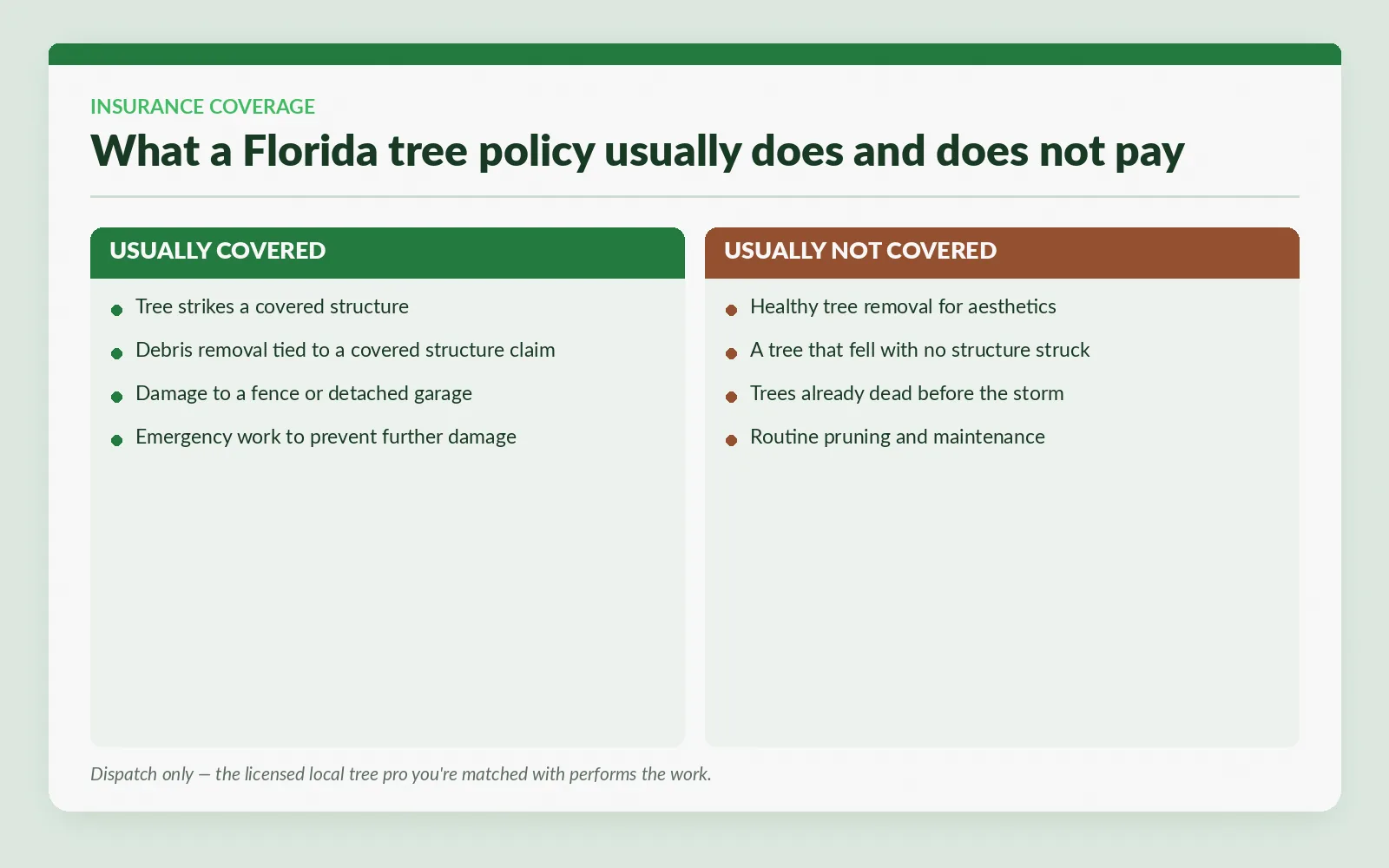
Usually Covered
- Tree falls on a covered structure (house, garage, fence) due to a covered peril (wind, hail, lightning, vehicle strike, weight of ice/snow — most of these matter less in Florida than the wind one). Insurance typically pays to repair the structure damage. Removal of the tree off the structure is usually also covered, up to a per-tree or per-event cap.
- Tree falls on insured personal property (car parked in the driveway, but auto policies often take this through comprehensive coverage instead).
- Tree falls on the house from a neighbor’s yard. Generally still your insurance, not the neighbor’s, unless the neighbor was demonstrably negligent (e.g., the tree was already dead and you had notified them in writing).
Usually Not Covered
- A tree falls in your yard and does not hit anything. Even after a major storm, removing a fallen tree from your lawn is typically out of pocket unless your policy has specific debris-removal coverage.
- A dead or dying tree comes down. Most policies will deny if the tree was clearly hazardous and the homeowner had not addressed it. This is why a written arborist assessment of dying trees is so valuable — documented notice that the homeowner acted is harder for the carrier to deny against later.
- Preventive removal of a hazardous tree. Removing a tree because it might fall is rarely covered. Removing a tree because it just fell on the house usually is.
- Damage caused by the tree’s roots (foundation lifting, sewer line break). Almost always denied as gradual damage, not a covered peril.
Caps and Sublimits
Many Florida policies have both a per-tree removal cap and a per-event cap, and both are stated on your declarations page rather than set by the size of the tree. On a major storm with multiple trees down, you can hit the per-event cap fast. Read the dec page.
The Claim Process Most Homeowners Should Follow
When a tree falls on something covered, the rough sequence:
- Safety first. Tarp up exposed openings if rain is coming, and stay clear of any tree still hanging or tangled with utility lines. If wires are down or compromised, call the utility before doing anything else.
- Document before you cut. Photos of the tree on the structure, from multiple angles, before any chainsaw runs. This is the most important step a homeowner can take. Video is even better.
- Call your carrier. File the claim. Get the claim number. Ask whether they want to send an adjuster before removal or whether you can proceed with mitigation under standard “preserve from further damage” coverage.
- Call a licensed, insured tree service for emergency mitigation. Mitigation = stop the bleeding. Get the tree off the structure, get a tarp on the roof, get the car out from under the trunk. Document each step.
- Save every receipt and invoice. Itemized, dated, with the address on it.
- Coordinate with the roofer or contractor for repairs. Most carriers want the tree removed before the roofer can quote repair. The arborist you’re connected with can help sequence around that.
What Documentation an Insurance-Friendly Tree Service Provides
For storm and emergency work where insurance is paying, the arborist you’re connected with typically provides:
- Itemized written invoice with date, address, and scope of work.
- Photos before, during, and after the work.
- A short written note documenting the cause-of-failure if it is obvious from the assessment (storm-broken limb, root-plate uplift, pre-existing decay, etc.). For unclear cases we recommend a Certified Arborist‘s written assessment, which is a separate service from the removal.
- The provider’s insurance certificate naming your address.
Most carriers do not require a Certified Arborist’s report for routine fallen-tree claims, but for contested claims (especially “was the tree already dead” disputes) the report is the strongest documentation a homeowner can provide.
Want a guided version of this documentation process? Work through our free interactive Storm/Tree Damage Insurance Checklist step by step before you call your carrier.
Special Case — A Neighbor’s Tree Fell on Your House
This is the most common confused-homeowner call. The short answer for Florida: usually your insurance pays, not the neighbor’s. The reasoning is that insurance carriers treat tree falls as acts of nature unless the tree owner was negligent — and negligence requires the tree owner to have been on notice of a known hazardous condition and to have failed to act.
If you had written and notified your neighbor that their tree was clearly dead or hazardous (and you kept a copy), you have a stronger negligence case. Without that paper trail, your carrier pays and may try to subrogate (recover) from the neighbor’s carrier — which is their problem, not yours.
Special Case — The Tree Was Already Dead Before It Fell
This is where dying-tree assessment matters most. If a homeowner had been notified — by a tree service, by a neighbor, by a city inspector — that a tree was dead and was a hazard, and did nothing, and then the tree fell on their own house, the carrier may deny on grounds that the homeowner failed to maintain the property.
This is the strongest argument for getting a written arborist assessment on any tree you suspect is in decline. The assessment cuts both ways — it documents that you knew, but it also documents that you acted on the information, which most carriers will respect. See the dead tree removal page for how these assessments work.
Related Pages
- Storm damage tree removal Tallahassee — emergency response workflow
- Dead tree removal Tallahassee — when a tree has to come down before it falls
- Tree service workmanship coverage Tallahassee — what is and is not covered
- Emergency tree service — 24/7 dispatch
- Insurance tree removal — operational page for insurance-direct billing
Get Matched for Storm and Emergency Work
24/7 dispatch, insurance-grade documentation, ISA-certified arborists in our network. Call now to get connected. Same-day, emergency, and 24/7 availability are not guaranteed and depend on provider schedules, location, and demand.
Frequently Asked Questions
Will my homeowner’s insurance pay to remove a fallen tree? Usually yes, if it fell on a covered structure (house, garage, fence) due to a covered peril. Usually no if it just fell in the yard without hitting anything. Specifics depend on your policy and the per-tree and per-event caps in your dec page.
A tree from my neighbor’s yard fell on my house. Whose insurance pays? In Florida, usually your insurance pays. Carriers treat tree falls as acts of nature unless the neighbor was demonstrably negligent (the tree was clearly dead, you notified them in writing, they did nothing). Your carrier may try to recover from theirs.
What if the tree was already dead before it fell? Carriers can deny on grounds of failure to maintain the property if the homeowner was on notice of a known hazard and did not act. A documented arborist assessment of dying trees is the homeowner’s best protection both for getting the tree handled and for supporting any future claim.
What documentation do I need from a tree service for an insurance claim? Itemized invoice with date, address, and scope. Photos before, during, after. A cause-of-failure note when the cause is obvious. The provider’s insurance certificate naming your address.
Should I get a Certified Arborist’s report? For routine fallen-tree claims, usually not required. For contested claims — especially “was the tree already dead” disputes — a written Certified Arborist’s report is the strongest documentation a homeowner can provide.
Do you handle insurance-direct billing? For larger storm claims, the arborist you’re connected with can often coordinate with the carrier and bill directly with the homeowner’s written authorization. See the insurance tree removal page for the workflow.