Insurance Tree Removal in Tallahassee, FL
A tree through the roof is a claim before it is a chainsaw job. Call now and we’ll connect you with a vetted, insured local pro who documents the damage the way carriers expect — many of them will bill an approved scope straight to the carrier.
📞 Call Now — (858) 319-0022Adjuster giving you the runaround? Call now and we’ll connect you any hour.The hard part of a tree-on-house claim in Leon County is almost never the tree. It is the paperwork. Photos taken at the wrong moment, scope language the adjuster will not accept, a debris-removal sublimit nobody mentioned, and three weeks of you playing telephone between a contractor and a carrier who are both waiting on the other one.
This page lays out what is usually covered, what usually is not, what to do in the first hour, and how the claim actually moves. Coverage varies by carrier and policy — read yours — but the shape of it in Florida is consistent enough to plan around.
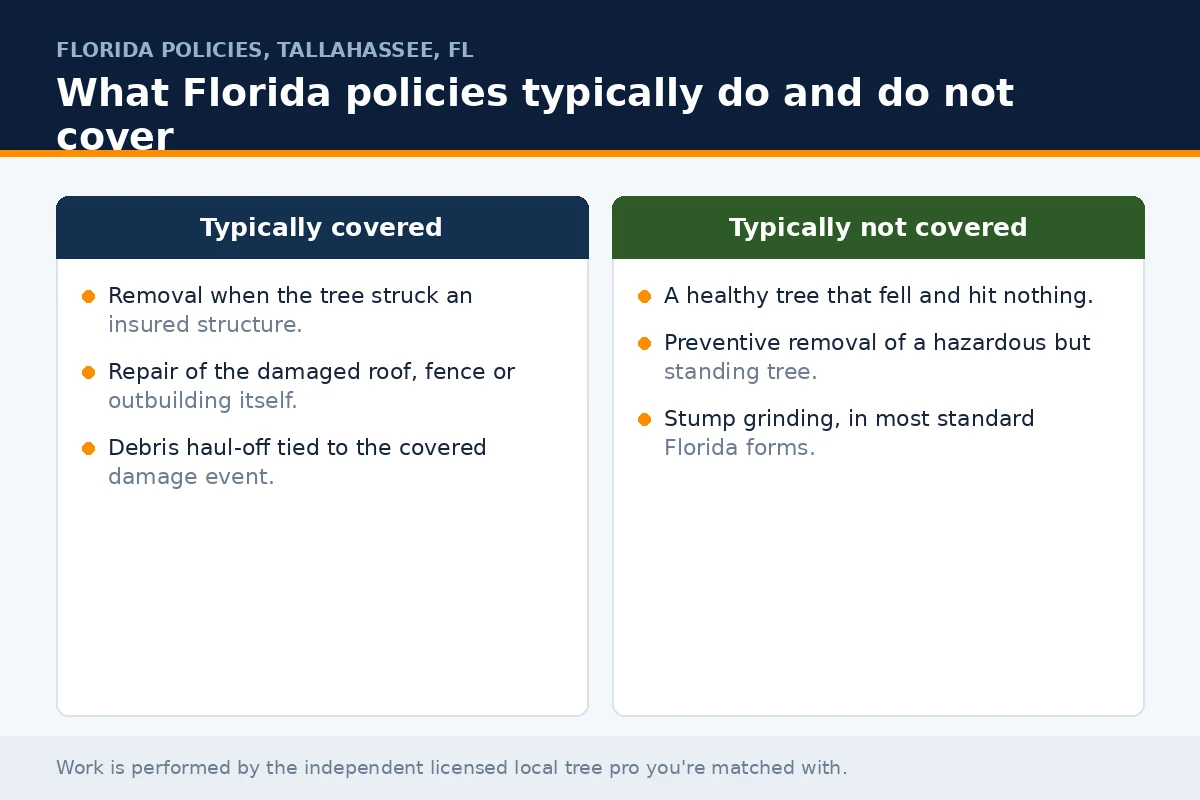
What Florida policies typically cover — and what they typically do not
| Usually covered | Usually not covered |
|---|---|
| Tree on the house, attached garage, or another covered structure during a covered peril such as wind, hail, or lightning | Preventive removal of a hazardous tree that has not fallen yet |
| Tree blocking the driveway and preventing reasonable access to the property | Tree down in the yard that hit nothing (often only a small debris sublimit, if anything) |
| Lightning-struck tree that subsequently failed | Tree that died of disease, decay, or beetles rather than a storm |
| Removal of the tree from the structure plus reasonable cleanup | Root damage to foundations, driveways, or sewer lines |
Two numbers matter and they are not the same number: the debris/tree-removal sublimit (often a modest cap) and the dwelling limit that pays to repair the structure itself. A quote that lumps them together will get kicked back. See tree service insurance coverage in Tallahassee for the fuller breakdown.
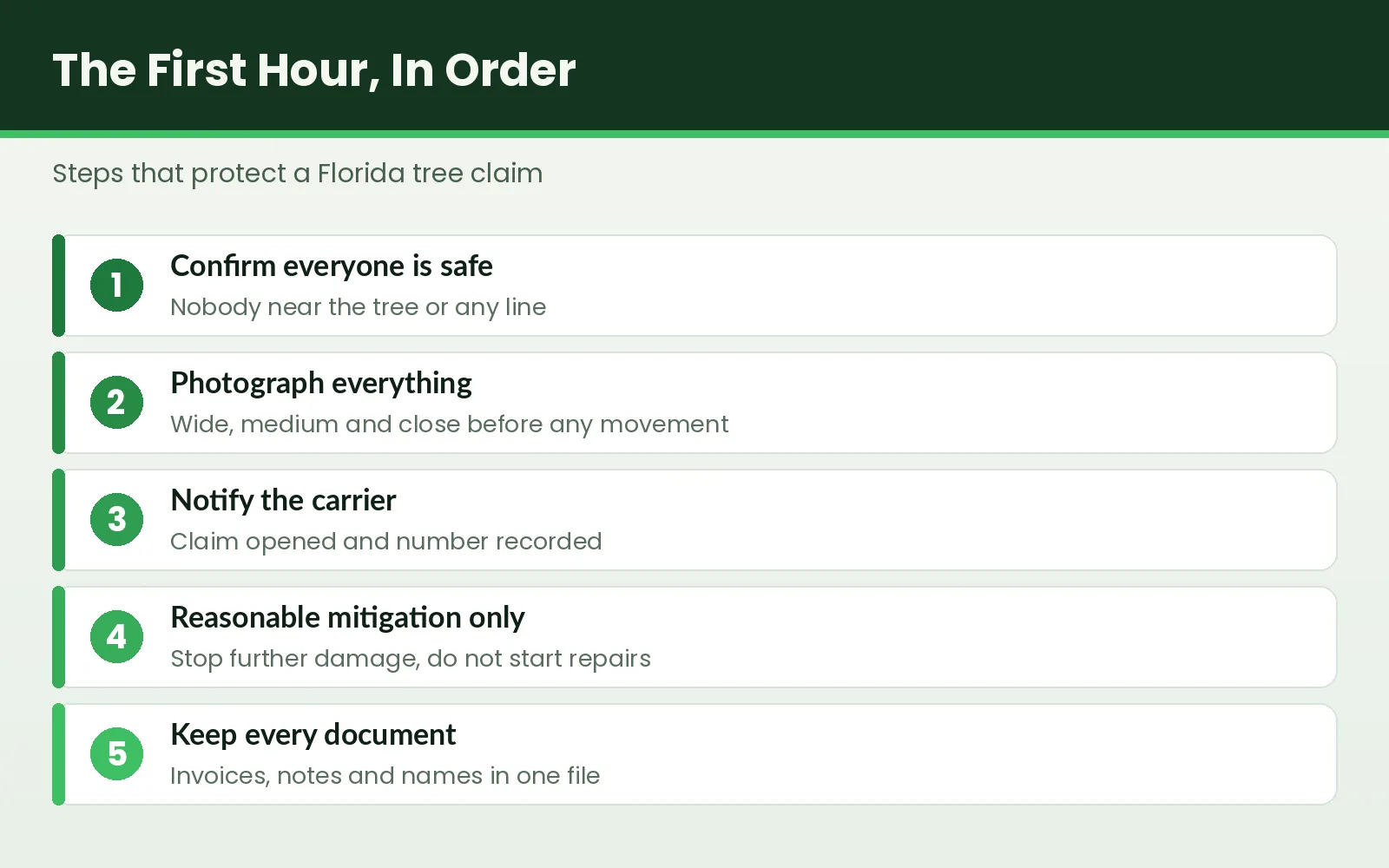
The first hour, in order
Make-safe work — tarping the opening, securing the trunk, clearing an emergency path — is generally permitted and generally reimbursable even before the adjuster has been out, because you have a duty to prevent further damage. Full removal usually waits for an approved scope.
Tree on the roof right now? That is a priority-dispatch situation. Get people out of the room, photograph it, then call now.
📞 Call Now — (858) 319-0022Vetted local pros — availability depends on independent provider schedules and demand.*How the carrier-direct path usually works
Many — not all — of the tree pros in the dispatch network will work directly with your adjuster on a covered event rather than making you the middleman. When they do, it generally runs like this:
- Make-safe and document. Tarp, secure, clear access. Photo packet captures the tree, the structure, the surroundings, and the access route.
- Scope written in carrier language. Line items and units the adjuster recognizes, with sales tax handled correctly, so the estimate does not bounce on formatting.
- Submitted straight to the adjuster. Estimate, photos, and scope go to the carrier from the contractor.
- Work performed against the approved scope. Changes get documented, not assumed.
- Closeout packet. Before, during, and after photos with scope confirmation.
- Carrier pays the contractor. You pay your deductible.
Whether a given pro offers that is between you and them — ask directly, in writing, before work starts. Nothing on this page is a guarantee about any provider’s billing practices, and the contract is yours with the contractor, not with us.
The adjuster conversation
- You generally pick the contractor. Florida policies typically let you use any licensed, insured contractor. A carrier’s preferred-vendor list is a convenience offered to you, not an obligation on you.
- Know which bucket each line item lands in. Tree removal sublimit versus dwelling repair. Arguing the wrong bucket wastes weeks.
- “Pre-existing decay” is contestable. If the carrier asserts the tree was already failing, ask what documentation supports that. An ISA-certified arborist’s written opinion carries weight in that conversation.
- “Final offer” is often not final. It is a negotiating posture. Documented disagreement, a second-opinion estimate, and mediation all exist for a reason.
- Bigger claims can justify a public adjuster. Florida-licensed public adjusters typically work on a percentage of recovery.
If the claim gets denied
| Stated reason | What usually answers it |
|---|---|
| “Pre-existing decay” | Ask for the documentation behind the determination. Counter with a written arborist assessment of the failure mode. |
| “Not a covered peril” | Check the storm timing against National Weather Service records for Leon County. Event classifications are sometimes simply wrong. |
| “No covered structure damaged” | Check how your policy defines covered structures — detached garages, sheds, and fences vary widely. |
| “Wear and tear” | The burden generally sits with the carrier to establish it. Ask them to show their work. |
A denial is the beginning of a different conversation, not the end of the claim. Document everything and keep every photo.
The work insurance will not pay for
Preventive removal of a leaning laurel oak, taking down a beetle-killed pine before it drops, clearing a tree that fell in the back forty and hit nothing — these are out-of-pocket in most Florida policies. Typical local-market ranges for that work sit on the Tallahassee tree removal cost page; those are market ranges, not our prices, and the pro you are matched with gives the binding written quote.
One nuance worth knowing: some policies contain loss-prevention or imminent-peril language that can reach a documented hazard tree. It is not common, it is not automatic, and it generally requires a written hazard assessment from a qualified arborist — which is exactly what a tree risk assessment produces. Read your policy before assuming either way.
Frequently asked questions
Will my insurance cover tree removal after a Tallahassee storm?
Generally yes when the tree hit a covered structure during a covered peril such as wind — removal from the structure plus reasonable cleanup, subject to your deductible and to a debris-removal sublimit that is often smaller than people expect. A tree that fell in the yard and hit nothing is frequently not covered.
Do I have to pay up front and get reimbursed?
Not always. On a carrier-approved scope, many contractors will bill the insurer directly and collect only your deductible from you. Confirm it in writing with the specific pro before work begins — billing arrangements are set by the contractor, not by this site.
Do I have to use the insurer’s preferred contractor?
Generally no. Florida policies typically allow you to hire any licensed, insured contractor you choose. The preferred-vendor network exists for convenience. Verify licensing through FDACS and any ISA credential through the ISA’s own verification tool — do that yourself rather than taking anyone’s word for it.
What if the carrier denies the claim?
Florida provides for documented disagreement, second-opinion estimates, mediation, and public-adjuster involvement. Ask for the basis of the denial in writing, counter with arborist documentation where the dispute is about the tree’s condition, and do not treat a first “final offer” as literal.
Can insurance pay to remove a dangerous tree before it falls?
Usually not. Most policies require the tree to have actually fallen on a covered structure. Some contain imminent-peril or loss-prevention provisions that may reach a documented hazard, which requires a written assessment from a qualified arborist. Check your specific policy language.
Should I clean up before the adjuster comes?
Only what is necessary to prevent further damage or keep people safe — tarping, securing, clearing an emergency path. Photograph everything first. Hauling the tree away before it has been documented is the single most common way homeowners weaken their own claim.
Related Tallahassee tree services
Storm Damage Tree Removal
Tree on Roof Removal
Emergency Tree Service
Fallen Tree Removal
Storm Cleanup
Insurance Coverage Guide
Tree Risk Assessment
Hazardous Tree Removal
Get a pro who knows what the adjuster needs
Call now and we’ll connect you with a vetted, insured Tallahassee-area tree pro. Free to use, no obligation, no sign-up.
📞 Call Now — (858) 319-0022Tallahassee Tree Service is a free referral service. Tallahassee Tree Service is not a licensed tree service provider and does not directly provide tree care services. All work is performed by independent, licensed and insured third-party providers in your area. Calls and form submissions placed through this site may be connected with a participating provider, and you may be contacted by that provider regarding your request. Same-day, emergency, and 24/7 availability are not guaranteed and depend on provider schedules, location, and demand. Service availability, pricing, licensing, and final response times are determined solely by the providers. It is the responsibility of the homeowner to verify that the hired contractor furnishes the necessary license and insurance required for the work being performed. All persons depicted in a photo or video are actors or models and not contractors listed on Tallahassee Tree Service.