Mimosa Tree Removal in Tallahassee, FL
The pink silk tree is charming for about three weeks a year and a problem for the other forty-nine. It suckers, it seeds, it snaps in storms, and most of the mature ones in Leon County are already dying of mimosa wilt. Call now and we’ll connect you with a vetted, licensed and insured local pro who removes it so it stays removed.
📞 Call Now — (858) 319-0022One tree or a whole thicket? Call now and describe what you’re looking at.Somebody planted it on purpose. That is the thing to understand about the mimosa in your yard — nobody wants to hear that the tree with the pink powder-puff flowers is a mistake, because it was almost certainly planted deliberately, often decades ago, by someone who thought it was pretty. It is pretty. It is also Albizia julibrissin, an escaped exotic that has naturalized across the southeastern coastal plain, and in Tallahassee it behaves like a weed that learned to be a tree.
This page covers why it belongs on the removal list, why most Tallahassee mimosas are dying anyway, how to identify it with certainty, which removal methods actually work and which ones just make more mimosas, and what to expect from the job.
Why mimosa belongs on the removal list
1. It spreads aggressively, and not just by seed
Mimosa reproduces on two fronts. The flat seed pods scatter viable seed that stays alive in the soil for years, and the root system throws suckers that emerge more than twenty feet from the parent trunk. If you have one mature mimosa, volunteer seedlings within fifty to a hundred feet of it are close to guaranteed — along a fence line, in the ditch, in the neighbor’s beds, in the strip nobody mows. Remove the trunk and do nothing else and you have not removed the tree; you have pruned it.
2. Mimosa wilt is killing them anyway
This is the part most homeowners have not heard. Mimosa wilt — a soil-borne vascular fungus in the Fusarium group — has been studied by southern forestry and extension programs since the 1960s, and it is endemic across the Southeast. It enters through the roots, colonizes the vascular tissue, and chokes the tree’s water transport from the inside.
The symptoms are unmistakable once you know them: leaves yellow and wilt on one branch or one side of the canopy first, then the dieback spreads. Cut into an affected branch and the wood shows brown or olive-brown streaking in the sapwood ring. Decline is usually rapid — a tree can go from apparently healthy to dead within a season or two.
There is no practical treatment. You cannot spray a soil-borne vascular pathogen out of a mature tree, and the fungus persists in the soil afterward, which means replanting another mimosa in the same spot is simply feeding it. What this means for your decision is straightforward: if your mimosa is showing one-sided wilt, you are not choosing between keeping it and removing it. You are choosing between removing it on your schedule and removing it on the storm’s.
3. The wood is brittle and it fails in storms
Mimosa wood is soft, light and weak, and the tree’s habit makes that worse: it grows a wide, flat-topped umbrella canopy that spreads far wider than the tree is tall — commonly thirty to forty feet across on a trunk only twenty to thirty feet high. That is a lot of leverage on a weak stem. Add a mimosa-wilt-compromised vascular system and you have a tree that comes apart in exactly the kind of summer thunderstorm gust the Big Bend produces weekly. Ours is a region that has taken Hermine, Michael, Idalia, an EF-2 tornado outbreak and Helene inside a decade. A brittle, dying, top-heavy exotic is not what you want overhanging the driveway.
4. It offers almost nothing to local wildlife
The flowers draw some nectar traffic, and that is about the extent of it. Mimosa did not co-evolve with anything here. The native insects that feed our birds do not use it, which means a mimosa occupies a canopy slot in a Tallahassee yard while contributing a small fraction of the ecological work a native would do in the same square footage. Every mimosa is a redbud, a fringetree or a native magnolia that is not there.
5. The suckers cause real property damage
Mimosa root sprouts push up through lawn, through bed edging, through the seams in a driveway and along the base of fences. They are persistent, they resprout when you mow them, and over a few seasons a single parent tree can convert a maintained back yard into a thicket you have to fight annually.
6. It never stops making a mess
Spent flowers in early summer. Fine leaflets, constantly. Then the flat brown seed pods, which hang on the bare branches all winter, rattling, and then drop. If the tree is over a pool, a patio or a driveway, that is a year-round housekeeping tax.
7. Florida restricts its sale
Mimosa is recognized as an invasive exotic in Florida, and it is not a species the state wants propagated. The City of Tallahassee takes the same view — which is why, unlike your live oak, mimosa removal is not a protected-tree situation.
8. The seeds and pods are toxic
Mimosa seed contains a neurotoxic compound and the pods are a genuine hazard for dogs and livestock that chew them. In a yard with a curious dog, that is worth knowing.
How to identify a mimosa with certainty
| Feature | What to look for |
|---|---|
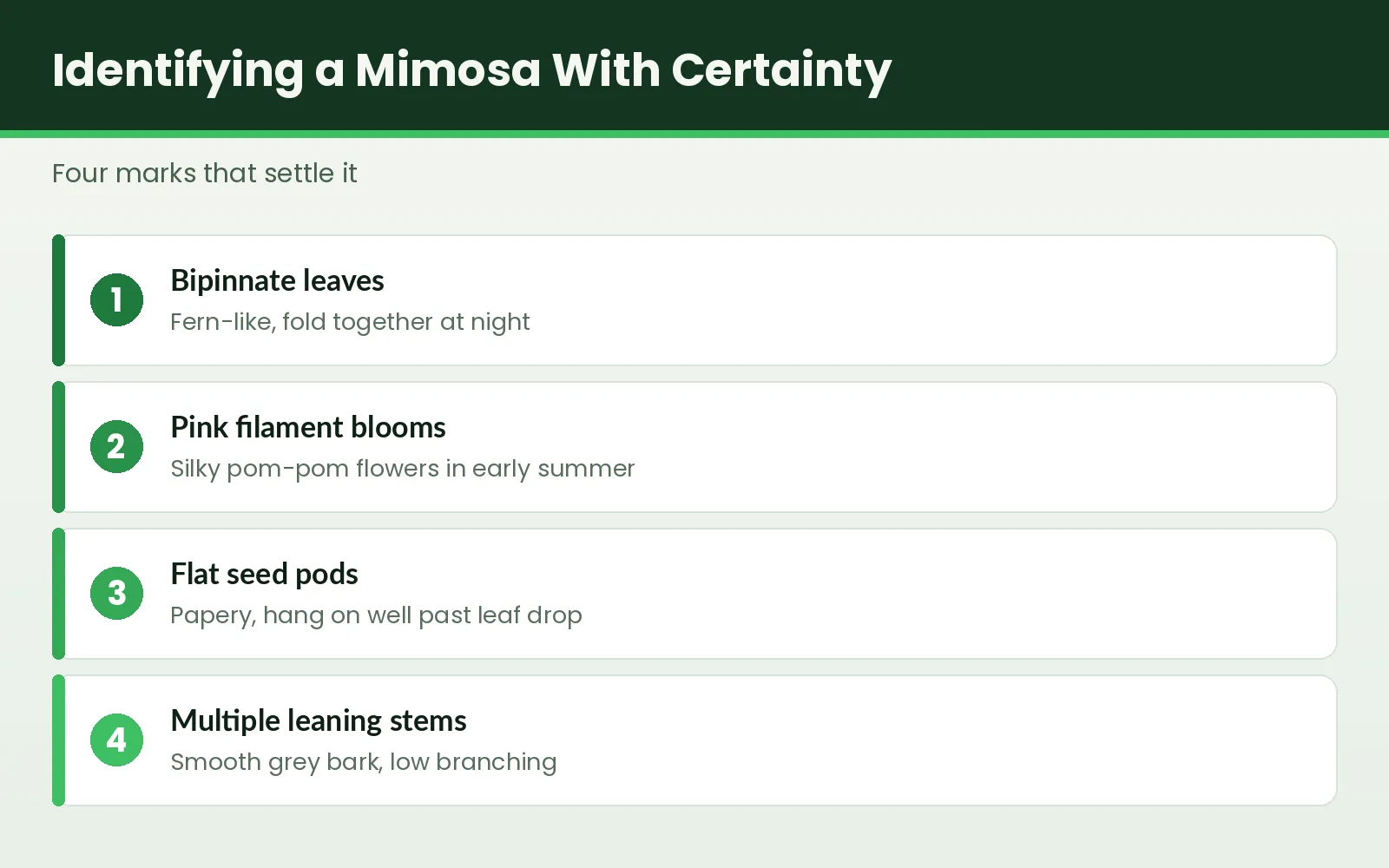
| Flowers | Pink “powder puff” blooms — silky filaments radiating from a central point, appearing in late spring through summer. Nothing else in a Tallahassee yard looks like this. |
| Leaves | Bipinnately compound and fern-like — each leaf eight to fifteen inches long, divided into dozens of small leaflets. They fold up at night and in rain, which is a good confirming tell. |
| Seed pods | Flat, papery, brown pods roughly five to eight inches long. They persist on bare branches through winter, which makes a dormant mimosa easy to spot from the street. |
| Form | A distinctive flat-topped, spreading umbrella crown — often 30–40 feet wide on a tree only 20–30 feet tall. |
| Bark | Smooth, thin, gray-brown, often with fine lighter striping. It never develops the deep furrowing of a mature oak. |
| The giveaway | Volunteer seedlings and root suckers all around it. Mimosa rarely occurs alone for long. |
Mimosa today, thicket tomorrow. Every season you wait is another seed crop in the soil and another ring of suckers along the fence line.
📞 Call Now — (858) 319-0022Vetted local pros — availability depends on independent provider schedules and demand.*Removal methods — what works, and what just makes more mimosa
This is the section that matters, because mimosa is one of the trees where the method decides whether the job is permanent or merely cosmetic. Cutting a mimosa down without treating it is not removal. It is a hard prune that the root system answers by throwing a dozen new stems.
| Method | How it works | Verdict |
|---|---|---|
| Cut + immediate stump treatment | The tree is felled and a concentrated systemic herbicide (typically triclopyr or glyphosate) is applied to the freshly cut stump surface within minutes, while the vascular tissue is still drawing. The chemical travels down into the root system rather than sitting on top of it. | The method that actually works. Timing is everything — a stump surface that has begun to seal will not take up the treatment. |
| Basal bark treatment | For smaller stems — roughly under six inches DBH — herbicide in an oil carrier is applied to the bottom 12–18 inches of bark on the standing live tree, and absorbed through the bark. | Highly effective on small trees and saplings. Useful for clearing a stand of volunteers without felling each one. |
| Foliar spray | Direct application to the leaves of small trees and resprouts. | Works on small material. Not appropriate near desirable plants, and useless on a mature trunk. |
| Hand-pulling seedlings | Mimosa seedlings under about a foot tall come out of moist soil root and all. | Genuinely effective, and free. Do it after rain and get the whole root. |
| Cut only, no herbicide | Fell the tree and walk away. | Counterproductive. The root system survives and responds by suckering vigorously. You will have more mimosa stems next year than you had trees this year. |
| Stump grinding alone | Grind the stump out, no chemical treatment. | Does not solve it. Grinding removes the stump, not the root system — and mimosa suckers from roots well beyond the grind radius. |
That last row surprises people, because grinding feels thorough. On a live oak it more or less is. On a mimosa, the roots that matter are the ones running twenty feet out under your lawn, and no grinder reaches those. If a bid proposes cut-and-grind on a live mimosa with no stump treatment step, the bid is missing the only step that determines the outcome.
How getting matched works
Why the follow-up visit matters
Even a properly treated mimosa stump usually leaves some seed in the soil and some root fragments capable of pushing a sprout. A serious invasive removal includes a plan for what comes up next spring — a return pass on seedlings and any resprouts, whether that is the pro coming back or you handling it with a shovel after a rain. Do that one follow-up season and the mimosa is genuinely gone. Skip it and you are back where you started in three years.
Permits — the good news
Under the City of Tallahassee’s tree provisions, invasive exotics are not protected trees. Mimosa sits on that list alongside Chinese tallow, camphor and Bradford pear — the City is not defending it, and no §5-83 permit is required to take it out. There is no application, no fee, no mitigation planting owed. If you are outside the city limits, Leon County’s rules apply instead, and the arborist you are matched with should confirm the specifics for your address. Our Tallahassee tree permit guide and the City tree removal page cover the framework in detail.
That exemption is worth appreciating. A comparable-sized regulated hardwood would mean paperwork and possibly replacement planting. Your mimosa means neither.
What drives the scope of a mimosa job
Mimosa work is scoped to the property — these are typical local-market drivers, not our prices. The pro you are matched with gives the binding written quote.
| Factor | Why it moves the number |
|---|---|
| Single tree, cluster, or thicket | One 25-foot mimosa in an open lawn is a straightforward day. A multi-trunk cluster with a decade of suckering behind it is a clearing project. |
| Trunk count and form | Mimosa frequently grows multi-stemmed. Each stem is a separate fell-and-treat sequence. |
| Canopy spread and what it overhangs | That wide umbrella crown over a fence, a roof or a pool means rigging rather than felling. |
| Access | A back-lot mimosa behind a fence means hand-carrying brush out through a side yard. |
| Sucker and seedling load | Treating the visible volunteers is part of doing it properly, and it scales with how long the tree has been there. |
| Follow-up pass | A return visit for resprouts is cheap insurance and is usually quoted as its own line. |
The mistakes people make
- Cutting it down and doing nothing else. The single most common error, and it converts one tree into a thicket.
- Treating the stump the next day. The window is minutes, not hours. A sealed cut surface does not take up herbicide.
- Grinding instead of treating. Grinding is a cosmetic finish, not a kill.
- Leaving the seed pods on site. Pods left in a brush pile are a seed bank sitting in your yard.
- Replanting another mimosa. Wilt fungus persists in the soil. So does the regret.
- Waiting for it to die on its own. It will — and it will most likely do it in a storm, over whatever is underneath it.
Mimosa across Tallahassee
You find mimosa everywhere people once landscaped for looks and then stopped weeding. It is common along fence lines and rear property boundaries throughout Betton Hills, Myers Park, Indianhead Acres and Lafayette Park, where mid-century plantings escaped decades ago. It shows up in the untended margins of Killearn and Bradfordville back lots, and along drainage easements and roadside ditches where the seed washes and germinates freely.
South of the Cody Scarp, in Woodville, Apalachee Ridge and out toward Crawfordville, mimosa colonizes disturbed sandy ground quickly, and it takes to cleared or burned-over land with real enthusiasm. Anywhere in Leon, Wakulla, Gadsden or Jefferson County that a lot has been cleared and left alone, mimosa is one of the first woody plants to claim it.
What to plant instead
If you liked the mimosa for the spring color, the good news is that north Florida has natives that do it better and do not turn into a maintenance problem. Eastern redbud gives you an earlier, harder pink. Fringetree is a genuinely lovely small native. Flowering dogwood and Southern magnolia both belong here. Any of them will outlive a mimosa, feed local wildlife, and stay where you put them.
Frequently asked questions
Can I just cut the mimosa down myself?
You can cut it down. You will not have removed it. Mimosa responds to felling by suckering hard from the root system, and within a couple of seasons you will have multiple stems where you had one tree. The cut has to be paired with immediate stump treatment while the surface is still fresh, or the job is worse than not doing it.
Do I need a permit to remove a mimosa in Tallahassee?
No. Mimosa is an invasive exotic and is not a protected tree under the City’s §5-83 provisions — no application, no fee, no mitigation planting. Outside the city limits, Leon County rules apply; the arborist you are matched with will confirm for your address.
My mimosa has yellowing, wilting branches on one side. What is that?
Almost certainly mimosa wilt — a soil-borne vascular fungus that is endemic across the Southeast. One-sided canopy dieback with brown streaking in the sapwood is the signature. There is no practical treatment, decline is usually fast, and the tree becomes a structural hazard as it goes.
Will stump grinding stop it from coming back?
No. Grinding removes the stump, not the root system, and mimosa suckers from roots well beyond the grind radius. Grinding is a finishing step for appearance and replanting — the herbicide treatment at the moment of the cut is what actually kills the tree.
What does mimosa removal cost in Tallahassee?
It is scoped to the property — single tree versus thicket, trunk count, canopy spread and what it overhangs, access, and the sucker load all move the number, so there is no honest flat figure. The pro you are matched with walks the site and gives a binding written quote. See our removal cost guide.
Are mimosa seed pods dangerous to my dog?
The seeds contain a neurotoxic compound and the pods are a real hazard to dogs and livestock that chew them. If you have a dog that eats things in the yard, that is one more reason to get the tree and its pods out.
Related Tallahassee tree services
Tree Removal
Chinese Tallow Removal
Camphor Tree Removal
Bradford Pear Removal
Stump Grinding
Brush Removal
Lot Clearing
Tree Permit Guide
Get the mimosa out — permanently
Call now and we’ll connect you with a vetted, licensed and insured Tallahassee-area pro who treats the stump, not just the trunk. Free to use, no obligation, no sign-up.
📞 Call Now — (858) 319-0022Tallahassee Tree Service is a free referral service. Tallahassee Tree Service is not a licensed tree service provider and does not directly provide tree care services. All work is performed by independent, licensed and insured third-party providers in your area. Calls and form submissions placed through this site may be connected with a participating provider, and you may be contacted by that provider regarding your request. Same-day, emergency, and 24/7 availability are not guaranteed and depend on provider schedules, location, and demand. Service availability, pricing, licensing, and final response times are determined solely by the providers. It is the responsibility of the homeowner to verify that the hired contractor furnishes the necessary license and insurance required for the work being performed. All persons depicted in a photo or video are actors or models and not contractors listed on Tallahassee Tree Service.