Live Oak Removal in Tallahassee, FL
Live oaks are the trees Tallahassee is famous for — and the ones the City protects hardest. Removal is a last resort, it usually involves a permit, and it is always a crane-and-rigging job. Call now and we’ll connect you with a vetted, licensed and insured local arborist who will tell you the truth about whether it has to go.
📞 Call Now — (858) 319-0022Big limb over the roof, or soil lifting at the base? Call now — hazard trees are triaged first, any hour.The southern live oak (Quercus virginiana) is why people say Tallahassee has a canopy rather than trees. It is dense-wooded, hurricane-tested, slow to rot, and it lives for centuries — the specimens along the canopy roads were mature before Florida was a state. It is also, by a wide margin, the tree most likely to trigger a permit conversation when someone wants it gone.
Which is appropriate, because most live oaks that homeowners want removed do not actually need to be removed. Before you get a quote, it is worth understanding what a live oak can survive, what it cannot, and what the City is going to say.
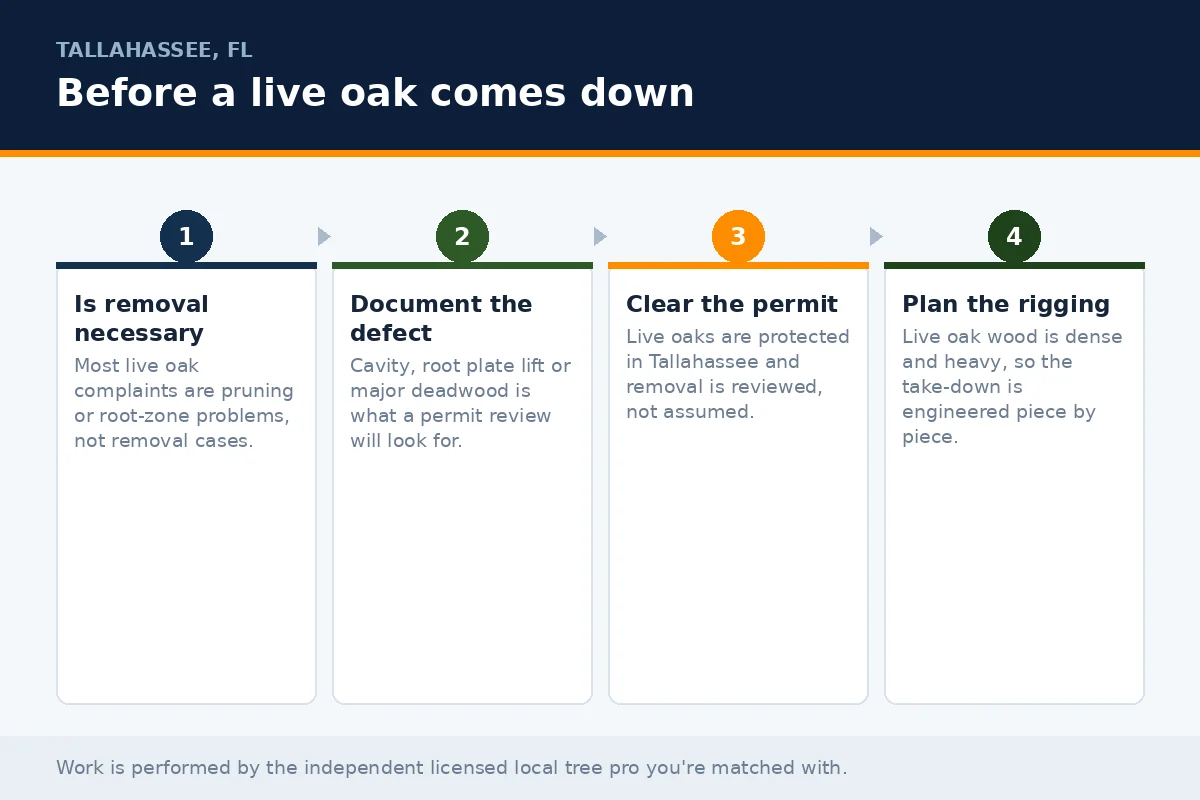
First: is removal actually necessary?
Live oaks tolerate an enormous amount. They shed limbs and carry on. They compartmentalize wounds better than almost any tree in our climate. They survived Hermine, Michael, Idalia, and Helene standing next to laurel oaks that came apart. So before removal is on the table, an honest arborist works through the alternatives:
- Reduction pruning to shorten heavy end-weight over a roof, keeping the tree and lowering the load. Often this alone solves the problem people came in for.
- Cabling and bracing a codominant union or a heavy horizontal limb — see cabling and bracing. A properly installed system can retain a limb that would otherwise be cut.
- Deadwooding — taking the dead material out of the canopy so it stops dropping.
- Root-zone care — decompaction, mulching correctly, and deep-root fertilization where soils are exhausted.
- Clearance pruning for a driveway, a roofline, or a service drop, rather than removal.
A tree risk assessment is what separates “this tree makes me nervous” from “this tree has an unacceptable likelihood of failure onto a target.” Those are very different findings and only one of them justifies taking down a two-hundred-year-old tree.
When live oak removal is genuinely justified
- Advanced trunk decay — large cavities, extensive hollowing, Ganoderma conks at the root flare. Live oaks resist rot, but they are not immune, and once the structural shell is gone it does not come back.
- Root-plate failure. Soil cracking or heaving on the far side of a lean. That is a tree in the act of falling over slowly.
- Catastrophic storm damage — a trunk split, more than half the canopy gone, a major union torn out.
- Severe root loss from construction. A live oak that lost a big share of its root plate to a foundation, pool, or utility trench may decline for years and become hazardous.
- Direct, unresolvable structural conflict — the trunk is heaving the foundation or the tree is genuinely growing into the house, and pruning cannot fix it.
- Oak wilt or major disease confirmed by diagnosis. See tree disease treatment.
“It drops acorns,” “it makes leaves,” “it shades my grass,” and “I want more sun” are not on this list — and in the City of Tallahassee, they are also not going to get you a permit.
Soil heaving at the base, a fresh trunk crack, or a huge limb hanging over the bedroom? Keep people clear and call now — life-safety situations are triaged first.
📞 Call Now — (858) 319-0022Vetted local pros — availability depends on independent provider schedules and demand.*The permit reality in Tallahassee
This is the part that surprises new residents. Tallahassee protects its canopy in law, not just in sentiment.
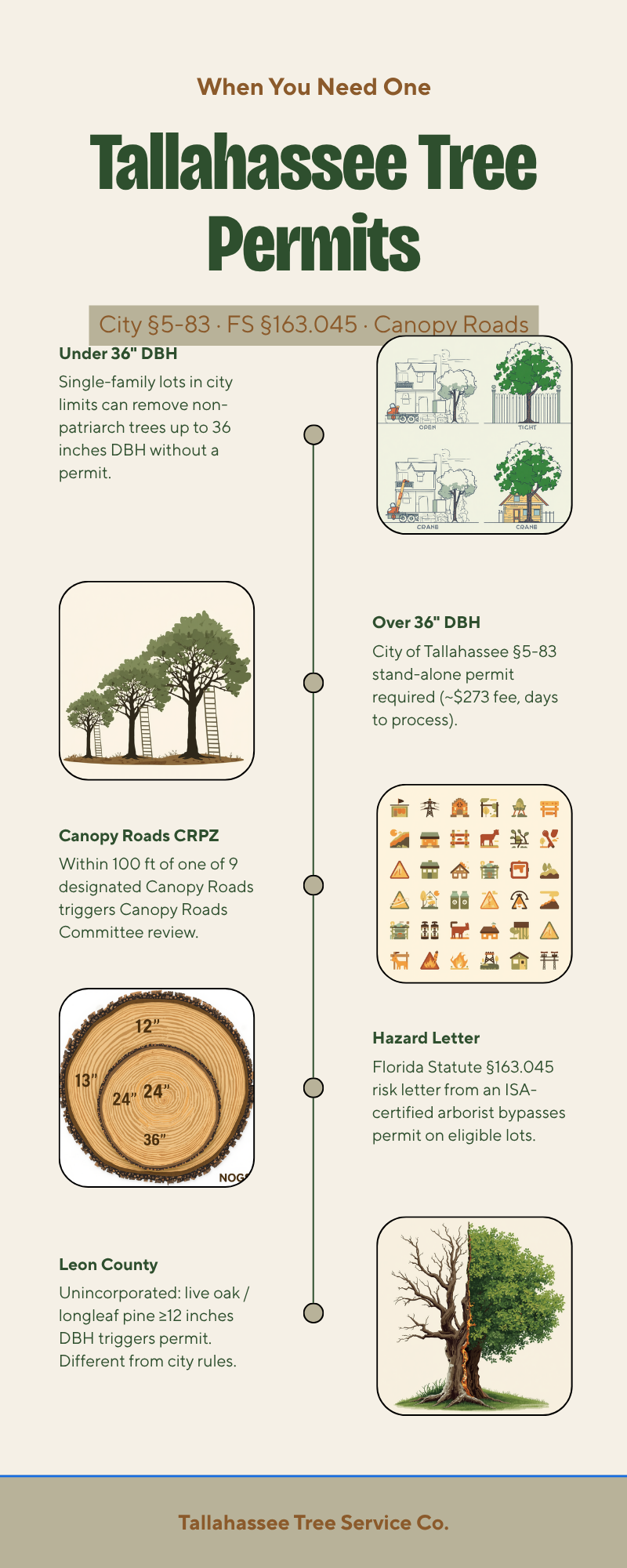
- City of Tallahassee §5-83 establishes protected trees and the process for removing them, including mitigation — replanting or paying into the tree fund — when a protected tree comes down.
- Patriarch trees — the largest specimens, which in practice are very often live oaks — carry the highest protection. Getting approval to remove one is a serious process, not a form.
- Canopy Road Protection Zones along the historic canopy roads (Old Bainbridge, Miccosukee, Centerville, Meridian, Old St. Augustine and the others) add another regulatory layer on top.
- Leon County Chapter 10 environmental management rules govern unincorporated areas.
- Florida Statute §163.045 is the hazard exception: a residential property owner may remove a tree without local approval when documentation from an ISA-certified arborist or Florida-licensed landscape architect shows the tree presents an unacceptable risk. This is a real protection for homeowners — and it is not a loophole for “I don’t like the leaves.” The documentation has to be defensible.
The practical advice: get the arborist’s written risk determination before the tree comes down, and keep it. Full detail in the Tallahassee tree permit guide and City of Tallahassee tree removal.
Why removing a live oak is a heavy job
Even when it is fully justified, this is one of the biggest residential tree jobs there is.
- The wood is dense. Green live oak is among the heaviest wood in the region — roughly 60 pounds per cubic foot. A single lateral limb can outweigh a car.
- The form is horizontal. Live oaks spread rather than climb. Long horizontal limbs mean long lever arms, and the rigging has to account for enormous swing loads.
- The spread is huge. A mature live oak can cover most of a lot. There is rarely a drop zone.
- It is a crane job more often than not. Picking sections straight up and away is usually the only safe way to handle limbs that big over a structure — see crane tree removal and large tree removal.
- The wood volume is enormous. Expect multiple truckloads. Decide up front whether it is hauled, milled, or left in rounds.
- The stump is a project. A wide live oak flare and buttress roots grind slowly. See stump grinding.
What drives the scope
| Factor | Why it matters |
|---|---|
| Trunk diameter & canopy spread | The two biggest drivers. Live oaks routinely exceed 40 inches of trunk and 70 feet of spread. |
| Crane access | A setup pad and a clear swing path can transform the job. Tight in-town lots often have neither. |
| Targets | House, garage, pool cage, fence, neighbor’s roof, power drop — each adds rigging steps. |
| Permit & mitigation | Protected-tree approval, and any replanting or mitigation requirement, sits outside the tree work itself. |
| Wood disposition | Haul-off, milling, or rounds left on site — a big cost lever on a tree this heavy. |
| Stump & roots | Buttress roots and a wide flare take real grinding time. |
These are local-market realities, not our prices. The arborist you’re matched with gives the binding written quote after seeing the tree. See the tree removal cost guide.
How getting matched works
Protect the live oaks you are keeping
Most live oaks are lost to slow damage rather than storms. The big three:
- Root-zone construction. Driveways, pools, additions, and utility trenches inside the critical root zone kill live oaks on a multi-year delay. If you are building, get the tree-protection zone fenced before equipment arrives.
- Soil compaction. Heavy vehicles parked under the canopy crush the pore space the roots breathe through.
- Volcano mulching. Mulch heaped against the trunk rots the bark. Mulch as a wide flat donut, never a cone — see mulching.
And prune them in the dormant season, to ANSI A300 — see live oak trimming and live oak care.
Before you call — how to describe it
- Trunk size. How many people to reach around it?
- Why you want it gone. Be honest — it changes what the arborist can offer, and whether a permit is even possible.
- Condition signs. Cavities, conks at the base, dead limbs, cracks, soil heaving.
- Targets and access. What is under the canopy, and is there room for a crane?
- Canopy road? If you are on or near one of the protected canopy roads, say so up front.
Frequently asked questions
Do I need a permit to remove a live oak in Tallahassee?
Very likely. City §5-83 protects trees above certain sizes, patriarch trees carry the strongest protection, Canopy Road Protection Zones add another layer, and Leon County Chapter 10 applies outside city limits. Florida Statute §163.045 allows removal without local approval when an ISA-certified arborist documents unacceptable risk — get that determination in writing first.
Can I remove a live oak just because I want more sun?
Generally no. Wanting more light, fewer leaves, or fewer acorns is not a basis for removing a protected tree in the City of Tallahassee. Crown thinning or raising can often let meaningfully more light through without taking the tree.
Is my live oak dangerous?
Live oaks are among the most storm-resistant trees we have — a big limb overhead is not automatically a hazard. Real warning signs are cavities and fungal conks at the base, cracks in major unions, soil heaving on the side opposite a lean, and large deadwood. A tree risk assessment answers this properly.
Can a hollow live oak be saved?
Sometimes. Live oaks tolerate a surprising amount of internal cavity and continue standing for decades, particularly with reduction pruning to lower the load. But extensive decay in the main structural stem, especially over a house, is the point where removal becomes the honest recommendation.
How much does live oak removal cost in Tallahassee?
It is scoped to the tree — trunk size, canopy spread, crane access, targets underneath, wood volume, and stump all move it, and permitting or mitigation is a separate matter. There is no honest flat figure. The arborist you’re matched with assesses on site and gives a written quote.
My builder says the live oak has to come out for the addition. Is that true?
Sometimes, but get an arborist’s opinion independent of the builder. Foundations can often be adjusted, root pruning can be done properly under supervision, and tree-protection fencing during construction preserves trees that would otherwise die three years later. The City may also require you to explore alternatives before approving removal.
Related Tallahassee tree services
Live Oak Care
Live Oak Trimming
Tree Permit Guide
City Tree Removal Rules
Crane Tree Removal
Large Tree Removal
Cabling & Bracing
Tree Risk Assessment
Get a straight answer on your live oak
Call now and we’ll connect you with a vetted, ISA-certified, insured Tallahassee-area arborist. Free to use, no obligation, no sign-up.
📞 Call Now — (858) 319-0022Tallahassee Tree Service is a free referral service. Tallahassee Tree Service is not a licensed tree service provider and does not directly provide tree care services. All work is performed by independent, licensed and insured third-party providers in your area. Calls and form submissions placed through this site may be connected with a participating provider, and you may be contacted by that provider regarding your request. Same-day, emergency, and 24/7 availability are not guaranteed and depend on provider schedules, location, and demand. Service availability, pricing, licensing, and final response times are determined solely by the providers. It is the responsibility of the homeowner to verify that the hired contractor furnishes the necessary license and insurance required for the work being performed. All persons depicted in a photo or video are actors or models and not contractors listed on Tallahassee Tree Service.