Live Oak Trimming in Tallahassee, FL
The live oak is the tree Tallahassee is famous for — and the tree most often ruined by a crew with a saw and no standard. Call now and we’ll connect you with a vetted, ISA-certified local arborist who prunes to ANSI A300 on the dormant calendar.
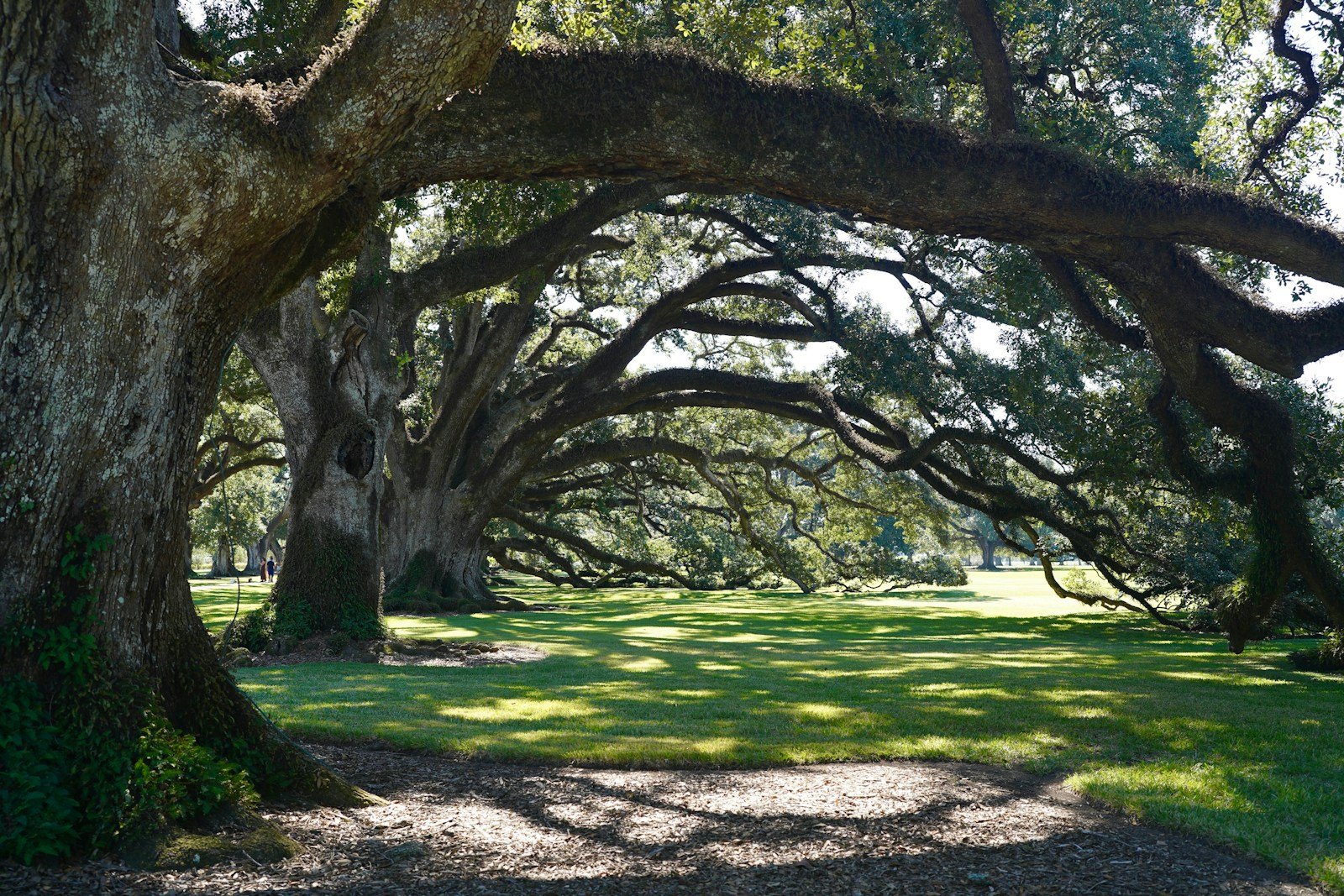
📞 Call Now — (858) 319-0022Want it looked at before winter? Call now and we’ll connect you any hour.Quercus virginiana is the signature species of this city. It fills the Canopy Roads, arches over Killearn and Bradfordville driveways, and holds up half the shade in Midtown and Los Robles. It is also the species most commonly damaged by three specific mistakes: cutting in the wrong season, cutting in the wrong position on the limb, and cutting too much at once.
Done properly, live oak pruning buys decades of safe service life and produces a tree that comes through a Category 3 with its structure intact. Done badly, it opens decay columns, forces weak sprout attachments, and manufactures the failure that arrives with the next storm. The difference is not artistry. It is a standard — ANSI A300 — and a calendar.
The right window: dormant season, roughly December through February
Live oak in Leon County slides into dormancy from about mid-November through late February. That window is when four things line up at once:
- Carbohydrate reserves sit in the roots and trunk, so reducing canopy does not starve the tree going into spring.
- Sap flow is minimal, so cuts seal faster with far less ooze.
- Fungal and insect pressure is low — Hypoxylon canker spores in particular are far less active in the cold months.
- The structure is visible. With the canopy thinned out, an arborist can actually see branch unions, included bark and crossing limbs instead of guessing through foliage.
A word about “oak wilt prevention”
You will occasionally see a tree service in Florida selling dormant pruning as oak wilt prevention. Oak wilt (Bretziella fagacearum) is not established in Florida — UF/IFAS document FOR274 and FDACS rule 5B-26.006 are both clear on this. Dormant pruning here is done for structural and wound-response reasons, full stop. If someone quotes you an oak-wilt prevention program in Leon County, that is a sales script, not arboriculture, and it tells you something about the rest of their advice.
What real live oak trimming actually consists of
An ANSI A300-compliant prune on a Tallahassee live oak is a combination of named operations, not a vague “cut it back.” Ask which of these the pro intends to perform and you will immediately learn whether they know the standard:
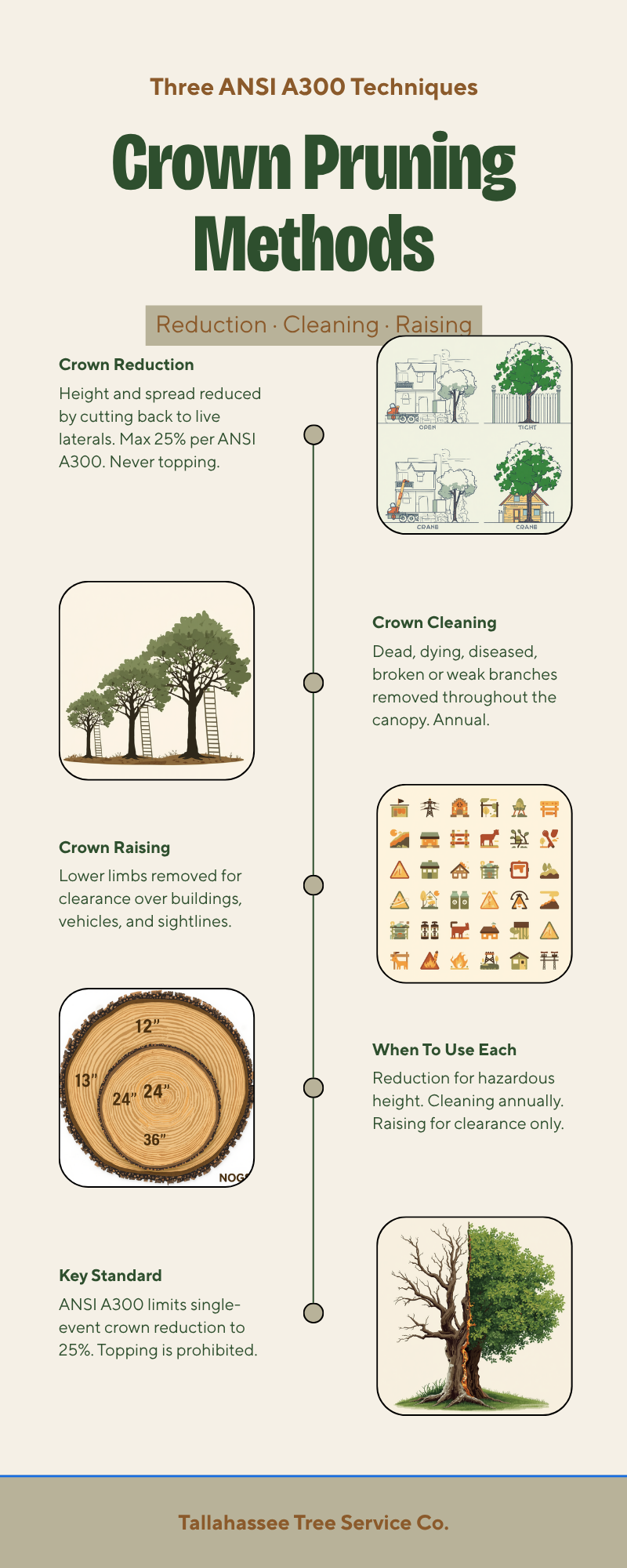
- Crown cleaning — taking out dead, diseased, broken, weakly attached and crossing branches. Pound for pound, the biggest hurricane-prep win available on a live oak.
- Crown thinning — selective interior removal to let wind pass through rather than push the canopy like a sail. Capped at roughly 25% of live foliage in a season.
- Structural pruning on young trees — establishing a dominant leader and well-spaced scaffold limbs before the tree is fifteen. This is the single highest-value cut anyone will ever make on your oak, and almost nobody does it, which is why so many mature Tallahassee live oaks carry codominant stems.
- End-weight reduction — shortening over-extended limbs back to a suitable lateral, honoring the one-third diameter rule. This is what keeps a 40-foot horizontal limb from levering itself off the trunk in a gust.
- Deadwood removal — every dead branch of any real size cut cleanly at the branch collar, never flush and never stubbed.
- Clearance pruning — roofs, driveways, walkways, and utility-coordinated line clearance.
What it never includes: topping, hat-racking, lion-tailing (stripping interior growth and leaving foliage only at the tips, which is a great way to snap a limb), or pulling more than about a quarter of the living canopy in one season. If a bid describes any of those, get another bid. See why topping destroys a tree.
The failure modes a good arborist plans around
Live oaks fail in predictable ways. A proper inspection is really a hunt for these five patterns:
| Failure mode | What it looks like | The right response |
|---|---|---|
| Codominant stems | Two roughly equal trunks meeting in a tight union, often with bark trapped inside it | Subordinate one leader while the tree is young; on a mature tree, cabling and bracing rather than a saw |
| Included bark | A sharp V-shaped union instead of a rounded U | Remove one of the codominant branches, or support the union — it will split eventually otherwise |
| Decay at old wounds | Cavities, soft punky wood, mushroom conks at the base or on limbs | A TRAQ-level assessment. If the decay column runs into the trunk, pruning is not the answer |
| End-weight breakage | A long horizontal limb extending well past half the tree’s height | Reduction cuts back to a lateral, plus cabling where the limb is worth keeping |
| Root plate lift | Soil cracking or heaving on one side of the trunk | Not a pruning problem at all. That is a failure in progress — keep people clear and get it assessed |
The last row matters more than any of the others. No amount of trimming fixes a root plate that has started to rotate, and any pro who offers to “lighten it up” instead of assessing it is selling you a delay. See tree risk assessment and the leaning tree guide.
Big limb reaching over the roof, or a union that looks like a V instead of a U? Those are the two things worth getting eyes on before hurricane season, not after.
📞 Call Now — (858) 319-0022Vetted local pros — availability depends on independent provider schedules and demand.*Patriarch live oaks and City §5-83
A great many of the live oaks on Tallahassee residential lots are patriarch-eligible — generally the very large specimens, and the City’s tree ordinance at §5-83 protects them regardless of any lot exemption the property might otherwise enjoy. A patriarch tree needs a permit to remove, and mitigation rules can attach to heavy pruning that takes a substantial share of the canopy. Cutting deeply into a patriarch live oak without the paperwork can trigger replacement mitigation at multiples of what was removed.
The arborist you are matched with should flag patriarch status during the walk-through and tell you plainly when a permit applies before any work is scoped. If your street is one of the designated Canopy Roads, an additional protection zone stacks on top of that. Our Tallahassee tree permit guide walks through which trees are covered and what the process looks like, and City of Tallahassee tree removal covers the removal side.
How getting matched works
What drives the scope of a live oak prune
Live oak work is scoped to the individual tree — these are typical local-market drivers, not our prices, and the pro you are matched with gives the binding written quote.
| Factor | Why it matters on a Tallahassee live oak |
|---|---|
| Spread, not just height | A live oak grows out as much as up. A 60-foot spread is a lot of limb to reach, and reach is what costs hours. |
| Wood density | Live oak is heavy. Every piece that comes off a limb over a roof has to be rigged and lowered, not dropped. |
| Number and type of cuts | A crown clean is a different animal from a full structural reduction with cabling. |
| Access | A fenced Betton Hills backyard with no equipment path means climbing and hand-lowering every piece. |
| Patriarch or Canopy Road status | Permit and mitigation handling adds process, and heavy cuts may simply not be permissible. |
| Debris volume | Chipping on site versus hauling a full canopy out through a narrow side yard changes the time considerably. |
Before you call — how to describe your oak
- Roughly how wide is the canopy? Spread tells an arborist more about the job than height does.
- What is underneath it? Roof, driveway, pool cage, play set, service drop, neighbor’s fence.
- Is there a limb you are specifically worried about? Point at it. That one limb often defines the whole scope.
- Has anyone cut it before? A previously topped or lion-tailed oak needs restorative pruning, which is a different plan.
Frequently asked questions
When should a live oak be pruned in Tallahassee?
The dormant window — roughly December through February — is the right season for structural work. Broken or clearly dead branches can come out any time of year. Heavy reduction should wait for dormancy so the tree isn’t pushed into spring with depleted reserves.
Does dormant pruning prevent oak wilt in Florida?
No, and anyone selling that is misinformed. Oak wilt is not established in Florida per UF/IFAS FOR274 and FDACS rule 5B-26.006. Dormant pruning here is done for structural and wound-response reasons.
How much of the canopy can be taken in one season?
ANSI A300 caps removal at roughly 25% of live foliage per growing season on a mature tree. Young trees can sometimes take a little more. Anything past that is stress, not maintenance.
Will pruning stop my oak from failing in a hurricane?
It shifts the odds substantially — crown cleaning, end-weight reduction and deadwood removal all cut sail area and take out the limbs most likely to go. It does not eliminate risk; a strong enough storm can take any tree. Pair it with hurricane tree prep before June.
Is my live oak a protected patriarch tree?
Very large live oaks commonly qualify under the City’s §5-83 provisions, and Canopy Road protection zones add another layer. The arborist confirms species and trunk diameter during the walk-through and tells you when a permit applies.
What if the oak is too far gone to prune?
It happens — advanced trunk decay, a lifting root plate, or a split codominant union can put a tree past the point where cutting helps. In that case the honest conversation is about removal and the when-to-remove decision guide, not another prune.
Related Tallahassee tree services
Tree Trimming
Oak Tree Trimming
Live Oak Care
Live Oak Removal
Tree Pruning
Tree Cabling & Bracing
ISA-Certified Arborist
Hurricane Tree Prep
Get your live oak pruned to the standard
Call now and we’ll connect you with a vetted, ISA-certified Tallahassee-area arborist who works to ANSI A300. Free to use, no obligation, no sign-up.
📞 Call Now — (858) 319-0022Tallahassee Tree Service is a free referral service. Tallahassee Tree Service is not a licensed tree service provider and does not directly provide tree care services. All work is performed by independent, licensed and insured third-party providers in your area. Calls and form submissions placed through this site may be connected with a participating provider, and you may be contacted by that provider regarding your request. Same-day, emergency, and 24/7 availability are not guaranteed and depend on provider schedules, location, and demand. Service availability, pricing, licensing, and final response times are determined solely by the providers. It is the responsibility of the homeowner to verify that the hired contractor furnishes the necessary license and insurance required for the work being performed. All persons depicted in a photo or video are actors or models and not contractors listed on Tallahassee Tree Service.