Live Oak Tree Care in Tallahassee, FL
Pruning windows, root-zone protection, hurricane prep, and how to tell normal live oak behavior from a real warning sign. When the job is bigger than a pole saw — call now and we’ll connect you with a vetted, ISA-certified local pro who works heritage oaks for a living.
📞 Call Now — (858) 319-0022Limb already split or resting on a roofline? Treat that as urgent and keep everyone out from under it.Live oaks aren’t just another species in Tallahassee — they’re the reason the city looks the way it does. The canopy roads out Miccosukee, Meridian, Centerville, and Old St. Augustine, the Lichgate Oak off High Road, the block-shading giants in Betton Hills and Myers Park — nearly all of it is Quercus virginiana. A live oak that gets decent care can run three centuries or more, which means every pruning and root-zone decision you make compounds for generations. It also means the mistakes — topping, trenching, fill dirt, volcano mulch — compound too.
When to prune a Tallahassee live oak (and how much)
The working answer for major structural pruning here is July and August. Mid-summer heat has two things going for it: the tree is in full energy production and closes wounds fast, and the insect and fungal activity that exploits fresh cuts on stressed oaks runs lower than in the cool, wet transition months. Deadwood removal — cutting only what’s already dead — is fine any month of the year. What you want to avoid is heavy live-crown pruning during the spring leaf exchange (roughly February through April), when the tree is spending stored energy and every big cut hits hardest.
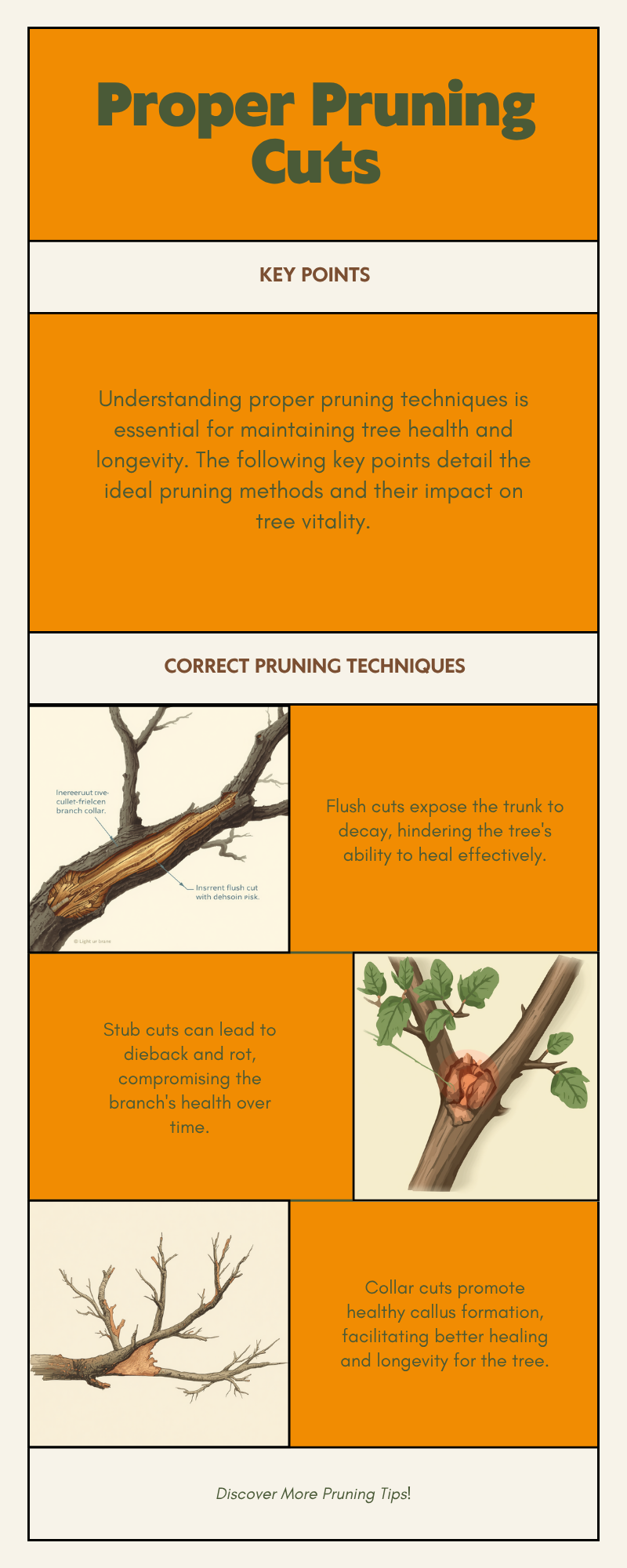
How much is as important as when. On a mature live oak, a good arborist rarely takes more than 10–15 percent of the live crown in one pass, and every cut lands just outside the branch collar — the swollen ring where limb meets trunk — so the tree can wall the wound off. Flush cuts and long stubs both defeat that natural sealing system.
- Young live oaks (first 20 years): structural pruning is the highest-value work — establish one dominant leader and wide-angled scaffold limbs now, and the tree never develops the weak unions that need cables at year 80.
- Mature oaks: crown cleaning (deadwood, rubbing limbs) and selective end-weight reduction on over-extended laterals. Never interior stripping (“lion-tailing”), which shifts all the load to the branch tips.
- Never topping or hat-racking. No trained arborist tops a live oak — it trades one storm risk for a permanent one. If someone quotes it, read why topping kills trees and what to do instead.
The root zone is the tree
Most live oak decline in Tallahassee doesn’t start in the canopy — it starts under the lawn, years earlier. The feeder roots that keep a 60-foot oak alive live in the top 12–18 inches of soil and extend well past the drip line. The working rule the pros use: protect a radius of roughly one foot for every inch of trunk diameter. On a 40-inch heritage oak, that’s a 40-foot circle where construction traffic, trenching, grade changes, and soil compaction all do slow, invisible damage.
- Construction and additions: require root-zone fencing in the contract before equipment arrives. A skid steer parked under the canopy for a week can start a decline that shows up as sector dieback five years later.
- Trenching for utilities or irrigation: route around the protection zone, or bore under it. One trench through a structural root plate can destabilize the whole lean of the tree.
- Fill dirt and grade changes: even a few inches of added soil over the root plate suffocates feeder roots. If a landscaping plan calls for “building up the bed” around a live oak, that plan needs rework.
- Mulch: 2–4 inches, pulled back from the trunk flare — a wide flat doughnut, never a volcano. Done right it’s the cheapest root-zone protection there is; see the mulching guide.
Normal live oak behavior vs. real warning signs
| You’re seeing | Verdict | Why |
|---|---|---|
| Heavy leaf drop in late winter/early spring | Normal | Live oaks aren’t true evergreens — they exchange their entire canopy every March. Two weeks of raking, then fresh green. |
| Spanish moss draped through the crown | Normal | An epiphyte, not a parasite — it takes nothing from the tree. Heavy moss on a thinning crown is a symptom of decline, not its cause. |
| Ferns growing along the big limbs | Normal | Resurrection fern — harmless, and one of the signature looks of an old Tallahassee oak. |
| Small round growths on twigs and leaves | Normal | Galls from tiny wasps — cosmetic only. |
| One whole section of canopy thin or bare while the rest looks full | Warning | Sector dieback tracks root damage or vascular disease on one side of the tree. Worth a professional look this season. |
| Bark sloughing off with a silvery-gray or tan crust underneath | Warning | Hypoxylon canker — a stress-follower fungus that means the tree’s defenses are already down. See tree disease treatment. |
| Mushrooms or shelf conks at the base or on the root flare | Warning | Fruiting bodies of root- and butt-rot fungi — the visible tip of internal decay. This is a risk-assessment trigger, not a wait-and-see. |
| New lean, heaved soil, or a cracked union after a storm | Urgent | Structural movement on a tree this heavy is an immediate call. |
Not sure which column your oak is in? A walk-through with an ISA-certified pro settles it — and on a heritage live oak, an early look is always the cheap option.
📞 Call Now — (858) 319-0022Vetted local pros — availability depends on independent provider schedules and demand.*Hurricane prep: the strongest tree in the yard still needs it
UF/IFAS wind-resistance research puts live oak in the highest survival tier of any large tree on the Gulf Coast — it’s the species that’s still standing in the after photos. When live oaks do fail, the pattern is specific: over-extended horizontal laterals snapping under their own leverage, co-dominant trunks splitting at included-bark unions, and whole-tree uprooting in saturated soil after days of rain. All three have pre-season answers:
- End-weight reduction on the long horizontal limbs over the house — measured cuts at the right laterals, not topping.
- Cabling and bracing for tight V-unions between co-dominant trunks — the hardware case is covered in the cabling and bracing guide.
- A pre-season risk assessment if the tree carries targets — roof, driveway, service drop, the neighbor’s garage. The risk assessment page covers what a TRAQ-based look involves.
June is late but workable; the smart window is February through May, before the hurricane prep rush starts.
Permits: live oaks are exactly what the ordinance protects
Inside Tallahassee city limits, routine pruning doesn’t need a permit — but removal is size-gated, and mature live oaks are the poster species for the protected and heritage tiers. Unincorporated Leon County runs its own, lower thresholds. Two practical points: hazard documentation (photos of conks, cracks, dieback) makes a legitimate removal application straightforward, and doing it without paperwork on a heritage oak is the expensive way to learn the ordinance exists. The Tallahassee tree permit guide walks the tiers; if the tree is genuinely at end of life, live oak removal covers what that job involves.
How getting matched works
What shapes a live oak care quote
No dollar figures here — pricing is between you and the licensed pro, and on live oaks it swings widely. What moves it:
- Size and spread: a 100-foot crown is a day of rope work, not an afternoon.
- What’s under it: pruning over a roof, pool cage, or service drop means rigging every cut instead of dropping it.
- Access: street-side crown work with bucket access runs leaner than a backyard oak behind a fence, where everything is climbed and carried.
- Deadwood volume: decades of deferred maintenance come out limb by limb.
- Hardware: cables and brace rods add materials and an installation climb.
- Documentation: risk-assessment write-ups and permit support are scoped items on heritage trees.
Frequently asked questions
When is the best time to prune a live oak in Tallahassee?
July and August for major structural pruning — fast wound closure, lower disease pressure. Deadwood-only cleanups are fine year-round. Avoid heavy live-crown cuts during the spring leaf exchange.
My live oak dropped most of its leaves in March. Is it dying?
Almost certainly not — that’s the annual leaf exchange. Live oaks swap their whole canopy in late winter or early spring. The worry sign is a section that doesn’t releaf when the rest does.
Is Spanish moss hurting my oak?
No. It’s an epiphyte that photosynthesizes on its own and takes nothing from the tree. A thinning crown loaded with moss means the tree is declining for another reason and the moss got the extra light.
How much of a live oak can be pruned at once?
On a mature tree, plan around 10–15 percent of the live crown maximum in a single season — and only to clear deadwood, reduce end weight, or resolve structural conflicts. Anyone proposing to “take it way back” is describing topping.
We’re building an addition near a big live oak. What should happen first?
Root-zone protection fencing at roughly one foot of radius per inch of trunk diameter, written into the contractor’s scope before equipment shows up — plus a pre-construction walk-through with an arborist. Prevention is the whole game; compaction damage has no cure.
Do live oaks need watering or fertilizing?
Established oaks on a normal Tallahassee lot generally need neither. The exceptions: first two years after planting, extended drought on sandy upland soils, and prescription feeding after a professional assessment — see deep-root fertilization for when that’s actually warranted.
Do I need a permit to prune or remove a live oak?
Routine pruning, no. Removal inside city limits is size-gated and live oaks commonly qualify for the protected tiers, so the paperwork question gets answered before the saw starts. The pro you’re matched with flags what applies, or start with the permit guide.
Related Tallahassee tree services
Tree Trimming
Tree Pruning
Live Oak Removal
Cabling & Bracing
Tree Risk Assessment
Tree Permit Guide
Hurricane Tree Prep
Topping Alternatives
Three hundred years of tree deserves better than guesswork.
Call now and we’ll connect you with a vetted, ISA-certified Tallahassee pro for pruning, root-zone planning, cabling, or a straight answer on a worrying sign. Free to use, no obligation, no sign-up.
📞 Call Now — (858) 319-0022Tallahassee Tree Service is a free referral service. Tallahassee Tree Service is not a licensed tree service provider and does not directly provide tree care services. All work is performed by independent, licensed and insured third-party providers in your area. Calls and form submissions placed through this site may be connected with a participating provider, and you may be contacted by that provider regarding your request. Same-day, emergency, and 24/7 availability are not guaranteed and depend on provider schedules, location, and demand. Service availability, pricing, licensing, and final response times are determined solely by the providers. It is the responsibility of the homeowner to verify that the hired contractor furnishes the necessary license and insurance required for the work being performed. All persons depicted in a photo or video are actors or models and not contractors listed on Tallahassee Tree Service.