Tree Service Indianhead Acres Tallahassee — Pine Specialists for a Tornado-Affected Neighborhood
Indianhead Acres is a 1950s–1970s mid-century neighborhood south of Magnolia Drive, just south of Lafayette Park. The neighborhood’s identity is shaped by mature loblolly and slash pines — many 70–110 feet tall and 50+ years old — that line streets and dominate backyards. The May 2024 EF-2 tornado clipped the northern edge of Indianhead Acres, taking down dozens of mature pines and reshaping the canopy. Two years later, the neighborhood is dealing with delayed pine decline, southern pine beetle pressure on storm-stressed survivors, and the long-term question of what to plant under reduced overstory. Our tree service Indianhead Acres Tallahassee crews handle pine removal, hazard tree work, beetle-related diagnostics, ongoing care, and replanting recommendations. ISA-Certified arborists oversee all work.
Indianhead Acres — A Mid-Century Pine Canopy Neighborhood
Indianhead Acres has a different canopy profile than the older Lafayette Park to its north. Understanding the pine-dominated character explains why tree work needs in this neighborhood differ from heritage-oak neighborhoods.
Indianhead Acres developed primarily from the 1950s through the early 1970s south of Magnolia Drive, between Indian Mound Road on the east and South Monroe Street on the west. The neighborhood was platted on land that was previously open piney-woods scrub typical of Tallahassee’s broader landscape, and the original pine canopy was largely preserved during development. Most homes were built in clearings between mature pines rather than starting from a clear-cut, giving the neighborhood its distinctive pine-grove character that persists today. Many properties have 8–15+ mature pines on a single lot, often 70–110 feet tall and 50–80+ years old.
Indianhead Acres differs significantly from neighboring Lafayette Park in canopy composition. Where Lafayette Park is dominated by mature live oaks, hickories, and southern magnolias dating back over a century, Indianhead Acres is dominated by loblolly pines (Pinus taeda), slash pines (Pinus elliottii), and longleaf pines (Pinus palustris) dating to the original natural stand or replanting from the development era. Hardwood species — oaks, hickories, magnolias — appear as scattered specimens within the pine matrix rather than as the dominant canopy.
The May 10, 2024 EF-2 tornado track clipped the northern edge of Indianhead Acres, with the most severe damage concentrated in the streets closest to Magnolia Drive. The southern half of the neighborhood escaped acute tornado damage but is now dealing with the regional effects: increased southern pine beetle pressure on storm-stressed pines, delayed decline on pines that took partial damage in May 2024, and the broader management challenge of mature pine populations in a hurricane-prone region. Tree service Indianhead Acres Tallahassee work today is overwhelmingly pine-focused, with a smaller mix of hardwood care and replanting consultation.
Why Pine Canopy Care Is Different
Indianhead Acres pines need different care than oaks, hickories, or hardwoods. Several characteristics drive the differences.
Tall & Top-Heavy
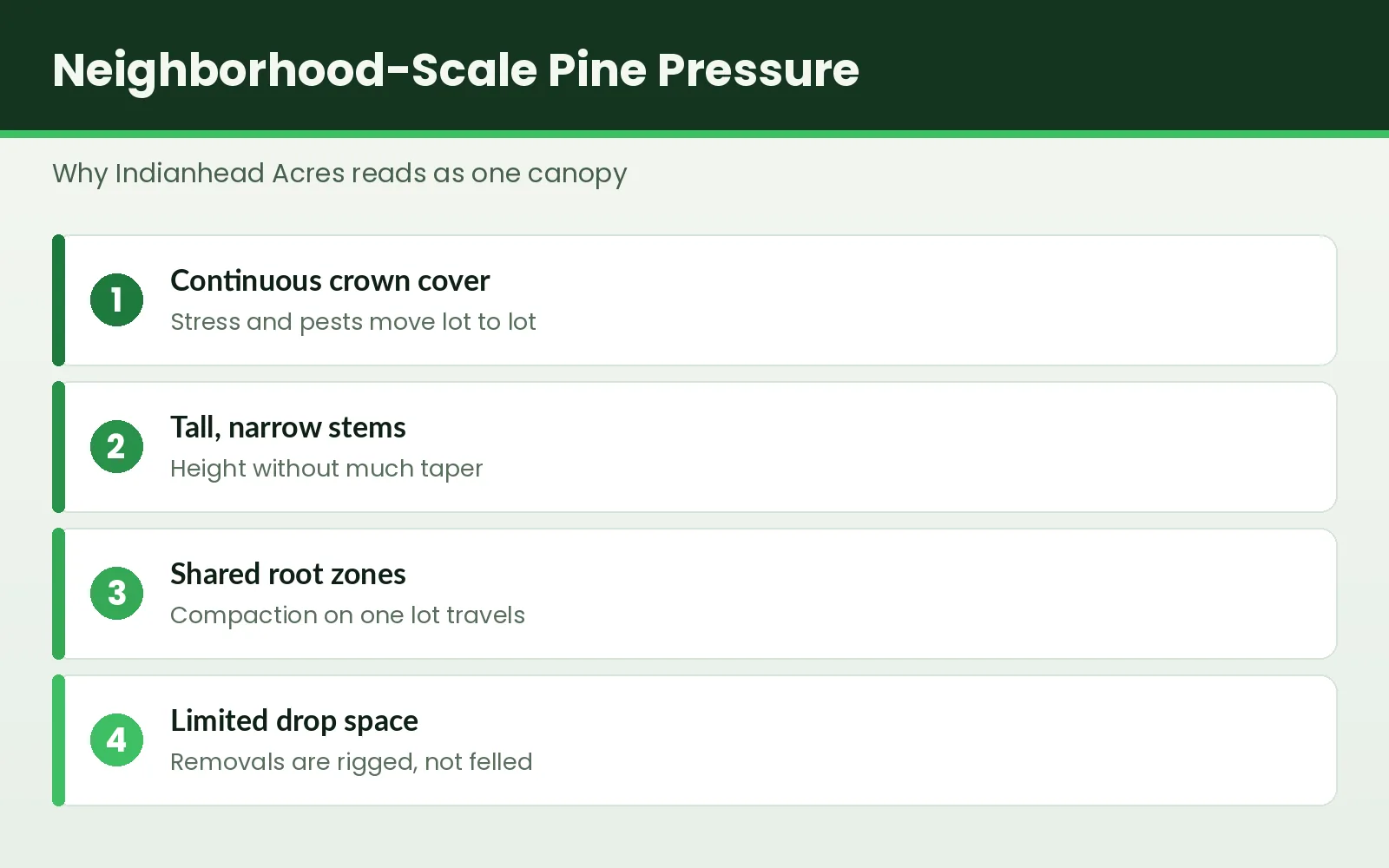
Mature loblolly and slash pines reach 90–110 feet with most foliage in the upper third. The combination of height and top-heavy form creates large wind-loading surfaces that fail differently than spreading hardwood canopies. Pine failure often involves trunk snap or whole-tree uprooting rather than branch failure.
Brittle Wood Under Stress
Pine wood is naturally resinous and somewhat flexible, but stressed pines (drought, beetle damage, partial root loss) lose structural integrity faster than stressed hardwoods. A pine that looks fine externally can have significant internal weakening that makes it a hidden hazard.
Vulnerable to Bark Beetles
Southern pine beetle (Dendroctonus frontalis) and Ips engraver beetles attack stressed pines aggressively. A single beetle-infested pine can spawn an attack that spreads through neighboring pines within weeks. Quick identification and removal of beetle-killed trees prevents wider losses.
Difficult to Prune Effectively
Unlike hardwoods, pines don’t respond well to most pruning interventions. Topping creates major problems. Heavy crown reduction stresses the tree and invites beetle attack. The right approach on most pines is targeted deadwood removal and structural decisions about whether to keep or remove rather than aggressive shaping.
Difficult Crane Access
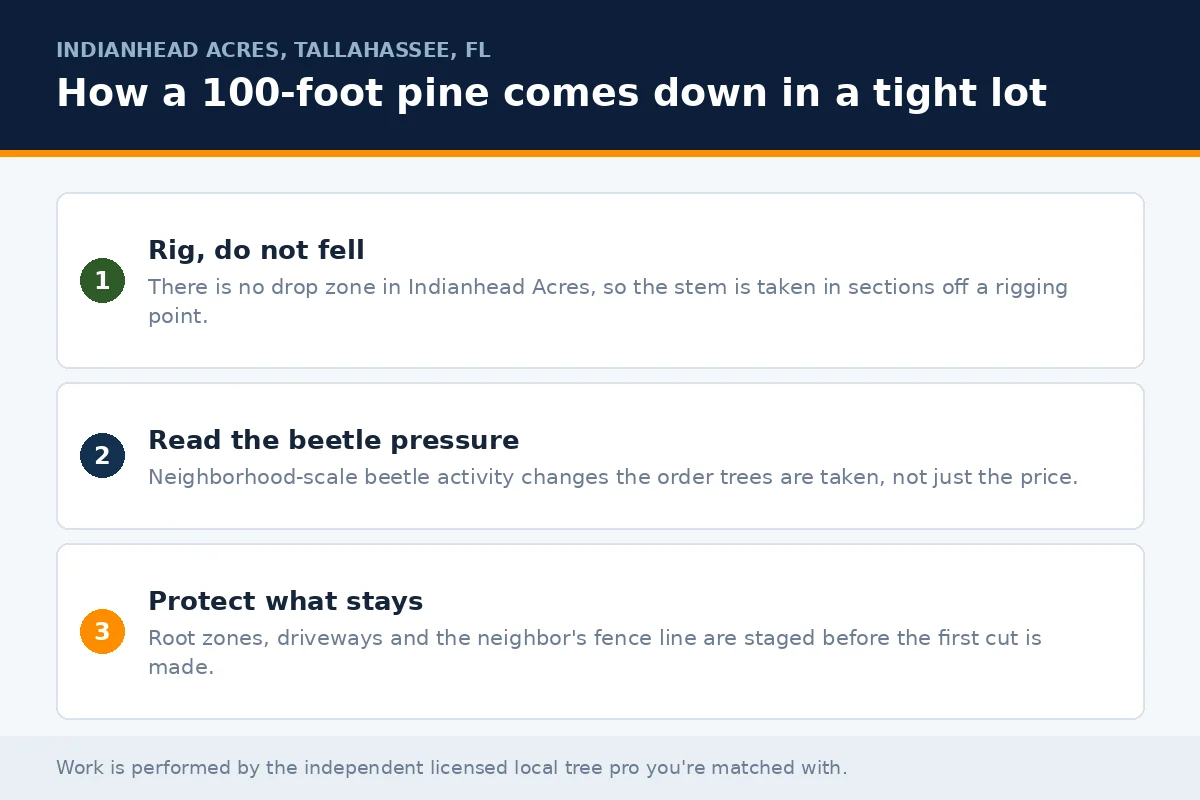
Pine removal in Indianhead Acres often requires crane access because of the height (90–110′) and tight-lot conditions of mid-century development. The streets in the neighborhood weren’t designed with crane staging in mind. Specialized crew experience matters for accessing these properties safely.
Long-Lived but Replaceable Slowly
Healthy loblolly pines in Tallahassee live 100–150+ years; slash pines slightly less. Replacement pines from new plantings reach 50′ height in roughly 25–30 years — meaning canopy loss in Indianhead Acres won’t be replaced in any homeowner’s active lifetime. The mature pines now standing are essentially irreplaceable on a human timescale.
Southern Pine Beetle Pressure in Indianhead Acres
Beetle pressure on Tallahassee pines has been elevated since the May 2024 tornado. Storm-stressed trees attract beetles, and beetle infestations spread quickly through adjacent healthy pines.
Why beetles target Indianhead Acres
Southern pine beetle preferentially attacks stressed pines — trees with reduced sap pressure, recent root damage, drought stress, or tornado-induced wounds. The May 2024 tornado created a region-wide population of stressed pines across northern Indianhead Acres and adjacent neighborhoods, providing ideal beetle breeding conditions. Once beetles establish in stressed trees, they can attack adjacent healthy pines as populations build during summer.
How to recognize beetle activity
Diagnostic signs include: white or yellowish pitch tubes (resin masses) at the trunk in early stages, brown S-shaped or J-shaped galleries beneath the bark, sawdust-like frass at the base, premature needle fading from bright green to yellow-green to red-brown over weeks, and finally needle drop. Once needles turn red on a previously-healthy pine, the tree is dead and should be removed within weeks to prevent spread to neighbors.
Why fast removal matters
Beetle-killed pines must come out fast — ideally within 2–3 weeks of confirmed infestation — because emerging beetles disperse to attack adjacent pines. A single delayed removal can result in 5–15 additional pine losses in the surrounding canopy as the population spreads. Insurance and budget concerns sometimes drive homeowners to delay; from a neighborhood-wide management perspective, quick removal is the highest-leverage intervention.
What treatment options exist
Preventive trunk injection treatments exist for high-value pines but are expensive ($200–$500 per tree per treatment cycle, typically annual or semi-annual) and not cost-effective for large stands. Most Indianhead Acres beetle response is removal of confirmed-infested trees plus monitoring of nearby healthy pines for early signs. UF/IFAS publications detail treatment options for specialty applications. See southern pine beetle for fuller treatment guidance.
For Indianhead Acres property owners with concerns about possible beetle activity on their pines, an ISA-Certified arborist visit confirms diagnosis and recommends timing for any necessary removal. Call (850) 555-0123 for beetle assessment scheduling.
Tree Services for Indianhead Acres Properties
Pine-focused work spectrum tailored to the neighborhood’s specific canopy character and post-tornado context.
Pine Tree Removal
Removal of declining, beetle-infested, or storm-damaged pines. Crane access standard on most jobs given 90–110′ mature heights and tight Indianhead Acres lots. ISA-Certified climbing on accessible specimens. See pine tree removal.
Beetle Damage Assessment
ISA arborist evaluates pines for southern pine beetle, Ips engraver, or black turpentine beetle activity. Confirms diagnosis, recommends removal timing, identifies neighboring at-risk pines. Critical service for delayed-tornado-stress pines.
Storm-Damaged Tree Cleanup
Storm cleanup remains active as subsequent thunderstorms and tropical systems affect already-stressed pines. Limb removal, hazard tree drops, debris hauling. Same-week or same-day response. See storm-damaged trees.
Tree Risk Assessment
ISA-Certified arborist evaluates standing trees for failure risk. Particularly valuable for pines where internal damage isn’t externally visible. Documents which trees can be preserved vs. should be removed. See risk assessment.
Emergency & 24-Hour Response
Same-day response for new pine failures or hazard situations. Common during summer thunderstorms as stressed pines fail in subsequent events. See emergency tree service.
Hazardous Tree Removal
Removal of structurally compromised pines and hardwoods. Pre-failure removal is dramatically cheaper than post-failure cleanup. See hazardous tree removal.
Stump Grinding
Pine stumps grind cleanly compared to oaks. Important for replanting plans. Multi-pine properties often benefit from same-day stump grinding on multiple removals. See stump grinding.
Selective Tree Trimming
Limited but valuable on pines — deadwood removal, hazard limb pruning, occasional clearance work. Avoid topping or aggressive crown reduction on pines. See tree trimming.
Tree Planting
Replanting recommendations as homeowners decide what to put in under reduced overstory. Native species selection accounts for new light conditions and Indianhead Acres soil profile. Long-term canopy planning. See tree planting.
How an Indianhead Acres Tree Service Visit Works
The on-site workflow follows a consistent structure tailored to the neighborhood’s pine-dominated character and tight mid-century lots.
On-Site Walkthrough
ISA-Certified arborist examines the property. Counts and identifies all pines and hardwoods, evaluates structural condition, looks for beetle activity, checks for tornado-related damage signatures, and assesses hazard priorities.
Beetle Activity Confirmation
Specifically check pines for southern pine beetle, Ips engraver, or black turpentine beetle pressure. Identify infested trees needing prompt removal vs. healthy trees that just need monitoring. Beetle response is time-sensitive.
Risk Prioritization
Pines and hardwoods ranked by failure risk, target proximity (house, vehicles, neighbors’ structures), and intervention timeline. Beetle-infested pines get top priority. Lower-priority work scheduled across multiple visits if budget requires phasing.
Permit Verification
For trees requiring removal, City of Tallahassee §5-83 permit requirements verified for each specific tree based on size and species. Permit fees ($273 reported FY2026 rate, confirm with City Growth Management) factored into quote. Most Indianhead Acres pines are well over the 4″ DBH permit threshold.
Crane Access Planning
For removals requiring crane access — nearly all mature pine removals in Indianhead Acres — we plan crane staging, street closure if needed, and overhead clearance. Mid-century lot patterns sometimes require working from a neighbor’s property with permission.
Written Quote
Itemized scope: removals, crane fees, beetle treatment if applicable, permit fees, debris hauling, optional services. Same-day for simple scopes; 1–3 business days for multi-tree or technical access scopes.
Execution & Cleanup
Pine sectional dismantling with crane assist where applicable. Pine wood and brush hauled off-site (pine doesn’t make great firewood; not worth keeping). Property left clean. Final walkthrough with homeowner.
Follow-Up Plan
For multi-tree properties or beetle-pressure situations, follow-up monitoring scheduled. Most Indianhead Acres properties with mature pine canopy benefit from annual ISA-Certified arborist visits to catch early beetle signs and structural issues.
Pine on Your Property Showing Signs of Stress?
ISA-Certified arborist visits same-week. Confirms whether beetle activity is present, identifies whether removal timing is urgent, and prevents spread to adjacent healthy pines.
Tree Service Pricing in Indianhead Acres
Pricing varies based on tree height, scope, and access conditions. Indianhead Acres’ tall pines and tight mid-century lots often require crane access, which factors into total cost.
| Service | Typical Range | Notes |
|---|---|---|
| Risk assessment / beetle diagnostic visit | $95 – $250 | ISA-Certified arborist; written documentation |
| Pine removal (40–60′) | $700 – $1,800 | Smaller specimens; sometimes climbable |
| Pine removal (60–90′) | $1,500 – $4,500 | Most common Indianhead Acres size |
| Pine removal (90–110′) | $3,000 – $7,500+ | Mature legacy specimens; crane required |
| Beetle-killed pine emergency removal | $1,500 – $5,000 | Same-week timing for spread prevention |
| Crane access fee (when needed) | $800 – $2,000/day | Standard on most mature pine removals |
| Multi-pine property (3+ pines) | 15–25% per-tree discount | Same-day crane staging efficiency |
| Hardwood tree removal (mixed canopy) | $700 – $4,500 | Smaller hardwood specimens than Lafayette Park |
| Stump grinding (pine) | $100 – $300 | Per stump; pine grinds cleanly |
| Tree planting (per tree) | $300 – $1,500 | Tree cost + installation labor |
| City §5-83 permit fee | $273 | Reported FY2026; confirm with City Growth Management |
Why Indianhead Acres Properties Choose Our Crews
Pine-dominated mid-century neighborhood work requires specific competencies that differ from heritage-oak neighborhood work.
- Pine specialty experience. Mature pine removal is technically different from hardwood removal — different cutting techniques, different rigging, different drop-zone calculations. Our crews work pines daily across Tallahassee’s pine-canopy neighborhoods.
- Beetle pressure expertise. Diagnosis of southern pine beetle, Ips engraver, and black turpentine beetle activity. Knowing the difference between beetle-killed pines (urgent removal) and other decline causes (less urgent) saves homeowners money and prevents spread to neighbors.
- Crane access infrastructure. Crane work is required on most mature Indianhead Acres pine removals. We have established relationships with crane operators familiar with the neighborhood’s mid-century street patterns and tight setbacks.
- Tornado-context-aware crews. Our arborists worked Indianhead Acres directly after the May 2024 tornado and have continued working the neighborhood through the delayed-stress phase. The progression patterns are familiar.
- ISA-Certified arborists. All risk assessments, beetle diagnoses, and removal decisions supervised by ISA-Certified arborists. Documentation that holds up for insurance claims and city permit processes.
- Same-week scheduling. 7-day standard scheduling window for non-emergency work; same-day response on hazard situations including beetle-infested pines that need urgent removal to prevent spread.
- Permit handling included. §5-83 permit applications, arborist documentation, and Growth Management coordination handled as part of every removal scope.
- Multi-tree coordination. Indianhead Acres properties often have 5–15 mature pines. We coordinate removal scheduling, crane staging, and budget phasing across multi-tree projects to maximize efficiency and minimize total cost.
Mature Pines Need Pine-Experienced Crews.
ISA-Certified arborists, beetle diagnosis expertise, crane access for tall pines, permit handling included. Tree service Indianhead Acres Tallahassee work that meets the neighborhood’s specific pine-canopy needs.
Tree Service Indianhead Acres Tallahassee FAQs
How do I know if my pine has southern pine beetle?
Signs include: white or yellowish pitch tubes (resin masses) on the trunk, brown S-shaped or J-shaped galleries beneath the bark, sawdust-like frass at the base of the tree, and progressive needle color change from green to yellow to red-brown over weeks. Once needles turn red, the tree is dead and should be removed within weeks to prevent spread. Call (850) 555-0123 for diagnostic visits.
Why are pines in Indianhead Acres dying now if the tornado was two years ago?
Delayed stress effect. Pines that took partial damage in May 2024 — root damage, vascular wounds, or major limb loss — survived initially but weakened over the following 18–24 months. The reduced sap pressure and weakened defenses make these pines highly attractive to beetles. The May 2024 tornado triggered a multi-year wave of pine decline rather than just immediate kill.
Do I need a permit to remove a pine in Indianhead Acres?
Almost certainly yes. City of Tallahassee §5-83 requires permits for trees over 4″ DBH. Most Indianhead Acres pines are 18–36″ DBH at maturity, far above the threshold. We handle the permit application as part of every removal scope. See our permit guide.
How much does it cost to remove a 100-foot pine?
Mature pine removal in the 90–110′ range typically runs $3,000–$7,500+ in Indianhead Acres, plus $800–$2,000 crane access fee. Beetle-killed pines requiring urgent removal sometimes run higher because of timing pressure and limited scheduling options. Site visit required for accurate quoting because tight Indianhead Acres lots vary significantly in crane access feasibility.
Can I save a pine that has beetle activity?
Usually not, once beetles are confirmed in the tree. Preventive trunk injections work on still-healthy pines but don’t reverse established infestations. Once needles begin fading from green to yellow, the tree’s vascular system is compromised and removal is the right call. The faster decision matters less than the urgency of preventing spread to adjacent pines.
Should I remove healthy pines preemptively to avoid beetle problems?
Generally no. Healthy pines have natural beetle resistance through sap pressure. Removing healthy pines doesn’t reduce overall neighborhood risk meaningfully. The right strategy is monitoring — ISA-Certified arborist visits to catch early stress signs — combined with prompt removal of any tree that does become infested. Annual or every-other-year monitoring on multi-pine properties is the standard approach.
What should I plant after removing pines?
Depends on light conditions after canopy reduction and what you want long-term. Replanting pines is fine if you want to maintain pine character — longleaf pine specifically is a good choice for ecological value and storm resistance. Native hardwoods like live oak, southern magnolia, hickory, and southern red oak provide longer-term canopy diversity. Smaller alternatives include redbud, fringetree, and hybrid disease-resistant dogwoods. See our best trees to plant page.
How fast can you respond to a pine emergency?
Same-day for hazard situations — trees on structures, blocking driveways, threatening utilities, or beetle-confirmed pines that need urgent removal to prevent spread. Standard non-emergency scheduling is 7-day window. Call (850) 555-0123 for urgent situations and we’ll dispatch the next available crew with crane access if needed.
Do you handle insurance claim documentation?
Yes — ISA-Certified arborist documentation, photos, and written assessments supporting homeowner insurance claims. Particularly relevant for pine claims related to delayed tornado damage, beetle infestation following storm stress, or fall events causing structural damage. Documentation that meets insurance carrier requirements is included.
Do you serve the entire Indianhead Acres area?
Yes — throughout Indianhead Acres boundaries (Magnolia Drive on the north, Indian Mound Road area on the east, South Monroe Street area on the west) plus the surrounding neighborhoods south of Magnolia. ISA-Certified tree service Indianhead Acres Tallahassee crews work the area regularly. Call (850) 555-0123.
Indianhead Acres & the Surrounding Tallahassee Neighborhoods
Indianhead Acres sits within a constellation of Tallahassee neighborhoods that share the May 2024 tornado context and pine-dominated canopy character.
Indianhead Acres’ immediate neighbor to the north is Lafayette Park, separated by Magnolia Drive. The two neighborhoods have very different canopy character — Lafayette Park is heritage-oak-dominated while Indianhead Acres is pine-dominated — but share the May 2024 tornado context. Properties along Magnolia Drive on either side experienced similar tornado impact, though the species mix differs significantly. To the east is Levy Park (the next Priority C area page), which shares more pine character with Indianhead Acres than oak character with Lafayette Park.
For property owners with multiple Tallahassee locations or rental properties across several neighborhoods, our crews maintain consistent ISA-Certified standards across the region. Multi-property pine canopy management programs covering Indianhead Acres, surrounding pine-canopy neighborhoods, and other pine-heavy areas of Tallahassee can be coordinated on annual visit cycles for efficiency.
Beyond the immediate Indianhead Acres area, the broader Tallahassee tree management context spans Killearn Estates, Killearn Lakes, Myers Park & Betton Hills, Northwest Tallahassee, Bradfordville, and Southwood — each with distinct canopy character, development eras, and tree management profiles. Indianhead Acres’ mid-century pine canopy and post-tornado context make it one of the more distinctive neighborhoods for specialty pine care work. Call (850) 555-0123 for any Tallahassee tree service needs.
Related Services & Areas
Most relevant pages for Indianhead Acres property owners.
Indianhead Acres’ Pine Canopy Deserves Specialty Care.
Tree service Indianhead Acres Tallahassee work is about meeting the neighborhood’s pine-dominated character — tall mature specimens, beetle pressure on storm-stressed survivors, tight mid-century lots requiring crane access, and a long-term canopy management horizon that won’t be solved in any one homeowner’s lifetime. ISA-Certified arborists, pine specialty crews, permit handling, fair pricing.