Hurricane Tree Prep in Tallahassee, FL
This is not routine pruning. It’s targeted, time-bound work — done before June 1 — that takes away the specific failure modes hurricanes exploit: end-weight on overextended limbs, deadwood, weak codominant unions, seed-heavy palm heads. After Hermine, Michael, Idalia, Helene, and the May 2024 tornadoes, every Leon County homeowner knows the math. Call now and we’ll connect you with a vetted, ISA-certified local arborist.
📞 Call Now — (858) 319-0022Prefer not to type? Just call now — 24/7 dispatch line*When is the deadline for hurricane tree prep in Tallahassee?
Practically, June 1 — crews book out as season opens, and thinning done after a storm is named helps nobody. Call now to get matched now for pre-season storm-prep trimming on your oaks and pines.
What hurricane tree prep in Tallahassee actually means
Hurricane tree prep is its own service category, distinct from routine tree pruning, risk assessment, or hazardous tree removal. The difference is scope and timing. Routine pruning is year-round canopy maintenance. Risk assessment delivers a written report. Hazardous removal addresses already-failing trees. Hurricane prep is a defined pre-season package — usually two to five hours of work per property — that targets the specific structural and biological vulnerabilities Atlantic hurricanes exploit when they reach the Big Bend.
The work is calendar-driven. Hurricane season opens June 1 and runs through November 30. Peak Big Bend impact runs September through October — Hermine made landfall September 1, 2016; Idalia August 30, 2023; Helene September 26, 2024. Pre-season prep belongs in the March–May window. Book in March or early April for first-choice scheduling; by mid-May, crews across Leon County are typically booked solid through the end of the month.
The arborists we dispatch follow ANSI A300 Part 1 pruning standards on every prep job. No topping, ever. No lion-tailing (stripping interior branches and leaving a tuft at the end — which actually increases wind-failure risk, despite being widely sold as “hurricane pruning”). The work is targeted reduction, structured deadwood removal, and species-specific protocols validated by University of Florida hurricane research over the past two decades.
Tallahassee context: the local canopy carries a high proportion of laurel oak, water oak, and pine — three species disproportionately involved in storm failures. Helene 2024 dropped roughly 60% of its tree-related damage in Leon County onto these three species combined. Live oaks, by comparison, came through nearly intact. Smart prep focuses the pre-season effort on the species that actually fail, not generic canopy reduction across every tree on the property.
Planning the season yourself first? Start with our free Tallahassee Hurricane & Storm Tree-Prep Guide — the species risk table, hazard-tree warning signs, a printable homeowner checklist, and the City/County permit basics, all in one reference.
The 8-point hurricane tree prep checklist
Every prep site walk works through these eight items. The arborist you’re matched with confirms which apply to your property and which can be skipped — no padding the scope.
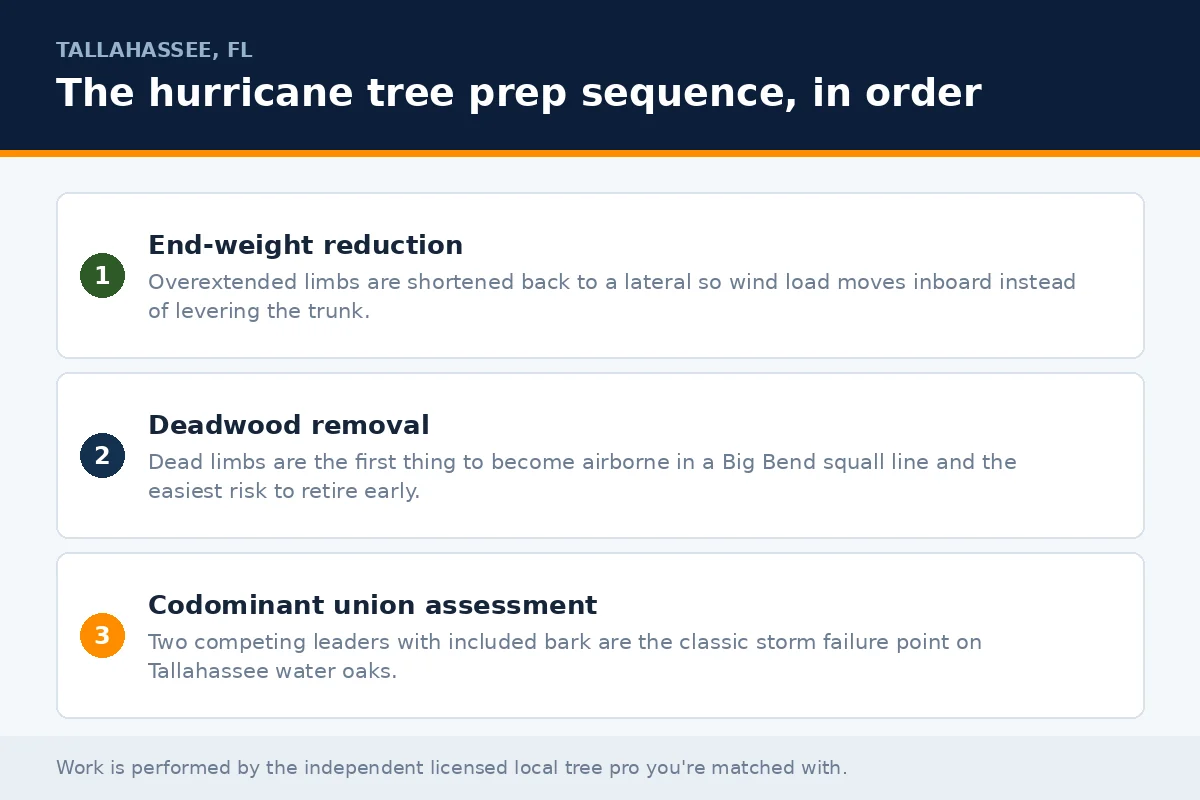
1. End-weight reduction on overextended limbs
The single highest-value pre-season cut. Long laterals carrying heavy end weight act like levers in storm winds. Reducing the outer 25–35% of these branches dramatically lowers the failure moment without compromising the tree’s overall structure.
2. Deadwood removal
Dead branches drop on their own schedule. In a hurricane, that schedule compresses to a few hours. Pre-season deadwood removal eliminates the airborne projectile inventory before the wind picks it up — targeting every dead branch over about two inches in diameter.
3. Codominant union assessment
Laurel oaks, water oaks, and Bradford pears commonly fail at codominant unions with included bark. The arborist identifies these unions, evaluates the bark inclusion, and recommends either targeted reduction or structural cabling on borderline candidates. Severe cases head to hazardous removal instead.
4. Crown thinning (selective — not lion-tailing)
True crown thinning removes roughly 10% of small interior branches to let wind pass through. Done correctly, it reduces canopy “sail effect” without weakening structure. Done incorrectly (lion-tailing), it concentrates weight at branch tips and dramatically increases failure risk.
5. Hanger identification & removal
Branches partially failed in past storms but still wedged in the canopy. After Helene 2024 and the January 2025 ice storm, hangers are present in many Tallahassee canopies. They drop on their own schedule; in a hurricane, they drop early.
6. Palm prep (the 10-and-2 standard)
Heavy seed heads on sabal palms and Washingtonias become projectiles in storm winds. Pre-season removal of seed heads, fully brown fronds, and any frond positioned below horizontal — never above — protects the surrounding property. See palm tree trimming.
7. Root plate inspection
Trees with active root plate failure cannot be saved by canopy work. The arborist walks the root zone looking for soil heaving, cracks running in arcs around the trunk, and lean changes. Confirmed root plate issues route to risk assessment and likely removal under FS §163.045 hazard documentation.
8. Structural defect documentation
Cracks, conks, hollows, and decay indicators get photographed and noted. Some warrant immediate action; others warrant monitoring through the season. The paper trail supports your homeowner’s insurance posture if a documented defect later figures in a claim event.
What if a tree is already showing damage from past storms? That tree may need risk assessment rather than prep — or in severe cases, hazardous removal. Pre-season prep is appropriate for trees that are structurally sound but warrant maintenance. Trees with active root plate failure, severe lean, or substantial heart rot from past storm damage can’t be saved by canopy work and need a different conversation. The arborist you’re matched with makes that call honestly during the site walk — nobody should sell prep on a tree that needs to come down.
Hurricane season is closer than it feels. A pre-season walk with an ISA-certified arborist tells you straight which of the eight points your property needs — and which it doesn’t. March–May books cleanest.
Get matched with a local pro — call now24/7 dispatch line — availability depends on independent provider schedules and demand.*Hurricane tree prep by Tallahassee species
Not every tree on your property needs the full eight-point protocol. The work concentrates on species and conditions where it actually matters:
Live oak (Quercus virginiana)
Highest wind tolerance of any common Tallahassee species. Live oaks usually need only minor end-weight reduction on overextended laterals plus deadwood cleanup. Over-pruning live oaks is counterproductive — the dense crown structure is what gives them their storm tolerance. Avoid pruning April through July to limit oak-wilt vector exposure. See live oak trimming.
Laurel oak (Quercus laurifolia)
The species most likely to fail during hurricanes. Codominant unions, fast-growing weak wood, and mid-life decline patterns combine into Tallahassee’s local hurricane casualty species. Aggressive pre-season prep — end-weight reduction, codominant union work, deadwood — is justified. Severely declining laurel oaks may need removal instead of prep — see laurel oak decline.
Water oak (Quercus nigra)
Heart rot is endemic past age 40. Many mature water oaks are hollow inside an apparently sound exterior. Prep work on water oaks centers on sounding the trunk, evaluating remaining sound wood, and making the keep-versus-remove call before storm season. Trees that fail the sounding test route to water oak removal.
Pines (loblolly, slash, longleaf)
Pines fail through three pathways during hurricanes — beetle-killed branch progression, lightning-strike weakening, and wind-induced lean from neighboring losses. Pre-season prep checks for southern pine beetle activity (see the SPB guide) and removes any beetle-killed material that could become storm projectiles.
Palms (sabal, Washingtonia, queen)
Seed heads are the projectile concern. Sabal palms (the Florida state tree) hold seed clusters that become 5–10 pound airborne hazards. Washingtonias add heavy frond bases. Pre-season palm prep removes seed heads and fully brown fronds using the 10-and-2 standard — never harder. Over-pruning palms is a documented stress factor.
Bradford pear & magnolia
Bradford pears fail at codominant unions between ages 15 and 25 — many properties have Bradfords now in the failure window, and pre-season removal often outperforms attempted prep. Magnolias are low-priority: dense low-canopy structure handles wind well, and minor deadwood cleanup is usually all that’s warranted.
Authority source: the University of Florida IFAS Extension publishes hurricane-specific tree research developed after Hurricanes Andrew, Charley, Wilma, and Michael. See edis.ifas.ufl.edu for the full library, including ST549 (laurel oak), ST564 (live oak), EP443 (palms), and EP399 (crape myrtle).
Why the March–May window matters
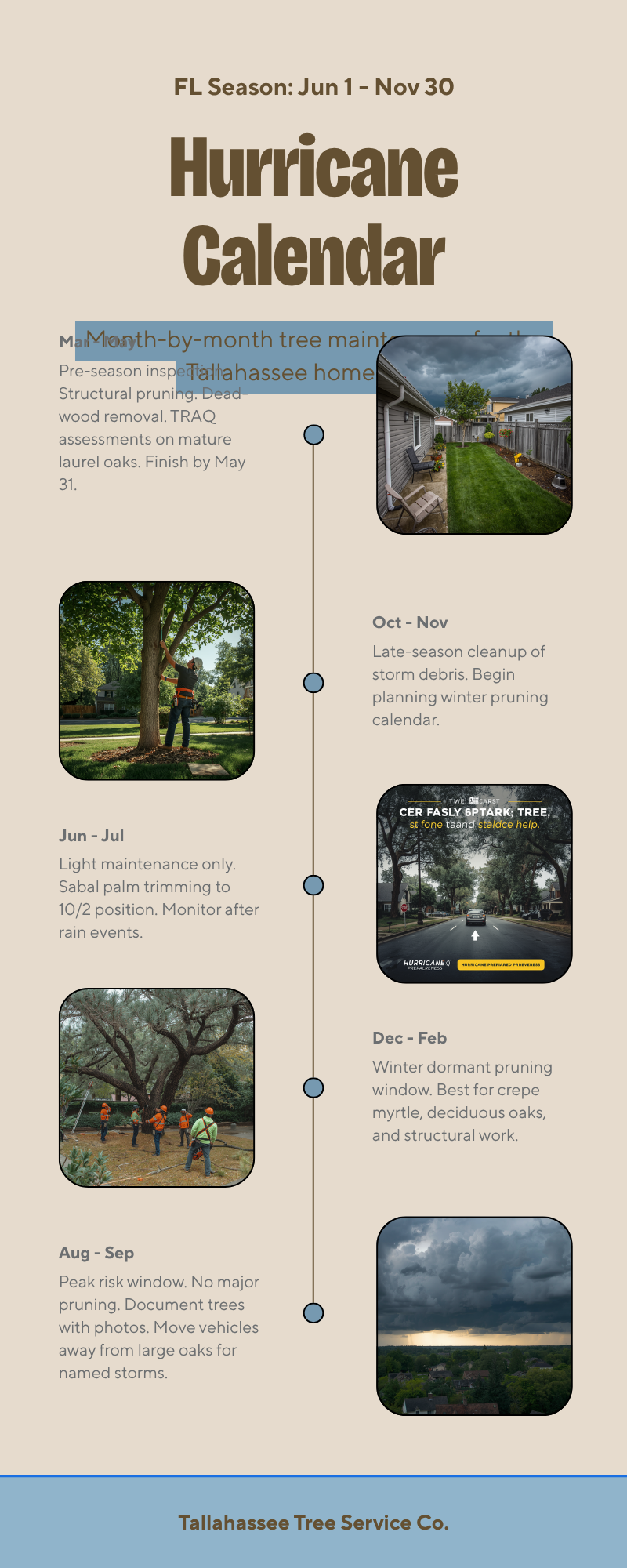
Tree biology. Most Tallahassee hardwoods are in active spring growth or transitioning into early summer during March–May. Pruning wounds compartmentalize cleanly in this window, and the tree has the energy reserves to seal cuts properly before the long, hot summer compounds water stress. Pruning in late summer (heat-stressed trees) or after the season opens (when storm-damaged trees are being triaged) is biologically less favorable and operationally rushed.
Scheduling capacity. The crews that handle pre-season prep are the same crews that handle post-storm response. From early June through November they’re increasingly committed to fallen trees, hazard removals, and cleanup. Booking in March or early April locks in scheduling at standard market rates with full crew availability. Booking in May tightens the window. Booking after June 1 means competing with storm response for crew time — and local-market pricing reflects the urgency, with post-May urgency premiums of roughly 25–40% a consistent pattern.
The storm calendar. The Big Bend’s most active impact window is mid-August through October — Hermine September 1, Michael October 10, Idalia August 30, Helene September 26. Prep work needs to be complete before mid-August at the latest, which means the on-site work happens March–May, with minor touch-ups feasible into early June.
The honest math: a Killearn homeowner who books prep in March pays standard market rates for full ANSI A300 work with first-choice crew availability. The same work booked in late August carries the storm-season premium and competes with active storm response for crew time. Same job, different price, different timeline. An honest arborist will still take the August call — but the March call is the smarter one.
What Tallahassee hurricanes actually do to trees
Hurricane Hermine (September 2016). Category 1 at landfall, sustained winds around 80 mph through the Big Bend. Damage was dominated by branch failures on overextended laterals — laurel oak and water oak paid the highest cost, mostly through codominant union splits. Live oaks came through nearly intact. The lesson Tallahassee carried forward: end-weight reduction on the failure-prone species is high-value pre-season work.
Hurricane Michael (October 2018). Category 5 at landfall in the Panhandle, Category 3 winds into the eastern Big Bend. Damage skewed heavily to whole-tree windthrow rather than branch failure — root plate failures dominated, particularly on laurel and water oaks with previously undetected root issues. Lesson: pre-season root plate inspection matters as much as canopy work.
Hurricane Idalia (August 2023). Category 3 at landfall, 100+ mph sustained winds in coastal Big Bend before weakening through Leon County. Substantial pine failures (loblolly and slash), particularly in beetle-stressed stands. Lesson: pre-season SPB assessment paired with prep prevents cascading failures.
May 2024 EF-2 tornadoes. Three confirmed tornadoes through Lafayette Heights, Levy Park, and surrounding corridors — concentrated, severe damage in narrow tracks, with tree-on-house calls dominating the response. Lesson: prep work also reduces tornado damage in the affected canopies, even though tornadoes aren’t specifically what it targets.
Hurricane Helene (September 2024). Category 4 at landfall further east, but Tallahassee took sustained tropical-storm-force winds for hours. The damage profile mirrored Idalia — laurel and water oak codominant failures plus pine windthrow. Helene also exposed trees that took partial damage from Idalia thirteen months earlier and were never addressed in the intervening pre-season window. Lesson: storms compound. Trees that took partial damage in one season fail harder in the next.
January 2025 ice storm. Not a hurricane, but uniquely severe. Heavy ice snapped large limbs across the city — particularly tall, slender pines and hardwoods with codominant unions. Hangers from this event sat in canopies for weeks, which is why hanger identification is getting extra emphasis in the current prep cycle. See hurricane tree damage and storm-damaged trees for the post-event side.
What hurricane prep runs in the Tallahassee market
Cost rides on tree count, property size, and how much actual work each tree needs after the eight-point assessment. These are typical local-market scope patterns, not our prices — the licensed arborist you’re matched with walks the property first and gives the binding written quote:
| Property profile | Typical scope |
|---|---|
| Small property (1–4 mature trees) | Targeted prep, deadwood, light reduction — usually a few hours for a two-person crew. |
| Standard property (5–10 mature trees) | Full eight-point checklist — half day to a full day. |
| Larger property (10–20 mature trees) | Full checklist, one to two days of crew time. |
| Estate property (20+ mature trees) | Full checklist across multiple days; often phased by priority. |
| Palm-only prep | Seed heads and brown fronds to the 10-and-2 standard, priced per palm. |
| Codominant union work / cabling | Per union; hardware and height drive the scope. |
| Post-May urgency premium | Local market pattern: roughly 25–40% over standard pre-season rates. |
Market patterns referenced from HomeBlue Tallahassee data (March 2025) and ProMatcher, cross-checked against quote ranges homeowners report in Leon County pre-season. The ROI math is blunt: a single fallen mature tree on a Tallahassee residence commonly causes five-figure structural damage, and Florida hurricane deductibles are their own painful line item. Prep that prevents one failure pays for itself many times over — and a good arborist won’t oversell items your property doesn’t need. See the trimming cost guide for the factor detail.
How long does the work take? A small property with one to four trees is typically a two-to-four-hour job for a two-person crew. A standard five-to-ten-tree property runs a half day to a full day. Larger properties can take one to two days, and estate properties run two to four, often phased by priority. The site walk itself takes about 30–60 minutes. The work is intrusive for an afternoon — not disruptive for a week.
Before you call — how to describe your canopy
You’ll get a sharper site walk (and a tighter quote) if you can tell the arborist four things up front:
- Rough tree count and the big species — “a dozen mature trees, mostly laurel oaks and two big pines” sets the scope instantly.
- What hangs over what — limbs over the roof, the driveway, the pool enclosure, or a neighbor’s fence move those trees up the priority list.
- Prior storm history — anything that lost limbs in Helene or the ice storm, or leans differently than it used to, deserves a closer look.
- When it was last pruned professionally — a canopy untouched for a decade is a different job than one maintained every three years.
How getting matched works
One honest note on DIY: some ground-level deadwood pruning is feasible for a careful homeowner. Anything at height, anything involving heavy laterals, and anything requiring rigging belongs to ISA-certified climbers with proper gear and insurance. Chainsaw injuries concentrate heavily in homeowner DIY scenarios, and the average chainsaw injury claim runs into the tens of thousands of dollars in medical costs alone. The math does not favor DIY.
Hurricane prep coverage across Tallahassee & the Big Bend
Same eight-point checklist, same ANSI A300 standards, everywhere the network dispatches: Killearn Estates · Killearn Lakes · Bradfordville · Lake Jackson · Myers Park / Betton Hills · Midtown · SouthWood · Northwest Tallahassee · Woodville · Crawfordville · Monticello · Quincy · Wakulla County · all of Leon County.
Frequently asked questions
When should I book hurricane tree prep in Tallahassee?
March or early April is the optimal window for first-choice scheduling at standard market rates. Crews across Leon County are typically full by mid-May. After June 1 — when hurricane season officially opens — scheduling competes with active storm response and market pricing reflects the urgency. Booking early is cheaper and biologically better for the trees.
Is hurricane tree prep different from regular pruning?
Yes. Routine pruning is year-round canopy maintenance with general objectives. Hurricane prep is a defined eight-point pre-season package targeting the failure modes hurricanes exploit — end-weight reduction, deadwood removal, codominant union work, true crown thinning (never lion-tailing), hanger removal, palm prep, root plate inspection, and structural defect documentation.
Will pre-season pruning prevent storm damage to my trees?
It significantly reduces failure risk but doesn’t eliminate it. Category 4 and 5 hurricanes can drop healthy, properly maintained trees. The honest answer: prep makes trees more likely to survive storms within the historical Tallahassee impact range (tropical storms through Category 3) and shrinks the projectile inventory — deadwood, hangers, seed heads — that causes secondary damage in any wind event.
What is a “hurricane cut” — is that the same thing?
Be careful with the term. Real hurricane prep follows ANSI A300 — targeted reduction, structured deadwood removal, no topping, no lion-tailing. “Hurricane pruning” or “hurricane cut” are sometimes marketing terms used by contractors who actually lion-tail or top trees, both of which violate A300 and increase storm-failure risk. Ask exactly which cuts are planned before anyone climbs.
What’s safe to prune on palms before a hurricane?
The 10-and-2 standard is the maximum acceptable cut — fronds above horizontal are preserved, seed heads are removed, fully brown fronds are removed, and anything green above horizontal stays. Over-pruning palms is a documented stress factor and counterproductive going into season.
Will my insurance company recognize hurricane tree prep?
Documented prep helps in two ways. Some carriers treat professional tree maintenance as a positive underwriting factor. And if a properly maintained tree still fails in a storm, written documentation of the completed work supports your position against any negligence claim. The arborist you’re matched with provides that documentation for your file.
Related Tallahassee tree services
Hurricane & Storm Tree-Prep Guide (free)
Tree Pruning
Tree Risk Assessment
Cabling & Bracing
Hazardous Tree Removal
Tree Branch Removal
Dead Tree Removal
Storm-Damaged Trees
24-Hour Tree Service
Palm Tree Trimming
Laurel Oak Problems
Southern Pine Beetle Guide
Tree Trimming Cost
Get storm-ready before June 1.
Call now and we’ll connect you with a vetted, ISA-certified Tallahassee arborist for pre-season prep. Free to use, no obligation, no sign-up. Serving Tallahassee, Killearn, Bradfordville, Lake Jackson, Midtown, SouthWood, Woodville, Crawfordville, Monticello, Quincy, and all of Wakulla and Leon Counties.
📞 Call Now — (858) 319-0022Or call now — 24/7 dispatch line*Tallahassee Tree Service Co. is a free dispatch and referral service. We are not a tree-service contractor and do not perform tree work ourselves. When you call, we connect you with an independent, licensed and insured local tree-care professional who carries their own license and insurance and provides any binding quote. Price information anywhere on this site is typical local-market information for planning only; people or scenes in images are illustrative.
References to “24/7,” “same-day,” or “emergency” describe call-handling and dispatch availability. Actual on-site response times depend on the independent professional’s schedule, crew availability, and weather, and are not guaranteed.