Southern Pine Beetle in North Florida
How to identify an SPB infestation in your Tallahassee pines, tell it apart from the look-alikes, and use the §163.045 emergency hazard pathway when removal can’t wait for a standard permit review. Call now to get connected with a vetted, ISA-certified local arborist for on-site diagnosis.
📞 Call Now — (858) 319-00224–6 weeks from attack to crown death in warm conditions — speed matters with this one.The southern pine beetle (Dendroctonus frontalis) is the most destructive forest insect in the southeastern United States — and it works residential North Florida landscapes as readily as timber stands. In a residential slash or loblolly pine, initial attack to complete kill can take 4–6 weeks under warm Tallahassee conditions. By the time most homeowners notice something wrong, the infestation is weeks old. Speed matters here in a way it doesn’t with most tree problems.
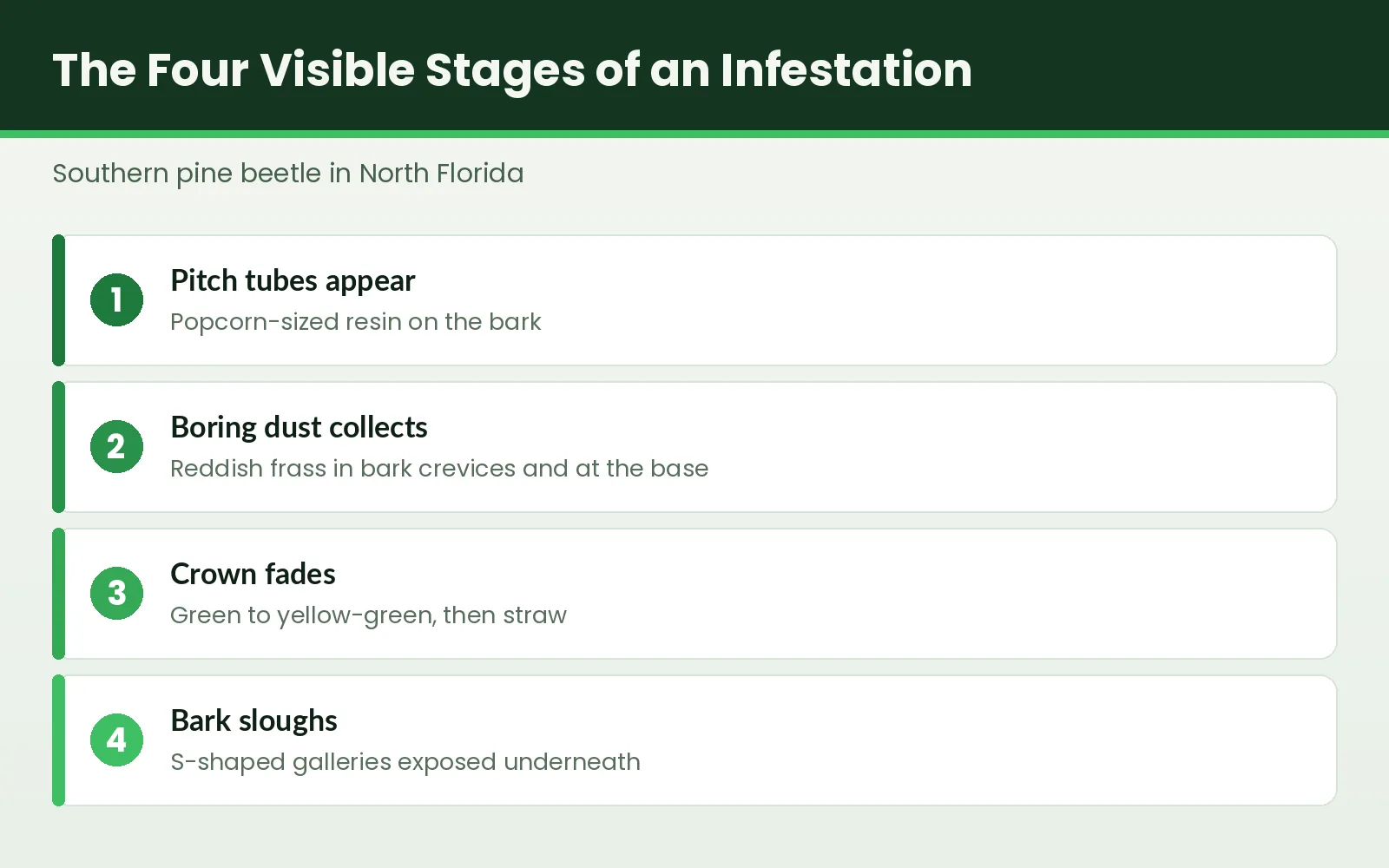
The four visible stages of an SPB infestation
Stage 1 — early attack (first 2–4 weeks)
What you see: small popcorn-like resin masses (pitch tubes) on the lower to mid trunk — cream or pinkish when fresh — plus fine reddish-brown boring dust (frass) at the base or in bark crevices. Crown: still fully green. Action: this is the narrow window where intervention may matter. Get an ISA-certified arborist out immediately; for trees near structures, start §163.045 documentation at the same time.
Stage 2 — established (weeks 4–8)
What you see: pitch tubes up the mid and upper trunk, running pitch streaks, extensive boring dust; a trained eye can find the S-shaped egg galleries under loose bark. Crown: starting to yellow, often top sections first. Action: removal is now the only appropriate response for infested trees near structures; preventive treatment becomes the play for adjacent healthy pines.
Stage 3 — advanced (weeks 8–16)
What you see: heavy pitch-tube coverage, loosening bark, and blue-gray staining in the sapwood from the blue-stain fungus SPB vectors. Crown: yellow-orange turning red-brown. Action: remove immediately — the tree is structurally compromised. FDACS protocol: chip all material on-site; never haul logs that may carry live beetles.
Stage 4 — dead and dry (4–6 months on)
What you see: full red-brown crown, dropping needles, bark falling in sheets. The brood has emerged; what’s left is a dry, structurally weakened snag with far less wind resistance than a living tree. Action: remove before hurricane season if it’s near anything that matters.
Pitch tubes on your pines? Stage 1 is the only window where intervention may matter. Get an ISA-certified arborist on-site to confirm the diagnosis and start §163.045 documentation in the same visit.
📞 Call Now — (858) 319-0022Free to use — the arborist gives the quote on-site. Availability depends on provider schedules.SPB vs the look-alikes — don’t misdiagnose
A sick-looking pine isn’t always SPB. Ruling out the others prevents unnecessary removals — and catches the cases where “drought stress” is actually a beetle.
| Problem | Key signs | Speed | Spread risk |
|---|---|---|---|
| Southern pine beetle | Cream popcorn pitch tubes, lower-to-mid trunk, grouped; S-shaped winding galleries; fade top-down or whole-crown | 4–6 weeks warm-season | HIGH — attacks adjacent healthy pines |
| Ips engraver beetles | Smaller tubes concentrated in upper crown/branches; Y- or H-shaped galleries; top-down dieback only | 6–12 weeks | Low — picks off already-stressed trees |
| Lightning damage | Vertical bark scar crown-to-base; asymmetric one-side fade; no pitch tubes at first | Days to weeks | Attracts secondary beetle attack — monitor |
| Drought stress | No pitch tubes; gradual whole-tree yellowing over seasons | Months to years | Becomes a primary SPB target — water it |
| Annosus root rot | Conks at base/stumps; bottom-up thinning | Months to years | Spreads via root contact and fresh stumps |
Rule of thumb: pitch tubes on the lower trunk plus a crown fading within weeks is almost certainly SPB. Ambiguous symptoms are exactly what a gallery check under the bark settles in minutes.
Current SPB pressure in North Florida — what FDACS shows
FDACS Forest Health monitoring has documented elevated SPB activity in North Florida in recent years, with pressure varying by winter temperature, drought, and host stress. Warm winters accelerate the beetle’s reproductive cycle and push higher populations into residential areas bordering natural pine stands. Tallahassee’s interface between neighborhoods and longleaf/slash flatwoods — especially Bradfordville, Killearn Estates, and south Leon County near Woodville — keeps residential pines at ongoing risk in high-pressure periods. UF/IFAS EDIS publishes the standing identification guidance for Dendroctonus frontalis.
If you have multiple pines: SPB spreads laterally. Removing the infested tree before the brood emerges — typically 4–6 weeks after attack in warm weather — is the single most effective way to protect the rest of your lot. Chip on-site; don’t haul logs.
Preventive treatment for healthy neighbors
An infested pine can’t be treated — removal is the only response. But adjacent healthy pines can get preventive bark applications (registered carbaryl or permethrin sprays) to deter new attacks, usually coordinated in the same visit as the infested-tree removal. Prevention doesn’t substitute for removing the source tree — it lowers the odds for the treated neighbors.
The cheapest prevention is unglamorous: don’t wound the bark with mowers and trimmers, water pines through long droughts, keep mulch off the trunk, and have any lightning-struck or storm-damaged pine evaluated within 6 months — stressed pines are SPB magnets.
Removal and the §163.045 emergency pathway
An SPB-infested pine within falling distance of a structure qualifies as a hazard tree under Florida Statute §163.045. A written ISA assessment documenting the infestation and structural risk lets removal proceed without waiting on a standard 5–15-business-day permit review — the correct pathway when a compromised pine stands over an occupied structure. For longleaf pines in unincorporated Leon County (12″ DBH trigger under §10-4.362), the same documented-hazard pathway applies. Confirm post-removal documentation with City Growth Management at (850) 891-6586 (inside city limits) or Leon County Development Services at (850) 606-1300. Full permit context: Tallahassee tree permit guide.
Southern pine beetle — FAQ
Is southern pine beetle active in North Florida right now?
FDACS Florida Forest Service tracks SPB across North Florida counties annually and publishes pest-conditions reports. Pressure varies with winter temperatures and drought. Tallahassee, Leon County, and the adjacent Big Bend stay on active monitoring because of the neighborhood-flatwoods interface.
How fast does SPB kill a pine in Tallahassee?
Typically 4–6 weeks from successful attack to crown death in warm conditions, stretching to 12–16 weeks in cooler periods. By the time the crown starts fading, the next beetle generation may be close to emerging — which is why removal speed matters more than with almost any other pest.
Can I save my pine once it has SPB?
No. The phloem damage plus the blue-stain fungus are fatal, and no chemical saves an infested tree. Removal eliminates the structural hazard and takes the infested wood out before beetles emerge and hit the neighbors. Preventive bark treatment exists only for the healthy pines next door.
How do I tell SPB from Ips beetles?
Three checks: pitch-tube location (SPB lower/mid trunk; Ips upper crown and branches), gallery shape under bark (SPB winding S-shapes; Ips Y- or H-shapes), and attack pattern (SPB hits healthy pines in groups; Ips picks off stressed trees one at a time). An arborist confirms from gallery evidence in minutes.
Does SPB removal need a permit in Tallahassee?
An infested pine within falling distance of a structure qualifies as a §163.045 hazard tree — a written ISA assessment lets removal proceed without prior permit. Confirm post-removal documentation with City Growth Management (850) 891-6586 or Leon County Development Services (850) 606-1300.
Will my other pines get it if one is infested?
The risk is significant — adults emerging from the colonized tree attack the nearest pines first. Remove the infested tree before brood emergence (about 4–6 weeks after attack in warm weather), chip on-site, and consider preventive bark treatment for close neighbors.
Related Tallahassee tree resources
Emergency tree service
When to remove a tree
Tree inspection
Tree disease treatment
Bradfordville tree service
Woodville tree service
Tree permit guide
Possible SPB infestation? Don’t wait for the spread.
Stage 1 is the narrow window where intervention matters. Call now and we’ll connect you with a vetted, ISA-certified arborist who confirms the diagnosis on-site and starts §163.045 documentation in the same visit. Free to use, no obligation.
📞 Call Now — (858) 319-0022Tallahassee Tree Service is a free referral service. Tallahassee Tree Service is not a licensed tree service provider and does not directly provide tree care services. All work is performed by independent, licensed and insured third-party providers in your area. Calls and form submissions placed through this site may be connected with a participating provider, and you may be contacted by that provider regarding your request. Same-day, emergency, and 24/7 availability are not guaranteed and depend on provider schedules, location, and demand. Service availability, pricing, licensing, and final response times are determined solely by the providers. It is the responsibility of the homeowner to verify that the hired contractor furnishes the necessary license and insurance required for the work being performed. All persons depicted in a photo or video are actors or models and not contractors listed on Tallahassee Tree Service. SPB biology sourced from USDA Forest Service and UF/IFAS EDIS publications; FDACS pest-conditions reporting; Fla. Stat. §163.045 and permit data current through April 2026.