Pine Tree Removal in Tallahassee, FL
A 90-foot loblolly does not tip over politely — it snaps, and the top goes through whatever is beneath it. Call now and we’ll connect you with a vetted, licensed and insured local arborist who knows how to take a big Big Bend pine down in sections.
📞 Call Now — (858) 319-0022Pine leaning after a storm, or browning out fast? Call now — those get triaged first, any hour.Tallahassee is a pine town as much as an oak town. Drive out toward Bradfordville, Woodville, or the Apalachicola National Forest edge and the canopy is longleaf, loblolly, slash, and spruce pine, much of it left standing when subdivisions were cut into the woods in the 1980s and 90s. Those trees are beautiful. They are also 80 to 110 feet tall, brittle at the top, and standing over houses that were built around them.
Pines fail differently from oaks, which changes both the risk and the removal. An oak tends to shed a limb or, on wet ground, tip with its root plate. A pine snaps — usually somewhere in the upper third of the trunk — and the broken top falls as a spear. That is why pine strikes so often go through a roof rather than resting on it.
The pines you actually have
| Species | How to spot it | What it means for you |
|---|---|---|
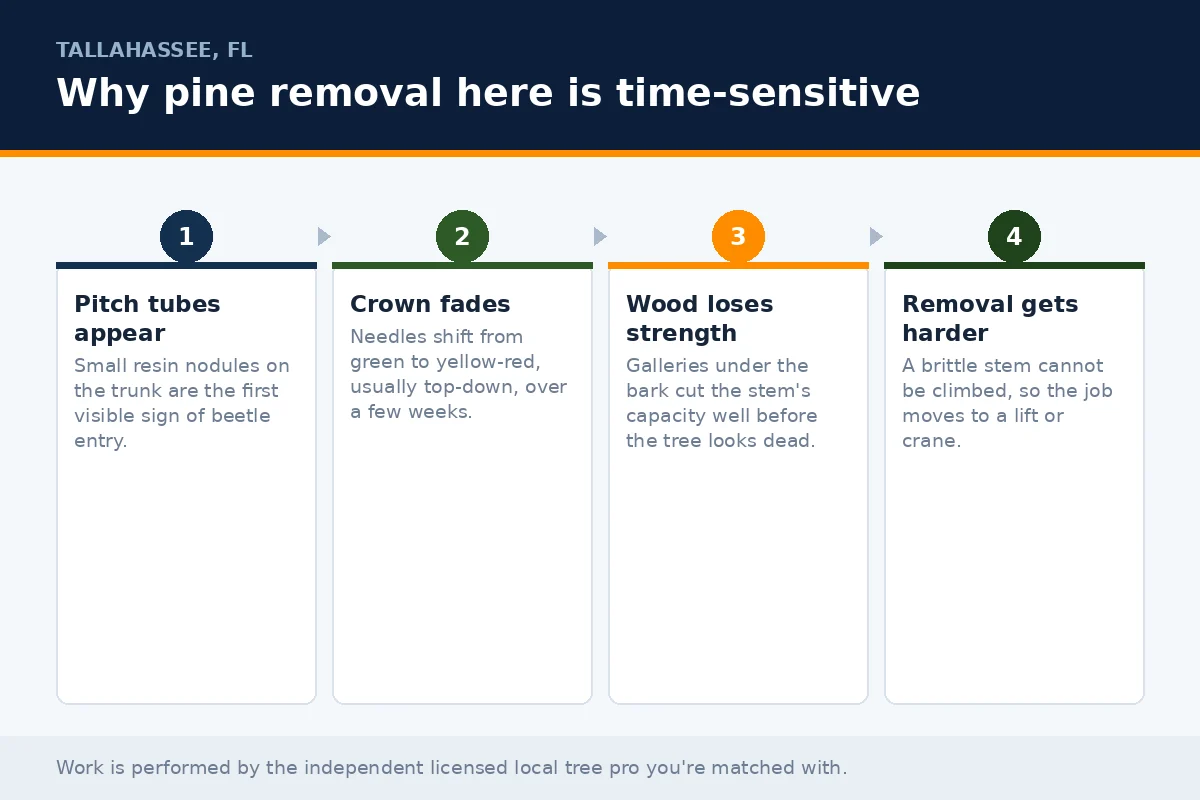
| Longleaf pine | Very long needles in bundles of 3, big cones, open airy crown, thick plated bark. | The native. The most wind-resistant of the group and worth trying to keep. Fire-adapted and long-lived. |
| Loblolly pine | Needles in 3s, shorter; fast growing; the default plantation and yard pine. | Very tall, shallow-ish rooted, prone to snapping and to beetle attack when stressed. |
| Slash pine | Needles in 2s and 3s, glossy; common in planted stands. | Similar risk profile to loblolly. Sensitive to root disturbance. |
| Spruce pine | Short, soft, twisted needles in 2s; smoother bark; more shade-tolerant. | Weaker wood. Frequently found in older established neighborhoods. |
| Sand pine | Small, scrubby, on dry sandy sites. | Short-lived, poor structure — rarely worth retaining near a target. |
When a pine has to come down
Pines are not subtle about dying, but the signals are easy to misread until it is late.
- Needles browning from the top down, fast. A pine that goes from green to rust in a few weeks is dead or dying. Unlike hardwoods, a browned-out pine does not come back.
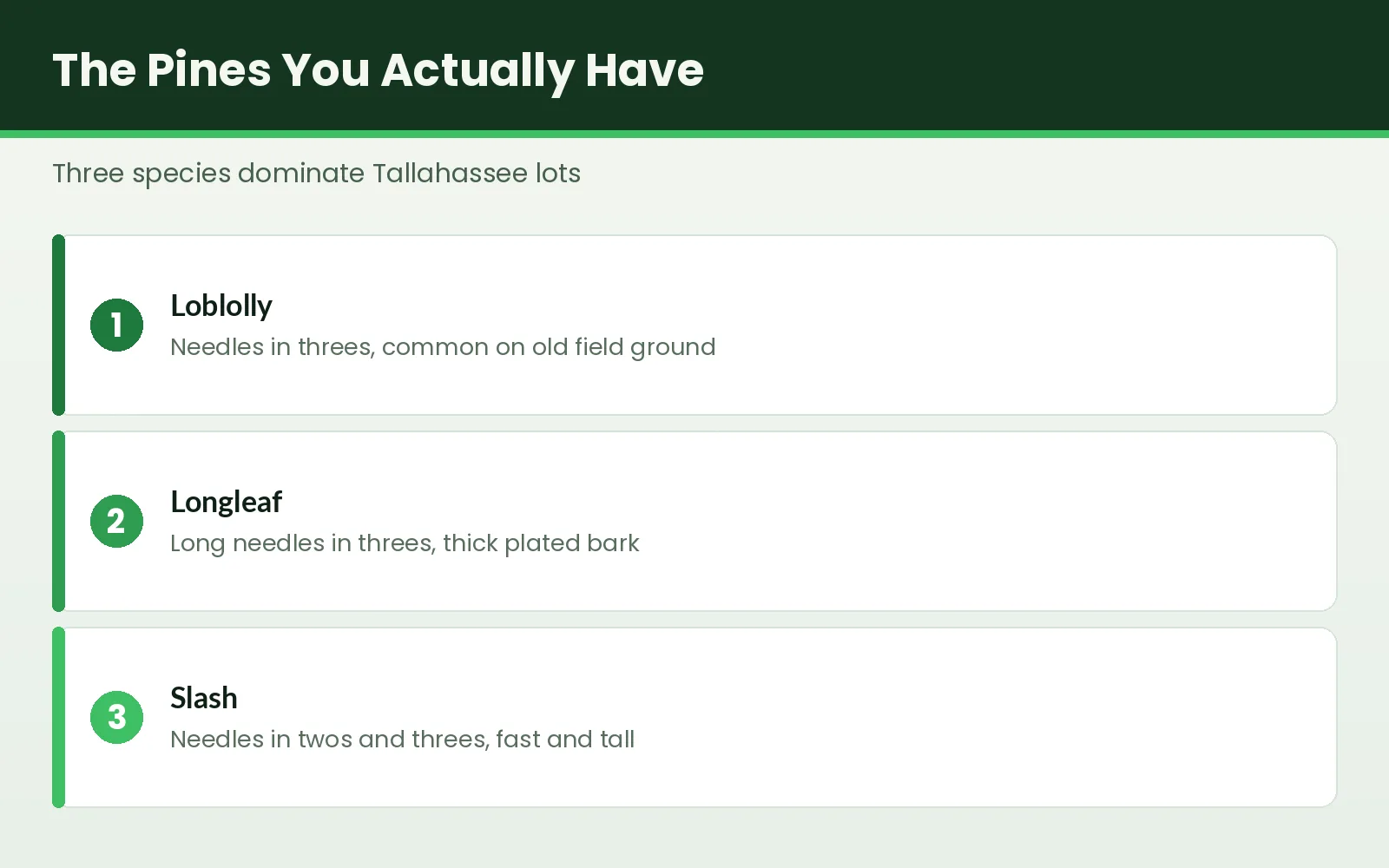
- Pitch tubes on the trunk. Popcorn-sized blobs of resin, sometimes with sawdust. That is the tree trying to push out bark beetles.
- Boring dust in the bark crevices or at the base — fine, reddish-brown frass. Beetles are in.
- Woodpecker activity and flaking bark. Birds are after the larvae. They know before you do.
- A fresh lean after a storm, especially with soil cracking on the uphill side.
- A snapped or hanging top. A broken pine top is a widow-maker on a very large scale.
- Construction damage within the last few years. Pines are unforgiving about root-zone disturbance — a driveway pour or a trench inside the root plate can kill a pine on a two- to four-year delay.
Bark beetles: the reason pine removal is time-sensitive
The Big Bend has a real bark-beetle story, and it changes the urgency of a pine job.
Ips engraver beetles and the southern pine beetle attack pines that are already stressed — by drought, by lightning, by construction damage, by storm injury. After a hurricane season that batters and wounds a stand, beetle pressure climbs. Once beetles have colonized a tree, that tree is not savable, and it becomes a source: the emerging generation moves to the neighbors.
So a beetle-killed pine is not just a dead tree you can deal with next spring. Removing it promptly — and getting the infested wood off site rather than stacking it against the fence — is how you protect the rest of your pines and your neighbor’s. Read more on southern pine beetle in North Florida.
Why pine removal is a technical job
- Height. An 80-to-110-foot pine is above what most bucket trucks reach. That means a climber going up the stick, or a crane.
- No structure to rig from. An oak gives a climber a spreading framework of limbs. A pine gives you a pole with a tuft on top. The rigging is entirely different.
- Brittle tops. Dead or beetle-killed pine wood is treacherous. A climber cannot trust it, which pushes the job to a crane or a lift — see crane tree removal.
- Weight and volume. A mature pine is a lot of wood. Chipping, bucking, and haul-off is a genuine cost line.
- They stand in groups. Removing one pine from a tight stand means dropping sections in a corridor that may not exist. This is where large tree removal planning earns its money.
Pine leaning toward the house, or a snapped top hung up in the canopy? Get everyone out from underneath and call now — that is a life-safety triage, not a scheduled job.
📞 Call Now — (858) 319-0022Vetted local pros — availability depends on independent provider schedules and demand.*What drives the scope
| Factor | Why it matters in Tallahassee |
|---|---|
| Height & diameter | The primary driver. A 100-foot loblolly is a different animal from a 40-foot sand pine. |
| Live vs. dead | Beetle-killed or long-dead pine is unsafe to climb, which pushes the job to a crane or lift. |
| Drop zone | An open pasture lets sections come down fast. A 20-foot gap between two houses does not. |
| Number of trees | Removing six pines from a stand in one mobilization is usually more efficient than one at a time. |
| Wood volume | Pine is bulky. Haul-off versus leaving rounds is a real decision. |
| Stump & roots | Big pine flares grind slowly — see stump grinding. |
These are local-market factors, not our prices. The pro you’re matched with assesses the tree and gives the binding written quote. See the tree removal cost guide.
How getting matched works
Should you keep your pines?
Not every pine is a liability, and clear-cutting a lot of its pines is usually a mistake — both aesthetically and because a thinned-out stand is more wind-vulnerable, not less. Pines in a group shelter each other; a lone survivor left standing in an open yard has never had to hold up its own wind load and often fails in the first serious storm after its neighbors were cut.
Keep the healthy longleaf where you can. Consider removing pines that are: dead or beetle-infested; leaning toward a structure; damaged from a previous storm; badly root-disturbed by recent construction; or so close to the house that a snap would inevitably reach it. That is exactly the kind of triage a tree risk assessment is for — and if you are going into hurricane season, see hurricane tree prep.
Permits
Pines can fall under City of Tallahassee §5-83 protected-tree rules and Leon County Chapter 10 based on size and location, and Canopy Road zones add another layer. Dead or beetle-killed trees and demonstrable hazards are treated differently — and Florida Statute §163.045 permits residential removal without local approval when an ISA-certified arborist documents unacceptable risk. Get that written before the tree comes down. See the permit guide.
Before you call — how to describe it
- How tall — taller than the house? Twice the house?
- Color — fully green, thinning, or gone rust-brown?
- Any pitch tubes or sawdust on the trunk?
- Lean — and whether it is new since the last storm.
- Drop zone — how much open ground is there, and what is in the fall radius?
- How many — one pine or a whole stand?
Frequently asked questions
My pine turned brown. Can it be saved?
No. Once a pine browns out top-down over a few weeks, it is dead — pines do not releaf the way hardwoods can. The next question is whether beetles are involved, because that affects your other pines and makes removal time-sensitive.
What are the popcorn-like blobs on my pine trunk?
Pitch tubes — the tree pushing resin out at bark-beetle entry points. Together with fine reddish boring dust and woodpecker flaking, they are the classic beetle signature. An infested pine cannot be saved and should be removed and hauled off rather than stacked on site.
Are pines more dangerous than oaks in a hurricane?
They fail differently. Oaks tend to shed limbs or tip with the root plate; pines snap in the upper trunk and the broken top falls like a spear, which is why pine strikes often go through a roof. Neither is universally worse — but a tall pine within falling distance of a bedroom deserves a serious look.
Should I remove all the pines around my house?
Usually not. Pines in a group shelter one another; thinning a stand heavily can leave the survivors more wind-vulnerable than they were. Target the dead, the beetle-infested, the leaning, the storm-damaged, and the ones so close that a snap must reach the house.
How much does pine tree removal cost in Tallahassee?
It is scoped to the tree — height, condition, drop zone, access, number of trees, wood volume, and stump all move it, so no honest flat figure exists. The arborist you’re matched with assesses on site and gives a written quote before work begins.
Why did my pine die after we poured the driveway?
Pines are unusually intolerant of root-zone disturbance. Trenching, grading, or paving inside the root plate can kill a pine on a two- to four-year delay — the tree looks fine, then declines. It is one of the most common preventable pine losses in growing Tallahassee neighborhoods.
Related Tallahassee tree services
Pine Tree Trimming
Southern Pine Beetle
Dead Tree Removal
Hazardous Tree Removal
Large Tree Removal
Crane Tree Removal
Hurricane Tree Prep
Tree Removal Cost
Get the pine handled before the next storm
Call now and we’ll connect you with a vetted, licensed and insured Tallahassee-area arborist. Free to use, no obligation, no sign-up.
📞 Call Now — (858) 319-0022Tallahassee Tree Service is a free referral service. Tallahassee Tree Service is not a licensed tree service provider and does not directly provide tree care services. All work is performed by independent, licensed and insured third-party providers in your area. Calls and form submissions placed through this site may be connected with a participating provider, and you may be contacted by that provider regarding your request. Same-day, emergency, and 24/7 availability are not guaranteed and depend on provider schedules, location, and demand. Service availability, pricing, licensing, and final response times are determined solely by the providers. It is the responsibility of the homeowner to verify that the hired contractor furnishes the necessary license and insurance required for the work being performed. All persons depicted in a photo or video are actors or models and not contractors listed on Tallahassee Tree Service.