Pine Tree Trimming in Tallahassee, FL
Three pines dominate the Big Bend and they look nearly identical from the driveway — but they trim differently, snap differently in a hurricane, and attract Southern Pine Beetle at wildly different rates. Call now and we’ll connect you with a vetted, ISA-certified local arborist who works pines specifically.
📞 Call Now — (858) 319-0022Not sure which pine you have? Call now and describe the needles — the arborist will sort it out on site.Pines are the other half of Tallahassee’s canopy, and they are the half most homeowners misread. A loblolly and a longleaf standing forty feet apart in a Killearn back lot are not interchangeable trees. One has a 36% chance of snapping mid-trunk in a Category 3; the other has a nine percent chance. One is a beetle magnet; the other shrugs the beetle off. The species you have decides almost everything about how — and when — it should be cut.
This page covers the three pines you actually have, why pine pruning follows different rules than oak pruning, the FDACS Southern Pine Beetle forecast by county, what Hurricane Ivan taught us about which pines survive, and how to describe your tree so you get matched with the right rig.
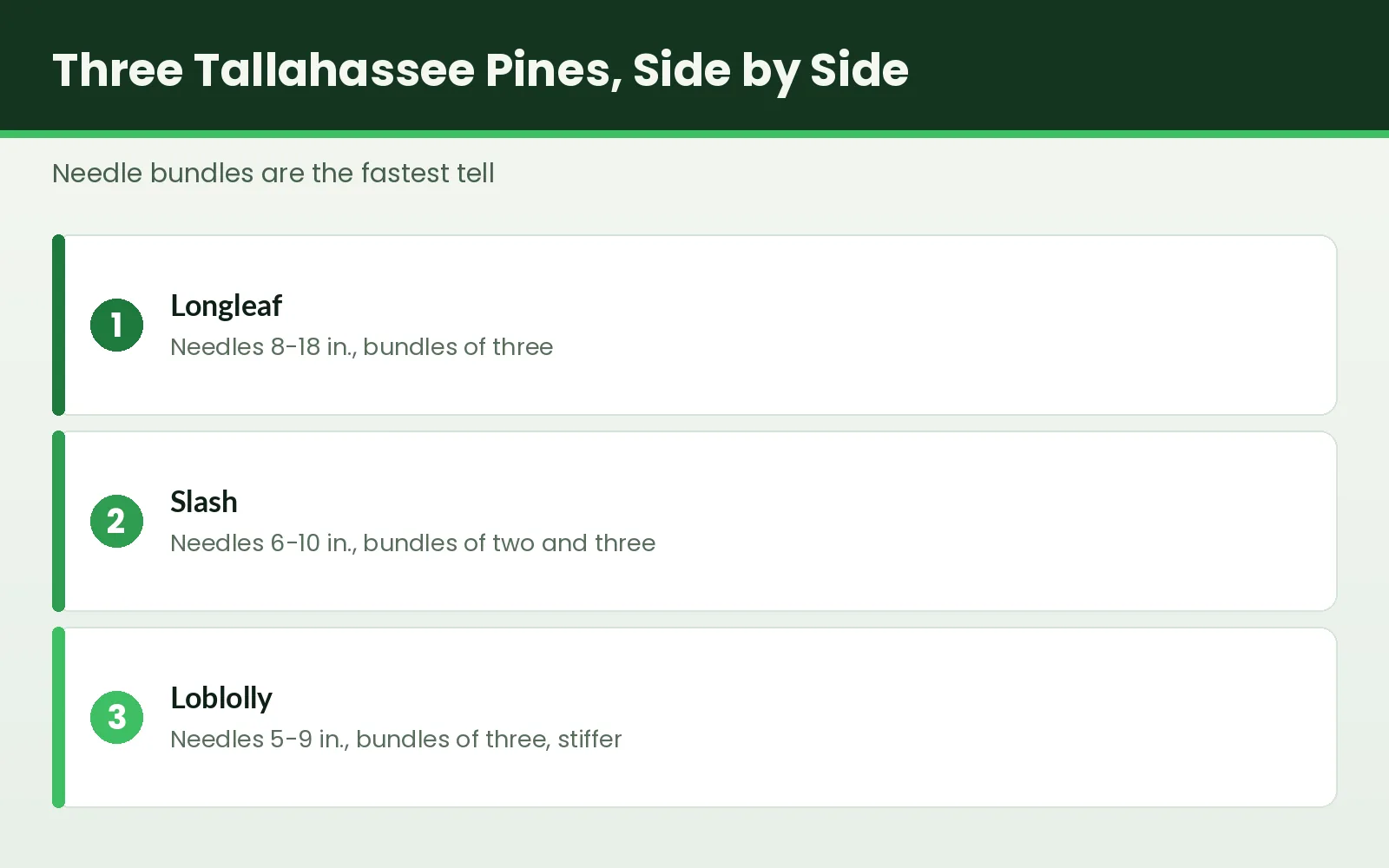
The three Tallahassee pines — how to tell them apart
Species matters because trimming approach, beetle vulnerability and storm survival all diverge. Look at the needles first — length and bundle count give it away.
| Species | Needles | Where you find it here |
|---|---|---|
| Loblolly (Pinus taeda) | 5–9 in., bundles of 3, soft and flexible | The default residential pine. Killearn, Bradfordville, Betton Hills, most subdivisions. Gray-brown bark with flaking reddish plates. Lives 60–100 years, but plenty fail at 40–60 in wind events. |
| Longleaf (Pinus palustris) | 8–18 in., bundles of 3, long and stiff | The native fire-climax pine of the Big Bend. Apalachicola National Forest, older Crawfordville lots, larger Killearn Lakes parcels. Deep-grooved reddish bark, candelabra branching. Can live 300+ years. |
| Slash (Pinus elliottii) | 7–11 in., bundles of 2–3 | The plantation pine. Power-line corridors, commercial plantings, southern Leon and Wakulla properties. Plate-like bark, shallower grooves than longleaf. Lives 80–150 years. |
| Sand & shortleaf | Short needles, 2s | Occasional. Sand pine on the dry uplands around north Leon; shortleaf scattered in the northern Big Bend. Most homeowners never meet either. |
Why pines are pruned by different rules than oaks
Three biological facts separate pine work from hardwood work, and a real ISA-certified arborist will not violate any of them.
1. The central leader is untouchable
A pine grows from a single dominant vertical shoot. Cut the leader — or cut close enough to it that competing shoots take over — and the tree develops multiple leaders that fork weakly and split years later. Any cut near the top of a pine belongs well below the active leader, never through it. This is why “topping” a pine is not a haircut, it is a slow-motion structural failure. See what to do instead of topping.
2. Candle pruning only works on young trees
New pine growth pushes from “candles” — the elongating shoot tips. On a young pine (under about 15 feet), an arborist can pinch candles back to steer growth without making true wood cuts. Once the tree matures, that window closes, and legitimate pine trimming narrows to deadwood removal and clearance cuts. Anyone selling you a heavy “thinning” on a mature pine is selling you damage.
3. Fresh cuts in warm months advertise to beetles
Injured pines pump resin, and the volatile compounds in that resin are exactly what Southern Pine Beetle uses to find a host. April through October in Tallahassee, that scent travels. Dormant-season pruning — roughly December through February, when sap flow is minimal — is the right window for anything beyond an emergency hazard cut.
Southern Pine Beetle — the county risk picture
SPB (Dendroctonus frontalis) is the sharpest threat to pines in north Florida. The beetle bores through the bark, lays eggs in galleries against the cambium, and the larvae girdle the tree from the inside. Once an infestation is confirmed, vascular collapse typically follows in three to six weeks. The FDACS Forest Health Section publishes an annual county-by-county outbreak forecast, and the Big Bend numbers are not comfortable reading.
| County | 2025 FDACS SPB outbreak probability | What it means for you |
|---|---|---|
| Wakulla | 21.2% — highest in Florida | Dense loblolly on most residential lots plus warming springs that stretch the beetle’s active season. Annual inspection is the right cadence here. |
| Gadsden | 17.9% | Heavy slash and loblolly stands around Quincy and Havana, many 50+ years old. |
| Leon | 8.6% | Moderate. Wind-throw on aging loblollies is the bigger day-to-day risk in the subdivisions. |
| Jefferson | 7.4% | Moderate; scattered pine stands on larger rural parcels. |
| Franklin | 5.1% | Lowest in the region. |
The early signs are findable if you know them: popcorn-sized pitch tubes on the bark, S-shaped galleries under loose bark, and crown fade that goes yellow-green then rust-red in a matter of weeks. Catch it early and a cut-and-remove breaks the cycle before the beetle jumps to the neighboring pines. Miss it and you lose a cluster. Once SPB is confirmed, the clock runs in days, not weeks.
Pitch tubes on the bark, or a pine crown going rust-red out of season? That is a days-not-weeks situation — the beetle spreads to the pines beside it.
📞 Call Now — (858) 319-0022Vetted local pros — availability depends on independent provider schedules and demand.*What Hurricane Ivan taught us about pine survival
Ivan came ashore on the western Panhandle on September 16, 2004 as a Category 3. The pine stands it flattened from Pensacola to Crestview became an accidental controlled experiment, and UF/IFAS and the U.S. Forest Service published the results. The species differences were stark:
| Species | Trunk snap rate in Ivan | Why |
|---|---|---|
| Loblolly | 36% snapped mid-trunk | Evolved in sheltered uplands. Thinner bark, shallower roots, less flexible trunk. |
| Slash | 19% snapped | Middle ground — sturdier than loblolly, softer than longleaf. |
| Longleaf | 9% snapped, 90%+ overall survival | Evolved under the coastal plain’s fire-and-wind regime. Thick bark, deep taproot, flexible stem. |
The practical read for a Tallahassee homeowner: if your lot carries a mix, the loblollies are the ones that warrant structural attention and the longleafs are the ones likely to still be standing afterward. And if you are replanting for storm resilience, longleaf is the right species for this region even though it takes its time getting there. Fold that into your hurricane tree prep before June, not during the cone.
How getting matched works
When pine trimming turns into pine removal
Sometimes trimming is not the honest answer. Three situations tip a pine toward removal:
- Confirmed SPB. Once pitch tubes and crown fade line up, cutting branches accomplishes nothing — the beetles are already under the bark and the vascular system is failing. Cut-and-remove is what breaks the cycle for the pines beside it.
- A snapped top. Pines do not regrow a leader the way an oak sometimes recovers. A topped pine becomes a tall snag that sheds limbs for a year or two and then has to come down anyway. Cleaner to take it down deliberately. See pine tree removal.
- A loblolly leaning after a wet stretch. Saturated clay north of the Cody Scarp lets shallow loblolly root plates rotate. Sometimes the tree settles; often the lean keeps growing. The leaning tree guide covers how to read the soil on the far side of the lean.
What drives the scope of a pine job here
Pine pricing is scoped to the tree, not to a menu — these are typical local-market drivers, not our prices, and the pro you are matched with gives the binding written quote.
| Factor | Why it matters on a pine |
|---|---|
| Height | An 80-foot mature loblolly needs a climber working multiple tie-in points, or a crane. A 25-foot clearance trim is a morning. |
| Deadwood volume | Pines shed lower limbs naturally as they self-prune, and years of accumulated deadwood is a lot of separate cuts. |
| Access | Back-lot pines behind a fence in Bradfordville mean hand-lowering everything out through a side yard. |
| Proximity to house and lines | Pine limbs over a roof or near a service drop need controlled rigging, and utility involvement stops the clock until the line is cleared. |
| Multiple trees | Five pines on one property is one mobilization instead of five — the per-tree math changes accordingly. |
| Infested wood handling | SPB-confirmed wood has to be dealt with promptly rather than stacked, which adds haul-off to the scope. |
Pines by neighborhood and county
Wakulla County (Crawfordville, Sopchoppy, Panacea, St. Marks) carries the heaviest beetle pressure in the state on top of dense residential loblolly. Several Crawfordville streets saw cluster pine mortality in 2024. An annual look is warranted here in a way it is not in central Tallahassee.
Killearn, Bradfordville and northeast Leon are mixed oak-pine, with mature loblolly filling the back lots of most subdivisions. The bigger everyday risk here is summer-thunderstorm wind-throw on aging loblollies whose root plates sit in wet Orangeburg clay.
SouthWood, Apalachee Ridge and southern Leon run heavier to pine, with longleaf surviving in undeveloped corridors. Beetle pressure climbs as you move toward the Wakulla line.
Gadsden County (Quincy, Havana) has slash and loblolly stands going back half a century and the second-highest SPB probability in the region.
Bordering the Apalachicola National Forest, longleaf dominates and USDA fire management keeps the stands healthy — adjacent properties in Crawfordville and southern Leon quietly benefit from that buffer.
Before you call — how to describe your pines
- Needle length. Palm-length needles say loblolly; forearm-length needles say longleaf. That one detail tells an arborist a lot.
- Crown color. Any yellowing or rust-red fade in a season when it should be green is urgent, not cosmetic.
- The target. What is under the tree — roof, driveway, play set, service drop, neighbor’s fence.
- How many. One pine and a stand of eight are entirely different jobs.
Frequently asked questions
When is the right time to trim a pine in Tallahassee?
The dormant season — roughly December through February — when sap flow is minimal. Fresh cuts in the warm months release volatile resin compounds that Southern Pine Beetle actively hunts for. Hazard limbs and storm damage are the exception: those get cut whenever they are dangerous.
Which county in the Big Bend has the worst pine beetle risk?
Wakulla, at 21.2% outbreak probability in the 2025 FDACS forecast — the highest single-county figure in Florida. Gadsden follows at 17.9%. Leon sits at 8.6%.
Can a pine be topped to make it safer?
No. Pines do not regenerate a central leader, so a topped pine becomes a decaying snag that drops limbs and eventually has to be removed. Reduction and deadwood removal are the legitimate options; if a pine is genuinely hazardous, removal is the honest answer.
How do I know if my pine has Southern Pine Beetle?
Look for pitch tubes — small popcorn-like resin blobs on the trunk — and S-shaped galleries under loose bark, followed by rapid crown fade from green to yellow to rust. Once those signs appear, the tree is on a weeks-long clock and the pines around it are at risk.
Are longleaf pines really safer in a hurricane?
The data says yes. In Hurricane Ivan, longleaf snapped at roughly 9% versus 36% for loblolly, thanks to thicker bark, a deeper root system and a more flexible stem. It is the right species to plant here for storm resilience even though it grows slowly.
What does pine trimming cost in Tallahassee?
It is scoped to the tree — height, deadwood volume, access, proximity to structures and how many pines are on the property all move it, so there is no honest flat figure. The local arborist you are matched with inspects the trees and gives a binding written quote. See our trimming cost guide.
Related Tallahassee tree services
Tree Trimming
Pine Tree Removal
Southern Pine Beetle Guide
Tree Disease Treatment
Tree Health Assessment
Hurricane Tree Prep
Tree Risk Assessment
Tree Trimming Cost
Get your pines looked at before beetle season
Call now and we’ll connect you with a vetted, ISA-certified Tallahassee-area arborist who works pines. Free to use, no obligation, no sign-up.
📞 Call Now — (858) 319-0022Tallahassee Tree Service is a free referral service. Tallahassee Tree Service is not a licensed tree service provider and does not directly provide tree care services. All work is performed by independent, licensed and insured third-party providers in your area. Calls and form submissions placed through this site may be connected with a participating provider, and you may be contacted by that provider regarding your request. Same-day, emergency, and 24/7 availability are not guaranteed and depend on provider schedules, location, and demand. Service availability, pricing, licensing, and final response times are determined solely by the providers. It is the responsibility of the homeowner to verify that the hired contractor furnishes the necessary license and insurance required for the work being performed. All persons depicted in a photo or video are actors or models and not contractors listed on Tallahassee Tree Service.