Tree Topping Alternative in Tallahassee — Crown Reduction Done the ANSI A300 Way
If a tree service quoted you on “topping” an oak in your yard, stop and read this first. Tree topping is condemned by the International Society of Arboriculture, violates the ANSI A300 pruning standard, and almost always shortens the life of the tree. The good news: there’s a real alternative that gets the size reduction you actually want without destroying the tree. Our ISA-Certified arborists do it correctly.
What Tree Topping Actually Is — and Why You Want the Alternative
Topping is the practice of cutting back a tree’s main stems to stubs, with no regard for branch collars, lateral leaders, or the tree’s ability to recover. It’s sometimes called “hat-racking,” “heading,” or “rounding over.” You’ve seen it — oaks left looking like coat racks after a crew runs through a neighborhood with a bucket truck.
Most homeowners who request topping aren’t trying to harm their tree. They want it shorter, less likely to fall on the house, and out of the power lines. Those are reasonable goals. The problem is that topping doesn’t accomplish any of them long-term — it makes every one of them worse over a 5-to-10-year window. The real tree topping alternative Tallahassee homeowners need is called crown reduction, and it’s a completely different procedure.
The International Society of Arboriculture — the global certifying body for arborists — takes a clear position on topping. Their consumer-facing resource at treesaregood.org describes topping as one of the most harmful pruning practices known. The ANSI A300 standard, which governs professional tree care in the United States, explicitly prohibits topping as a standard pruning method. If a Tallahassee tree service is willing to topp your tree, they’re willing to violate the only standard the industry has. The right tree topping alternative Tallahassee homeowners should be asking for — by name — is crown reduction performed to ANSI A300 specs.
Why Topping Destroys the Tree
There are five distinct ways topping damages a tree — and most of them compound over years, so the damage isn’t obvious until it’s too late.
1. Massive Decay Entry Points
Topping cuts leave large stub wounds with no branch collar to seal. In live oak, water oak, and laurel oak — the species most often topped in Tallahassee — these wounds become gateways for heart rot fungi within 18–24 months. The decay then moves down the trunk and structural branches.
2. Sun-Shock to the Trunk
The bark of an interior or shaded trunk isn’t adapted to direct sun. Topping suddenly exposes that bark, which then cracks, peels, and admits more pathogens. This shows up as “bark splitting” the summer after topping — and it’s permanent damage.
3. Weakly-Attached Regrowth
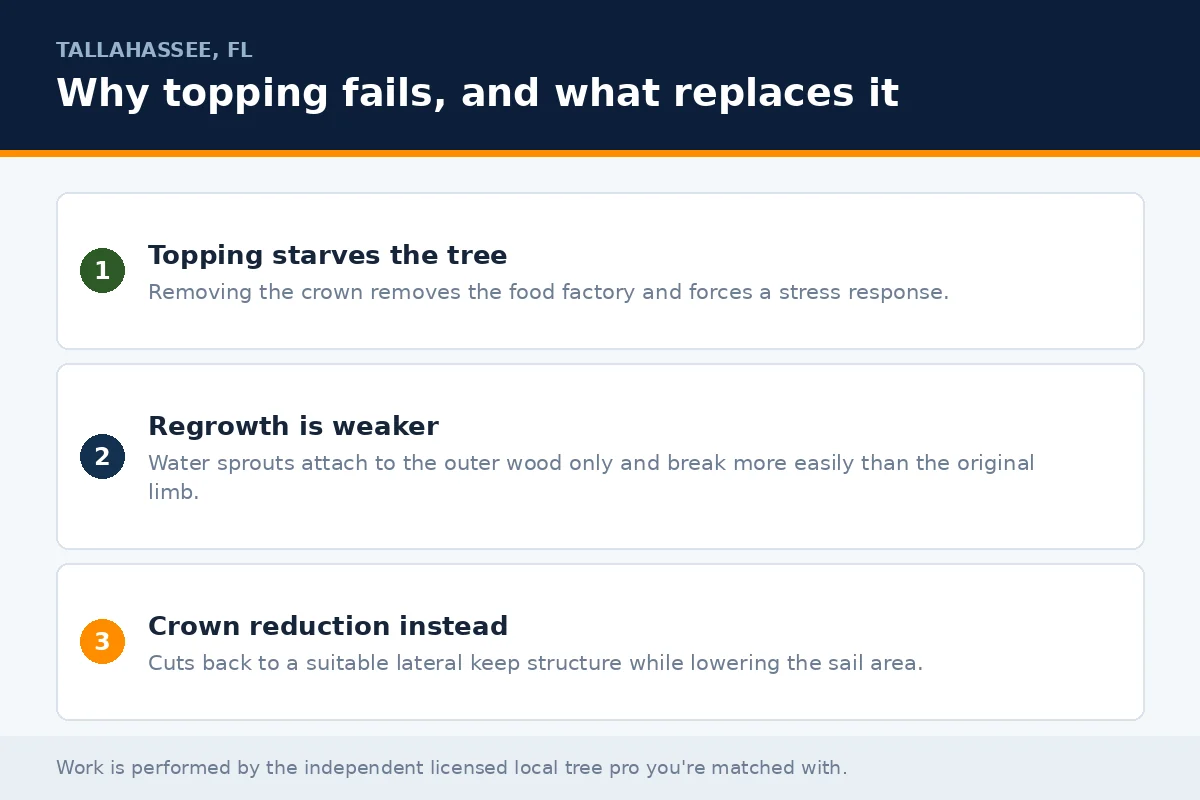
Topped trees produce dense clusters of fast-growing “water sprouts” from the cut stubs. These shoots are attached only at the bark — not embedded in the wood like a normal branch — and they rip off in storms. Helene 2024 dropped huge numbers of these regrowth limbs onto Tallahassee roofs.
4. Energy Starvation
Trees feed themselves through their leaves. Topping removes 50–100% of the canopy in one cut, which means the tree has no way to feed itself for the season. It pulls from stored reserves, regrows quickly with weak wood, and goes into a long decline that can span a decade.
5. Permanent Form Loss
A properly grown live oak develops a spreading, structurally sound crown over 50–80 years. Once topped, it never gets that form back. The tree may live another 30 years, but it will look like a topped tree for the rest of its life — and so will every photo of your house.
6. Insurance & Liability Exposure
Many homeowners’ insurance policies exclude damage from improperly maintained trees. If a regrowth limb from a topped tree drops on your neighbor’s car, the claim can be denied because topping is recognized industry-wide as malpractice. Documentation matters.
If a crew is already coming next week to topp a tree on your property, that’s a good moment to pause and call. The tree topping alternative Tallahassee arborists deliver doesn’t cost much more — call (850) 555-0123 for a quick second opinion before the bucket truck shows up.
Got a Quote for Topping? Call Us First.
An ISA-Certified arborist can walk your property and tell you whether crown reduction, structural pruning, or full removal is actually the right call. No pressure, no upsell.
The Real Tree Topping Alternative: Crown Reduction
Crown reduction is the ANSI A300 method that gets you the size reduction you actually want — without the damage. It’s slower, more skilled, and a little more expensive in a single visit. Over a decade, it’s far cheaper because the tree stays healthy.
Cut to Lateral Branches
Every reduction cut is made back to a live lateral branch at least one-third the diameter of the limb being removed. The lateral takes over as the new leader — no stub, no decay entry, no water-sprout regrowth.
Limit to 25% Live Crown
ANSI A300 caps live-crown removal at 25% per pruning cycle for mature trees. Anything more starves the tree. This is why proper crown reduction is staged across multiple visits over a few years on heavily oversized trees.
Keep the Tree’s Form
Crown reduction shrinks the silhouette while keeping the tree shaped like a tree — not a bottle brush. Done correctly, you can take 8–15 feet off a mature live oak and most people won’t notice it’s been pruned within a year.
Species-Specific Cuts
Live oak heals slow. Laurel oak compartmentalizes decay poorly. Pines basically don’t recover from major cuts. A skilled arborist adjusts the technique — reduction targets, cut size, season — for the species in your yard.
Documented & Photographed
Every reduction job we do is documented before and after, with cut diameters and percentage of live crown removed. That documentation protects you for insurance and HOA disputes — topping crews don’t produce this.
Future Maintenance Plan
A reduced tree is easier to maintain on a 3-to-5-year cycle. We hand off a written maintenance recommendation so you know when to schedule the next visit and what to watch for — see tree pruning.
Other Tree Topping Alternatives Tallahassee Arborists Use
Crown reduction is the most common tree topping alternative Tallahassee crews use, but it’s not the only one. Depending on what you’re trying to accomplish, one of these may be a better fit.
- Crown thinning — selective removal of small interior branches to reduce wind resistance and let light through. Doesn’t change the tree’s height or spread, but reduces sail effect for storm safety. Best for mature live oaks. See tree trimming.
- Crown raising — removal of lower limbs to clear vehicles, sight lines, or roof clearance. Solves the “tree is too low” problem without touching the upper canopy.
- Structural pruning — correction of crossing limbs, co-dominant leaders, and weak attachments before they fail. Best done on young to middle-aged trees. Prevents the situation that leads to topping in the first place.
- Cabling and bracing — for trees with structural concerns that can’t be fully pruned out, steel cable systems redistribute load and prevent failure. See tree cabling.
- Removal and replant — sometimes the right call. A water oak that’s outgrown its space and is heading into decline anyway is better replaced with a properly-sited species than repeatedly topped. See tree removal and best trees to plant.
- Hazard pruning only — sometimes the answer is to leave the tree mostly alone and only remove the deadwood and over-the-house limbs. This is a minimal intervention that preserves the tree.
The Hidden Costs of Topping
Topping is cheap up front. That’s why people accept it. Here’s what it actually costs over the next ten years.
- Repeat pruning every 2–3 years — topped trees regrow water sprouts so fast that the tree needs cutting again within 24–36 months. Five cycles of topping costs more than one proper crown reduction.
- Eventual full removal — most topped oaks in Tallahassee end up needing full removal within 8–15 years because of internal decay. Removal cost on a 50-foot live oak runs $1,500–$4,500. See tree removal cost.
- Property value loss — mature healthy trees add 5–15% to home value depending on the neighborhood. Topped trees subtract from curb appeal and can hurt comp pricing in Killearn Estates, Myers Park, and other canopy-protected areas.
- Insurance claim risk — if a regrowth limb from a topped tree drops on your neighbor’s car or your roof, claims are sometimes denied because topping is recognized as improper maintenance.
- HOA & covenant violations — some Tallahassee HOAs explicitly prohibit topping in their CC&Rs. Killearn Lakes and parts of Southwood have written language on this.
- Wildlife habitat loss — topped trees lose nesting cavities, food sources, and the structural complexity that supports birds and pollinators. This isn’t just a feel-good point — it impacts the broader urban forest in your neighborhood.
Common Reasons People Topp — and What to Do Instead
Most topping requests come from a real, legitimate concern. The mistake is the solution — not the worry. Here’s what to do instead.
“The tree is too tall — I’m worried it’ll fall on the house.”
Why topping doesn’t fix itTopped trees produce weakly-attached regrowth that’s more likely to fail in storms than the original branches.
Better solutionGet a tree risk assessment. If the tree is genuinely high-risk, full removal beats topping. If it’s healthy, crown reduction + thinning reduces sail load without the regrowth problem.
“Branches are over the roof.”
Why topping doesn’t fix itTopping the whole tree is a sledgehammer for a problem that needs a scalpel.
Better solutionTargeted limb removal — cutting back the specific over-the-house branches at proper lateral cuts. See tree branch removal.
“The tree is in the power lines.”
Why topping doesn’t fix itUtility-line clearance topping creates a perpetual maintenance cycle and disfigures the tree.
Better solutionDirectional pruning by a qualified arborist trains the tree away from the lines using lateral-branch reduction. For ongoing concerns, the City of Tallahassee Utilities handles primary-line clearance directly — you don’t pay for it.
“Hurricanes — I want it shorter before storm season.”
Why topping doesn’t fix itTopped trees are more storm-vulnerable, not less. Helene 2024 destroyed huge numbers of previously-topped oaks across Tallahassee.
Better solutionCrown thinning + selective reduction reduces wind sail without weakening branch attachments. See hurricane tree prep.
“It’s blocking my view.”
Why topping doesn’t fix itTopping creates a dense cluster of regrowth that blocks the view worse than the original canopy within 3 years.
Better solutionCrown raising (removing lower limbs) often opens up the view at eye level without touching the upper canopy. Selective branch removal can also create “view windows.”
“My neighbor topped theirs and it looks fine.”
Why topping doesn’t fix itThe damage from topping isn’t visible for 18–24 months. By year 5, the same tree is in clear decline. By year 10, it often needs removal.
Better solutionDon’t take pruning advice from your neighbor unless your neighbor is an ISA-Certified arborist. The decisions made on this tree will play out over decades, not seasons.
Get a Real Diagnosis Before You Topp
A 15-minute walkthrough with a certified arborist will tell you what your tree actually needs — and save you from a decade of regret.
Topping vs. Crown Reduction — 10-Year Cost Comparison
Here’s what the actual numbers look like for a typical 40-foot mature water oak in Tallahassee, comparing both paths over a decade.
| Year | Topping Path | Crown Reduction Path |
|---|---|---|
| Year 0 | Initial topping: $400–$700 | Initial crown reduction: $700–$1,400 |
| Year 2–3 | Re-topping (regrowth): $400–$700 | — |
| Year 4 | — | Maintenance trim: $300–$600 |
| Year 5–6 | Re-topping again: $500–$800 | — |
| Year 8 | Hazard pruning (decay): $400–$900 | Maintenance trim: $300–$600 |
| Year 9–10 | Likely full removal: $1,500–$4,500 | — |
| 10-Year Total | $3,200–$7,600 | $1,300–$2,600 |
| Tree Status at Year 10 | Removed or in decline | Healthy, mature canopy |
Tallahassee Species Most Damaged by Topping
North Florida’s common shade trees respond differently to topping. A few species are more vulnerable than others — and these are exactly the species most often topped in town.
Live Oak
Quercus virginianaThe signature tree of Tallahassee. Heals slowly, compartmentalizes decay moderately well, but never recovers its proper crown form after topping. A topped live oak is a 100-year tree turned into a 40-year tree. See live oak care.
Laurel Oak
Quercus laurifoliaAlready short-lived (60–80 years) and notorious for poor decay compartmentalization. Topping a laurel oak basically guarantees heart rot within 3–5 years. See laurel oak problems.
Water Oak
Quercus nigraThe most-topped species in Tallahassee — and the one that suffers the most from it. Water oaks decline rapidly after major wounding and frequently need removal within 8–12 years of being topped. See water oak removal.
Southern Pines
Pinus elliottii, P. taeda, P. palustrisPines essentially don’t survive topping. They lack the epicormic budding that hardwoods use to regenerate. A topped pine usually dies within 2–3 years. Removal is the only correct response when a pine is too tall. See pine tree removal.
Sweetgum
Liquidambar styracifluaAggressive regrowth from topping creates dense water-sprout clusters. The wood is brittle, so the regrowth is even more storm-vulnerable than other species. See sweetgum.
Crepe Myrtle
Lagerstroemia indicaThe infamous “crepe murder.” Crepe myrtles do regrow from topping cuts, but the result is ugly knuckled stubs and weak flower-bearing shoots. Proper pruning maintains the tree’s natural form. See crepe myrtle trimming.
Tree Topping Alternative Tallahassee FAQs
Is tree topping ever the right choice?
Almost never on residential property. The only context where heading-style cuts are accepted in modern arboriculture is utility-line clearance done by trained line-clearance arborists, and even there, directional pruning is preferred. For a homeowner, the tree topping alternative Tallahassee arborists recommend — crown reduction or full removal — is virtually always the better path.
What’s the difference between topping and crown reduction?
Topping cuts main stems back to stubs without regard for branch structure. Crown reduction cuts back to a live lateral branch large enough to take over as the new leader (at least one-third the diameter of the limb being cut). Topping creates decay-prone wounds and weakly-attached regrowth; crown reduction maintains the tree’s structure and limits live-crown removal to 25% per cycle per ANSI A300.
How much can a tree be reduced in one visit?
The ANSI A300 standard caps live-crown removal at 25% per pruning cycle for mature trees, less for stressed or older specimens. If you need more reduction than that, the work is staged across multiple visits over 2–4 years. A reputable Tallahassee arborist will tell you this even if it costs them a bigger initial sale.
Will topping help my tree survive a hurricane?
No — the opposite. Hurricane Helene in September 2024 destroyed disproportionate numbers of previously-topped oaks in Tallahassee. The water-sprout regrowth on topped trees is attached only at the bark and rips off in high wind far more easily than naturally-formed branches. For storm-prep work, you want crown thinning + selective reduction, not topping. See our hurricane tree prep page.
How can I tell if a tree was previously topped?
Look for dense clusters of pencil-thin water sprouts emerging from large stub cuts on the main scaffolds. Topped oaks often have a “wig” appearance — thick base, abrupt cuts at 15–25 feet up, and a haze of fast regrowth above. If you suspect a tree was topped years ago, an ISA-Certified arborist can assess whether the tree is recoverable or whether it’s heading toward removal. Call (850) 555-0123.
Why do some companies still offer topping?
Three reasons. First, it’s easier and faster than proper crown reduction — no need to identify lateral branches or follow ANSI A300. Second, it locks in repeat customers because the tree needs cutting again in 2–3 years. Third, untrained crews don’t know any better. Any tree service that quotes you on topping without explaining the alternative is a service to avoid.
Does topping violate any Tallahassee ordinances?
City of Tallahassee Code §5-83 governs tree protection — it covers permitting for removal but doesn’t explicitly prohibit topping. However, some HOAs in Killearn, Southwood, and other canopy-protected neighborhoods do prohibit topping in their CC&Rs. Always check your HOA documents before any major tree work. See our permit guide.
What does proper crown reduction cost in Tallahassee?
Pricing depends on the species, size, and access. For a typical 40–50-foot mature oak, crown reduction usually runs $700–$1,800. Larger live oaks with crane access can reach $2,500–$4,000 for a single staged reduction. Compare with tree trimming cost for related ranges.
Can a topped tree be saved?
Sometimes. If topping was recent (within 1–2 years), the species is decay-resistant (live oak), and the cuts weren’t catastrophic, restorative pruning can guide the tree toward a more natural form over 5–10 years. If topping was severe, the tree is a water oak or laurel oak, or decay has set in — removal and replant is usually the better path. An on-site assessment is the only way to know.
Do you turn down jobs where homeowners insist on topping?
Yes. Our crews are ISA-Certified, and topping violates the standards we work to. If after a walkthrough a homeowner still wants topping despite the explanation of the alternatives, we’ll politely decline the work and refer them elsewhere. The tree topping alternative Tallahassee homeowners deserve is the one we actually deliver.
Related Tallahassee Tree Services
Crown reduction sits inside a network of proper tree care services. Here are the most relevant adjacent pages.
Don’t Topp. Call an Arborist Instead.
A 15-minute walkthrough costs nothing and tells you exactly what your tree needs — whether that’s crown reduction, structural pruning, hazard removal, or just leaving it alone. The right tree topping alternative Tallahassee homeowners can rely on starts with that conversation. ISA-Certified arborists, same-week scheduling.