Tree Service in Wakulla County, FL
One county, four ecosystems — Gulf-front Panacea, longleaf Sopchoppy, historic St. Marks, and the growing Crawfordville corridor. Call now and we’ll connect you with a vetted, ISA-certified local arborist who works the county from the forest line to the salt line.
📞 Call Now — (858) 319-0022The closer to the water, the earlier the assessment should happen.Wakulla County runs from the Apalachicola National Forest boundary to open Gulf water in under thirty miles, and its tree work changes character with every mile south. The permit picture, at least, is simple: unincorporated Wakulla answers to one authority — Wakulla County Planning & Community Development, (850) 926-0919, in Crawfordville — and Florida’s single-family hazard-tree path (FS §163.045 with ISA-certified arborist documentation) applies countywide.
How fast can Wakulla County get a tree crew?
The dispatch line runs 24/7 from Crawfordville to St. Marks, and storm-felled trees on structures jump the queue. Call now to get matched now, or see how emergency tree service is triaged across the region.
Need a tree crew near you today?
📞 Call (858) 319-0022Free 24/7 dispatch line · licensed, insured local tree services · no obligation
Community by community
| Community | Canopy character | What tree work looks like |
|---|---|---|
| Crawfordville & Medart | Tall pines over subdivisions, oaks on older roads | Strike-zone pine assessments, subdivision removals, stump grinding — detail on the Crawfordville page |
| Panacea & the coast | Salt-pruned oaks, cabbage palms, slash pine | Direct-landfall exposure and surge-influenced soils — wind-firm species selection matters as much as removal; see sabal palm care |
| Sopchoppy | Longleaf country at the forest gateway | Preservation-minded work around mature longleaf, river-corridor soft ground, rural drop-zone removals |
| St. Marks | Historic port canopy beside the refuge | Old hardwoods over small historic lots, wetland-edge review, wind exposure off Apalachee Bay |
| Wakulla Station & rural corridors | Large lots, natural mixed stands | Acreage clearing, beetle monitoring, long-drive access planning |
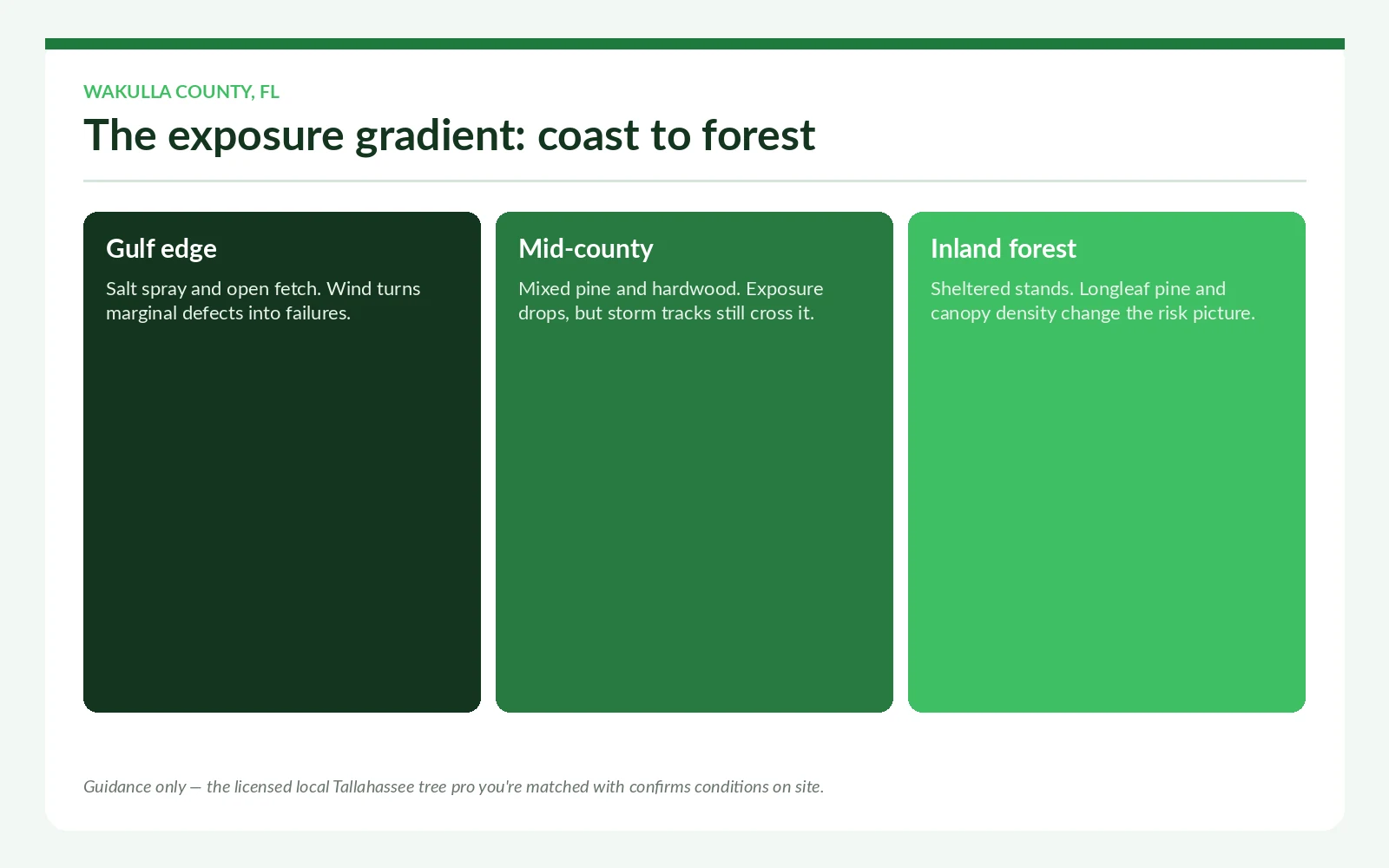
The exposure gradient — coast to forest
- Gulf-front (Panacea, Ochlockonee Bay, coastal US-98): first wind on landfall, storm surge in the soil profile, and salt spray shaping crowns year-round. Trees here live pre-stressed; the assessment question isn’t whether wind will test them but which ones fail the test.
- Mid-county (Medart, Crawfordville, Wakulla Station): hurricane-force gusts arrive with the pine canopy still fully loaded — the county’s biggest volume of tree-on-structure work happens in this band.
- North county (Sopchoppy, forest edge): more land friction, taller old-growth stands, and the longleaf worth designing around rather than through.
Everywhere on that gradient, the pattern holds: a February-to-May assessment of what stands within striking distance of the house converts hurricane season from a lottery into a checklist. The hurricane prep guide lays out the timeline.
Species notes for a salt-and-wind county
Wakulla’s canopy sorts itself by tolerance, and smart owners plant and keep accordingly. Live oak is the county’s wind champion — low, broad, deep-anchored, and salt-tolerant enough to hold the first line at Panacea; the coastal form grows shorter and tougher than its Tallahassee cousins and should be treasured, not tidied. Cabbage (sabal) palm is effectively hurricane-proof when left unskinned — the mistake is over-trimming: hurricane-cutting a sabal weakens the very crown that makes it wind-worthy. Sand live oak and yaupon hold the dune lines and deserve the same respect. On the pine side, longleaf is the wind-firm aristocrat — deep taproot, open crown — while fast-grown slash and loblolly planted on old field ground are the trees that snap at forty feet in a landfall; that difference should drive which pines stay inside a strike zone. Southern red cedar shrugs off salt along the marshes and makes an underused coastal screen. And at every wet margin — river, lake, or bay head — bald cypress is the keeper, built for the saturation that kills upland species. The wrong-tree-wrong-place failures an arborist sees after every Wakulla storm are predictable: brittle water oaks over septic drainfields, over-lifted sabals, and old-field slash pine towering over new roofs. A species-literate assessment catches all three before the wind does.
Coastal lot with a leaning pine or a salt-burned oak? Get local eyes on it before the season’s first named storm.
📞 Call Now — (858) 319-0022Vetted local pros — availability depends on independent provider schedules and demand.*How getting matched works
What drives tree service cost across Wakulla County
| Factor | The county angle |
|---|---|
| Location on the gradient | Coastal soft ground and surge-zone staging differ from upland forest-edge lots with room to drop. |
| Tree height vs. targets | The 90-foot pine question — what it can reach governs how it comes down. |
| Ground protection | River-corridor and bayfront lots need mats, lighter machines, or hand-rigging. |
| Permit & wetland review | County review plus wetland delineation where lots touch protected water. |
| Travel & access | A county this rural prices drive time and gate width into every job. |
| Season | Pre-June books normally; post-landfall runs hazard-first for weeks, coastal communities first. |
Frequently asked questions
Is there an emergency tree service near me in Crawfordville or Wakulla County?
Call (858) 319-0022 24/7. The dispatcher connects you with a licensed, insured crew that works Crawfordville, Medart, Panacea and the rest of Wakulla County. How fast they can arrive depends on storm volume and distance, and the crew gives you a price before cutting.
Who issues tree permits in Wakulla County?
Wakulla County Planning & Community Development in Crawfordville, (850) 926-0919 — one authority for the whole unincorporated county. Neither Tallahassee’s nor Leon County’s thresholds apply here.
Are coastal trees worth saving after salt exposure?
Often yes — live oaks and cabbage palms are salt-tolerant by design, and a salt-burned crown isn’t a dead crown. What matters is distinguishing cosmetic burn from decline, which is a species-by-species call an arborist makes at the tree.
Does the county protect longleaf pines?
Mature longleaf carries real conservation weight in Wakulla, and protected-tree provisions can apply — confirm with the county before removal. Healthy longleaf is also among the most wind-firm pine species; keeping it is usually the smart storm play.
What happens after a hurricane landfall here?
Crews work hazard-first: trees on structures and blocked access before everything else, coastal communities typically hit hardest and worked first. Standing relationships and early calls matter; availability always depends on event severity. See storm cleanup.
Can trees near the St. Marks refuge or the rivers be removed?
On private land, generally yes with the right review — wetland edges may need delineation, and riverine work can involve the water management district. Refuge and forest land itself is federal and state managed; property-line certainty is step one.
Do providers really cover the whole county?
Yes — the network reaches Crawfordville, Medart, Sopchoppy, Panacea, St. Marks, Wakulla Station, and the corridors between. Rural drive time is planned into scheduling rather than bolted on as a surprise.
Wakulla County tree work, service by service
Pick the job you actually have — every page below is Wakulla County-specific.
Related tree services
Tree Service Crawfordville
Hurricane Tree Prep
Storm Cleanup
Sabal Palm Care
Cypress Tree Care
Hazardous Tree Removal
Land Clearing
All Tallahassee Tree Services
From the forest line to the salt line — covered.
Call now and we’ll connect you with a vetted, ISA-certified arborist who works all of Wakulla County. Free to use, no obligation, no sign-up.
📞 Call Now — (858) 319-0022Tallahassee Tree Service is a free referral service. Tallahassee Tree Service is not a licensed tree service provider and does not directly provide tree care services. All work is performed by independent, licensed and insured third-party providers in your area. Calls and form submissions placed through this site may be connected with a participating provider, and you may be contacted by that provider regarding your request. Same-day, emergency, and 24/7 availability are not guaranteed and depend on provider schedules, location, and demand. Service availability, pricing, licensing, and final response times are determined solely by the providers. It is the responsibility of the homeowner to verify that the hired contractor furnishes the necessary license and insurance required for the work being performed. All persons depicted in a photo or video are actors or models and not contractors listed on Tallahassee Tree Service.