🌳 ISA-Certified Walkthrough • Same-Week Scheduling

Tree Inspection Tallahassee — ISA-Certified Visual Health Check for Your Yard

Worried about that big oak leaning toward the house? Pine showing brown needles in February? Cracks at the base of the trunk? A tree inspection Tallahassee homeowners can schedule the same week catches problems early — before a storm, a falling limb, or an insurance dispute makes the decision for you. ISA-Certified arborist on site, walkthrough takes 20–45 minutes, written summary included.

20–45
Minutes On Site
ISA
Certified Arborist Performs
7-Day
Typical Scheduling Window
$0
Quote & Walkthrough Visit
🌳Visual Tree Health Check 🌪️Pre-Storm Inspections 🏠Pre-Purchase Tree Reports 🌿Live Oak & Pine Specialists 📋Written Summary Included

What a Tree Inspection in Tallahassee Actually Covers

A tree inspection is the homeowner’s starting point. It’s the “is my tree OK?” conversation done properly — by someone with credentials and a trained eye, not a guess from the lawn guy or a Facebook neighborhood group.

Our tree inspection Tallahassee service is a Level 1 visual assessment: an ISA-Certified arborist walks your property, looks at every tree of concern from base to crown, checks for the usual North Florida failure patterns (heart rot in laurel oak, southern pine beetle in pines, root issues from regrading or compaction), and gives you a written summary with recommendations.

It’s deliberately less formal than a full tree risk assessment. A risk assessment is a TRAQ-credentialed (Tree Risk Assessment Qualified) Level 2 process with detailed documentation, often used for litigation, insurance disputes, HOA conflicts, and pre-construction permitting. An inspection is what most homeowners actually need: a competent professional looking at the tree, telling you what they see, and recommending next steps.

🩺

Health Check

Crown density, leaf color, dieback patterns, signs of fungal infection, southern pine beetle attack, mistletoe load, and overall vigor.

🪵

Structural Review

Co-dominant leaders, included bark, weak attachments, large old wounds, decay cavities, and any prior topping damage.

🌱

Root Zone Assessment

Visible root flare condition, soil compaction signs, recent grading impacts, exposed roots, and root-rot indicators at the trunk base.

🏚️

Target Risk Mapping

What’s under the tree if it fails — house, garage, fence, neighbor’s property, power lines, kids’ play area — and how that changes priorities.

📋

Written Recommendations

Plain-language summary of what we found, with a clear yes/no on whether further action is needed and what that action would be.

🔁

Next Steps Plan

If pruning, removal, cabling, or formal risk assessment is needed, you get a written quote at the same visit — no second appointment required.

Tree Inspection vs. Tree Risk Assessment — Which Do You Need?

These are two different services with different purposes and price points. Most homeowners need an inspection. A handful of situations require the formal risk assessment. Here’s the difference.

For most homeowners

Tree Inspection (Level 1 Visual)

A trained arborist walks the property, looks at trees of concern, and reports findings.

  • 20–45 minutes on site
  • ISA-Certified arborist (visual assessment)
  • Written summary, plain language
  • Verbal walkthrough with the homeowner
  • Often free with same-day quote on follow-up work
  • Best for: pre-storm checks, general “is this tree OK” questions, pre-purchase due diligence
For high-stakes situations

Tree Risk Assessment (TRAQ Level 2/3)

A formal documented assessment using ISA TRAQ methodology, with quantified risk ratings.

  • 1–3+ hours on site, longer for multiple trees
  • TRAQ-credentialed arborist (Tree Risk Assessment Qualified)
  • Formal report with risk matrix, photos, measurements
  • Defensible documentation for legal & insurance use
  • Paid service: typically $250–$1,500+ per assessment
  • Best for: insurance disputes, HOA conflicts, pre-construction, litigation, expert witness work
💡 Not sure which one fits? Start with the inspection. If we find something that warrants a formal assessment, we’ll tell you — and we can refer you to a TRAQ-credentialed arborist or schedule one of ours. Either way, you’ll know what you’re looking at within a week.

How a Tree Inspection Works — Start to Finish

Most tree inspection Tallahassee visits run 20 to 45 minutes start to finish. Here’s what happens.

Phone Intake

Quick call to understand what’s prompting the inspection — new lean, recent storm, pre-purchase, neighbor concern, insurance request — and confirm scheduling.

On-Site Walk

The ISA-Certified arborist walks the property with you. You point out the trees of concern; they look at the rest too. Notes get taken; specific concerns get photographed.

Crown Inspection

Visual review from multiple angles — ground level, far view for crown form, close view for trunk and root flare. Binoculars used for upper-canopy issues.

Trunk & Root Flare Check

Hands-on look at the trunk base for fungal fruiting bodies, oozing wounds, cavities, root flare burial, and visible decay. Light probing where appropriate.

Target Identification

Mapping what’s under or near the tree if it failed — structures, vehicles, walkways, neighbor property — which drives priority of any recommendations.

Verbal Findings

On the spot, the arborist tells you what they found. No going home and waiting two weeks for a report — you hear it directly while you’re still at the tree.

Written Summary

Within 1–3 business days you get a written email summary listing the trees inspected, key findings, and recommended actions in plain language.

Quote on Follow-Up

If pruning, removal, cabling, or other work is recommended, the same arborist provides a written quote either same-day or with the summary email. No second site visit needed.

Worried About a Tree? Schedule the Walkthrough.

Same-week scheduling open. ISA-Certified arborist on site, plain-language findings, and a written summary follows within a few days. No commitment to follow-up work.

Warning Signs That Mean You Should Book an Inspection

A few of these on their own may not be a problem. Multiple signs together — or any one of the bigger ones — warrants a tree inspection Tallahassee homeowners shouldn’t put off.

New Lean or Worsening Lean

If a tree didn’t lean before and now does — or a small lean has gotten visibly worse — the root system may be failing. Major red flag, especially after heavy rain.

Mushrooms at the Base

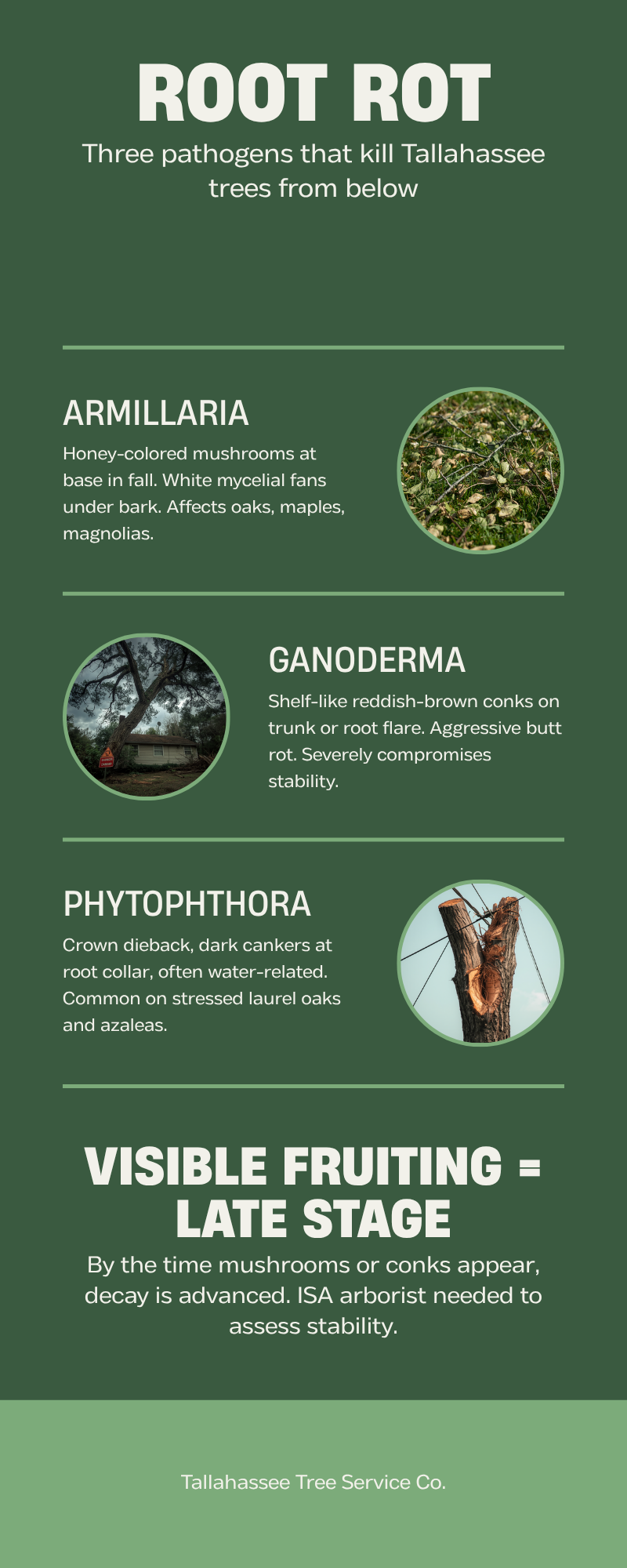
Conks, brackets, or fungal fruiting bodies at the trunk base or on root flares mean active wood decay. In live oak and laurel oak, this is especially concerning.

Cracks in the Trunk

Vertical cracks, especially long ones running up the trunk, can indicate internal failure. Horizontal cracks are urgent — book the inspection immediately.

Dead Branches in the Canopy

One or two dead twigs are normal. Multiple dead branches over 2" in diameter suggest the tree is in decline and large limb failure becomes a real risk.

Bark Falling Off in Sheets

Pine bark sloughing off in large pieces — especially if you see fine sawdust at the base — is a southern pine beetle attack. See southern pine beetle.

Heaving Soil at the Base

Cracked or raised soil on one side of the tree — especially the side opposite the lean — means the root plate is moving. This is the failure pattern.

Recent Construction or Grading

Trees stressed by trenching, regrading, paving over the root zone, or compaction often die slowly over 3–7 years. Inspect early so you can react.

Buyer Wants Tree Documentation

Selling the house and a buyer is asking for a tree report? An inspection covers most pre-purchase contexts; if a formal report is required, we’ll route you to risk assessment.

Tree Inspection Pricing in Tallahassee

Inspection pricing in Tallahassee is straightforward. For most residential properties, the visit is free when paired with same-day follow-up work or quote. Standalone inspections and formal documentation come with set fees.

Service TierTypical RangeWhat You Get
Quote-Visit InspectionFree20–30 min walkthrough, verbal findings, written quote
Standalone Visual Inspection$95 – $175Walkthrough + emailed written summary, no quote required
Pre-Purchase Tree Report$150 – $300Inspection + formatted report for real-estate use
Multi-Tree Property Inspection$200 – $500Acreage or large lot with 8+ trees of concern
Formal TRAQ Risk Assessment$250 – $1,500+Routes to tree risk assessment
Insurance Documentation Letter$75 – $200Add-on to inspection; formatted for carrier requirements

Most homeowners doing routine “is my tree OK” checks pair the visit with follow-up work and pay nothing for the inspection itself. Call (850) 555-0123 to confirm pricing for your specific situation.

Common Reasons to Book a Tree Inspection

Most calls fall into one of these categories. If your situation matches any of them, scheduling makes sense.

Pre-Hurricane Season Check

Late spring or early summer inspection before the June–November hurricane window. Catch issues while there’s still time to act.

Post-Storm “Did We Survive?”

After a hurricane, severe thunderstorm, or ice event — tree may look OK but have hidden damage. Always inspect after Helene-scale events.

Buying or Selling a House

Pre-purchase due diligence on mature trees, or pre-listing documentation showing trees are healthy. Common in Killearn Estates and other canopy areas.

Insurance Carrier Asked

Some carriers request tree health documentation on properties with multiple mature trees, or after a previous claim.

Neighbor Dispute or HOA Notice

Documentation that your tree is healthy — or honestly that it isn’t — resolves most neighbor disputes faster than back-and-forth.

You Just Don’t Trust the Tree

Sometimes you just have a feeling. That counts as a valid reason. An inspection puts an experienced eye on it and gives you a real answer.

Dead Limbs Started Falling

If you’re finding sticks and small limbs in the yard that didn’t come from wind, the tree is shedding deadwood — time to look at the upper canopy.

Recent Construction Nearby

New driveway, addition, fence, or utility trenching can damage tree roots. Decline shows up 1–5 years later. Inspect early to know your status.

One Phone Call. One Walkthrough. Real Answers.

Don’t guess about your trees. Get a tree inspection Tallahassee homeowners count on — ISA-Certified, same-week, written summary included.

What an ISA-Certified Arborist Looks For in a Tallahassee Inspection

Region matters. The tree inspection Tallahassee crews perform is tuned to North Florida species and the failure patterns we actually see here.

  • Live oak heart rot indicators — trunk cavities, sapwood splits, fungal conks at branch crotches. The most common “hidden” issue in old Tallahassee oaks.
  • Laurel oak decay — this species is short-lived (60–80 years) and decays poorly. Inspect every laurel oak over 50 years old. See laurel oak problems.
  • Southern pine beetle entry holes & pitch tubes — small popcorn-like resin masses on the bark mean active beetle attack. Time-critical.
  • Water oak decline — canopy thinning, dieback in upper third, mushrooming at the base. Common in mature Tallahassee neighborhoods.
  • Sweetgum brittleness — sweetgum wood is weak and large limbs fail in summer thunderstorms. Inspect for major scaffold limb attachment quality.
  • Magnolia trunk wounds — magnolia is sensitive to bark damage; even old wounds can become decay entry points decades later.
  • Palm crown rot — collapsed or asymmetric crown, oozing trunk lesions, soft spots. Less common but show-stopping when it happens. See palm trimming.
  • Root plate movement — cracks or heaving soil on the windward or opposite side of leaning trees indicates active failure.
  • Compaction & grade changes — recent construction, paving, or fill within the root zone is the #1 hidden killer of mature urban trees.
  • Mistletoe load — common on water oaks and laurel oaks; heavy mistletoe accelerates host decline and is worth flagging early.

Tree Inspection Tallahassee FAQs

How long does a tree inspection take?

Most residential tree inspection Tallahassee visits run 20 to 45 minutes on site. Larger lots with multiple mature trees can take 60 to 90 minutes. The written summary is delivered within 1–3 business days after the visit.

Is a tree inspection free?

If you’re booking the inspection alongside potential follow-up work (pruning, removal, cabling, etc.), the visit is typically free and rolled into the work quote. Standalone inspections without follow-up work are paid services starting around $95–$175 for residential properties.

What’s the difference between an inspection and a risk assessment?

An inspection is a Level 1 visual walkthrough by an ISA-Certified arborist with a written summary — suitable for most homeowner concerns. A formal tree risk assessment is a TRAQ-credentialed Level 2/3 process with measurements, photos, risk ratings, and defensible documentation — required for litigation, insurance disputes, expert-witness work, and pre-construction permitting.

Do I need to be home for the inspection?

Strongly recommended. The arborist’s observations during the walkthrough often surface questions only the homeowner can answer (recent construction, prior tree work, history of leaning, etc.). If you can’t be there, we can still inspect — but the report will be more general.

Will the arborist climb my tree?

Standard tree inspections are visual from ground level (binoculars used for upper canopy). If a specific concern requires close inspection — like a possible cavity 30 feet up — aerial inspection can be added for an additional fee or scheduled as a separate climbing visit.

How fast can you schedule?

Most inspections are scheduled within the same week. During hurricane season (June–November), demand spikes — book 1–2 weeks ahead if possible. After major storms, scheduling stretches further because crews are also doing storm cleanup. Call (850) 555-0123 to confirm current availability.

Can the inspection report be used for insurance?

The standard inspection summary is suitable for most insurance correspondence and homeowner documentation. If your insurance carrier specifically requests a TRAQ-format risk assessment with quantified risk ratings, you’ll need the formal version — we can route you there or schedule it directly.

What if you find something serious during the inspection?

You hear about it on the spot, before the arborist leaves the property. If a tree is an immediate hazard, we’ll explain why, flag the specific concern, and discuss options — including emergency removal if warranted. See 24-hour emergency tree service for time-critical situations.

Do you inspect trees outside the city limits?

Yes. ISA-Certified arborists dispatch throughout Leon County and into Wakulla, Gadsden, and Jefferson Counties. Rural properties with multiple mature trees may have a slightly higher minimum visit fee due to drive time.

Can you inspect trees on a commercial property or HOA common area?

Yes — we do inspections for HOAs, property managers, retail centers, and apartment complexes throughout Tallahassee. See commercial tree service for B2B engagements. Multi-tree commercial inspections are typically scheduled as single project visits with a single consolidated report.

Tree Inspection by Tallahassee Neighborhood — What We See Where

Different parts of Tallahassee have different tree inventories and different failure patterns. The tree inspection Tallahassee crews perform adapts to what the neighborhood actually has growing.

In the older heavy-canopy neighborhoods — Killearn Estates, Myers Park & Betton Hills, and Northwest Tallahassee — the dominant species are mature live oaks, water oaks, and laurel oaks, many of them 60–100+ years old. Inspections in these neighborhoods focus heavily on heart rot indicators, large old wounds, co-dominant trunk leaders, and root flare burial from decades of mulch and grade changes. We also see a lot of construction-impact decline here because home additions and pool installs disturb root zones that the tree was relying on for stability.

Out in Bradfordville, Killearn Lakes, and the larger-lot suburbs, you see a different tree mix: more pines (especially loblolly and slash), more sweetgum, and more diverse hardwoods. Inspections out there commonly catch southern pine beetle attack — which is time-critical — and structural problems on sweetgum, which has notoriously brittle wood. See southern pine beetle if you’re seeing pitch tubes on pine bark.

In Southwood, Midtown, and other newer or recently-redeveloped areas, the tree inventory is younger. Inspections here often catch staking damage, girdling roots from improper planting depth, and structural problems that can still be corrected with structural pruning. Catching these issues early in the tree’s life is one of the highest-value moves a homeowner can make — you’re shaping the tree’s next 50 years.

Outside the city — Crawfordville, Monticello, Quincy, and the Wakulla County rural areas — properties tend to be larger and tree counts are higher. Multi-tree inspections are the norm. We work the priority targets first (anything within striking distance of the house, driveway, or outbuildings) and step out from there.

When to Schedule a Tree Inspection in Tallahassee

North Florida has clear inspection windows. Knowing them helps you book at the right moment and avoid the rush.

The best inspection window for general health checks is February through April, before the heavy growing season starts. Trees are still mostly leafless or just leafing out, so trunk and structural problems are easier to see. Crowns are starting to push and any failures-to-leaf-out (a key sign of decline) become obvious within a few weeks.

The second window is May through early June — pre-hurricane season. This is when Tallahassee homeowners book inspections to make decisions before the storm window opens. If a tree needs reduction, cabling, or removal before storm season, May is your last comfortable scheduling month before crews start filling up. Call (850) 555-0123 to lock in pre-storm dates.

After hurricanes — September through November — inspections are absolutely worth doing even if your trees look fine. Wind damage to root plates and internal cracking from major storms doesn’t always show on the surface. Helene 2024 dropped a number of trees that “looked fine” the day after the storm. A post-storm tree inspection Tallahassee homeowners book in October is good cheap insurance.

📌 Avoid scheduling inspections during heavy rain weeks — saturated soil and active dripping make some failure signs harder to read. Reschedule for the next dry stretch if possible.

Related Tallahassee Tree Services

An inspection is the starting point. Here are the most common follow-up services.

Get Eyes on That Tree Before Storm Season.

A tree inspection Tallahassee homeowners can schedule the same week takes the guessing out. ISA-Certified arborist on site, plain-language findings, written summary, and a clear path forward whether action is needed or not.

Call Now – Free Estimate