City of Tallahassee Tree Removal — Public vs. Private
Is that tree the city’s problem or yours? The answer decides whether it gets removed at no cost to you, or whether you need a private arborist and a §5-83 permit. Call now and we’ll connect you with a vetted, licensed and insured local arborist who works inside the city’s process.
📞 Call Now — (858) 319-0022Not sure whose tree it is? Call now and describe where it stands — that usually settles it.Tallahassee is a canopy city with a canopy city’s rulebook. Roughly half the questions homeowners here have about a tree are not really about the tree — they are about jurisdiction. Who owns it, who pays, who has to file paperwork, and what happens if you cut first and ask later. This page sorts that out.
The short version: who removes which tree
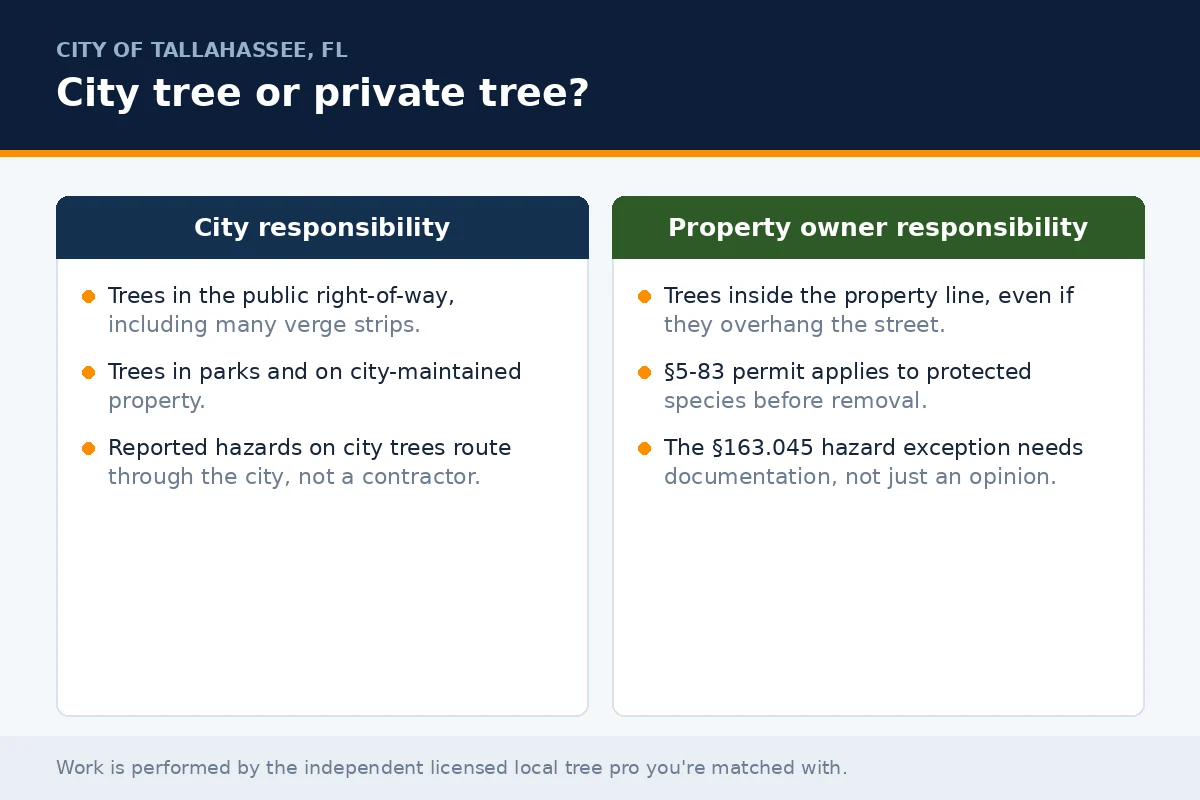
The City of Tallahassee is responsible for trees in three zones: the public right-of-way (the strip of ground between the sidewalk and the street curb on city-maintained roads), city parks, and city-owned property. If a tree in one of those zones is dead, hazardous, or already down, the City’s Urban Forestry section handles it at no cost to the homeowner. That is the genuinely no-charge removal you can count on in this town, and it is worth knowing about.
Everything else is yours. Trees inside the fence line, on the lawn, in the back yard, arching over your driveway — all homeowner responsibility, even when the branches drop into the street. And on top of paying for it, you generally need the City’s permission before you remove a regulated tree, under municipal code §5-83.
How to tell if a tree is city or private
Stand on the sidewalk in front of your house and look at the grass strip between the walk and the curb. That strip is public right-of-way, and the trees in it belong to the City. Everything on the house side of the sidewalk is yours. If your street has no sidewalk, the right-of-way typically reaches somewhere in the range of five to seven feet in from the back of the curb — which means a tree that feels like it is in your front yard may not legally be. Your property survey, or the Leon County GIS parcel maps, will give you the actual line rather than a guess.
When you need a §5-83 permit
The City requires a removal permit for any regulated tree. Broadly, that means a healthy hardwood at 8 inches DBH (diameter at breast height) or larger, plus certain species at their own thresholds — live oak and southern magnolia from around 8 inches, bald cypress similarly, longleaf pine at a larger diameter. The authoritative species-and-size list lives with the City’s Growth Management Department, and it is the list that governs, not this page.
Layered on top of that: if your street is one of the designated Canopy Road Protection Zones, an additional layer of protection applies within the zone, and the bar for touching anything is higher. Outside the city limits, Leon County’s Chapter 10 environmental management rules govern instead, and they are not identical. The arborist you are matched with should be able to tell you which regime you are actually under before quoting.
When a permit is not required
- Dead trees, once confirmed dead by an ISA-certified arborist.
- Invasive species — Chinese tallow, mimosa, camphor, Bradford pear. The City is not defending these; it would rather they came out. See Chinese tallow, mimosa, camphor and Bradford pear removal.
- Trees under the size threshold for their species.
- Documented hazard trees, under the statutory exception below.
The Florida Statute §163.045 hazard exception
This is the provision worth understanding. Under FS §163.045, a homeowner on residential property may remove a tree that has been documented as a hazard — without going through the local permit process first — provided the hazard is supported by written documentation from an ISA-certified arborist or a Florida-licensed landscape architect. The documentation is the whole ballgame. Photographs, a written determination, and the credential behind it. Cut first without the paperwork and you are simply an unpermitted removal with a good story.
Storm damage follows similar logic: an emergency removal after a tree comes down on a structure does not wait for a permit, but the condition needs to be documented promptly, with timestamped photographs taken before anything is cut. That is also exactly what your insurance carrier will want. See emergency tree service and the insurance coverage guide.
What happens if you skip the permit
Removing a regulated tree without authorization can draw a fine that scales with the size and species of what came down, plus mitigation — commonly replacement planting assessed on a caliper-inch basis, or a payment in lieu. The City does enforce, and in a neighborhood full of people who moved here for the canopy, neighbors do call. It is a bad trade. The permit is the cheap part.
Not sure whether your tree is regulated, hazardous, or somebody else’s problem entirely? That is a question worth answering before a saw comes out, not after.
📞 Call Now — (858) 319-0022Vetted local pros — availability depends on independent provider schedules and demand.*The scenarios that actually come up
| Situation | Who owns it | What to do |
|---|---|---|
| A right-of-way tree fell on my house | City owns the tree; you own the damage | Both tracks run in parallel. The City handles the tree; your carrier handles the structure. Photograph everything before anything is moved. |
| My tree is leaning over the public sidewalk | Yours — entirely | The City does not remove private hazard trees, even when they threaten public infrastructure. Get it assessed; if it is hazardous, the FS §163.045 route applies. |
| My neighbor’s branches overhang my yard | Their tree, your airspace | Florida generally lets you trim back to the property line — but only what is on your side, you cannot enter their property, and you cannot cut so much that you compromise the tree’s health or structure. Do it properly or you own the consequences. |
| Storm just hit and a tree is on my roof | Yours | Emergency removal proceeds without a prior permit. Documentation happens as the work happens. |
| I’m buying a house with a huge live oak | Will be yours | Ask before closing. A healthy regulated live oak is exactly the tree the City is most likely to decline to let you remove. Do not assume. |
| I want to clear a tree to build a deck or pool | Yours | Construction-related removal needs a permit and usually triggers mitigation. Coordinate it with your site plan early, not after the contractor is booked. |
How getting matched works
Permit fees and timelines
Permit fees are set by the City, not by any contractor, and they scale with the scope — a single regulated tree on a residential lot sits at the modest end; a commercial site with multiple regulated trees is a different matter. Mitigation, where it applies, is generally assessed per caliper inch removed. Review typically takes on the order of a couple of weeks rather than days, so build it into your timeline if you are working around a construction schedule.
Because fee schedules and species lists get revised, treat the City’s Growth Management Department as the authority on current numbers rather than any page on the internet — including this one. A good arborist will pull the current schedule as part of scoping your job.
Frequently asked questions
Does the City of Tallahassee remove trees at no charge?
Only trees in the public right-of-way, in city parks, or on city-owned property. Those are handled by Urban Forestry at no cost to residents. A tree on your private property is your responsibility regardless of what it is threatening.
What counts as a regulated tree under §5-83?
Broadly, a healthy hardwood at 8 inches DBH or larger, plus certain species — live oak, southern magnolia, bald cypress and others — at their own thresholds. Invasive species such as Chinese tallow, mimosa, camphor and Bradford pear are not protected. The City’s Growth Management Department maintains the governing list.
Can a hazard tree be removed without a permit?
Yes, under Florida Statute §163.045, provided the hazard is documented in writing by an ISA-certified arborist or a Florida-licensed landscape architect. The documentation is not optional — without it, you have an unpermitted removal.
What happens if I remove a regulated tree without a permit?
Fines that scale with size and species, plus mitigation — typically replacement planting on a caliper-inch basis or a payment in lieu. The City enforces, and neighbors report. The permit costs far less than the penalty.
Can I cut my neighbor’s branches that hang over my yard?
Generally you may trim back to the property line, but only the portion on your side, you cannot enter their property to do it, and you cannot cut so aggressively that you damage the tree’s health or structure. Doing it badly can make you liable for the tree.
Does the City grind the stump too?
For right-of-way trees, stump work generally follows the removal as part of the City’s process. For a private tree, the stump is yours — see stump grinding.
Related Tallahassee tree services
Tallahassee Tree Permit Guide
Tree Removal
Hazardous Tree Removal
Dead Tree Removal
Emergency Tree Service
Tree Risk Assessment
ISA-Certified Arborist
Stump Grinding
Find out whose tree it is — before you cut
Call now and we’ll connect you with a vetted, ISA-certified Tallahassee-area arborist who works inside the City’s process. Free to use, no obligation, no sign-up.
📞 Call Now — (858) 319-0022This page is informational. The City of Tallahassee Growth Management Department is the authoritative source for §5-83 ordinance interpretation, current species lists, fees and permit decisions; Leon County governs outside the city limits. Florida Statute §163.045 governs hazard-tree removal documentation.
Tallahassee Tree Service is a free referral service. Tallahassee Tree Service is not a licensed tree service provider and does not directly provide tree care services. All work is performed by independent, licensed and insured third-party providers in your area. Calls and form submissions placed through this site may be connected with a participating provider, and you may be contacted by that provider regarding your request. Same-day, emergency, and 24/7 availability are not guaranteed and depend on provider schedules, location, and demand. Service availability, pricing, licensing, and final response times are determined solely by the providers. It is the responsibility of the homeowner to verify that the hired contractor furnishes the necessary license and insurance required for the work being performed. All persons depicted in a photo or video are actors or models and not contractors listed on Tallahassee Tree Service.