Crepe Myrtle Trimming in Tallahassee, FL
Every February, someone drives down Thomasville Road with a hedge trimmer and turns a beautiful multi-stemmed tree into a row of knuckled fence posts. Call now and we’ll connect you with a vetted, licensed and insured local pro who prunes crepe myrtles the way they are supposed to be pruned.
📞 Call Now — (858) 319-0022Already been topped? It can often be rebuilt. Call now and we’ll connect you any hour.The crepe myrtle (Lagerstroemia indica) is the signature summer flower of North Florida — a hundred days of bloom, cinnamon-colored exfoliating bark, and a graceful multi-stemmed vase shape when it is left to be itself. It is also the most abused plant in Tallahassee. Zone 8b suits it perfectly, our long hot summers push the bloom, and yet every winter thousands of them get chopped to stumps for no reason anyone can actually defend.
The practice has a name that arborists use without irony: crape murder. This page is about how it happens, why it damages the tree, and what proper crepe myrtle pruning looks like instead.
What crape murder actually does to the tree
Topping a crepe myrtle — cutting every stem back to the same height, year after year, until knobby knuckles form at the cut points — is not a style choice. It is damage, and it compounds:
- It forces weak regrowth. The tree responds to topping with a panic flush of thin, fast, water-sprout shoots from just below each cut. Those shoots are attached to the outer wood only. They are structurally weak by definition.
- The blooms get worse, not better. The famous “topping makes more flowers” belief is half-true and entirely counterproductive — you get big heavy flower clusters on whippy stems that flop to the ground in the first summer thunderstorm. A properly pruned crepe myrtle blooms across a wide, held-up canopy.
- It creates decay entry points. Every knuckle is a cluster of wounds the tree never fully sealed. Decay works into them.
- It destroys the bark. The smooth, mottled, cinnamon trunk is one of the best features of the species — and it only develops on mature stems that are allowed to stay.
- It is permanent. The knuckles do not go away. They can be pruned around and gradually disguised, but the tree carries the record.
Why it happens here
Two reasons, both fixable. First, the wrong cultivar in the wrong spot. A lot of Tallahassee crepe myrtles were planted under eaves, under power lines, or against a wall by someone who assumed they stay small. Many cultivars want to be 20 to 30 feet tall. So each winter the homeowner or the mow-and-blow crew hacks it back to fit. The tree is not the problem; the planting was.
Second, copying the neighbors. Crape murder spreads down a street because everyone assumes the person who did it first knew something. They did not.
What proper crepe myrtle pruning looks like
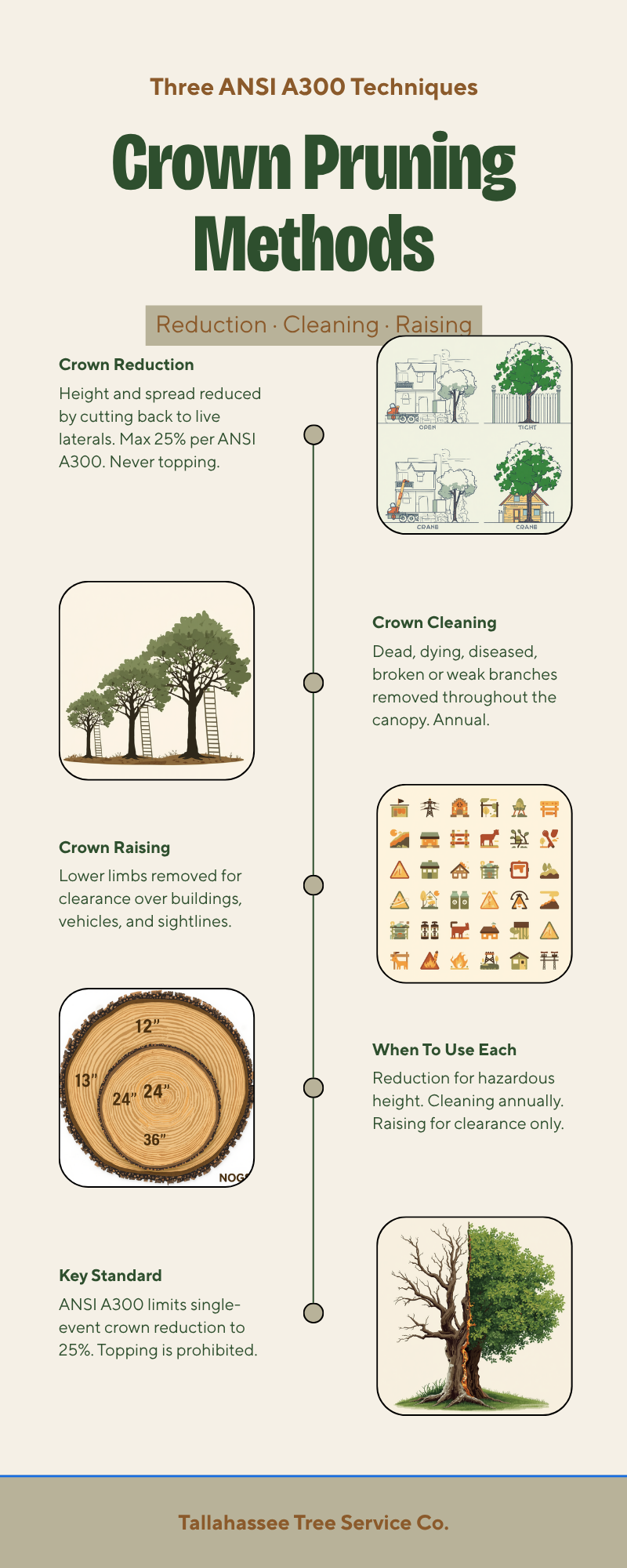
Correct pruning is subtractive and light. In a single winter session an arborist working to ANSI A300 will typically:
- Remove suckers at the base — the shoots coming up from the roots that muddy the trunk line.
- Remove crossing and rubbing branches in the interior.
- Remove dead, damaged, and spindly interior growth to open the canopy for airflow — which, in our humidity, is real disease prevention.
- Select and keep 3 to 7 main trunks, removing the rest at ground level, to establish the vase form.
- Raise the canopy gradually by removing the lowest side branches, revealing the bark and letting you walk under it.
- Remove old seed heads if you want (optional — it is cosmetic).
- Take nothing thicker than about a pencil from the upper canopy. If the saw is coming out for the top, something has already gone wrong.
Note what is not on that list: shortening every stem to a uniform height. If your crepe myrtle is genuinely too tall for its spot, the honest options are to accept it, to relocate it while it is still small, or to replace it with a dwarf cultivar — not to amputate it annually.
When to prune in Tallahassee
| Window | What to do |
|---|---|
| Late winter (roughly February, before bud break) | The main structural pruning window. The tree is dormant and leafless, so the structure is visible and cuts are least stressful. |
| Spring after bud break | Remove basal suckers as they appear. Light work only. |
| Summer | Deadheading spent blooms can encourage a second flush. Do not do structural work in heat. |
| Fall | Leave it alone. Pruning now pushes tender growth into the first cold snap. |
Crepe myrtles bloom on new wood, which is why late-winter pruning does not cost you flowers — and why the “I have to top it to get blooms” argument falls apart. It was going to bloom anyway.
Somebody about to top your crepe myrtles? Get a second opinion first — call now and we’ll connect you with a pro who prunes to standard.
📞 Call Now — (858) 319-0022Vetted local pros — availability depends on independent provider schedules and demand.*Can a topped crepe myrtle be rescued?
Usually, yes — with patience. Restorative pruning over about three years:
Year one. Let the water sprouts grow all season. Do not touch them. You need to see which ones are strongest and best-placed.
Year two, late winter. From each knuckle, select the one or two best-positioned, strongest shoots and remove the rest cleanly. You are rebuilding a branch structure out of the regrowth.
Year three onward. Continue thinning to the selected leaders and let them thicken. The knuckle stays — but the canopy above it becomes a real canopy again rather than a broom.
It takes discipline, mostly because it looks worse before it looks better. But a rescued crepe myrtle in year four is a genuinely handsome tree, and it costs a fraction of replacing a mature specimen.
Pests, disease, and the humidity problem
Tallahassee’s summers are a greenhouse, and crepe myrtles have three common complaints here:
- Powdery mildew — white film on new leaves and buds. Airflow is the fix; a crowded, unpruned interior is the cause. Modern cultivars are far more resistant than the old ones.
- Crape myrtle bark scale — white, felt-like specks on stems and a sticky honeydew that turns into sooty black mold. It has been moving through the Southeast. It is treatable, and it is one of the few genuine reasons to get a pro involved beyond pruning.
- Aphids and sooty mold — the classic sticky-leaves-and-black-film combination. Same story: the mold is a symptom, not the disease.
If your tree has sticky leaves, black film, or white felt on the bark, that is a tree disease treatment conversation, not a pruning one.
How getting matched works
What drives the scope
| Factor | Why it matters |
|---|---|
| Number of trees | A row of eight along a driveway is a very different visit from one specimen. |
| Size & height | A 25-foot mature specimen needs a ladder or lift; a 10-foot one is pole-and-hand work. |
| Condition | A neglected interior full of crossing wood is more selective cutting than an annually maintained tree. |
| Restoration vs. maintenance | Rebuilding a topped tree is a multi-year plan, not a one-time cut. |
| Debris | Fine crepe myrtle brush is bulky. Chipping or hauling is a line item. |
Those are local-market factors, not our prices — the pro you’re matched with gives the binding written quote. See the trimming cost guide for the full picture.
Before you call — how to describe it
- How many and roughly how tall.
- Have they been topped? If you see knuckles or knobs at the ends of the stems, say so — that changes the plan to restoration.
- What is bothering you — blocking a window, floppy blooms, sticky leaves and black film, or just overgrown.
- Where they are — under a roofline, near a power drop, along a driveway.
Frequently asked questions
Why is topping a crepe myrtle bad?
It forces weak, whippy regrowth from below each cut, creates permanent knuckles that decay works into, ruins the mottled bark that takes years to develop, and produces heavy flower clusters on stems too weak to hold them up. It also does not increase bloom in any way that helps — crepe myrtles bloom on new wood regardless.
When should I prune a crepe myrtle in Tallahassee?
Late winter, before bud break — roughly February here. The tree is dormant and leafless, so its structure is visible. Remove suckers, crossing branches, and dead interior wood. Avoid fall pruning, which pushes tender growth right into the first cold snap.
My crepe myrtle was already topped. Can it be fixed?
Usually, over about three years. Let the regrowth run for a full season, then each late winter select the strongest one or two shoots per knuckle and remove the rest, gradually rebuilding a real branch structure. The knuckle stays, but the canopy above it becomes a canopy again.
What are the white specks and black film on my crepe myrtle?
Likely crape myrtle bark scale (white, felt-like specks on the stems) and the sooty mold that grows on the honeydew it produces. It is treatable and it is worth involving a pro — it has been spreading across the Southeast.
My crepe myrtle is too tall for where it is. What now?
Honestly, the tree is fine — the planting was wrong. The real options are accepting the size, relocating it while it is still young, or replacing it with a dwarf cultivar sized to the spot. Annual topping is not a solution; it is a recurring injury.
How much does crepe myrtle trimming cost in Tallahassee?
It is scoped to the trees — how many, how tall, their condition, and whether it is maintenance or restoration all move it, so there is no honest flat figure. The pro you’re matched with looks at them and gives a written quote first.
Related Tallahassee tree services
Tree Trimming
Tree Pruning
Why Topping Is Not Pruning
Palm Tree Trimming
Tree Disease Treatment
Tree Health Assessment
Deep Root Fertilization
Tree Trimming Cost
Prune it right this winter
Call now and we’ll connect you with a vetted, licensed and insured Tallahassee-area pro. Free to use, no obligation, no sign-up.
📞 Call Now — (858) 319-0022Tallahassee Tree Service is a free referral service. Tallahassee Tree Service is not a licensed tree service provider and does not directly provide tree care services. All work is performed by independent, licensed and insured third-party providers in your area. Calls and form submissions placed through this site may be connected with a participating provider, and you may be contacted by that provider regarding your request. Same-day, emergency, and 24/7 availability are not guaranteed and depend on provider schedules, location, and demand. Service availability, pricing, licensing, and final response times are determined solely by the providers. It is the responsibility of the homeowner to verify that the hired contractor furnishes the necessary license and insurance required for the work being performed. All persons depicted in a photo or video are actors or models and not contractors listed on Tallahassee Tree Service.