Camphor Tree Removal in Tallahassee, FL
Crush a leaf and it smells like a medicine cabinet. That is the tree that has quietly become one of the biggest invasive hardwoods in Leon County — multi-trunked, shallow-rooted, berry-dropping, and increasingly the thing that comes apart in a storm. Call now and we’ll connect you with a vetted, licensed and insured local arborist.
📞 Call Now — (858) 319-0022Single-trunk or a six-trunk giant? Call now and describe it — the scope changes a lot.Camphor (Cinnamomum camphora) is the invasive that hides in plain sight, because it does not look like a weed. It looks like a big, glossy, handsome evergreen shade tree, and mature specimens genuinely are enormous — sixty to eighty feet tall with a spread to match. Nobody looks at one and thinks “problem.” They think “that’s a nice tree.”
Then they discover the roots under the driveway, the carpet of black berries every year, the seedlings coming up in every bed on the property, and eventually the day a sixty-foot leader splits off at a narrow union and lands on something. Camphor has naturalized across the southeastern coastal plain, and in Tallahassee it is one of the species the City would rather see gone.
Why camphor is worth removing
1. It spreads, and birds do the work
Camphor fruits heavily. The glossy black berries are eaten by birds, which then deposit viable seed across every fence line, ditch and woodlot within their range. That is why you find camphor seedlings coming up in beds a quarter-mile from the nearest mature tree. It does not need you to plant it and it does not need to be adjacent to spread. In the disturbed edges around Tallahassee neighborhoods, camphor colonizes fast and holds ground.
2. The root system is aggressive and shallow
Camphor roots run wide and near the surface. In a residential lot that means lifted pavers, cracked driveway slabs, disturbed foundation plantings, and a persistent ring of root sprouts pushing up through turf within thirty to fifty feet of the trunk. On red Orangeburg clay north of the Cody Scarp, where drainage is slow, those surface roots spread even more readily.
3. The multi-trunk form is a structural problem
This is the defining camphor issue and it deserves its own section — see below.
4. It fails in storms
Camphor wood is not especially strong for its mass, and the tree carries an enormous dense evergreen crown that never sheds its sail area for winter. Combine that with narrow, included-bark trunk unions and shallow roots, and you get a species that shows up in the post-storm damage counts every time. Helene in 2024, Idalia in 2023 and Michael in 2018 each took down significant numbers of camphors across Tallahassee. When they go, they go big.
5. The berry and leaf drop never stops
Evergreen does not mean tidy. Camphor drops leaves year-round rather than in one clean autumn pass, and the annual berry crop stains driveways, clogs gutters and germinates in everything. If it overhangs a pool or a patio, it is a permanent chore.
6. Little value to local wildlife
Birds eat the berries — which is precisely the problem, since that is the dispersal mechanism — but the tree supports very little of the native insect life that actually feeds local bird populations. A camphor occupies a large canopy footprint and gives back a fraction of what a native hardwood of the same size would.
7. Florida restricts it
Camphor is recognized as an invasive exotic in Florida and is not a species the state wants propagated. That is also why removing it does not require a City permit.
8. Allelopathy and toxicity
Camphor produces aromatic compounds that suppress the growth of some plants beneath and around it, which is part of why the ground under a mature camphor is often notably bare. The foliage and berries also contain compounds that are toxic in quantity to pets and livestock.
The multi-trunk camphor problem
How they become multi-trunk giants
Almost every huge multi-stemmed camphor in Tallahassee has the same biography. Someone topped it decades ago. Camphor responds to topping the way most vigorous broadleaf trees do — not with one replacement leader, but with a crown of new shoots erupting from around the cut. A camphor topped at twenty feet in the 1980s may have thrown five to eight new leaders, and those leaders have now spent forty years growing into sixty-foot trunks in their own right.
The problem is where they attach. Those trunks are not anchored into the tree the way an original leader would be — they are attached to the old stub at narrow angles, with bark trapped inside the unions rather than wood knitting them together. Included-bark unions do not get stronger with time. They get bigger, which means they get heavier, while the union itself stays a weak seam.
The end state is a tree carrying an enormous mass of evergreen canopy — thousands of board feet of wood and foliage — balanced on a single shallow root system, distributed across several trunks joined at seams that were never designed to hold it. That tree is not stable. It is merely undefeated so far.
Why the removal is technically harder
You cannot fell a six-trunk camphor. Each leader has to come down as its own controlled removal, in sections, with the rigging planned around the fact that the unions holding them may fail unpredictably under load. Climbers working a multi-trunk camphor are working above unions they cannot fully trust. That is slow, deliberate work, and it is why a multi-trunk camphor is a substantially bigger job than its diameter alone would suggest — and why a crane, where one can reach, is often the safer option.
And the herbicide step still applies
Even after every trunk is down, the root system is alive and camphor suckers readily. The stump treatment is not optional on this species.
How to identify a camphor
| Feature | What to look for |
|---|---|
| The smell | Crush a leaf or scratch a twig — a strong, unmistakable medicinal camphor odor. This is the single definitive test and it takes two seconds. |
| Leaves | Oval to elliptical, roughly two to five inches long, glossy bright green above and paler beneath, evergreen. New growth often flushes reddish or bronze. |
| Flowers | Small, inconspicuous yellow-green clusters in spring — easy to miss entirely. |
| Fruit | Glossy black berries, roughly pea-sized, produced in quantity. This is what the birds move. |
| Form | A dense, rounded, heavy crown — on a mature tree sixty to eighty feet across — frequently on multiple trunks. |
| Habit | Root sprouts around the base and seedlings scattered across the property. Camphor rarely stays a single tree. |
Multiple sixty-foot trunks meeting at a narrow union? That is stored energy over whatever is underneath it — worth an assessment before the next tropical system, not after.
📞 Call Now — (858) 319-0022Vetted local pros — availability depends on independent provider schedules and demand.*Removal methods — what works on camphor
| Method | How it works | Verdict |
|---|---|---|
| Cut + immediate stump treatment | The tree comes down and concentrated systemic herbicide is applied to the fresh cut surface within minutes, while the stump is still drawing, so it moves down into the root system. | The method that works. The window is minutes — a stump that has begun to seal will not take it up. |
| Basal bark treatment | For smaller stems, roughly under six inches DBH, herbicide in an oil carrier applied to the bottom 12–18 inches of bark on the standing tree. | Effective on saplings and volunteers. Good for clearing seedlings without felling each one. |
| Foliar spray | Applied directly to the leaves of small trees and resprouts. | Works on small material only. Not appropriate near plants you want to keep. |
| Mechanical excavation | Physically digging out the stump and major roots with equipment. | Thorough where access allows it, and it deals with the surface-root problem at the same time. Expensive, disruptive, and impossible in a tight back yard. |
| Cut only, no herbicide | Fell it and walk away. | Counterproductive. Camphor suckers hard from a live root system. You trade one tree for a ring of stems. |
| Stump grinding alone | Grind the stump, no chemical step. | Insufficient. Grinding takes the stump, not the roots — and camphor sprouts from roots well outside the grind radius. |
How getting matched works
What drives the scope of a camphor job
Camphor is scoped to the tree — these are typical local-market drivers, not our prices. The pro you are matched with gives the binding written quote.
| Factor | Why it moves the number |
|---|---|
| Trunk count | The single biggest driver. Each leader is effectively a separate removal, and multi-trunk camphors are the norm rather than the exception. |
| Union condition | Included-bark unions that cannot be trusted under load force slower, more conservative rigging. |
| Sheer mass | A mature camphor carries a dense evergreen crown across sixty to eighty feet. That is a great deal of material to lower and haul. |
| Crane access | Where a crane can reach, the work is faster and safer. Many Tallahassee back yards cannot take one, which pushes everything onto ropes. |
| Surface roots | If the roots have lifted a driveway or patio, excavation rather than grinding may be on the table — a different job entirely. |
| Sucker and seedling load | Treating the volunteers is part of doing it once rather than twice. |
The mistakes people make
- Topping it. This is the original sin, and it is how the multi-trunk monsters got made. Never top a camphor — you are manufacturing the failure your grandchildren will pay for. See why topping destroys trees.
- Cutting without treating the stump. Camphor answers a bare cut with a thicket of sprouts.
- Treating the stump the next day. The uptake window is minutes.
- Grinding and calling it done. The roots are the tree.
- Ignoring the unions. A narrow, included-bark union between two sixty-foot leaders is not a feature of a healthy tree. It is a crack you have not seen yet.
- Leaving the berries. Fruit left on site is a seed bank.
Camphor across Tallahassee
Camphor turns up wherever mid-century landscaping met a mild climate and time. It is common as a large legacy shade tree throughout Betton Hills, Myers Park, Lafayette Park and Indianhead Acres — the same neighborhoods carrying the aging laurel oaks, and often the same properties. Many of those camphors were topped at some point in the past fifty years, which is exactly why so many are now multi-trunked.
It has naturalized aggressively along creek corridors, drainage easements and the wooded edges of Killearn and Bradfordville, where bird-dropped seed germinates in the leaf litter. Out toward Woodville, Crawfordville and the Wakulla County line, camphor takes to disturbed sandy ground readily. And in Gadsden County around Quincy and Havana, it has established in old field edges and fencerows.
Frequently asked questions
How do I know it is a camphor and not something else?
Crush a leaf. If it smells strongly medicinal — unmistakably like camphor — that is your tree. Glossy evergreen leaves, small black berries, and a dense rounded crown, often on multiple trunks, confirm it.
Do I need a permit to remove a camphor in Tallahassee?
No. Camphor is an invasive exotic and is not protected under the City’s §5-83 provisions — no application, no fee, no mitigation planting. Outside the city limits Leon County rules apply, and the arborist you are matched with will confirm for your address. See our City tree removal page.
Why is my camphor so much more expensive to remove than an oak the same size?
Trunk count and union condition. A single-stemmed oak comes down as one planned removal; a five-trunk camphor is five removals stacked on one root plate, performed above unions the climber cannot fully trust. That is slow, careful work.
Can I keep it if I have it cabled instead?
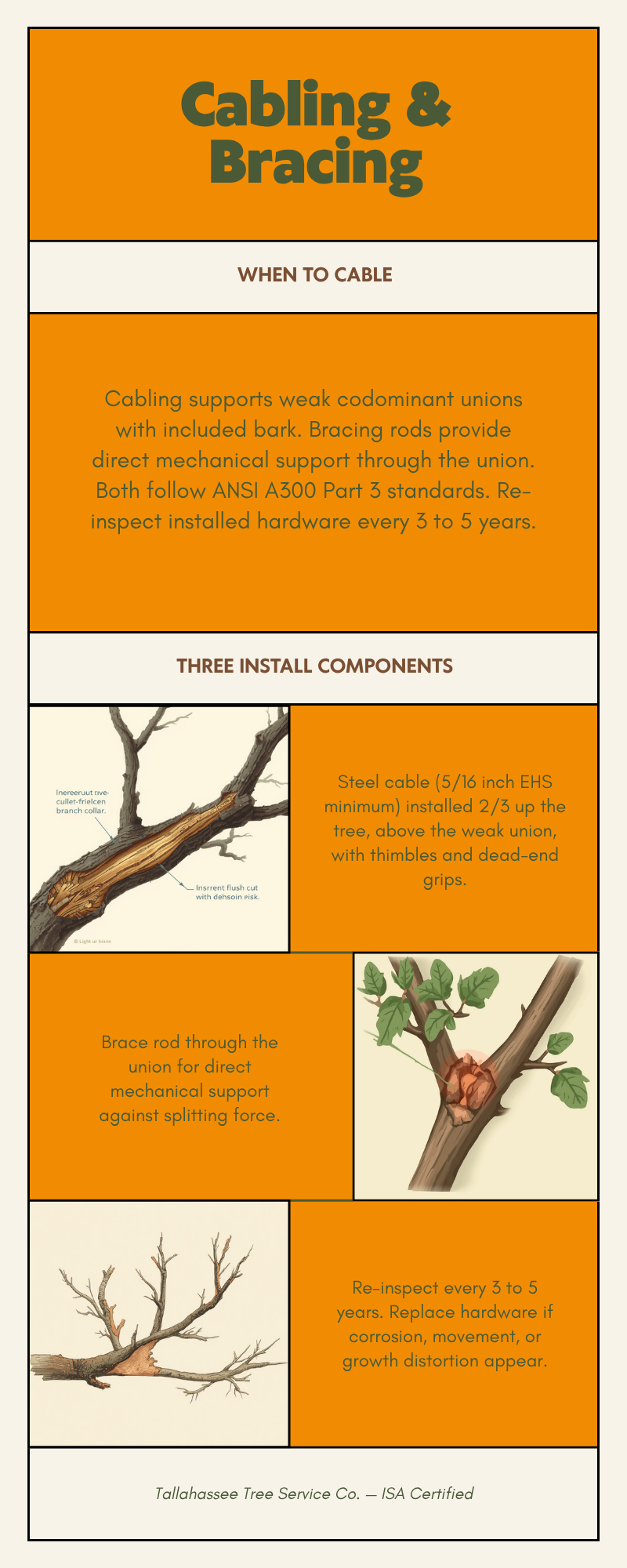
Cabling and bracing can support a valuable native tree with one weak union. It is a much harder case on a large invasive with several bad unions, an aggressive root system, and a berry crop seeding the neighborhood — you would be paying to preserve a liability. Worth discussing honestly with the arborist. See cabling and bracing.
Will the roots stop lifting my driveway once it is cut?
The roots stop growing once the tree is properly killed at the stump, but the existing displacement does not undo itself. If pavement has already lifted, excavation of the major roots is a separate conversation from the tree removal.
What does camphor removal cost in Tallahassee?
It is scoped to the tree — trunk count, union condition, total mass, crane access, root damage and sucker load all move the number, so there is no honest flat figure. The pro you are matched with inspects it and gives a binding written quote. See our removal cost guide.
Related Tallahassee tree services
Tree Removal
Crane Tree Removal
Chinese Tallow Removal
Mimosa Tree Removal
Bradford Pear Removal
Stump Grinding
Cabling & Bracing
Tree Permit Guide
Get the camphor out — permanently
Call now and we’ll connect you with a vetted, licensed and insured Tallahassee-area arborist who can handle a multi-trunk removal. Free to use, no obligation, no sign-up.
📞 Call Now — (858) 319-0022Tallahassee Tree Service is a free referral service. Tallahassee Tree Service is not a licensed tree service provider and does not directly provide tree care services. All work is performed by independent, licensed and insured third-party providers in your area. Calls and form submissions placed through this site may be connected with a participating provider, and you may be contacted by that provider regarding your request. Same-day, emergency, and 24/7 availability are not guaranteed and depend on provider schedules, location, and demand. Service availability, pricing, licensing, and final response times are determined solely by the providers. It is the responsibility of the homeowner to verify that the hired contractor furnishes the necessary license and insurance required for the work being performed. All persons depicted in a photo or video are actors or models and not contractors listed on Tallahassee Tree Service.