Sweetgum Tree Service in Tallahassee, FL
The gumballs that turn the lawn into a minefield. The surface roots lifting the driveway. The limb that came down in a summer thunderstorm without any warning at all. Sweetgums are their own particular problem — call now and we’ll connect you with a vetted, licensed and insured local arborist who will tell you straight whether yours is worth keeping.
📞 Call Now — (858) 319-0022Not sure if it’s even a sweetgum? Call now, send a photo, and we’ll route it any hour.Nobody plants a sweetgum on purpose in Tallahassee. They arrive on their own — a seed lands in a disturbed corner of the yard, the fencerow, the edge of an old field — and eight years later there is a forty-foot tree with star-shaped leaves and a serious opinion about your sidewalk. Liquidambar styraciflua is a native North Florida hardwood, and in the right place, out in the woods, it is a fine tree with genuinely gorgeous fall color, which is not nothing in a state that mostly does not do fall.
In a residential yard in Leon County it is a different story. Sweetgum is fast, brittle, aggressively surface-rooted, and it produces those infamous spiky seed balls by the thousand. It is one of the most common “get this thing out of here” calls we route, and also one of the most common trees people regret removing once the shade is gone. Here is the honest breakdown.
Is it actually a sweetgum?
Easy to confirm, and worth confirming before you plan anything:
- Leaves. Five-pointed star, like a maple leaf that went to art school. Alternate on the twig, not opposite — that is the fast way to separate it from a red maple.
- The gumballs. Hard, spiky, round seed capsules about an inch across. Nothing else in a Tallahassee yard drops those.
- Corky wings. Older twigs and small branches often grow strange corky ridges along the sides. Distinctive once you have seen it.
- Bark. Grey-brown, deeply furrowed in a fairly regular pattern on a mature trunk.
- Fall color. Red, purple, yellow, and orange, sometimes all on one tree, usually late November into December here.
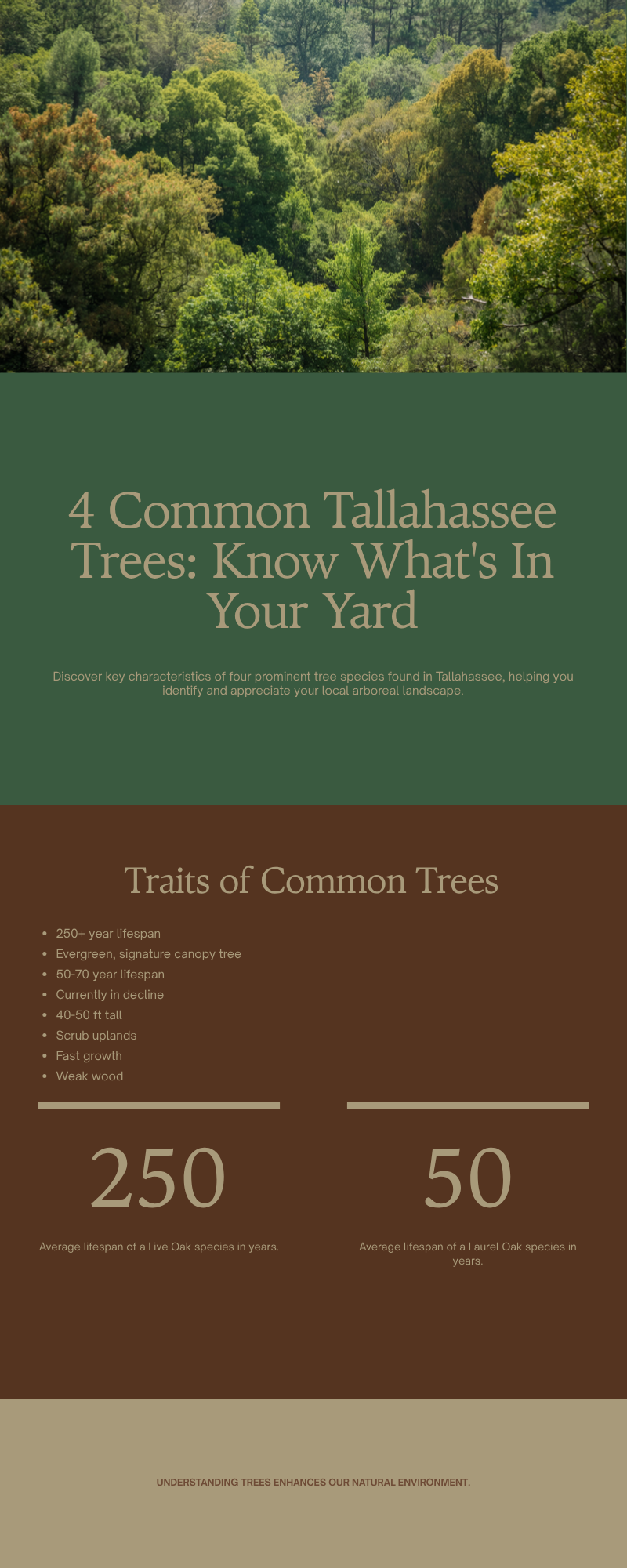
The four sweetgum problems
1. The gumballs
A mature sweetgum can drop thousands of seed capsules across the fall and winter. They are hard, they are spiky, they roll underfoot like ball bearings, they jam mowers, and they hurt to step on barefoot. If the tree is over a lawn, a play area, a pool deck, or a driveway where people walk in flip-flops, this is not a small annoyance — it is the reason most people call.
There is a chemical option: growth regulators applied as a foliar spray at flowering can suppress fruit set. The catch is that the timing window is narrow, the application has to be made by someone licensed to apply it, the results are inconsistent, and it has to be repeated every single year. On a big tree the annual cost adds up fast. It is worth asking about, but go in with realistic expectations rather than a fantasy of a gumball-free yard.
2. The roots
Sweetgum roots run shallow and wide, and they are strong. In our red Orangeburg clay north of the Cody Scarp — Midtown, Betton Hills, Killearn, Ox Bottom — those roots stay near the surface because the clay below is dense, and they will find your sidewalk, your driveway apron, your patio slab, and the shallow joints in your sewer lateral. Root pruning to save a slab is a delicate operation on any tree; on a sweetgum, cut too much and you have destabilized a tree that was already a poor storm performer.
The other root behavior that drives people mad: sweetgum suckers. Damage the roots — mow over them, trench through them, cut one — and the tree responds by throwing up shoots across the lawn. Cutting the main tree down without grinding the stump can produce a whole crop of them.
3. The wood is brittle
This is the safety issue and it is the one people underrate. Sweetgum grows fast, and fast-grown wood is weak wood. Limbs snap in summer thunderstorms with no warning and no visible defect beforehand. The tree does not usually uproot the way a saturated water oak does — it simply sheds pieces of itself. If a sweetgum has grown up over a roof, a driveway where cars park, or anywhere people sit, that shedding habit is a genuine hazard and it does not take a hurricane to trigger it.
4. It grows where you did not want a tree
Volunteer sweetgums come up in fencerows, along foundations, in the middle of hedges, and three feet from the house. A sweetgum seedling is trivial to pull. A ten-year-old sweetgum against your foundation is a removal with an access problem. Walk the perimeter of the house once a year and pull the volunteers — that one habit prevents most of these calls.
Sweetgum limb hanging over the roof after a storm? Brittle wood does not wait for a good moment. Life-safety calls are triaged first — say so when you submit.
📞 Call Now — (858) 319-0022Vetted local pros — availability depends on independent provider schedules and demand.*Keep it or remove it? An honest decision table
| Situation | The realistic call |
|---|---|
| Healthy sweetgum at the back of a large lot, away from structures | Keep it. It is native, it feeds wildlife, the fall color is the best in the yard, and the gumballs land where nobody walks. |
| Mature sweetgum leaning over the roof or the driveway | Get it assessed. Brittle limbs plus a target underneath is the classic sweetgum failure. Reduction pruning may help; removal is often the honest answer. |
| Roots lifting a slab, walk, or driveway | Assessment first. Root pruning is possible but it trades a trip hazard for a stability risk on a species that is already a mediocre storm performer. |
| Gumballs are the only complaint and the tree is otherwise sound and well-placed | Do not remove a healthy shade tree over seed pods. Ask about growth-regulator treatment, or a mulched bed under the canopy so they land somewhere that does not matter. |
| Volunteer sapling near the foundation | Pull it now. This is a five-minute job today and a real removal in eight years. |
| Storm-damaged with a torn limb or split leader | Get eyes on it. Sweetgum compartmentalizes decay poorly — a big open wound often means the tree is on a clock. |
If you keep it: what good sweetgum care looks like
Pruning is the main lever, and the goal is not to make the tree pretty — it is to reduce what can fall. That means removing deadwood, shortening over-extended limbs back to viable laterals to cut end weight, and clearing the roof line and any structures beneath the canopy. Do it in the dormant season, roughly late fall through winter, when the tree is not actively pushing growth.
What it does not mean is topping. Cutting a sweetgum back to stubs produces a flush of weak, fast, poorly-attached regrowth on a species whose wood is already brittle — you are manufacturing a more dangerous tree, on a timer. Any ISA-certified arborist will refuse. See why topping is not pruning and the tree pruning page.
Protect the root zone. No trenching, no grade changes, no parking on it. Mulch a wide ring — a donut, never a volcano against the trunk — and the surface roots will bother you less because they are not being mown over. See mulching service.
If you remove it: what to expect
Sweetgum removals are usually straightforward as removals go — the trees are big but rarely enormous, the wood cuts easily, and they are often in accessible parts of the yard. The complications are the usual ones: what is underneath, how the debris gets out, and whether a bucket truck can reach it.
Grind the stump. This is not optional advice with sweetgum — leaving the stump invites a forest of root suckers across the lawn for years. Grinding down past the flare, and grinding out the visible surface roots where practical, is what actually ends it. See stump grinding and tree removal.
And think about the replacement before the shade is gone. In Tallahassee’s Zone 8b heat, the difference between a shaded west wall and a bare one is real money on the power bill. A live oak, a southern magnolia, or a Florida maple planted the same season is the move most people wish they had made.
What drives the scope of a sweetgum job
| Factor | Why it matters |
|---|---|
| Size and spread | A 30-foot volunteer is a morning. A 70-foot mature sweetgum with limbs over two roofs is rigging work. |
| What is underneath | Roof, driveway, fence, pool, HVAC unit. Every target adds rope work instead of free drops. |
| Condition | Storm damage or decay means it may not be safe to climb, which pushes the job toward a lift or crane. |
| Access | Back-yard sweetgums behind a locked gate mean everything gets carried out by hand. |
| Stump and suckers | Grinding is strongly recommended here. Surface-root grinding adds time but ends the sucker problem. |
Any figures you see published are typical local-market ranges, not our prices. We do not perform the work and we do not set pricing — the pro you are matched with walks the tree and gives the binding written quote. See the tree removal cost guide.
Permits still apply
Sweetgum is not usually one of the species the City of Tallahassee protects most tightly, but size thresholds under the City tree ordinance (§5-83), Canopy Road Protection Zones, and Leon County’s Chapter 10 rules can still catch a large one — and the rules do not care that you find the gumballs annoying. Check before you cut. Florida Statute §163.045 provides a path when an ISA Certified Arborist documents that the tree presents an unacceptable risk. See the Tallahassee tree permit guide.
How getting matched works
Frequently asked questions
Can I stop my sweetgum from making gumballs?
Partially, sometimes. A growth regulator applied at flowering can suppress fruit set, but the timing window is narrow, results vary year to year, it must be applied by someone licensed to do it, and it has to be repeated annually. It is worth asking about — just do not expect a guaranteed gumball-free lawn.
Are sweetgum trees dangerous?
They are brittle. Limbs snap in ordinary summer thunderstorms, often with no visible defect first. That makes position the deciding factor: a sweetgum over an open lawn is low-risk, and the same tree over a roof or a driveway where cars park is a real hazard.
Will the roots damage my foundation or driveway?
Driveways, walks, and patio slabs, yes — sweetgum surface roots lift concrete routinely in our clay soils. Foundation damage is less common but root intrusion into old sewer laterals does happen. If a slab is already lifting, get an arborist to look before anyone cuts a root.
Why are little sweetgums coming up all over my yard?
Root suckering, usually triggered by root damage — or a stump that was cut and never ground. Grinding the stump and the surface roots is what actually stops it. Mowing them off forever does not.
Should I just remove it?
Only if the position and condition justify it. A healthy sweetgum away from structures is a good native shade tree with the best fall color in the neighborhood. A brittle one leaning over the bedroom is a different conversation. A good arborist will give you the honest version rather than the one that sells a removal.
Can a sweetgum be topped to control its size?
No — and no ISA-certified arborist will do it. Topping a brittle species produces weak, fast regrowth and creates a more hazardous tree within a few years. Reduction pruning back to viable laterals is the correct way to bring size down.
Related Tallahassee tree services
Tree Removal
Tree Trimming
Tree Pruning
Stump Grinding
Tree Risk Assessment
Topping Alternatives
Tree Branch Removal
Arborist Services
Get an honest read on your sweetgum
Call now and we’ll connect you with a vetted, licensed and insured Tallahassee-area arborist. Free to use, no obligation, no sign-up.
📞 Call Now — (858) 319-0022Tallahassee Tree Service is a free referral service. Tallahassee Tree Service is not a licensed tree service provider and does not directly provide tree care services. All work is performed by independent, licensed and insured third-party providers in your area. Calls and form submissions placed through this site may be connected with a participating provider, and you may be contacted by that provider regarding your request. Same-day, emergency, and 24/7 availability are not guaranteed and depend on provider schedules, location, and demand. Service availability, pricing, licensing, and final response times are determined solely by the providers. It is the responsibility of the homeowner to verify that the hired contractor furnishes the necessary license and insurance required for the work being performed. All persons depicted in a photo or video are actors or models and not contractors listed on Tallahassee Tree Service.