What’s happening to Betton Hills’ laurel oaks?
They’re hitting end-of-life together — the neighborhood’s laurel oaks were planted in the same era and are now failing in the same decade. Call now for a hazard check, and when one is done, tree removal in Tallahassee is dispatched before the storm makes the decision for you.
Betton Hills Tree Service Built Around the Laurel Oak Wave
Half the homes in Betton Hills have a failing tree that the homeowner hasn’t been told about yet.
That sounds dramatic. It isn’t. It’s an observation from walking the neighborhood. Betton Hills sits in the geographic center of Tallahassee’s most documented urban-forestry crisis: a wave of laurel oak (Quercus laurifolia) failures driven by the species’ short life expectancy meeting a neighborhood whose canopy was planted in a tight 20-year window in the 1960s and 70s.
Those trees are now 55 to 70 years old. Laurel oak life expectancy in Florida urban settings is documented in the 50-to-80 year range. When you plant a single species in one window, the failure curve hits in one window too. Betton Hills is in that window right now.
We connect Betton Hills homeowners with arborists who’ve worked those failures — hazard assessments, documented removals, replacement species selection, and insurance-related documentation when one of these trees comes down on a roof before the homeowner gets to it. Call now and we’ll connect you with a local arborist for a Betton Hills laurel oak hazard assessment. Free to use, no obligation — the provider sets any pricing.
Why Betton Hills Has More Laurel Oaks Than Almost Anywhere in Tallahassee
When Betton Hills was developed in the post-war boom, laurel oak was the dominant fast-growing shade tree of choice for new Tallahassee neighborhoods. It checked every box for the era: cheap nursery stock, fast canopy fill, evergreen-looking foliage retention into late winter, drought-tolerant once established. What it doesn’t check — what nobody knew at planting — is the long-term structural failure pattern that defines laurel oak as it ages out of middle-age.
The species has shallow roots. It develops codominant leaders with included bark. It hollows from the base up via white-rot fungi (Inonotus dryadeus, Ganoderma). And once those structural defects are present, the tree often looks fine from the ground. Full canopy. Green leaves. No obvious lean. And then one summer afternoon storm with 50-mph gusts brings down the entire crown.
If you live in Betton Hills and you have a tree taller than your roof in the front or back yard, there’s a meaningful probability it’s a laurel oak in the failure window. The full laurel oak decline write-up walks the diagnostic indicators in detail.
How to Tell If Your Tree Is the Problem Tree
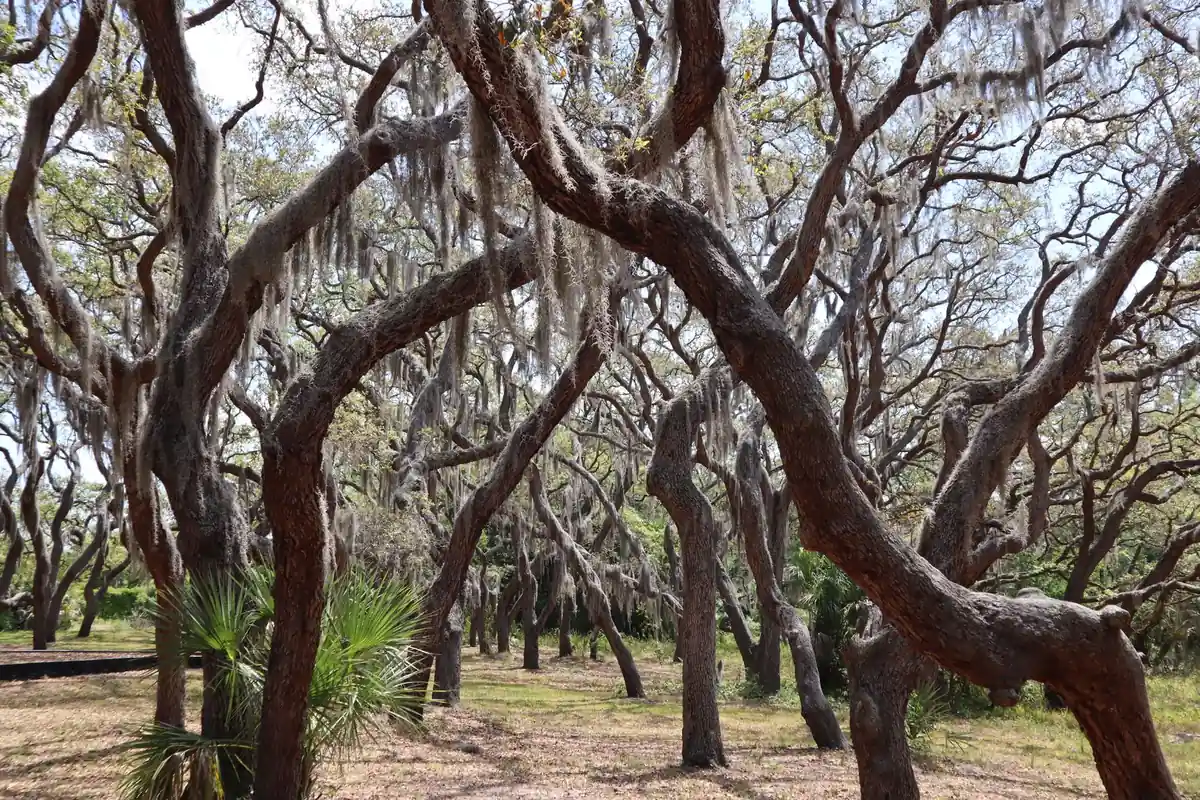
Laurel oak vs live oak is the first cut. Both are common in Betton Hills. Live oaks have small evergreen leaves, deeply furrowed bark, massive spreading limbs. Laurel oaks have larger, willow-shaped leaves, smoother gray bark, and a more vertical growth habit. The water oak vs live oak comparison covers some of the same ID terrain — laurel and water oak look similar at a distance and both fail similarly.
Once you’ve ID’d a laurel oak, the failure indicators arborists look for during a Betton Hills hazard inspection:
- Codominant leaders with included bark at the main junction — two trunks growing from one point with bark pressed between them, no living tissue connection
- Mushroom conks at the base — Inonotus dryadeus presents as wet white-brown shelf fungi during summer rains; Ganoderma as varnished red shelves
- Cavities or soft spots in the lower trunk — tap test, sounding hollow, or visible cavities
- Dieback in the upper crown — bare branches in the top third while the lower crown stays leafed-out
- Root crown buried below grade — if mulch or soil covers the root flare, decay can be advanced without surface signs
- Past topping cuts — any topping wound is now a decay column; if a tree was topped 10-15 years ago, the failure clock is well into its end
None of these are diagnosable from a phone photo. They take a walk-around with a probe, sometimes a resistograph for borderline calls. Call now — we’ll connect you with an arborist who will come out, look, and tell you what’s actually going on.
The Removal Process When the Tree Has to Come Out
A laurel oak over a Betton Hills roof is usually a crane job. The crane lets the crew lift sections out cleanly without bouncing them off the house or the driveway. The arborist brings the right-size crane for the job, sets up on the street with the right permits coordinated through City of Tallahassee right-of-way, and the actual removal day is typically one day from setup to cleanup.
What’s typically included in the quote:
- Pre-job walk and hazard documentation with photos — useful if there’s any subsequent insurance question
- City of Tallahassee §5-83 permit filing handled as part of the job — see our Tallahassee tree permit guide for what triggers a permit (laurel oak over 12-inch DBH usually does)
- Right-of-way permit for crane setup on the street when needed
- Removal, sectional lowering, full cleanup
- Stump grinding as a line-item option (some homeowners leave the stump for natural decay, others want it ground out for replanting)
- Replacement species recommendation if you want to replant — live oak, southern magnolia, or bald cypress are the most resilient long-term picks for Betton Hills
Pricing is documented in our Tallahassee tree removal cost guide. The crane factor dominates — expect crane-required removals to price 30-50% above non-crane equivalents.
The Insurance Question
The hardest conversation in Betton Hills is the one about preventive removal vs. waiting for the tree to come down.
Homeowner’s insurance in Florida generally covers tree removal after a tree has fallen on a covered structure. It generally does not cover preventive removal of a hazard tree that hasn’t fallen yet. That creates a perverse incentive — financially, the cheapest outcome for the homeowner is to wait for the storm and let the insurance pay. But it’s also the outcome that puts people in the house while the tree comes down.
The carrier-by-carrier scenario rundown is in when is tree removal covered by homeowner’s insurance (Florida focus). The short version: document the hazard with an ISA-certified arborist’s written assessment, file it with the carrier, and ask in writing whether they’ll cover preventive removal under the policy’s “imminent peril” or “loss prevention” clauses. Some Florida carriers will. Most won’t.
Once the tree comes down, call now to get connected. Storm damage tree removal Tallahassee covers what happens in the first hours and the insurance documentation that closes the claim cleanly.
What to Plant After
The laurel oak that comes out doesn’t need a laurel oak replacement. We never recommend that. The species’ failure pattern is well documented and you don’t want to plant the next problem.
The best long-term Betton Hills replacements:
- Live oak (Quercus virginiana) — the gold standard. Slow-growing but the canopy that defines mature Tallahassee neighborhoods. Multi-century life expectancy.
- Southern magnolia (Magnolia grandiflora) — evergreen, hurricane-resistant, beautiful. See southern magnolia care Tallahassee for the pruning and watering basics.
- Bald cypress (Taxodium distichum) — deciduous, native, exceptionally storm-resistant. Best for the lower lots and areas with seasonal wetness.
- Sweetgum, sycamore — can work, but the litter is meaningful (see the sweetgum ball cleanup post).
What’s not recommended for planting: laurel oak (failure pattern), water oak (hypoxylon, similar failure window), Bradford pear (structural failure, invasive in FL), Chinese tallow (invasive, prohibited in FL).
Why Use This Dispatch Line
Connection to an ISA-certified arborist — the difference matters and is documented in ISA-certified arborist vs general tree service Tallahassee. Crane-ready arborists for the Betton Hills configurations. City permit filing handled by the provider. Insurance-related documentation when the tree’s already down.
We connect you with arborists who’ve worked enough Betton Hills laurel oaks to know which structural patterns predict failure and which look scary but are stable for another decade. That matters for not removing trees that don’t need to come out — the canopy is what makes the neighborhood, and the network doesn’t take it down lightly.
Call now to get connected with a local arborist for a Betton Hills laurel oak hazard assessment.
Betton Hills Tree Service — FAQ
How do I know if my tree is a laurel oak?
Laurel oaks have larger willow-shaped leaves (not the small evergreen leaves of live oak), smoother gray bark, and a more vertical growth habit. The arborist we connect you with can ID it in 30 seconds on a site walk — call now to get connected.
What does laurel oak removal cost in Betton Hills?
Removal pricing tracks tree size, access, proximity to structures, and whether crane access is required. Most Betton Hills laurel oaks over a house need a crane, which is the dominant pricing factor. Quotes come after an in-person walk; the provider sets the quote.
Will my insurance pay for removal before the tree falls?
Most Florida homeowner’s policies do not cover preventive removal. The exceptions involve documented “imminent peril” assessments. The arborist provides the ISA-certified written hazard documentation; you submit to your carrier. See our insurance coverage guide.
What should I plant after the laurel oak comes out?
Live oak, southern magnolia, or bald cypress are the top recommendations for Betton Hills — all have multi-decade or multi-century life expectancies and good storm tolerance. Avoid planting another laurel oak or water oak.
Do I need a Tallahassee tree permit to remove a laurel oak?
Likely yes if the tree is over 12 inches DBH (City of Tallahassee §5-83). The arborist files the permit as part of the quote. Our Tallahassee tree permit guide covers the exact thresholds.
Can you take down a laurel oak before hurricane season starts?
Yes. The network schedules pre-hurricane laurel oak removals from late spring through early summer for exactly this reason, subject to provider availability. See our pre-hurricane tree checklist for the full timeline.