If you’ve noticed laurel oaks failing across Tallahassee — dropping limbs, thinning out, or coming down in storms — you’re seeing a real, age-driven wave. Many of the area’s laurel oaks were planted in the same mid-century window and are now hitting the end of their reliable lifespan at once. Here’s what’s happening and how to decide about yours.
The 60–90 Year Window
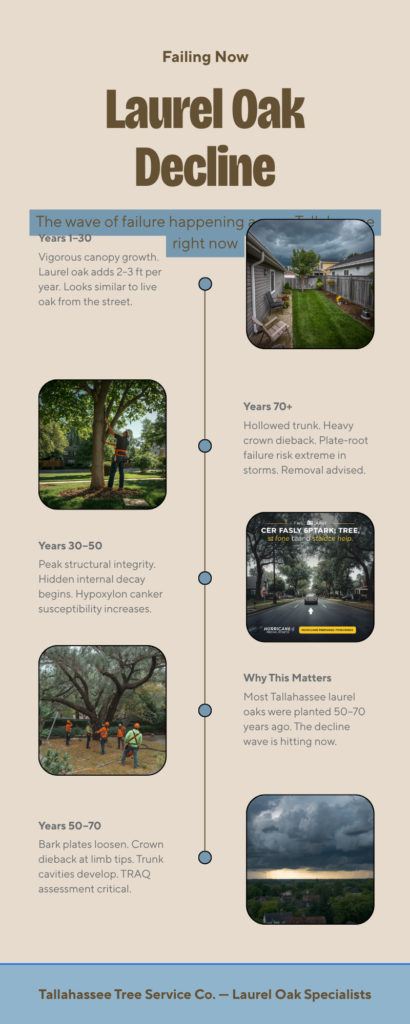
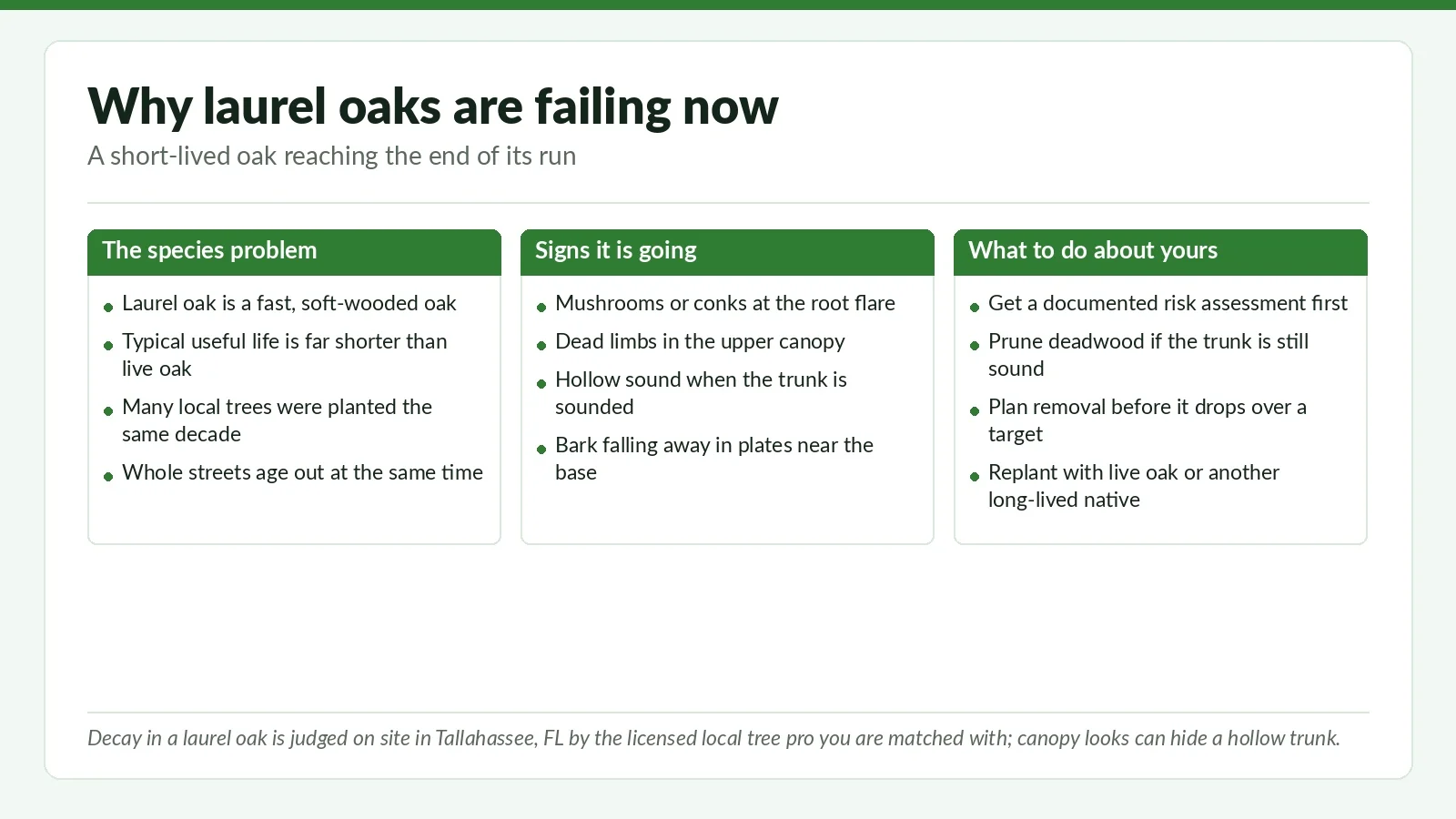
Laurel oak (Quercus laurifolia) is a fast-growing oak with a comparatively short useful life — often sound for several decades, then declining as internal decay sets in. Across Tallahassee, large numbers were planted during the same neighborhood-building era, so a whole generation of them is reaching the decline phase simultaneously. That’s why the failures seem to be everywhere at once.
Storm damage or a tree on your house? Call now.
Stay out of rooms under the tree and keep clear of downed lines — report those to the power company first. Then call and we’ll connect you with a local tree crew that handles storm work.
📞 Call (858) 319-0022Free 24/7 dispatch line · availability varies by storm volume
What “Failing” Actually Looks Like
Watch for canopy thinning and dieback in the upper crown, repeated deadwood and limb drop, mushrooms or conks at the base or on the trunk (a decay signal), cavities and soft wood, and any new lean. Laurel oaks often look fine from a distance while hollowing internally, which is what makes their failures so sudden.
Why Now — Climate Context
Age is the main driver, but repeated storm stress, saturated soils, and active hurricane seasons accelerate the decline of already-weakening trees. A laurel oak that might have limped along a few more years can fail in the next big blow once decay is established.
Decision Framework
The key question is target: a declining laurel oak over open lawn can sometimes be monitored, while one over the house, driveway, or a play area should be assessed promptly and often removed before it fails on its own terms. An ISA-certified arborist can gauge how far the decay has progressed and whether the tree can be retained safely or should come down. Don’t wait for a storm to make the decision for you. If you’re not sure where yours stands, call now on our Tallahassee tree service homepage to get matched with a local arborist for an assessment.
A Note on Cost
Removing a declining laurel oak proactively, at standard scheduled timing, is far less disruptive than an emergency removal after it has come down on a structure — and it lets you control the timing. The arborist gives you the specific scope after seeing the tree, its size, and its position. See tree removal and dangerous tree removal.
Worried about a laurel oak? Get matched with a licensed Tallahassee arborist Call now code and our 24/7 dispatch line connects you with an ISA-certified, insured arborist in our network serving Tallahassee and Leon County. A real person answers — describe the tree and you’ll be routed to the right pro for an assessment. Your quote is between you and the arborist. → Call now to get connected
Related TTS Resources
See the 7 trees most likely to fall in a Tallahassee storm and the Hurricane Tree Prep Hub.
TallahasseeTreeService.co is a dispatch service. We connect callers with licensed Florida arborists. We are not a licensed tree service company. The disclaimer in our site footer and our 24/7 dispatch caveat apply to this page.