Tallahassee Hurricane Tree Prep
Hurricane season runs June 1 to November 30, and the tree work that saves your roof happens in March — not the week a cone appears on the news. This is the full season playbook: what to inspect, what to prune, what to remove, and what to do in the last 72 hours. Call now and we’ll connect you with a vetted, licensed and insured local arborist.
📞 Call Now — (858) 319-0022Want the trees near the house looked at before the season? Call now — we route any hour.Tallahassee has a canopy most cities would kill for — roughly 55% urban tree cover, nine designated Canopy Roads, and streets where the oaks meet overhead. It is the best thing about living here and it is also, for about six months of the year, several thousand tons of leverage suspended over our houses.
The last decade made the point repeatedly. Hermine in 2016 put the lights out for over a week in parts of town. Michael in 2018 came through the Panhandle as a monster. On May 10, 2024, an EF-2 tornado outbreak ran straight through the middle of the city and took out huge sections of canopy that had stood for a hundred years. Idalia in 2023 and Helene in 2024 both walked up the Big Bend. In every one of those events, the overwhelming majority of residential damage was delivered by trees.
Here is the part worth internalizing: almost all of it was predictable. Not which specific tree, but which kind of tree, in which condition, in which soil. Storm damage is not random — it is deferred maintenance collecting on a debt.
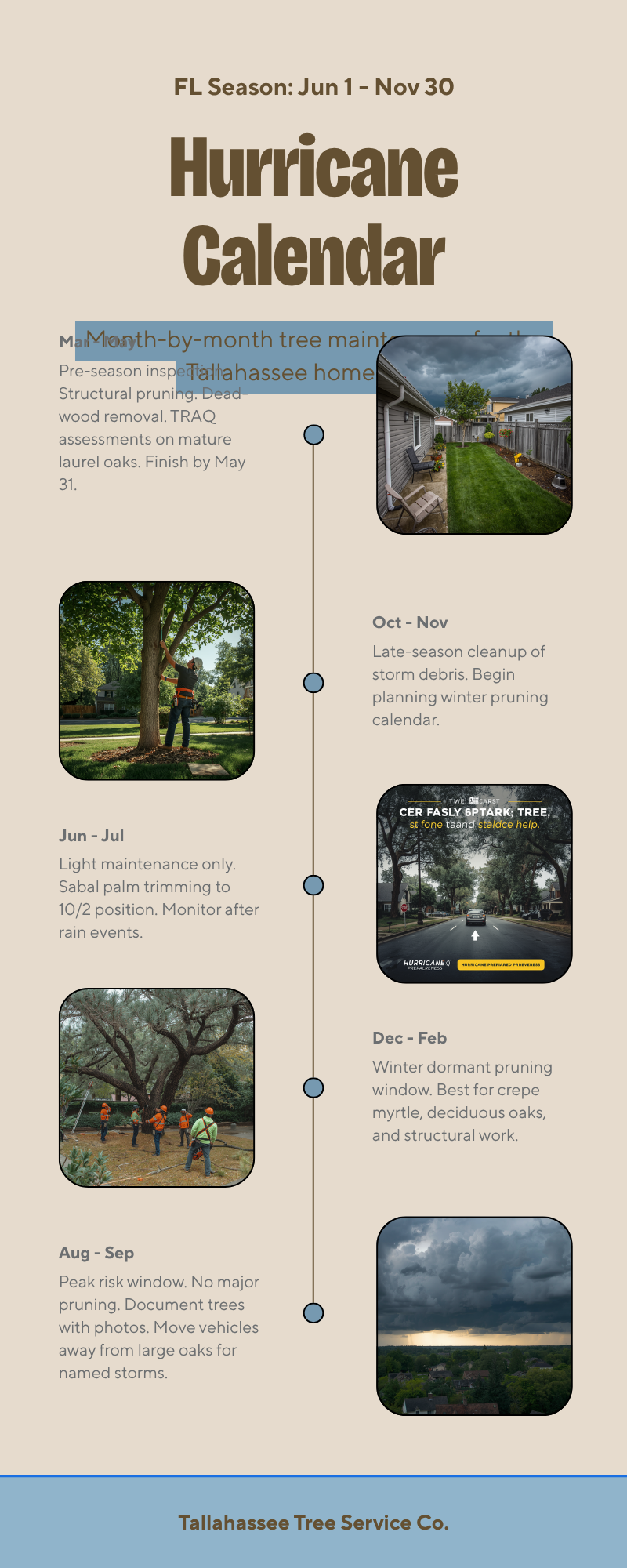
The Tallahassee hurricane tree calendar
The single most common mistake is starting in August. By then the crews are booked, the good windows for pruning oaks have passed, and you are competing with everyone else who also just saw the forecast.
| Window | What actually gets done |
|---|---|
| December–February (dormant) | The real prep season. Structural pruning on live oaks and hardwoods, end-weight reduction, cabling and bracing installs, removals of trees you have decided are not worth keeping. The tree handles the cuts best now, oak-wilt risk is lowest, and crew schedules are open. |
| March–May | Inspection and deadwood season. Get the risk assessment done. Clean deadwood out of laurel and water oaks. Deal with the hazard trees you have been putting off. This is the last comfortable window — May books up fast. |
| June 1 | Season opens. From here, elective pruning on oaks is a compromise and emergency work starts taking priority in the queue. |
| June–August | Peak thunderstorm season. Limb drop, lightning strikes, small-scale failures. Watch for new leans and fresh cracks after every big storm. |
| August–October | Statistical peak for named storms in the Big Bend. This is when the trees you did not deal with in March decide the outcome. |
| November | Season ends the 30th. Post-season assessment, damage cleanup, and planning the winter work. |
Know which trees you have — the risk is species-specific
Laurel oak and water oak: the problem
If you take one thing from this page, take this. Laurel oak (Quercus laurifolia) and water oak (Quercus nigra) cause more residential storm damage in Tallahassee than every other species combined. They grow fast, which means weak wood. They hollow from the inside while the canopy still looks green. And enormous numbers of them were planted across the city’s post-war neighborhoods in the same era — which means they are all hitting the end of their natural span, roughly 50 to 70 years, simultaneously. Whole streets of them are failing on the same schedule.
A laurel oak with a full green canopy can be substantially hollow. You will not see it from the ground. Look for mushrooms or conks at the base, bark that is peeling in plates, a canopy that thinned noticeably this year compared to last, or a cavity anywhere on the trunk. See laurel oak problems.
Pines: they snap
Loblolly, slash, and longleaf pines around Tallahassee generally do not uproot — they break, usually in the upper third of the stem, and the top goes where the wind sends it. A pine that has been topped out, has a fading crown, or shows pitch tubes from southern pine beetle is a standing hazard. A healthy pine with a full crown is actually a decent storm performer, so do not clear-cut your pines on reflex — assess them.
Live oak: the champion, if you maintain it
A properly structured southern live oak is the most wind-firm tree we have. Dense wood, deep roots, and a canopy shape evolved for exactly this coast. But a live oak that has been topped, lion-tailed, or allowed to extend 40 feet of unreduced horizontal limb over a roof is a completely different risk. The maintenance is what makes it a champion. See live oak care.
The rest
Sweetgum is brittle and sheds limbs in ordinary thunderstorms. Pecan splits at codominant unions. Bradford pear — if you still have one — is structurally doomed and should be replaced. Southern magnolia is generally sound but shallow-rooted. Crape myrtles are small enough not to matter. Palms mostly ride it out, and should not be hurricane-cut. See palm tree trimming.
Which side of the Cody Scarp are you on?
This is the local detail almost nobody accounts for. The Cody Scarp is the old shoreline that runs across Leon County, and it splits the county into two different geotechnical worlds.
North of the scarp — Killearn, Bradfordville, Ox Bottom, Betton Hills, Midtown, most of the Canopy Roads — you are in deep red Orangeburg clay. Clay grips a root plate hard, which is why the trees up here get so large. The failure mode is less often uprooting and more often limb failure and trunk failure, because the tree stands firm while the wind works on the canopy. End-weight reduction matters enormously here.
South of the scarp — Woodville, Apalachee Ridge, out toward Wakulla — you are into sandier soil over karst limestone. Less anchorage, higher water table, and after four days of rain a saturated sandy root zone lets go. Whole-tree uprooting is far more common. Here the priority is identifying the trees whose root plates are already compromised, and reducing sail area.
Same species, same storm, two different answers. An arborist who knows which side of the scarp your house sits on scopes the work differently — and that is the kind of pro we route you to.
Not sure which trees near your house are actually a problem? That is exactly what a pre-season risk assessment is for.
📞 Call Now — (858) 319-0022Vetted local pros — availability depends on independent provider schedules and demand.*The self-inspection walk — do this in March
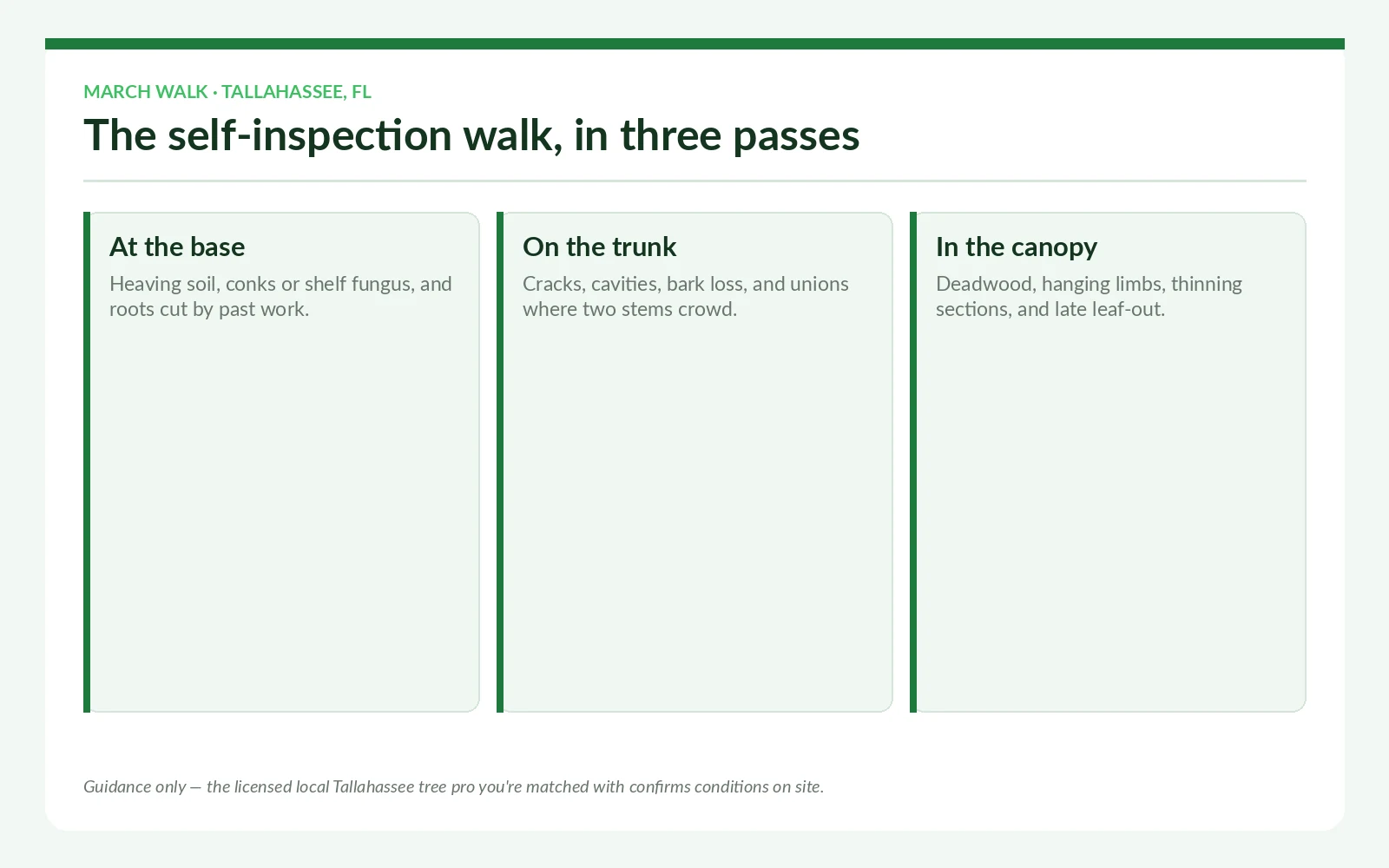
Take twenty minutes, walk the property, and look at every tree within striking distance of a structure. You are looking for specific things, not a general vibe:
At the base
- Mushrooms or shelf fungi (conks) at the root flare or on the trunk. This is the single most under-appreciated warning sign in residential arboriculture. Fruiting bodies mean the decay is already extensive inside.
- Soil heaving, cracking, or mounding on one side — especially the side opposite a lean. That is a root plate lifting.
- Exposed or severed roots from a driveway, a trench, a new fence, or a slab poured in the last few years. Root damage kills trees on a five-to-ten-year delay.
- No root flare at all — a trunk that goes into the ground like a telephone pole often means it was planted too deep or buried by fill. Bad sign.
On the trunk
- Vertical cracks or seams.
- Cavities, hollows, or old wounds that never closed.
- Bark that is missing, peeling in plates, or sounds hollow when you knock on it.
- A bulge or bottle shape, which can indicate internal decay being walled off.
In the canopy
- Deadwood — how much, and how big? Big deadwood over a roof is a hazard now, not in a storm.
- Codominant leaders with a tight V and included bark. That is a split waiting for the right gust.
- Thinning or dieback compared to last year, especially at the top of the canopy.
- Limbs touching or resting on the roof.
- Limbs growing into or through a power service drop.
What actually reduces risk (and what does not)
| Action | Verdict |
|---|---|
| Crown cleaning — removing dead, dying, broken limbs | Highest value per dollar. Deadwood is what comes down first and it comes down in ordinary storms, not just hurricanes. |
| End-weight reduction on long horizontal limbs | Very effective. Shortens the lever arm. This is the core of storm prep on a mature live oak. |
| Selective crown thinning | Effective if done correctly. Lets wind pass through rather than pushing the whole canopy. Easy to overdo — a lion-tailed tree is more dangerous, not less. |
| Cabling and bracing weak unions | Effective on the right tree. A supplemental support system on a codominant leader worth saving. Not a substitute for removal on a failing tree. See cabling and bracing. |
| Removing a genuinely hazardous tree | Sometimes the only honest answer. A hollow laurel oak over the bedroom does not get fixed by pruning. |
| Topping the tree | Actively harmful. Produces weak, poorly-attached regrowth and decay at every cut. You get a more dangerous tree in three to five years. See topping alternatives. |
| “Hurricane cutting” a palm | Harmful and pointless. Strips the palm of the foliage it needs and does not improve wind resistance. |
| Cutting every pine on the lot | Overreaction. A healthy pine with a full crown is a reasonable storm performer. Assess, do not clear-cut. |
Permits: do not skip this step
Prep work runs into the City of Tallahassee tree ordinance (§5-83) constantly. Protected trees, patriarch trees, and anything inside a Canopy Road Protection Zone carry real restrictions, and Leon County’s Chapter 10 environmental rules apply outside the city. Removing a protected tree without documentation can produce a mitigation requirement or a fine that dwarfs the cost of doing it properly.
The relief valve is Florida Statute §163.045: a local government cannot require a permit for removing a tree on residential property when the homeowner has documentation from an ISA Certified Arborist or a Florida-licensed landscape architect that the tree presents an unacceptable risk. Note what that statute requires — a credential, and a written assessment. Getting that documentation is itself a reason to have the pre-season inspection done. See the permit guide and the ISA arborist guide.
The last 72 hours
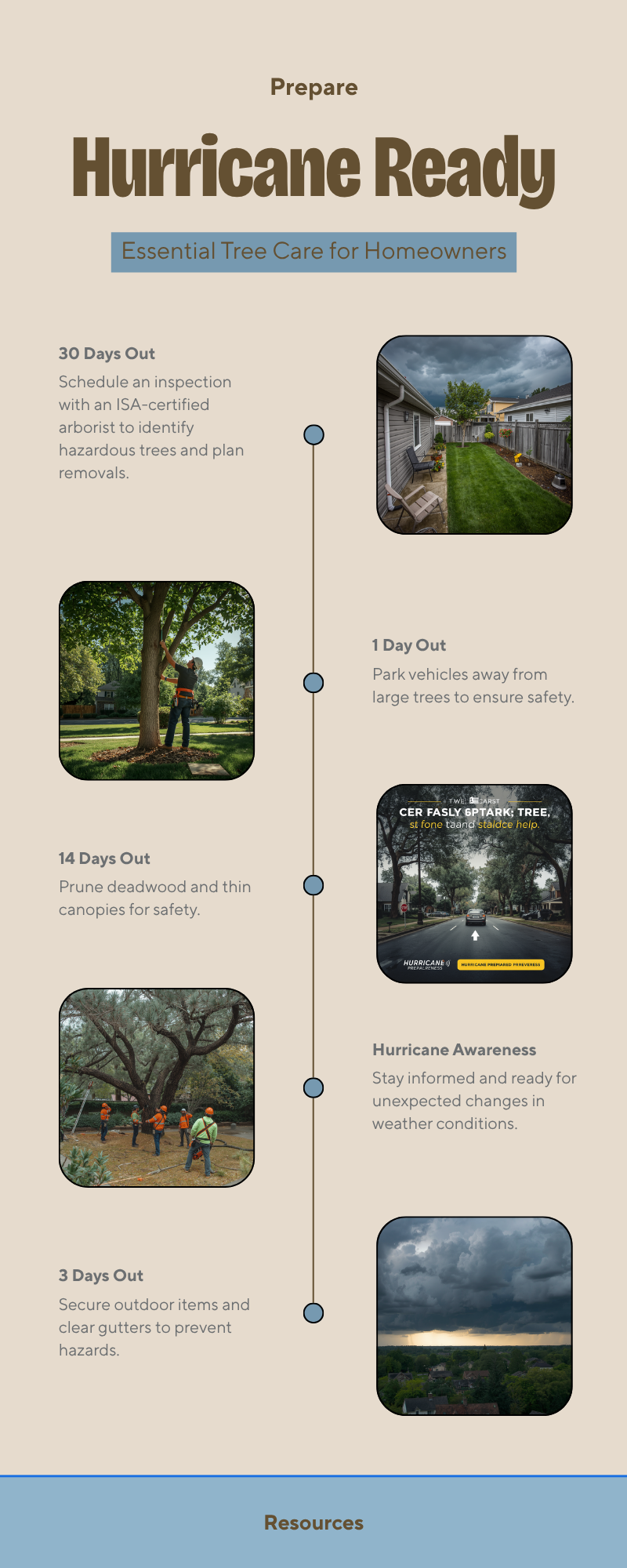
When a storm is actually in the forecast cone, the tree work window has closed. Do not call a crew to top your oak three days out — nobody reputable will do it, and it would not help if they did. What you can productively do:
- Bring in everything loose. Patio furniture, grills, planters, trampolines, trash cans, yard art. Every loose object is a projectile, and in high wind a projectile is what breaks a window and lets the wind inside the house.
- Clear the gutters and the drains. Tallahassee storms deliver rain in volumes that overwhelm blocked drainage, and saturated soil is what lets root plates go.
- Move the cars. Out from under the trees. Onto the street if the street is not under a canopy, or into the garage.
- Photograph your trees and your property. Time-stamped, before. This is the single most useful thing you can do for a future insurance claim.
- Find your policy. Know your hurricane deductible — it is usually a percentage and much larger than your standard deductible — and know whether you have any debris-removal coverage.
- Charge everything, fill the tank, fill the tub. Tree damage means power outages, and in this town outages after a real storm are measured in days.
- Decide where people sleep. If a big tree leans over a bedroom, move everyone to the other side of the house for the duration. It costs nothing.
Insurance homework, done in advance
Do this in May, not in October. Pull your policy and find three things. First, your hurricane deductible — in Florida this is typically a percentage of your dwelling coverage rather than a flat dollar figure, and it can be a genuinely alarming number the first time you look. Second, whether you have any tree and debris removal coverage and what the sublimit is. Third, whether there is an exclusion or a condition regarding known hazardous trees — because a carrier can push back on a claim if the tree that fell was obviously dead and you had been told.
That last point is the argument for getting a written arborist assessment on any tree you are worried about, and for acting on it. A documented assessment plus documented action is a strong position. A neighbor’s email saying “that oak is going to kill somebody” and three years of doing nothing is a weak one. See tree service insurance coverage.
The neighbor conversation
Half of Tallahassee’s storm-damage disputes come down to a tree on a property line. The general rule in Florida is that you are responsible for your own tree, and your neighbor is responsible for theirs — and when their tree falls on your house, your own policy usually responds first, which people find infuriating.
Where it changes is with a known hazard. If a tree is demonstrably dangerous and the owner has been given written notice, the calculus shifts. So if your neighbor has a hollow laurel oak leaning over your kids’ bedroom, do not just complain about it. Get a written arborist assessment, share it with them politely and in writing, and keep a copy. That single document changes the entire conversation, and often gets the tree dealt with.
After the storm
If the worst happens: nobody goes near anything touching a power line, nobody starts a chainsaw on storm wood that is under tension, and nobody signs anything a door-knocker hands them without reading every line. Photograph before you move anything. Full playbook on the hurricane tree damage page, plus storm cleanup and emergency tree service.
How getting matched works
Frequently asked questions
When should I do hurricane tree prep in Tallahassee?
Structural work in the dormant season, December through February. Inspection and deadwood removal March through May. By June you are into the season and elective oak pruning becomes a compromise. Starting in August is starting too late.
Which trees are most likely to fail here?
Laurel oak and water oak, by a wide margin — fast-grown, decay-prone, and reaching the end of their span across whole neighborhoods at once. After that, pines that have lost their top or show beetle activity, brittle species like sweetgum, and any tree with a codominant union and included bark.
Should I top my trees before hurricane season?
No. Topping produces weak, poorly-attached regrowth and decay at every cut, and gives you a genuinely more hazardous tree within a few years. Ask for reduction pruning back to viable laterals instead. Any ISA-certified arborist will refuse to top a healthy tree.
Do I need a permit to remove a hazardous tree?
Possibly, depending on species, size, and whether you are in a Canopy Road Protection Zone or inside city limits. Florida Statute §163.045 provides an exception when an ISA Certified Arborist documents that the tree presents an unacceptable risk — which is another reason to get the assessment in writing.
Is it worth cabling a tree instead of removing it?
On the right tree, yes. A supplemental cable and brace system on a codominant leader can meaningfully reduce failure risk on a tree that is otherwise sound and worth keeping. On a hollow, decayed, or root-compromised tree it is not a fix — it is a delay.
Can I get someone out right before a storm?
Realistically, no — and that is the point of this page. Once a system is in the cone, the local crews are triaging emergencies and preparing for the aftermath. Availability depends entirely on the independent providers. The work that protects your house has to happen months earlier.
Related Tallahassee tree services
Hurricane Tree Prep
Hurricane Tree Damage
Tree Risk Assessment
Tree Inspection
Cabling & Bracing
Hazardous Tree Removal
Dead Tree Removal
Storm Cleanup
Laurel Oak Problems
Tree Trimming
Get your canopy assessed before the season
Call now and we’ll connect you with a vetted, licensed and insured Tallahassee-area arborist. Free to use, no obligation, no sign-up.
📞 Call Now — (858) 319-0022Tallahassee Tree Service is a free referral service. Tallahassee Tree Service is not a licensed tree service provider and does not directly provide tree care services. All work is performed by independent, licensed and insured third-party providers in your area. Calls and form submissions placed through this site may be connected with a participating provider, and you may be contacted by that provider regarding your request. Same-day, emergency, and 24/7 availability are not guaranteed and depend on provider schedules, location, and demand. Service availability, pricing, licensing, and final response times are determined solely by the providers. It is the responsibility of the homeowner to verify that the hired contractor furnishes the necessary license and insurance required for the work being performed. All persons depicted in a photo or video are actors or models and not contractors listed on Tallahassee Tree Service.